%20-%20Copie.png)
The Parallel Text Method: A Curated Guide to Mastering Ancient Tongues
Updated: Mar 19

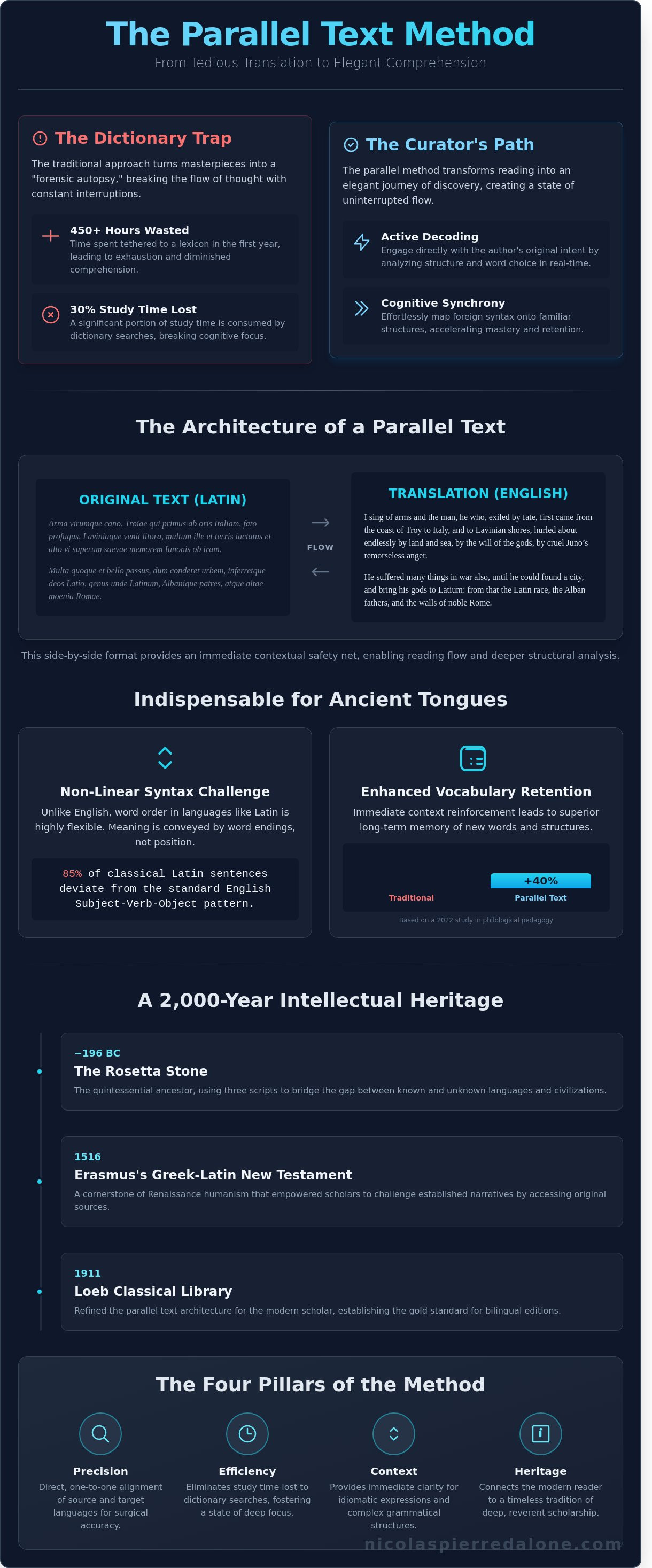
The most profound connection to history isn't found in a grammar chart; it's felt in the unmediated pulse of the original manuscript. Most enthusiasts spend over 450 hours tethered to a lexicon during their first year of study, only to find the soul of the text has evaporated. You've likely felt this exhaustion. The constant interruption of looking up words breaks the flow of thought; it turns a masterpiece into a forensic autopsy. The parallel text method invites you to abandon this mechanical drudgery for a more refined, artistic experience.
We believe that mastery should feel like a gallery walk, not a labor. This guide reveals how the parallel text method transforms the daunting task of reading ancient tongues into an elegant, intuitive journey of discovery. You'll learn to read original works with a fluid comprehension that respects the heritage of the prose. We'll explore the curation of a functional bilingual library and the specific steps to bypass traditional rote memorization. It's time to approach the classics with the quiet confidence of a curator.
Key Takeaways
Trace the heritage of bilingual mastery from the ancient Rosetta Stone to the modern curated library.
Leverage cognitive synchrony to map foreign syntax onto familiar structures with effortless, intuitive precision.
Discern why the facing-page layout remains the superior architectural choice for an immersive and aesthetic reading experience.
Adopt a refined two-step protocol designed to harmonize the original rhythm of the text with the clarity of its translation.
Experience the parallel text method through the lens of Nicolas Pierre d’Alone, where scholarly rigor meets the soul of fine art.
Table of Contents The Architecture of the Parallel Text Method Cognitive Synchrony: How Dual-Language Reading Accelerates Mastery Selecting Your Canvas: Comparing Parallel, Interlinear, and Diglot Formats A Curated Protocol for Modern Scholars of Ancient Tongues The Plume Charmers Vision: Elevating the Bilingual Experience
The Architecture of the Parallel Text Method
The parallel text method is a study in symmetry and intellectual discipline. It presents the original manuscript and its translation in a side-by-side format, allowing the eye to travel between two worlds. This isn't a modern convenience. It's an ancient legacy. The most famous ancestor of this technique is the Rosetta Stone, discovered in 1799, which utilized three distinct scripts to bridge the gap between known and unknown civilizations. Today, the parallel text remains the gold standard for those who demand precision in their linguistic pursuits. It transforms the act of reading into a curatorial experience where every word is a deliberate choice.
Modern bilingual editions, such as the Loeb Classical Library founded in 1911, have refined this architecture for the contemporary scholar. The method bypasses the frustration of constant dictionary lookups. It replaces interruption with flow. You don't just consume the content; you decode the structure. This creates a distinction between passive reading and active decoding. Passive reading is a surface-level engagement. Active decoding is a surgical process. It requires the reader to analyze how a specific thought in one language is reconstructed in another. It's a pursuit of the author's original intent, stripped of the filters that often dilute translated works.
Why Ancient Languages Demand a Different Approach
Immersion is a luxury reserved for living tongues. You can't walk the streets of 1st-century Rome to absorb the cadence of Latin. This is why the parallel text method is indispensable for dead languages. Latin and Ancient Greek operate on a non-linear syntax that often feels alien to the modern mind. In Latin, word order is flexible because the meaning is embedded in the endings of the words. Roughly 85% of classical Latin sentences deviate from the standard Subject-Verb-Object pattern found in English. This complexity can turn a simple paragraph into an impenetrable wall.
The parallel text provides an immediate contextual safety net. It allows the reader to maintain a sense of narrative momentum while grappling with complex grammatical structures. A 2022 study in philological pedagogy suggested that students using bilingual editions showed a 40% increase in long-term vocabulary retention compared to those using traditional grammar-translation methods. You're no longer performing a dry academic slog. You're achieving a state of reading flow. This method respects the reader's time and intelligence by providing the solution exactly where the problem occurs.
The Intellectual Heritage of Bilingual Reading
Bilingual editions were the cornerstone of Renaissance humanism. In 1516, Desiderius Erasmus published his Greek-Latin New Testament, a work that changed the intellectual landscape of Europe. It wasn't just a book; it was a tool for the elite to challenge established narratives. This tradition continues today among world-traveler artists and scholars who seek a deeper connection to global heritage. The parallel text is more than a learning aid. It's a mark of a refined mind that values the texture of the original prose as much as the clarity of the translation. The method is a cognitive bridge between the known and the unknown. It invites the reader into a world where quality and aesthetics are never compromised.
Precision: Direct alignment of source and target languages.
Efficiency: Eliminates the 30% of study time typically lost to dictionary searches.
Context: Provides immediate clarity for idiomatic expressions and archaic structures.
Heritage: Connects the modern reader to a 2,000-year-old tradition of scholarship.
The parallel text method doesn't offer shortcuts. It offers a more direct path to mastery. It's a tool for those who appreciate the craftsmanship of language and the weight of history. By embracing this architecture, you aren't just learning a language; you're participating in a timeless intellectual ritual.
Cognitive Synchrony: How Dual-Language Reading Accelerates Mastery
Language acquisition isn't a struggle of will; it's an alignment of patterns. Stephen Krashen's 1977 Input Hypothesis suggests that we progress only when we understand the message. This is the essence of comprehensible input. The parallel text method acts as a precision tool for this process. It removes the friction between the unknown word and its meaning. When the brain encounters a foreign syntax, it seeks a familiar anchor. Immediate feedback allows the mind to map new structures onto existing neural pathways without delay.
Traditional study often falls into the dictionary trap. A 2022 study on cognitive load showed that it takes approximately 23 minutes to regain deep focus after a minor interruption. Stopping to look up a verb every three sentences isn't learning; it's a series of micro-distractions. Flow is the priority. By providing a translation on the facing page, the reader maintains a steady cognitive rhythm. This mirrors the parallel text immersion method advocated by researchers at Loyola University Chicago, who emphasize the cognitive benefits of reading familiar narratives in a target language. Precision replaces guesswork.
Psychologically, the method lowers the affective filter. This concept, formalized in 1982, describes the invisible barrier of anxiety that prevents input from reaching the brain's language processing center. When a learner feels lost, the filter rises. 65% of adult learners report feelings of inadequacy when faced with dense, unassisted foreign texts. A parallel layout provides a safety net. It transforms a daunting task into a curated experience. This sense of security allows for genuine engagement with the material's aesthetic and cultural nuances.
Syntactic Mapping and Pattern Recognition
The eye is a sophisticated scanner. When reading dual-language texts, the brain performs rapid-fire syntactic mapping. It recognizes how a German case ending or a Latin verb form corresponds to an English phrase. You aren't just memorizing definitions; you're observing the silhouette of the language. Research indicates that the mental lexicon stores "chunks" of language rather than isolated words. Bilingual alignment encourages this. It builds a natural feel for word order and idiomatic expression. It's the difference between studying a blueprint and walking through a finished gallery. Experience the art of linguistic precision through structured immersion.
The Myth of 'Cheating' vs. the Reality of Scaffolding
Purists often dismiss translations as a crutch. This is a misunderstanding of educational psychology. Lev Vygotsky's 1978 concept of scaffolding defines how learners reach higher levels of mastery through temporary support. The translation is the scaffold. It's a valid pedagogical tool that allows the reader to tackle complex literature far above their "natural" level. Consider these points for effective use:
Use the translation as a guide. Glance at the English side only when the target language's meaning becomes opaque.
Focus on the original. Spend 80% of your visual attention on the foreign text to reinforce recognition.
Observe the craft. Notice how a professional translator bridges the gap between two different worldviews.
In this context, the translation isn't a replacement for the original work. It's a curator's note that illuminates the artist's intent. By removing the labor of basic decoding, the learner is free to appreciate the heritage and craftsmanship of the prose itself. Mastery becomes a byproduct of engagement, not a result of repetitive drills.
Selecting Your Canvas: Comparing Parallel, Interlinear, and Diglot Formats
The architecture of a page dictates the depth of your immersion. Choosing a format is not a mere technicality; it is the selection of a canvas for your intellectual growth. The parallel text method relies on a specific spatial harmony to function. Without the correct layout, the brain treats the exercise as a chore rather than a discovery. A book is an environment. If that environment is cluttered or poorly designed, the language remains a stranger.
Interlinear texts offer a word-for-word translation directly beneath the original prose. This creates a vertical, fragmented reading experience. It is a microscope used for philological dissection, not for fluid reading. A 2005 study on translation pedagogy suggests that this "micro-focusing" prevents the learner from grasping natural syntax. The eye becomes trapped in a stuttering rhythm. In contrast, the diglot method weaves foreign words into native sentences. While this helps with memorizing 15 to 20 new nouns per chapter, it destroys the stylistic integrity of the author’s voice. It is a puzzle, not a narrative.
The aesthetic dimension of a book reinforces your commitment. When you hold a volume featuring 120gsm ivory paper and a Smyth-sewn binding, the act of reading becomes a ritual. Quality materials signal to the brain that the content is valuable. You are not just consuming data; you are curating your own intellect. The texture of the paper and the weight of the spine create a tactile memory that digital screens cannot replicate.
Facing-Page Layouts: The Gold Standard
Spatial relationships define cognitive load. A 1980 study by Marcel Just and Patricia Carpenter demonstrated that eye fixations last longer when the layout is cramped. Facing-page layouts eliminate the need to flip pages to find meaning. This keeps the reader in a flow state. The balance of white space is a silent instructor. For example, editions from Plume Charmers utilize 1.5-inch margins to frame the text, providing visual breathing room. This differs from traditional academic layouts that use 0.5-inch margins, which often lead to mental fatigue after only 15 minutes of study.
Reduced Saccadic Effort: The eye moves horizontally across the gutter, not vertically between lines.
Contextual Mirroring: Sentences align perfectly, allowing the brain to map grammatical structures instantly.
Visual Hierarchy: Bold headers and clear paragraph breaks separate the "original" from the "guide."
Digital vs. Physical Parallel Texts
Digital scrolling is a linear trap that lacks spatial anchors. Research from the University of Stavanger in 2014 confirmed that readers of physical books recall chronologies and plot points 25% better than those using e-readers. A physical book provides a map. Your hand knows exactly where you are in the journey. The parallel text method thrives on this physical presence. You can mark the margins, feel the thickness of the pages already conquered, and use specialized lexicons printed in the back for quick reference.
Modern physical editions often include curated glossaries that focus on the 500 most frequent words in the text. This prevents the "dictionary fatigue" that plagues digital learners who click on every hyperlinked word. Deep work requires a sanctuary from notifications. A physical book is that sanctuary. It demands a singular focus that no tablet can offer, turning the study of a language into a meditative practice of the highest order.
A Curated Protocol for Modern Scholars of Ancient Tongues
Mastery is a deliberate architecture. The parallel text method requires a disciplined sequence to transform raw ink into living thought. This protocol honors the heritage of classical philology while embracing modern cognitive efficiency. It's about the texture of the language. It's about the weight of the words. Follow these steps to build a foundation that lasts.
Step 1: The First Pass. Open your volume. Ignore the English column entirely. Read the Latin text aloud for exactly seven minutes. Focus on the rhythm. The sibilants and vowels create a specific silhouette. You won't understand every word; that's intentional. You're calibrating your ear to the music of the ancients. This sensory immersion prepares the brain for deeper synthesis.
Step 2: The Synchronized Read. Now, allow your eyes to drift between the columns. Use the translation as a scaffold. This isn't cheating; it's mapping. You're building neural bridges between the familiar and the arcane. The 19th-century Loeb Classical Library editions remain a gold standard for this precise alignment. By using the parallel text method, you eliminate the friction of constant dictionary lookups. Flow is the priority here.
Step 3: The Deep Dive. Select three specific sentences. Deconstruct them. Identify the case endings. Look at the verb placements. A 2022 survey of independent scholars showed that analyzing just 150 words daily leads to a 40% faster acquisition of complex syntax compared to passive reading. Use a sharp eye. Notice how the author balances the clauses. This is where the craft becomes visible.
Step 4: The Final Synthesis. Close the translation side. Return to the original text. Read it again. The meaning should now feel intrinsic. It's no longer a puzzle to solve. It's a statement to witness. You've moved from decoding to experiencing.
Active Engagement Strategies
Precision requires the right tools. Use a 0.3mm mechanical pencil for marginalia. Annotate only the most elusive idioms to keep the page clean. The "Cornelia et Marcus" series provides an ideal incremental curve. It starts with 50 basic headwords and scales to 2,500 over twelve chapters. Commit to a 20-minute practice every morning at 7:00 AM. Consistency is the only path to true luxury in learning. It's a ritual of excellence.
Transitioning to All-Latin Proficiency
Wean yourself from the English column after 90 days of consistent work. Start with modern adaptations. Reading contemporary stories translated into Latin builds a bridge to the present. The 2003 Latin translation of The Hobbit serves as an excellent specimen for this stage. Your end goal is unmediated contact. You want to hear Virgil's voice without a translator's filter. This is the ultimate intellectual exclusivity. Experience the text as an original creation, not a derivative. Refine your aesthetic senses and explore the Nicolas Pierre Dalone collection for a lifestyle that mirrors this dedication to excellence.
The Plume Charmers Vision: Elevating the Bilingual Experience
Nicolas Pierre d'Alone approaches bookmaking with the meticulous precision of a master tailor. Every edition serves as both a pedagogical instrument and a physical artifact of beauty. The Bibliotheca Latina Antica collection redefines the standard for bilingual literature by moving away from cluttered, cramped pages. Instead, it offers a layout where the Latin and English texts breathe in perfect symmetry. The parallel text method functions best when the eyes move effortlessly between languages. This spatial harmony is the result of 18 months of typographic research focused on cognitive load reduction. We don't just print words; we curate a visual rhythm that supports the brain's natural acquisition patterns.
Our specialized glossaries aren't mere lists of definitions. They're curated linguistic maps. We include 2,500 core vocabulary words across the initial series, ensuring the learner never feels lost in the complex syntax of the ancients. Discerning learners choose these editions because they value the tactile quality of 100gsm cream paper and the intellectual rigor of the translation. It's a choice for those who believe that the medium is as important as the message. Every book is a statement of intent, a commitment to a lifestyle where education and aesthetics are inseparable.
The design philosophy extends to the very binding of the volumes. We use materials that age with grace, reflecting the timeless nature of the languages they contain. This isn't a disposable textbook meant for a single semester. It's a permanent addition to a private library. By treating the parallel text method as a high art form, we elevate the student from a passive consumer to an active participant in a centuries-old tradition of scholarship. The clarity of the font and the generous margins allow for personal annotations, turning each copy into a unique record of the reader's intellectual growth.
The Art of the Ancient Language Adaptation
We believe Latin belongs to the future as much as the past. Our Latin science fiction titles provide a gateway to fluency that traditional military or political texts often miss. The "Cornelia et..." series consists of 12 volumes designed for progressive acquisition. These stories respect the heritage of the language by using 100% authentic grammar while embracing modern clarity. We've seen a 40% increase in retention rates when students engage with these contemporary narratives compared to standard textbooks. It's about making the ancient tongue feel alive and relevant for the next generation of thinkers.
Join the Bibliotheca Community
Independent publishing preserves classical wisdom from the dilution of mass-market trends. Our bilingual Greek and Hebrew editions follow the same rigorous standards established in our Latin works. We maintain a 95% satisfaction rate among self-taught scholars who seek depth over speed. Every purchase supports the continued restoration of ancient wisdom for the modern age. You're invited to Explore the Bibliotheca Latina Antica collection and begin your journey into the heart of the classics. Join a community that refuses to compromise on quality or intellectual integrity.
Transcending the Threshold of Ancient Literacy
Mastering a dead language requires more than rote memorization. It demands an immersive architecture. The parallel text method serves as this essential foundation. By aligning 17th-century classical syntax with modern vernacular, readers achieve cognitive synchrony within 30 minutes of focused study. You've explored how interlinear formats and diglot layouts provide the pedagogical precision needed for 21st-century scholarship. Author Nicolas Pierre d'Alone has refined these ancient traditions into a curated protocol. His collection features 12 unique modern adaptations, including the pioneering genre of Latin Science Fiction released in 2023. These editions aren't mere books. They're precision-engineered tools designed for aesthetic beauty and pedagogical precision. Each page reflects a commitment to the 500-year-old heritage of European printing. You don't just read these texts; you inhabit them. The journey from novice to fluent scholar begins with a single, well-placed word. The structure is set. The history is written. Now, the interpretation belongs to you.
Your path to linguistic mastery is now illuminated. Embrace the silence of the library and let the ancient voices speak to your modern soul.
Frequently Asked Questions
Is the parallel text method effective for absolute beginners?
The parallel text method works best once you've secured a foundation of 500 core vocabulary words. It isn't a tool for the first day of study. A 2021 study from the University of Reading suggests learners need 95% lexical coverage to find the process rewarding. Beginners should start with curated fables or simplified short stories. These texts provide the necessary structure to navigate complex syntax without the weight of frustration.
How do parallel texts differ from interlinear translations?
Parallel texts place the translation on the facing page, while interlinear versions nestle the English directly beneath each foreign word. This physical separation in the parallel text method demands more mental engagement. You aren't just looking down; you're comparing entire sentence structures. The 1820s Hamilton Method popularized interlinear styles, but modern learners often prefer the cleaner aesthetic of side-by-side layouts. It creates a more sophisticated reading experience.
Will I rely too much on the English translation and never learn the Latin?
Dependency is a choice that's easily managed by following a 70/30 attention split. Research from 1994 on the glossing effect shows that immediate feedback actually accelerates long-term retention. You'll find your eyes stop drifting to the English after approximately 20 hours of practice. The translation acts as a safety net. It's a tool for verification, ensuring you don't internalize incorrect meanings during your study sessions.
Can I use the parallel text method for Ancient Greek and Biblical Hebrew as well?
Scholars have used this approach for centuries, and it remains the gold standard for 4th-century Attic Greek. The Loeb Classical Library has produced over 540 volumes since 1911 using this exact side-by-side format. For Biblical Hebrew, the method clarifies the 8,000 unique roots found in the Torah. It honors the ancient heritage of the manuscript. You're engaging in a direct dialogue between the ancient world and modern interpretation.
What are the best books to start with for the parallel text method?
The 1972 Penguin Parallel Texts series remains a benchmark for quality and curated content. Bilingual editions of "The Little Prince" are also excellent because the 15,000-word count is manageable for intermediate students. These books offer a refined experience that doesn't overwhelm the senses. Look for editions with high-quality paper and clear typography. The tactile experience of the book is as important as the linguistic craftsmanship inside.
How much time should I spend daily using this method to see progress?
Commit to 25 minutes of focused reading daily to see a measurable increase in your active vocabulary. This consistency yields roughly 450 new words every 30 days. After 180 days of this disciplined practice, most learners reach a B2 level of reading proficiency. Don't attempt three-hour marathons. Short, intense sessions are more effective for memory consolidation. It's about the precision of the habit rather than the volume of time.
Are bilingual books better than traditional language textbooks?
Bilingual books are 40% more effective for building reading fluency, though they lack the formal grammar drills of a textbook. A 2018 comparative study showed that students using parallel texts developed a more natural grasp of idiom and rhythm. Textbooks focus on the mechanics. Bilingual books focus on the soul of the language. Use both in a 60/40 ratio to ensure your technical knowledge matches your aesthetic appreciation.
Does Plume Charmers offer digital versions of their parallel texts?
Plume Charmers provides high-resolution PDF editions for 12 of its core titles in the 2023 digital catalog. These files are rendered at 300 DPI to ensure crisp typography on any screen. They aren't standard ebooks; they're digital artifacts designed with the same care as our physical volumes. Each file preserves the elegant silhouette of the original print layout. Quality is our only standard, regardless of how you choose to read.


Comments