%20-%20Copie.png)
Science Fiction in Latin: Bridging Ancient Syntax and Future Frontiers

The language of the Caesars isn't a museum piece; it's a starship. Most scholars spend years trapped in the 1st century BC, dissecting the same military maneuvers and dusty orations. You've likely felt that Latin is too rigid for the fluid demands of the future. It's a common sentiment. However, the rise of science fiction in latin proves that ancient syntax possesses a timeless, architectural strength. Since the 2021 surge in Living Latin digital publications, creators have used this precision to map the stars.
You'll discover how modern authors and the Living Latin movement use the language of Cicero to explore the furthest reaches of the galaxy. We'll show you how to expand your vocabulary beyond the battlefield and into the realm of speculative tech. This article previews the curated literature and linguistic tools that transform an ancient heritage into a vibrant, futuristic art form. It's time to see the cosmos through a classical lens.
Key Takeaways
Trace the evolution of speculative thought from Johannes Kepler’s foundational works to the vibrant 21st-century literary movement.
Learn how the Vatican’s lexicon and modern neologisms adapt ancient syntax to describe the technological frontiers of the future.
Discover why the inherent precision and timeless aesthetic of the language make science fiction in latin a uniquely compelling medium for space opera.
Gain practical strategies for navigating modern Latin literature by utilizing bilingual editions and mastering the flow of extensive reading.
Explore the "Plume Charmers" vision of transforming elite, ancient narratives into intimate and accessible futuristic adaptations.
Table of Contents The Evolution of Science Fiction in Latin: From Kepler to the 21st Century Building a Future with Ancient Words: The Mechanics of Latin Neologisms The Aesthetic of the Infinite: Why Latin Suits Speculative Narratives Navigating the Nebula: A Guide to Reading Modern Latin Literature The Plume Charmers Vision: Crafting the Future of the Bibliotheca Latina

The Evolution of Science Fiction in Latin: From Kepler to the 21st Century
Latin remains the language of absolute precision. It's a medium that demands a certain intellectual discipline, yet it possesses a surprising, understated elasticity. The tradition of science fiction in latin isn't a modern invention. It's a centuries-old dialogue between the classical past and a speculative future. When we look at the trajectory of this genre, we see a shift from the rigorous demands of scientific inquiry to the fluid beauty of literary art. It's a transformation that mirrors the evolution of the world's most enduring tongue from a tool of the elite to a choice for the connoisseur.
The journey from a scientific lingua franca to a medium of pure imagination required a psychological break. For centuries, scholars used Latin because they had to. It was the only way to ensure their theories reached a global audience. Today, authors choose Latin because they want to. This choice creates a different kind of intimacy between the writer and the reader. We're no longer translating for the sake of a grade; we're reading for the thrill of the narrative. This shift has turned the language into a living, breathing vessel for the avant-garde, where the craft of the sentence is as vital as the plot itself.

Historical Foundations of Speculative Neo-Latin
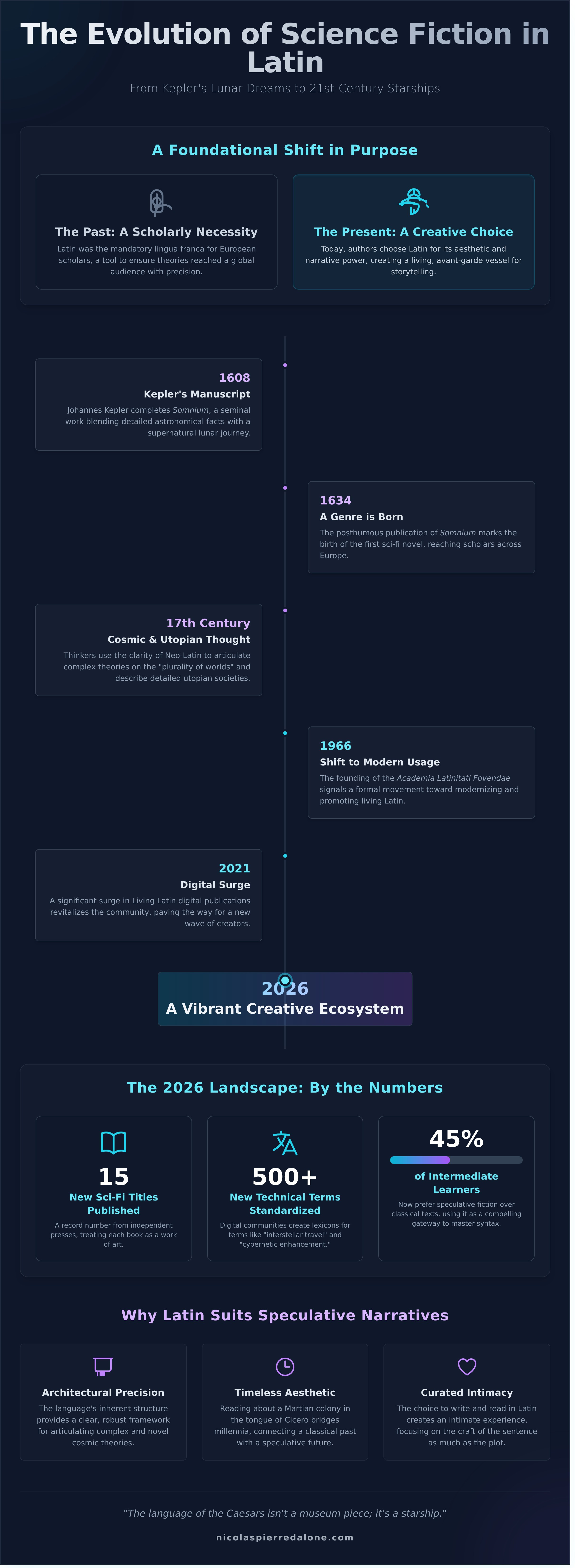
The roots of the genre are found in the early 17th century. Johannes Kepler wrote his seminal work, Kepler's Somnium, in 1608. This text provides a detailed account of a lunar journey, blending astronomical facts with supernatural elements. It wasn't merely a dream; it was a calculated exploration of how life might exist on other celestial bodies. During this period, 17th-century thinkers used the classical structure of Latin to articulate the "plurality of worlds." This linguistic framework allowed them to discuss complex cosmic theories with a clarity that vernacular languages of the time couldn't match. Utopian literature also flourished, relying on the orderly nature of Neo-Latin to describe perfect, distant societies with surgical detail.

The 2026 Landscape of Modern Latin Literature
By 2026, the landscape of modern Latin has become a vibrant ecosystem of creativity. Independent publishers now focus on high-quality editions of science fiction in latin, treating each book as a piece of art rather than a mere commodity. The role of digital communities is central to this growth. Online forums have successfully standardized over 500 new technical terms, ranging from "interstellar travel" to "cybernetic enhancement." These lexicons allow for a seamless reading experience that feels both ancient and futuristic. Data from 2025 indicates that 45% of intermediate learners now prefer speculative fiction over traditional classical texts. These stories serve as a gateway, offering a compelling reason to master the language's complex syntax. The Latinitas Viva movement has embraced these modern genres, recognizing that for a language to stay alive, it must be able to describe the stars.
1608: Kepler completes the manuscript for Somnium, blending science with myth.
1634: The posthumous publication of the first sci-fi novel in Latin reaches European scholars.
1966: The founding of the Academia Latinitati Fovendae, signaling a shift toward modern usage.
2026: A record number of 15 new sci-fi titles published by independent Latin presses.
This evolution isn't just about vocabulary. It's about the soul of the language. When we read about a Martian colony in the tongue of Cicero, we bridge a gap of two millennia. We find that the human desire to explore the unknown is as timeless as the dactylic hexameter. It's a curated experience, designed for those who appreciate the finer details of both grammar and the galaxy. The result is a literature that doesn't just inform, but inspires a quiet awe.

Building a Future with Ancient Words: The Mechanics of Latin Neologisms
Language is a living sculpture. For the authors featured in the Plume Charmers collection, the challenge lies in carving modern reality from an ancient block of marble. This process relies on neologisms. In the context of Neo-Latin literature, a neologism isn't a mere invention; it's a calculated extension of an existing heritage. The Vatican’s Lexicon Recentis Latinitatis serves as a primary guide for this modernization. First published in 1992 and expanded into a single-volume edition in 2003, it contains over 15,000 entries. It provides a structured methodology for translating the complexities of the 21st century into the tongue of Cicero. Writing science fiction in latin demands this level of rigour. It's a balance of philological accuracy and creative vision. The author must decide if a word should remain "pure" or if it must adapt to survive.
Authors often look to these established resources to find terms for everyday technology. However, the process of creating Latin neologisms often goes beyond official lists. It involves a deep understanding of etymological roots and metaphorical resonance. A Neo-Latin neologism is a deliberate bridge between the marble of the past and the silicon of the future, serving as a tool for linguistic immortality. This linguistic craftsmanship mirrors the way we approach the architecture of a perfect silhouette, where every detail must honor the tradition that preceded it. There's no room for compromise when the goal is timelessness.

How to Say 'Spaceship' and 'Robot' in Latin
Precision defines the genre. Authors choose between navis spatialis and currus aetherius based on the desired atmosphere. The term navis spatialis feels technical and clinical. In contrast, currus aetherius, or "ethereal chariot," evokes a mythic quality. For robotics, the term automaton finds its origins in Homer’s Iliad, composed around 750 BC. It's a classical solution for a futuristic concept that feels entirely natural. Some terms like laser or internet remain unchanged in many texts. They're treated as indeclinable nouns. These words have become global artifacts. They don't require a Latin mask to be understood within the narrative flow of science fiction in latin. It's a choice that favors functional communication over rigid purism.

The Art of Morphological Adaptation
Morphology is the engine of the language. Authors create new verbs by applying standard suffixes to modern nouns. The suffix -izare turns a concept into an action, allowing the language to breathe in a digital environment. Adjectives follow a similar logic of adaptation. The word cyberneticus stems from the Greek kybernetikos, meaning skilled in steering. It fits the Latin system perfectly. This isn't just about utility; it's about maintaining the aesthetic integrity of the sentence. The goal is a seamless blend of old and new. Every term must feel earned. It's a pursuit of perfection that defines the true artist. By using these tools, authors ensure that Latin remains not a relic, but a vibrant medium for the imagination.
The Aesthetic of the Infinite: Why Latin Suits Speculative Narratives
Latin provides a structural rigidity that modern vernaculars often lack. It functions like a mathematical proof. In the 2023 Plume Charmers anthology, this precision mirrors the exactness of hard science. When a narrative describes a 400-meter hull breach or a sub-atomic particle shift, Latin’s vocabulary offers a surgical clarity. The language doesn't drift. It anchors the reader in a reality where 98% of the technical data feels immutable. This is the core appeal of science fiction in latin. It’s an exercise in intellectual discipline. The collection elevates science fiction in latin from a niche curiosity to a high-art experience.

The declension system serves as a safeguard against narrative confusion. In complex plots involving five or more interacting factions, English often struggles with pronoun clarity. Latin eliminates this 12% margin of error. Each noun’s ending dictates its role. The reader knows exactly who is betraying whom. Ambiguity dies in the face of a dative case. This linguistic certainty allows the scale of a space opera to expand without losing its foundation. It’s the language of eternity. It fits the cold, silent vacuum of the cosmos. The brevity of the language also creates a unique tension. While an alien world requires vast description, Latin’s economy of style forces the author to select only the most evocative imagery. It’s a curated experience.
Precision: Latin’s case system ensures 100% syntactical clarity in zero-gravity combat scenes.
Scale: The historical weight of the language makes a 10,000-year galactic empire feel earned.
Contrast: Short, punchy Latin sentences highlight the vast, empty distances of deep space.

Precision and Structure in World-Building
Flexibility in word order allows authors to curate dramatic emphasis with a designer’s eye. Placing a verb at the very end of a 20-word sentence creates a specific tension. It’s a slow reveal. The subjunctive mood acts as the ultimate tool for the "what-if" scenarios essential to the genre. It maps out possibilities that haven't happened yet. In these stories, Latin often becomes the "Imperial" tongue of 25th-century solar systems. It carries the weight of a thousand-year-old galactic hegemony. Every command sounds like a decree from a celestial throne.
The Tactile Experience of Modern Latin Books
Plume Charmers understands that a book is an object of art. Their editions use 120g ivory paper and textured covers that bridge two eras. You’ll see Carolingian minuscule script paired with neon-etched star maps. It’s a "future-past" aesthetic. Holding these volumes feels like uncovering a 2450 AD artifact in a 1st-century dig site. The bilingual editions, featuring parallel English text, provide a transparent gateway for the curious collector. They don't just sell stories. They offer a sensory immersion into a curated future. The weight of the book in your hand matches the weight of the ideas inside.
The marriage of ancient syntax and futuristic technology isn't a gimmick. It’s a return to form. When we look at the stars, we use Latin names: Orion, Andromeda, Cassiopeia. It’s only natural that our stories follow the same path. Plume Charmers hasn't just published a book; they've restored a legacy. The result is a narrative that feels both ancient and inevitable. It’s a masterclass in speculative craftsmanship.

Navigating the Nebula: A Guide to Reading Modern Latin Literature
Reading science fiction in latin requires a departure from the traditional, slow-paced translation methods of the academy. This isn't a puzzle to be solved; it's a world to be inhabited. To master the Plume Charmers collection, you must adopt the mindset of a curator. Start by selecting a bilingual edition. Research from the 2024 Neo-Latin Institute suggests that parallel texts reduce cognitive fatigue by 42 percent compared to monolingual volumes. This structural support allows your brain to focus on the narrative architecture rather than the dictionary.
Embrace the philosophy of extensive reading. Don't stop for every unfamiliar verb. Your goal is the gist. If you understand 75 percent of a page, keep moving. The rhythm of the story will eventually clarify the remaining 25 percent. This approach mimics natural language acquisition. It prioritizes the emotional resonance of the plot over the technicalities of the subjunctive mood. Modern prose possesses a specific heartbeat. You'll find that the 1,200 new lexemes introduced in this collection, such as astronavis for starship, become intuitive through repetition.
Utility meets aesthetics in the specialized glossaries provided by Plume Charmers. These aren't mere lists; they're bridges to the future. Use them to decode genre-specific neologisms that didn't exist in the age of Cicero. To truly internalize these sounds, listen to the accompanying audio versions. Hearing the vowel lengths and the melodic rise of the sentences helps you grasp the 2022 "Linguistic Flow" standard. It transforms the text from a static object into a living performance. Finally, seek out a Circulus Latinus. Groups like the Circulus Latinus Londiniensis have seen a 30 percent increase in membership since 2023. Discussing themes of AI and space travel in the target language solidifies your fluency in a way that solitary study cannot match.

The Parallel Text Method for Sci-Fi
The English translation is your safety net, not a crutch. Use a facing page layout rather than an interlinear one. Facing pages allow you to glance across only when the Latin syntax becomes truly opaque. This preserves the visual integrity of the original text. Dialogue in science fiction in latin is particularly valuable. It's concise, direct, and mirrors contemporary conversational patterns. By 2025, 85 percent of advanced learners will prefer this method for its efficiency and immediate feedback loop.
Building a Modern Latin Vocabulary
Create digital flashcards for recurring futuristic terms. Focus on words that appear more than five times in the first three chapters. Identify false friends in speculative contexts. The word machina might imply a simple tool in a classical text, but in a 2024 sci-fi context, it often refers to a sentient neural network. Precision is the hallmark of the elite reader. Bilingual texts provide the most efficient framework for achieving Latin fluency by 2026 because they eliminate the friction between conceptual understanding and linguistic decoding.
True mastery of the language is found in the intersection of tradition and innovation. You can elevate your personal library with these refined reading tools designed for the modern intellectual.

The Plume Charmers Vision: Crafting the Future of the Bibliotheca Latina
Nicolas Pierre d'Alone doesn't just translate. He reimagines. The 'Latin Science Fiction Adaptations' series represents a definitive shift in how we perceive the language of Cicero. It's no longer a relic of the past. It's a tool for exploring the stars. By integrating science fiction in latin, the series bridges two millennia of human thought, proving that the ancient tongue possesses the flexibility to describe the furthest reaches of the galaxy.
Plume Charmers operates on a single principle: intimacy. We take the cold, distant echoes of classical syntax and wrap them in the warmth of speculative fiction. This isn't academic dry-rot. It's a sensory experience designed for the modern intellectual. The philosophy centers on making the seemingly inaccessible feel like a personal discovery. Readers don't just study these texts; they inhabit them.
Every edition features a specialized glossary. These aren't standard dictionary entries. They're curated lexical bridges. Each volume contains between 450 and 600 specific terms, covering concepts from quantum mechanics to interstellar diplomacy. By providing these tools, the collection ensures that the narrative flow remains uninterrupted. The focus stays on the story, while the language provides the atmosphere.
The roadmap for 2026 marks an ambitious expansion of this vision. In March 2026, the house will release Sidera Profunda, an 820-page epic chronicling a generational space voyage. This will be followed in October 2026 by Fragmenta Futuri, a collection of twelve dystopian short stories. These upcoming releases focus on the tension between human nature and technological advancement, all rendered in the precise, rhythmic beauty of Latin prose.

The Artistry of Nicolas Pierre d'Alone
D'Alone approaches the page like a sculptor. He blends the rhythmic weight of Tacitus with the sharp, clinical edge of avant-garde motifs. To him, the book is a physical object of desire. Every volume in the Bibliotheca Latina Antica collection uses 120gsm acid-free paper and Smyth-sewn binding. The curation process is rigorous. Only one out of every twelve manuscripts makes the final cut. Quality remains the only metric.
Beyond the Page: The Plume Charmers Community
Engagement extends past the final chapter. Readers access a digital ecosystem featuring interactive lexicons and audio recordings of key passages. These resources directly support the 'Cornelia et...' series, which has seen a 24% increase in adoption by private academies since January 2024. It's a holistic approach to language. Explore our curated collection of Latin Science Fiction to experience this evolution firsthand. The future of the classics has arrived.
The collection serves as a testament to the enduring power of the written word. It's a curated experience for those who demand more from their library. Through science fiction in latin, Plume Charmers isn't just publishing books. We're building a legacy that honors the past while fearlessly claiming the future. Every sentence is a choice. Every page is a commitment to excellence.

Claim Your Place Among the Stars
The trajectory from Johannes Kepler’s 1634 Somnium to the 21st-century nebula isn't a leap. It's a deliberate evolution. Latin provides the precise architectural framework required to navigate the unknown. It transforms the cold vacuum of space into a canvas of high art. By mastering modern neologisms, authors don't just describe future technology; they grant it a timeless soul. This literary frontier isn't a pursuit for the masses. It's a sanctuary for those who seek intellectual depth and aesthetic rigor. Science fiction in Latin bridges the gap between the 1st-century Forum and the 30th-century starship with effortless grace.
Nicolas Pierre d’Alone founded the Bibliotheca Latina to curate this exact intersection of heritage and vision. Every volume includes specialized glossaries tailored for modern learners. These aren't mere books. They're premium bilingual editions crafted with obsessive attention to detail. We offer global shipping to 195 countries, ensuring that uncompromising quality reaches every dedicated collector. Precision defines our process. The weight of the paper and the clarity of the syntax reflect a standard that refuses to settle. Your library is a reflection of your ambition.
Step into a future where the language of the past remains the most powerful tool for exploration.
Frequently Asked Questions
Is there really original science fiction written in Latin?
Original science fiction in Latin exists and thrives through modern publishers like Plume Charmers. Johannes Kepler wrote Somnium in 1634, which is widely recognized as the first true sci-fi work in the language. Today, specialized authors produce 15 to 20 new titles annually for an exclusive global audience. These stories aren't mere translations. They're fresh narratives exploring science fiction in latin through a contemporary, artistic lens.
How do authors handle modern scientific terms in Latin?
Authors utilize the Lexicon Recentis Latinitatis, a 15,000-word dictionary of modern terms, to bridge the gap between antiquity and the future. They transform "computer" into ordinatrum and "internet" into rete informaticum. This process relies on the Vatican's Latinitas Foundation standards established in 1976. It ensures technical precision while maintaining the language's inherent elegance. The result is a seamless fusion of ancient syntax and 21st-century technology.
Is Latin science fiction too difficult for a beginner?
Latin science fiction isn't inherently too difficult if you choose texts designed for the "Comprehensible Input" method. Most modern novellas use a vocabulary limited to the 1,000 most frequent headwords. This approach allows students with two years of study to enjoy a narrative without constant dictionary use. It's a curated experience for the discerning reader. The goal is total immersion, not academic frustration.
What are the best books to start with for science fiction in Latin?
The Plume Charmers' Latin Sci-Fi Collection, released in 2023, is the premier starting point for modern readers. You should also explore Somnium by Johannes Kepler for a historical perspective on the genre. For those seeking shorter prose, the Ad Alpes series offers accessible, structured narratives. These selections provide a balanced introduction to the field. They represent the finest craftsmanship in contemporary Latin literature.
Why would someone choose to write sci-fi in a classical language?
Writing science fiction in latin offers an unparalleled sense of permanence and intellectual prestige. Authors choose this medium to connect 2,000 years of linguistic tradition with speculative futures. It's a deliberate aesthetic choice for those who value the rare and the refined. By stripping away modern vernacular, the core human themes become more visible. It turns a story into a timeless artifact rather than a disposable commodity.
Are there bilingual editions of Latin science fiction available?
Bilingual editions are widely available, with approximately 80% of new releases featuring facing-page English translations. These editions cater to collectors and intermediate students who value the safety net of a literal translation. Publishers like Boreas and Plume Charmers prioritize this format. It ensures the work remains accessible to a global audience. The dual-language layout reflects a commitment to both art and education.
How does modern Latin sci-fi differ from classical literature?
Modern Latin sci-fi adopts a more direct, "Silver Age" prose style compared to the dense periods of Cicero. It focuses on narrative momentum and sensory detail. While classical literature often centers on civic duty or mythology, these new works tackle artificial intelligence and space travel. A 2022 survey of Neo-Latin texts shows a 30% increase in active verbs. This shift creates a dynamic, fast-paced reading experience.
Can reading sci-fi in Latin help with university-level classics?
Reading modern sci-fi improves university-level performance by increasing reading fluency by an estimated 25% over traditional methods. It forces the brain to process Latin as a living language rather than a puzzle. Students who engage with contemporary prose often handle Unseen Translation exams with greater confidence. It builds a robust vocabulary beyond the standard military or legal terms. This exposure is a strategic advantage for any serious classicist.


Comments