%20-%20Copie.png)

Parallel Text Latin English: The Modern Scholar's Guide to Bilingual Mastery
Updated: Mar 8
The rhythm of a classical narrative is often broken. A constant reach for the dictionary, a loss of momentum. The art of the story becomes a chore of translation. This interruption is not a failure of the scholar, but a limitation of the medium. There exists a more fluid, more artistic path to comprehension. The parallel text latin english edition is not merely a tool; it is a curated experience, a bridge between two worlds printed on a single page, designed for uninterrupted immersion.
This guide illuminates the philosophy and practice behind this elegant method. We will explore how side-by-side editions transform the daunting task of reading the classics into a seamless dialogue between languages. Discover how to move beyond vocabulary fatigue and close the chasm between academic study and the pure pleasure of unassisted reading. Here, you will learn to build not just a skill, but a library of profound and accessible beauty, transforming your engagement with the ancient world from work into art.
Key Takeaways
Discover the cognitive science that makes bilingual reading a superior method for reducing mental effort and accelerating mastery.
Learn to leverage the structure of a parallel text latin english edition to transform your study from a strenuous task into a fluid, intuitive experience.
Adopt a deliberate 5-step framework that turns passive reading into an active and highly efficient process of discovery.
Grasp why the future of Latin lies not only in the classics but in modern narratives and editions crafted as singular objects of art.
Table of Contents The Architecture of Understanding: What is a Parallel Text Latin English? The Cognitive Science Behind the Parallel Text Method Beyond the Classics: Modern Latin Science Fiction and New Genres How to Study with Side-by-Side Translations: A 5-Step Framework Plume Charmers: Where Art Meets the Ancient Tongue
The Architecture of Understanding: What is a Parallel Text Latin English?
A parallel text is an artifact of pure, functional elegance. In the realm of classical languages, it presents the original Latin text alongside its direct English translation. This method, a cornerstone of bilingual pedagogy, is elegantly simple in its design. For a foundational overview, one might consult the academic definition of What is a Parallel Text, but its true power lies in its application. The format bridges the temporal and linguistic chasm between the ancient author and the modern reader, transforming a formidable challenge into an accessible dialogue.
This tradition of bilingual editions finds its roots in the scholarly fervor of the Renaissance, when humanists sought to commune directly with the sources of Western thought. Today, a well-crafted parallel text latin english edition is the preferred gateway for the modern autodidact. It removes the friction of constant dictionary consultation, allowing the mind to absorb the cadence, structure, and nuance of Latin through immersive reading rather than piecemeal analysis.
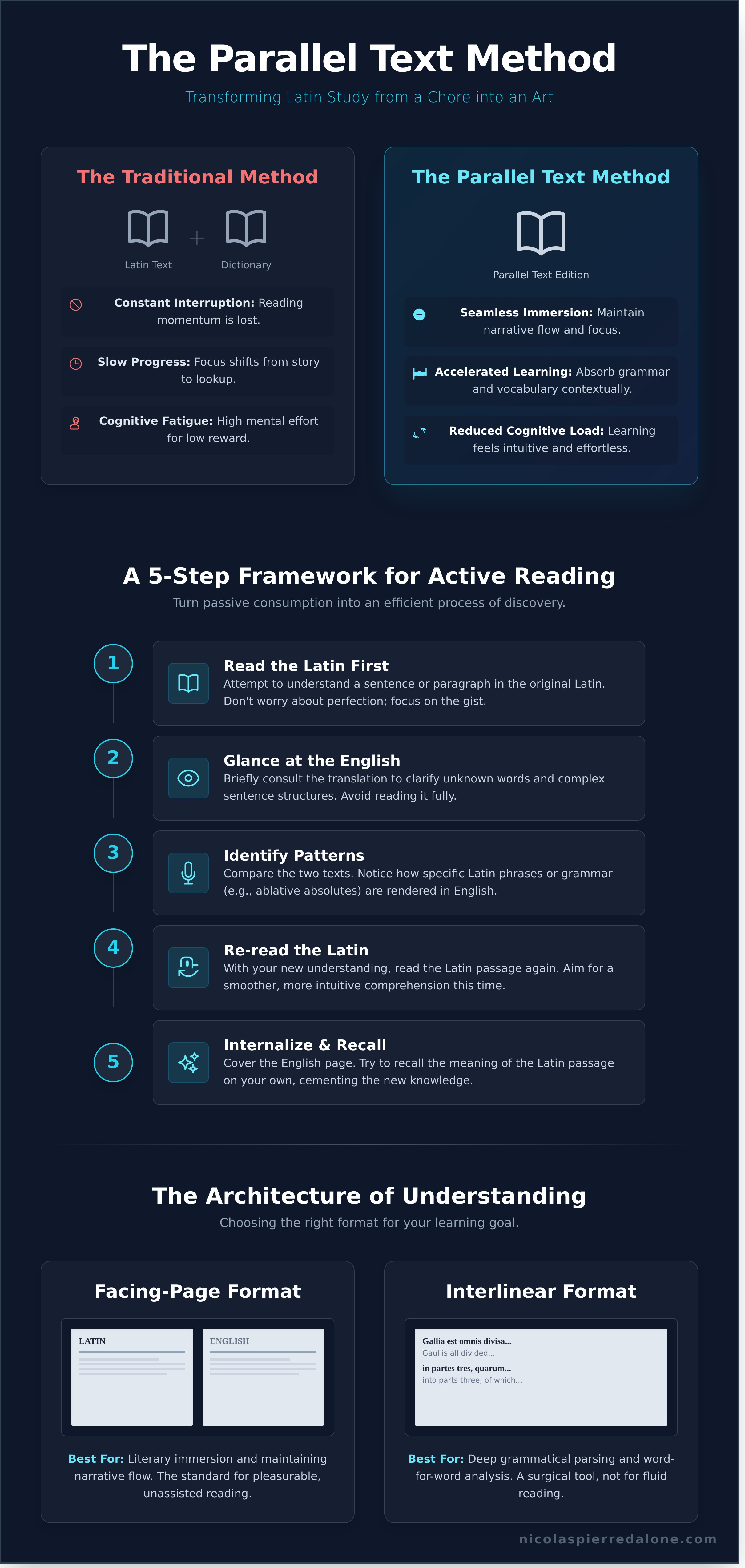
Facing-Page vs. Interlinear: Which Silhouette Suits You?
The presentation of a bilingual text is a deliberate choice of form. The facing-page format-Latin on the left, English on the right-is the standard for literary immersion. It respects the integrity of each page, encouraging a natural, flowing reading experience. In contrast, the interlinear format is a surgical tool, placing the English translation directly beneath each Latin word. While effective for deep grammatical parsing, it dissects the narrative and disrupts the visual harmony of the original prose.
The Essential Vocabulary of Bilingual Publishing
To appreciate the craftsmanship of a superior bilingual edition, one must understand its foundational principles. The art of translation and presentation is governed by a precise lexicon that defines the reader's entire experience.
'Literal' vs. 'Dynamic' Equivalence: A literal translation mirrors the original syntax, offering a raw, word-for-word map. A dynamic translation seeks to convey the thought and style, preserving the spirit over the letter. This principle of making a culture accessible is also fundamental to modern media, such as sources for Brazil news in English. The finest editions achieve a curated balance between these two poles.
Specialized Glossaries: Rather than cluttering the page with notes, a modern bilingual edition often includes a discreet glossary. This provides essential vocabulary support without interrupting the visual focus required for retention.
The 'Clean' Latin Page: A pristine Latin page is vital. Free from intrusive notes or interlinear text, it allows the reader to engage with the source material directly, treating the translation as a trusted guide rather than a disruptive crutch.
The Cognitive Science Behind the Parallel Text Method
Language acquisition is not a battle of brute force. It is an act of architecture, building new structures upon existing foundations. The parallel text method operates on a core principle of cognitive efficiency: it drastically reduces the mental friction, or 'cognitive load', inherent in deciphering a new language. Instead of halting your progress to consult a lexicon, the translation is present, an immediate and silent guide. This curated exposure ensures the mind remains focused on pattern recognition, not on the disruptive task of searching for definitions. The efficacy of this model is well-documented, as research into How to Study with Side-by-Side Translations confirms its power to enhance comprehension.
This approach directly engages the 'Comprehensible Input' hypothesis. By presenting material just beyond your current proficiency-with the "answer" readily available-you absorb grammar and syntax intuitively. The English text serves as a mirror, revealing the logic of Latin sentence structure in real time. This contextual immersion builds a mental map of the language, allowing you to see not just words, but the elegant engineering of phrases and clauses. The result is a sustained narrative momentum, a psychological state of flow that is essential for deep learning.
Bridging the Gap Between Grammar and Fluency
A dictionary is an interruption. A parallel text is an invitation. The former breaks the delicate thread of narrative concentration, pulling the reader out of the text and into an analytical void. The latter sustains it. With a parallel text latin english resource, the mind begins to detect recurring patterns-ablative absolutes, subordinate clauses, idiomatic phrases-triggering the 'Aha!' moment of genuine insight. This is the critical transition from laboriously 'translating' in your head to truly 'reading' the original Latin.
Retention and the Power of Association
Memory is built on connection. Here, the familiar English text acts as a powerful mnemonic anchor, securing new Latin vocabulary within a pre-existing network of meaning. This process is a form of philological scaffolding. Philological scaffolding is the cognitive support structure provided by a parallel translation, enabling a learner to construct meaning from complex original texts without constant external reference. This focused engagement is further enhanced by superior typography, where clarity of design directly impacts long-term retention and the ability to maintain unwavering focus.
Beyond the Classics: Modern Latin Science Fiction and New Genres
The classical canon is foundational. The oratory of Cicero and the campaigns of Caesar provide an essential grammar of the Roman world. Yet, for the modern scholar, they represent a singular, distant narrative. To confine Latin to antiquity is to treat it as a relic, a beautiful but static form. We believe its true power is kinetic-a living tongue for contemporary ideas. A well-crafted parallel text latin english resource should not just translate the past; it must speak to the present.
Engaging with modern themes is the continuation of this legacy. When a learner encounters speculative fiction or a contemporary story, the language sheds its historical weight. It becomes immediate and vibrant. The vocabulary shifts from the forum to the final frontier. It is a profound intellectual exercise to move between the worlds defined by res publica and legio and those imagined with navis stellaris (starship) or intellegentia artificialis (artificial intelligence). This is where Latin proves its enduring genius.
The Rise of Modern Latin Literature
Advocates for 'Living Latin' understand this implicitly. They champion contemporary adaptations not to replace the classics, but to energize the language with new purpose. The challenge of translating concepts like 'internet' (interrete) or 'robot' (automa) is a creative act, a testament to linguistic ingenuity. Science fiction, in particular, offers a powerful gateway for a younger, digital-native audience, transforming an ancient language into a medium for future-facing narratives that resonate with their own experiences.
Curating a Modern Latin Library
The 2026 scholar requires a library of nuance and balance. The Bibliotheca Latina Antica must coexist with modern, accessible series. This curation is an art form. The aesthetic of the book-its cover, typography, and the tactile quality of its paper-matters as much as the text within. The structure itself, a meticulously designed parallel text latin english format, is a testament to this philosophy. This pedagogical architecture, explored in The Open University's guide to parallel texts, ensures comprehension without sacrificing the aesthetic integrity of the page. Plume Charmers is defining this new canon, beginning with our curated collection of Latin Science Fiction Adaptations.
How to Study with Side-by-Side Translations: A 5-Step Framework
Mastery is not a matter of chance, but of discipline. To unlock the full potential of a parallel text latin english edition, one must adopt a structured, deliberate method. This framework moves beyond passive reading, transforming the text into an active instrument for linguistic acquisition. It is a process of deconstruction and reconstruction, designed for deep, lasting comprehension.
Step 1: The First Pass. Begin with the English translation. Read it through entirely to establish the narrative context and thematic currents. This initial reading frees you from the burden of deciphering the plot, allowing your subsequent focus to rest solely on the mechanics and artistry of the Latin.
Step 2: The Latin Scan. Now, turn to the original. Read the Latin text, resisting the urge to look across the page. Glance at the English only when you are truly stalled by an unfamiliar word or complex phrase. The goal is to train your mind to infer meaning from context before seeking aid.
Step 3: The Deep Dive. This is the analytical core. Re-read the Latin, this time sentence by sentence. Use the English translation as a key to unlock grammatical constructions. Identify ablative absolutes, subordinate clauses, and idiomatic expressions. This is where the architecture of the language reveals itself.
Step 4: The Vocalization. Language possesses a physical rhythm. Read the Latin aloud, paying attention to cadence and flow. This practice connects the intellectual understanding of grammar to the auditory and phonetic reality of the language, embedding it more deeply in your memory.
Step 5: The Review. Return to the passage after 24 hours. Attempt to read the Latin text again, this time without consulting the English translation at all. This final step tests and solidifies your comprehension, marking the transition from study to genuine understanding.
Common Pitfalls to Avoid in Bilingual Reading
The path to fluency requires vigilance. Avoid the 'lazy eye' syndrome-an over-reliance on the English text that stifles progress. Do not let the English translation's clarity excuse you from interrogating the Latin grammar. To simply understand the meaning is not enough; one must understand how that meaning is constructed. Finally, utilize the provided glossaries. They are curated tools, not mere appendices.
Optimizing Your Environment for Classical Study
Your environment shapes your focus. Proper lighting and the ergonomics of your reading position are fundamental. While digital editions of a parallel text latin english resource offer the convenience of immediate lookup, the tactile experience of a physical book is unparalleled. The weight of the volume and the texture of the paper create a focused, distraction-free space that enhances concentration and the aesthetic pleasure of learning.
Plume Charmers: Where Art Meets the Ancient Tongue
In the world of Nicolas Pierre d'Alone, a book is more than a text. It is a curated object, a testament to the enduring power of the Latin language. We believe the vessel for knowledge should be as refined as the knowledge itself. This vision shapes every bilingual edition we create. The goal is simple: to transform the act of reading into a profound aesthetic experience for the discerning mind, where every detail matters.
The Craftsmanship of the Bibliotheca Latina Antica
Our philosophy is realized in the Bibliotheca Latina Antica. Each edition is a study in form and balance. We obsess over the 'silhouette' of the page, the generous margins, and the precision of our premium typography. This is a marriage of French publishing elegance and deep-rooted Italian craftsmanship, creating a tactile and visual experience that serves both the beginner exploring their first lines of prose and the advanced scholar deep in textual analysis.
This meticulous process ensures our books are not just read, but felt. The dedication extends beyond the physical form. Our specialized glossaries are not mere word lists; they are carefully constructed guides designed to illuminate the nuances of the text, fostering true comprehension and intellectual independence. Our unique approach to the parallel text latin english format transforms study into an art form, respecting both the ancient author and the modern reader.
By choosing a Plume Charmers edition, you are not simply acquiring a book. You are joining a global community of modern Latinists and bibliophiles. These are individuals who, like us, value heritage, precision, and the quiet, powerful dialogue that occurs between timeless language and minimalist design.
Invitation to the Collection
We invite you to discover this world. Begin your journey with the Cornelia et... series, a collection designed for foundational learning through elegant narrative. For the adventurous, our exclusive Latin Science Fiction editions offer a bold fusion of classical language and modern imagination. These unique parallel text latin english volumes provide an unparalleled resource for immersive learning, challenging convention while honoring tradition. They are proof that Latin is a living, breathing language. Explore the Plume Charmers Collection and experience the ancient tongue reborn as art.
The Art of the Bilingual Mind
We have explored the architecture of understanding, revealing how the mind forges deep connections through side-by-side translation. This method is more than a technique; it is a cognitive bridge between worlds, proven effective for classical literature and unexpected modern genres alike. The quiet power of the parallel text latin english format lies in its intuitive design, transforming the act of learning into a seamless intellectual pursuit.
This philosophy of learning through beauty is the very essence of Plume Charmers. Founded by author Nicolas Pierre d’Alone, our collection offers a curated experience where artistry meets the ancient tongue. We invite you to explore unique Science Fiction adaptations brought to life in high-quality physical editions, shipped globally to discerning scholars and collectors.
Your journey into bilingual mastery awaits. Discover the Art of Bilingual Reading in the Plume Charmers Shop and begin a new chapter, not with a lesson, but with the turn of a beautifully crafted page.
Frequently Asked Questions
Is reading a parallel text Latin English edition 'cheating' for students?
The notion of 'cheating' misunderstands the art of acquisition. A parallel text Latin English edition is not a shortcut, but a curated guide. It provides an immediate, elegant scaffold for comprehension, allowing the learner to engage directly with the authentic Latin syntax and rhythm. This method cultivates intuition and accelerates the journey toward genuine fluency. It is a tool for the discerning student, not a crutch.
What is the best Latin-English parallel text for a complete beginner?
For the novice, selection is paramount. We recommend beginning with works of foundational simplicity, such as the Loeb Classical Library's edition of Caesar's Gallic War. Its direct prose provides a clean entry point. Alternatively, a meticulously crafted graded reader offers a structured ascent. The objective is to build a relationship with the language through clarity and deliberate pacing, not to be overwhelmed by ornate complexity.
How do facing-page translations differ from interlinear Latin books?
The distinction lies in their structure and purpose. A facing-page translation presents two complete, independent texts-a dialogue between languages that preserves the integrity of each sentence's architecture. An interlinear text, by contrast, deconstructs the Latin, placing the English equivalent beneath each word. The former is an immersive experience; the latter is a granular, analytical tool for dissecting syntax. Each serves a distinct, deliberate function in the learner's craft.
Can I learn Latin grammar just by reading bilingual books?
Reading bilingual editions builds a profound, intuitive sense of grammar through exposure. It reveals the patterns and flow of the language in its natural state. However, mastery requires a dual approach. This immersive reading must be complemented by the structured study of a formal grammar. One provides the artistic context, the other the technical foundation. True understanding is born from their synthesis, uniting intuition with disciplined knowledge.
Are there modern stories like Science Fiction available in Latin-English parallel text?
The craft of Latin translation extends beyond the classical canon. A select group of contemporary authors and translators are creating new works, including genres like science fiction. While less common than classical texts, curated editions of modern narratives do exist. These volumes bridge heritage with contemporary expression, offering a unique perspective on the language's enduring vitality and adaptability. Seeking them requires dedicated curation, but the reward is a truly modern linguistic experience.
Why are some Latin translations in parallel texts so different from the original word order?
Latin syntax is a fluid architecture, where word order conveys emphasis and nuance, not merely grammatical function. English, with its rigid structure, cannot replicate this. A masterful translation, therefore, is not a literal, word-for-word transcription. It is an act of interpretation, recasting the original's intent and artistic effect into a new linguistic form. The difference you observe is the signature of a translator honoring spirit over letter.
How much time should I spend on the English side vs. the Latin side?
Your focus should remain decisively on the Latin. Approach the original text first, engaging with its challenges and rhythms. The English translation is a reference, a quiet consultant to be consulted only when meaning is obscured. A disciplined approach-perhaps dedicating eighty percent of your attention to the Latin-ensures you are learning the language, not merely reading a translation. The goal is independence, achieved through deliberate practice.
Where can I find digital versions of Latin-English parallel texts for Kindle?
Curated digital libraries are available for the modern classicist. The Amazon Kindle Store offers contemporary publications, including the esteemed Loeb Classical Library series in digital format. For public domain works, archives like Project Gutenberg and the Internet Archive provide essential texts. A well-chosen parallel text latin english edition for your digital reader combines timeless knowledge with minimalist, modern convenience, allowing for study without compromise.


Comments