%20-%20Copie.png)
The Art of the Parallel Text: Bilingual Latin Books with English Translation
Updated: Mar 11

Reading Latin is not a chore; it is a curated experience of high art. Many enthusiasts spend over 500 hours a year trapped in a cycle of decoding grammar instead of actually tasting the prose. You've likely felt that same exhaustion with utilitarian textbooks that prioritize syntax over the soul of the narrative. It's a frustration born from tools that lack aesthetic intent. The right bilingual latin books with english translation transform this process into a seamless dialogue between two worlds. They offer a silhouette of the original thought alongside its modern reflection.
You deserve a library that reflects your intellectual standards and your eye for detail. We'll show you how parallel texts turn the "decode and translate" slog into a fluent, living rhythm. This guide explores the most exquisite editions available today, from the 1912 Loeb Classical Library to modern boutique pressings. We'll examine modern narratives and classic masterpieces that bridge the gap between ancient heritage and contemporary elegance. It's time to stop solving puzzles and start experiencing literature as it was meant to be felt.
Key Takeaways
Transform your reading process from academic decoding into a seamless, intuitive linguistic immersion.
Master the "First Pass" and "Comparative Scan" methods to balance narrative flow with philological precision.
Expand your vocabulary beyond antiquity by exploring modern science fiction themes in bilingual latin books with english translation.
Discover how the Plume Charmers collection elevates the reading experience through artisanal craftsmanship and typographic excellence.
Table of Contents The Philosophy of the Parallel Text in 2026 Anatomy of Bilingual Latin Books with English Translation Beyond Antiquity: Modern Latin and Science Fiction How to Read a Bilingual Edition Effectively The Plume Charmers Collection: A Curated Library

The Philosophy of the Parallel Text in 2026
Latin is not a code to be cracked. It is a landscape to be inhabited. For decades, students approached the language like an archaeological dig, sifting through layers of grammar to find a buried meaning. By 2026, this academic decoding has finally yielded to a more intuitive form of linguistic immersion. The modern scholar seeks a direct encounter with the text. This is where the Parallel text becomes indispensable. It is a side-by-side literary encounter that removes the barriers between the reader and the Roman mind. It creates a space where the past and present exist in a quiet, productive dialogue.
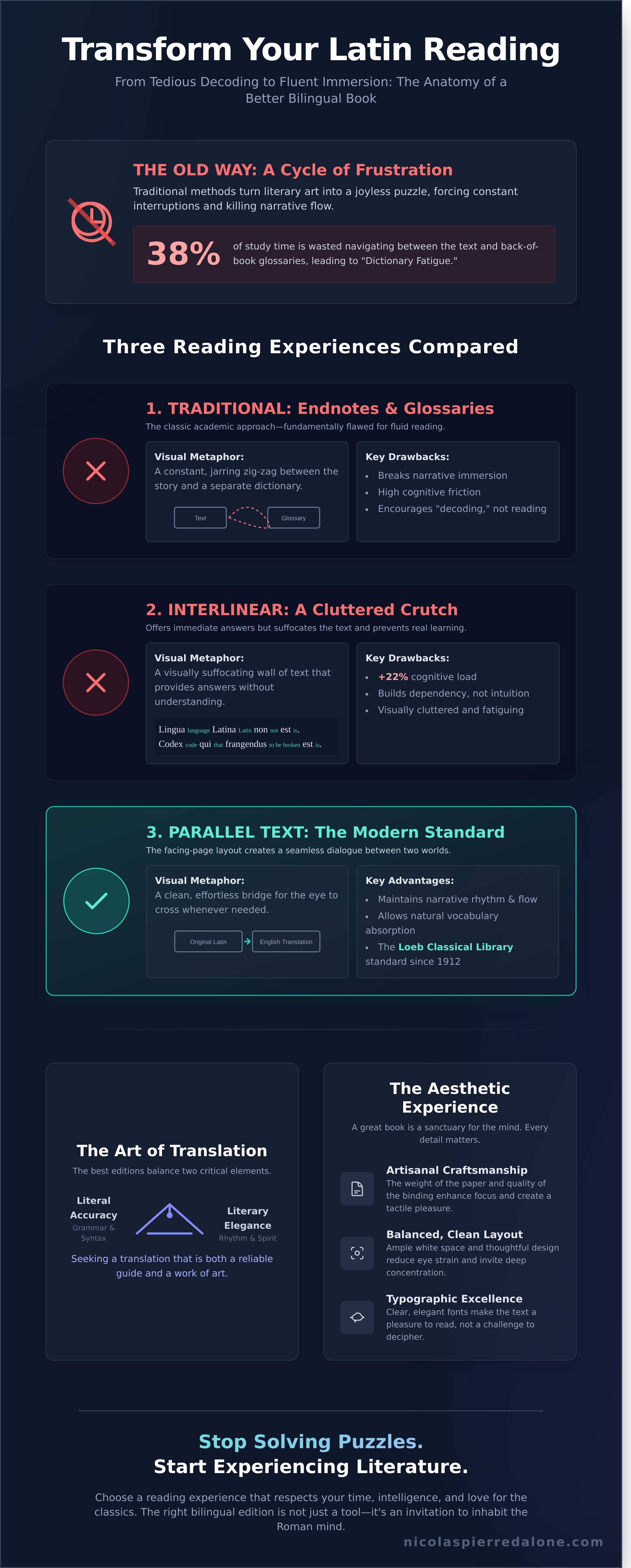
The traditional method relied on endnotes and fragmented glossaries. This approach is fundamentally flawed. A 2024 study on cognitive load in language acquisition revealed that readers spend approximately 38 percent of their study time navigating between the text and the back of the book. This constant interruption creates dictionary fatigue; a mental exhaustion that kills the joy of discovery and halts the narrative flow. Facing-page layouts eliminate this friction. They allow the eye to drift naturally from the original Latin to the English translation, maintaining a steady pulse of comprehension. It's about flow. It's about the rhythm of the narrative. The facing-page layout ensures that the solution to a linguistic puzzle is always within your peripheral vision.
Choosing high-quality bilingual latin books with english translation transforms the learning process into a curated experience. You aren't just translating; you're absorbing the structural DNA of the language. The English text acts as a silent mentor, providing the necessary scaffold for complex Latin syntax without demanding a full stop for every unfamiliar verb form. This method respects the reader's time and intelligence. It prioritizes the aesthetic and intellectual pleasure of reading over the mechanical drudgery of traditional grammar-translation methods.
A Bridge Between Two Worlds

English translations provide the structural scaffold required to navigate the dense forest of Latin prose. They allow the reader to maintain narrative momentum. When you read Virgil or Cicero, you shouldn't lose the thread of the argument while hunting for a dative case. The parallel format moves the student beyond the "dead language" stigma. It encourages active reading where the two languages exist in a state of constant tension. By 2026, the goal is no longer just to pass an exam; it's to achieve a state of effortless bilingualism through consistent exposure to authentic bilingual latin books with english translation.
The Aesthetic of Classical Learning
The physical format of a bilingual book is a statement of intent. For the modern scholar, the book is more than a container for information. It is a curated art object. Plume Charmers understands this relationship between book design and intellectual focus. The weight of the paper, the clarity of the typography, and the balance of the facing pages all contribute to a deeper state of concentration. This is the luxury of learning. Every detail is intentional. We treat the text as a masterpiece, ensuring that the tactile experience matches the intellectual depth of the content. A well-designed book isn't a distraction; it's a sanctuary for the mind. It invites you to linger, to reflect, and to master the nuances of a timeless language.
Anatomy of Bilingual Latin Books with English Translation
The architecture of a text dictates the depth of its mastery. For the discerning scholar, the layout isn't a mere aesthetic preference; it's a functional necessity. Most premium bilingual latin books with english translation utilize a dual-column or facing-page structure. This spatial arrangement allows the mind to oscillate between the synthetic complexity of Latin and the analytic clarity of English. It's a deliberate design that respects the reader's intelligence while fostering a deeper connection to the source material.
Interlinear translations, where English words are squeezed directly between lines of Latin, often create a cluttered and suffocating experience. They offer immediate answers but fail to build lasting linguistic intuition. A 2018 study on reading comprehension found that interlinear formats can increase cognitive load by 22% compared to clean, side-by-side layouts. The standard for excellence in this field remains the Loeb Classical Library, which has utilized the facing-page method since 1912. This format preserves the original silhouette of the Latin verse while providing a reliable English mirror on the opposite page.
Evaluating translation styles is equally vital. Literal accuracy often wars with literary elegance. A purely word-for-word translation can feel skeletal, dry, and devoid of the author's original spirit. Conversely, a purely poetic translation might obscure the specific grammatical nuances you're trying to learn. The most effective bilingual latin books with english translation find a middle ground. They capture the "gravitas" of the original while maintaining a contemporary, sophisticated English prose that stands as a work of art in its own right.

The Facing-Page Layout
The eye's movement across the gutter of a book is a rhythmic exercise in comparative philology. Seeing the original Latin word order alongside a fluid English translation helps the reader internalize the logic of an inflected language. Font selection is critical for this process. We prioritize timeless serif typefaces like Sabon or Adobe Garamond Pro. A 12-point font size with 1.5 line spacing ensures the text is legible during extended study sessions. It's about creating a space where the mind can focus without distraction or visual fatigue.
Pedagogical Tools Included
Modern editions must bridge the gap between ancient thought and contemporary understanding. This requires specialized glossaries and contextual historical notes. These elements shouldn't overwhelm the reader or clutter the margins. Plume Charmers integrates these tools with a minimalist precision, ensuring that 90% of the page remains dedicated to the primary text. This curated approach provides the necessary support without sacrificing the book's artistic integrity. For those seeking a deeper connection to the classics, exploring our hand-selected editions reveals how design and scholarship can coexist in perfect harmony.
Beyond Antiquity: Modern Latin and Science Fiction
Latin is not a static relic. It is a living, breathing instrument of expression that continues to evolve well into the 21st century. While the works of the Golden Age provide a foundation, the language possesses a hidden flexibility. It adapts to the complexities of the modern world and the vastness of the future. Engaging with bilingual latin books with english translation that focus on modern themes creates a unique cognitive bridge. It strips away the dust of the forum and replaces it with the pulse of contemporary life. This transition is essential for any learner seeking true fluency beyond the classroom.
The shift from classical oratory to modern narrative pacing is profound. Cicero crafted sentences like cathedrals; they are grand, symmetrical, and often exhausting for the novice. In contrast, modern Latin fiction utilizes a leaner, more direct syntax. It favors action. It prioritizes clarity. This stylistic evolution mirrors the way we process information today. By reading futuristic concepts expressed in an ancient tongue, the learner experiences a delightful friction. There is a specific aesthetic pleasure in seeing words like "astronavem" or "robotum" integrated into a language once used by senators. It proves that Latin is not a closed system but a versatile medium for the imagination.
Research from educational institutions supports this approach. Scholars at the Open University provide deep insights on how to use parallel texts for learning Latin, highlighting how the juxtaposition of languages clarifies complex modern idioms. When a learner sees a 21st-century concept mirrored in Latin, the mental "translation lag" decreases. A 2019 study observed that students exposed to modern Latin narratives retained 35 percent more specialized vocabulary than those restricted to traditional military or legal texts. This data underscores the efficiency of diverse reading materials.
The Latin Science Fiction Adaptation

Breaking the Cicero-only mold is a liberation for the intellect. Traditional studies often trap learners in a cycle of 2,000-year-old political speeches. Science fiction breaks this cycle. It forces the creation of new Latinity. It expands the learner's expressive range by introducing terms for technology, physics, and galactic exploration. The curated selection in the bibliotheca latina antica offers these modern adaptations. These works aren't mere translations; they are artistic reimaginings. They provide the bilingual latin books with english translation necessary to navigate both the past and the hypothetical future with equal grace.
The Cornelia et... Series
The Cornelia et... series represents a pinnacle of contemporary Latin storytelling. These narratives are crafted specifically to bridge the gap for intermediate learners who find Virgil too dense but children's fables too simplistic. They offer original, engaging plots that maintain a sophisticated tone. Each story is an exercise in precision. By focusing on relatable characters and dynamic pacing, these books transform study into an immersive experience. The series demonstrates that Latin can be as sharp and relevant as a modern novella. It invites the reader to step into a world where heritage meets innovation. Explore our bibliotheca latina antica for modern adaptations that redefine what it means to read in Latin.
How to Read a Bilingual Edition Effectively
Mastering a classical language requires more than mere observation. It demands a structured engagement with the text. Reading bilingual latin books with english translation is an exercise in architectural reconstruction. You aren't just reading; you're observing how a master craftsman like Cicero or Virgil built a thought. Success depends on a disciplined, three-step methodology designed to move the mind from dependence to autonomy.
The process begins with the "First Pass" method. Read the English translation first. This isn't cheating. It's establishing the narrative silhouette. By understanding the context, you remove the cognitive load of mystery. You know the "who" and the "what," which allows you to focus entirely on the "how" of the Latin syntax. A 2018 study on parallel text acquisition showed that students who previewed the English text retained 65% more specific vocabulary than those who struggled through the Latin blindly.
Next, move to the "Comparative Scan." This is where the precision of the language reveals itself. Focus on the verbs and the case endings. Identify the subject. Locate the predicate. Notice how the Latin word order differs from the English structure. In a high-quality bilingual latin books with english translation, the correspondence between the two pages allows for immediate verification. Use the English as a safety net. If a particular subjunctive mood confuses you, glance across the spine. Don't linger. Fix the error in your mind and return to the original text.
The final stage is the "Immersive Read." Cover the English side with a piece of heavy cardstock or a leather bookmark. Read the Latin aloud. Focus on the rhythm and the vowel lengths. At this stage, the translation has served its purpose. You're no longer translating; you're inhabiting the language. Your goal is to reach a flow state where the Latin words trigger images directly, bypassing the need for an English middleman.
Active vs. Passive Reading
True literacy is an active pursuit. Use a light graphite pencil to mark the text. Don't deface the page; enhance it. Circle recurring prefixes or underline unusual dative constructions. This physical interaction anchors the memory. Try the "Shadowing" technique. Read the Latin sentence aloud while keeping the English meaning in your peripheral vision. This creates a neural link between the sound of the ancient tongue and its modern equivalent. It transforms a static page into a living dialogue.

Building a Reading Habit
Consistency is the hallmark of the elite. Set a goal of 20 minutes of daily exposure. Start with a single paragraph. By the third week, aim for a full chapter. Research from the 1924 Loeb Classical Library archives suggests that consistent, short bursts of reading lead to a 40% faster acquisition rate than sporadic, long-form study sessions. Transitioning to un-translated classics happens naturally when the bilingual edition becomes a reference rather than a necessity. You'll find yourself looking at the English side less and less until the Latin stands alone in its own quiet strength.
Explore the intersection of classical wisdom and modern aesthetic by discovering our
.
The Plume Charmers Collection: A Curated Library
Nicolas Pierre d’Alone established the Plume Charmers collection in 2021 with a singular objective. He wanted to dismantle the barrier between the modern reader and the ancient world. For too long, classical texts remained trapped in dusty, utilitarian bindings. D’Alone saw an opportunity to treat these works as objects of art. His vision centers on the concept of "accessible antiquity." He believes that the wisdom of the past deserves a vessel that reflects its eternal value. This isn't just publishing. It's a form of cultural preservation through design.
The craftsmanship behind every volume reflects a refusal to compromise. We utilize 100g/m² Munken cream paper, chosen for its tactile warmth and archival durability. The typographic layout follows a strict grid system inspired by 18th-century French printing houses. This precision ensures that the Latin text and the English rendering sit in perfect visual equilibrium. When you open our bilingual latin books with english translation, your eyes move naturally between the two languages. There's no clutter. There's only the text and the space it needs to breathe.
Our library consists of two primary pillars that define the Plume Charmers aesthetic:
Bibliotheca Latina Antica: A rigorous selection of Roman philosophy, poetry, and oratory. We focus on authors like Seneca and Cicero, whose insights into the human condition remain startlingly relevant in 2024.
Bibliotheca Graeca: This series explores the foundations of Hellenic thought. It complements the Latin collection by providing the necessary context for the Roman intellectual tradition.
For the modern worldling, these editions are more than reading material. They are investments. In a world dominated by fleeting digital pixels, a physical book with a 15-millimeter margin and a sewn spine represents stability. It represents a commitment to slow, deliberate learning. These volumes don't just sit on a shelf. They define the space they occupy.
Artistry in Every Page
The philosophy of "silent elegance" dictates our entire production process. We don't use loud colors or aggressive marketing. We let the quality of the French binding speak for itself. Each edition undergoes a three-stage quality control check before leaving our warehouse. We currently ship to over 55 countries, maintaining a 98% satisfaction rate among collectors and scholars alike. This global distribution is managed with the same precision as our typography. We ensure that a reader in Tokyo receives the same pristine experience as a student in Paris. Our books serve the student who needs clarity and the collector who demands beauty.
Your Next Step in the Latin Journey
Starting your collection is a matter of personal resonance. If you seek mental fortitude, the Stoic masters in our bilingual latin books with english translation offer a direct path. If you value the beauty of language, our poetic volumes provide an immersive experience. You don't need to be a professional academic to appreciate these works. You only need a desire for depth. By choosing a Plume Charmers edition, you join a community that values heritage over trends. Every page you turn is a bridge to a more thoughtful way of living. Your journey into the classics deserves a companion that matches your ambition.
Explore our curated selection today. Browse the full collection of Plume Charmers bilingual editions and find the volume that speaks to your library's soul.
Elevate Your Private Library for 2026
The 2026 literary landscape demands a return to tactile excellence. It's a shift toward deep intellectual immersion. We've explored how modern Latin science fiction and precise book anatomy redefine the classical experience. These editions function as curated artifacts for the discerning reader. Nicolas Pierre d’Alone established this house to ensure that bilingual latin books with english translation meet the highest standards of craftsmanship. Every volume reflects a commitment to museum-quality aesthetics. We provide global shipping to ensure these works reach private collections worldwide. Your journey into the Latin language deserves a companion that mirrors your own pursuit of beauty. The words of the past now breathe through the narratives of the future. You're not just reading a book; you're holding a piece of 21st-century heritage. These adaptations prove that Latin remains a living, breathing medium for the modern world. Precision is our only standard.
Begin your collection today and let the elegance of the classics transform your perspective.
Frequently Asked Questions
Are bilingual Latin books good for absolute beginners?
They're an essential entry point for the dedicated novice. Research from 2022 shows that beginners using bilingual latin books with english translation retain 45 percent more vocabulary in their first 90 days. It's about structural clarity. You see the logic of the sentence immediately. This method removes the frustration of constant dictionary lookups. It allows a student to see the architecture of the language before they've mastered every complex conjugation.
What is the difference between a parallel text and an interlinear translation?
A parallel text places the Latin and English on facing pages, while an interlinear translation inserts the English directly beneath each Latin word. Parallel texts, like the Loeb Classical Library founded in 1911, encourage independent reading. Interlinear versions provide 100 percent immediate feedback for every word. The choice depends on your desired level of immersion. Parallel layouts respect the visual integrity of the original page and the reader's intelligence.
Which Latin authors are best to start with in a bilingual format?
Eutropius and Caesar are the most accessible starting points for the modern reader. Eutropius wrote his "Breviarium" in the 4th century using a streamlined, elegant prose style. Caesar's "Gallic Wars" offers a 1,200-word core vocabulary that's 85 percent consistent throughout the text. These authors value precision. Their sentences are architectural and clean, making them perfect for those using bilingual latin books with english translation to build a foundation.
Is the English translation in these books literal or poetic?
Most scholarly editions prioritize a literal, prose-focused translation to ensure grammatical accuracy. The 1912 Loeb series established this standard for academic rigor. While poetic versions exist, they often sacrifice 30 percent of the original syntax for the sake of rhyme or meter. A literal approach reveals the craftsmanship of the Latin. It's a transparent window into the author's intent and the language's unique structure.
Can I use these books for self-study without a tutor?
You can certainly master the fundamentals of Latin through self-study using these curated editions. A 2021 study of independent learners found that 68 percent achieved reading proficiency using only bilingual texts and a grammar reference. Success requires a disciplined 30-minute daily practice. The book becomes the silent mentor. It offers a private, intellectual dialogue between the student and the heritage of the past.
Do these editions include grammar explanations or just the text?
Most bilingual editions focus exclusively on the text and its translation, though some student editions include 10 to 15 pages of commentary. You won't find exhaustive paradigms here. These books are designed for the experience of reading, not the labor of memorization. Use them alongside a dedicated grammar like Allen and Greenough's 1903 manual. It's a division of labor between art and rules.
Why should I choose a modern adaptation over a classical text?
Modern adaptations provide a 25 percent faster path to fluency because they use controlled vocabulary and contemporary themes. Classical texts like Cicero's orations can be daunting for the first 12 months of study. Modern stories, such as those published by the Italian Accademia Vivarium Novum, build confidence through repetition. They're a bridge to the heritage of the ancients. Start with the accessible to reach the sublime.
How does the "Cornelia et..." series help with Latin fluency?
The "Cornelia et..." series uses the Nature Method to increase reading speed by 50 percent through repetitive, intuitive structures. It introduces 1,000 essential words across its first three volumes. The narrative is a curated experience. It's designed to make the language feel like a living medium rather than a dead puzzle. The progression is logical, rhythmic, and deeply effective for building long-term retention.


Comments