%20-%20Copie.png)
Ecclesiastical Latin vs. Classical Latin: Why the Sacred Tongue Still Matters

The Sacred Echo: Why the Study of Ecclesiastical Latin Remains the Ultimate Intellectual and Spiritual Frontier
In the modern age, characterized by "chronological snobbery"—the assumption that the newest is inherently the best—the study of Latin is often dismissed as a pedantic exercise in nostalgia. Yet, for those who seek to understand the structural foundations of Western civilization, the recovery of Ecclesiastical Latin (Christian or Medieval Latin) is not merely a hobby; it is an act of intellectual and spiritual liberation.
To learn the Latin of the Church is to reclaim a "commonwealth of the mind" that has unified saints, philosophers, and scientists for over fifteen hundred years.
I. The Linguistic Great Schism: Classical vs. Ecclesiastical Latin
A common misconception among modern students is that "Latin is Latin." In reality, a profound stylistic and philosophical evolution separates the Classical Latin of the Golden Age (Cicero, Caesar, Virgil) from the Ecclesiastical Latin of the Fathers, the Scholastics, and the Liturgy.
Syntax and Clarity: Classical Latin is famous for its "Periodic Style"—long, complex sentences with nested clauses that resemble a mathematical puzzle. It was a language of elite oratory. Ecclesiastical Latin, beginning with the Vulgate of St. Jerome, moved toward a more direct, "linear" syntax. It sought to be a vessel for Truth that could be understood by the faithful, prioritizing clarity and emotional resonance over rhetorical gymnastics.
Vocabulary Expansion: The early Christians faced a unique challenge: how to express transcendent, metaphysical concepts (like Incarnatio, Transubstantiatio, or Trinity) using a pagan vocabulary? The result was a massive expansion of the lexicon. Medieval Latin is richer in abstract nouns and theological nuances that simply do not exist in the writings of Augustus’s era.
The Shift in Soul: While Classical Latin is the language of the Empire and the Law, Ecclesiastical Latin is the language of the Altar and the Cloister. One is designed to command; the other is designed to pray.

II. Why Study the "Language of the Angels" Today?
1. Unlocking the Primary Sources of History
The vast majority of Western heritage—from the records of medieval villages to the profound Summas of Thomas Aquinas—is written in Medieval Latin. To rely on translations is to see the past through a veil. By learning Ecclesiastical Latin, the scholar gains direct access to the thoughts of the giants upon whose shoulders we stand. It is the difference between reading a description of a cathedral and actually walking through its nave.
2. The Logic of the Liturgy
For the Catholic believer, Latin is the "Sacred Sign." It provides a sense of the sacrum—a separation from the mundane language of the marketplace. When one understands the specific grammar of the Missal, the Mass is transformed. You no longer hear "sounds"; you hear the precise logic of praise. You understand why the priest uses the Subjunctive for a petition and the Indicative for a profession of faith. The language becomes transparent, allowing the mystery to shine through.
3. Mental Discipline and Universal Identity
Ecclesiastical Latin is a "stateless" language. It belongs to no single nation, making it the ultimate tool for universal communication. Furthermore, its rigorous grammatical structure trains the mind in logical precision. It is "mental calisthenics" that sharpens the intellect for any other pursuit, be it law, medicine, or coding.
III. The Medieval Pedagogy: A Return to Immersion
For centuries, Latin was not learned through dry tables in a vacuum. It was learned through immersion in the Sacred. The medieval student lived within the language—hearing it chanted, reading it in the Scriptorium, and speaking it in the halls of the great Universities.

This brings us to the necessity of a specific kind of guidance. Most modern textbooks fail because they treat Latin as a dead specimen in a lab. To truly master the "Tongue of the Angels," one needs a method that respects the Liturgical context of the language.
IV. A Path Forward: The Liturgical Journey
If you are ready to step out of the frantic pace of the 21st century and into the stillness of the eternal, you must choose your tools wisely. We recommend a path that focuses on the "Sacred Sentence"—a method that integrates grammar with prayer.
A premier example of this approach can be found in "The Tongue of the Angels: A Liturgical Journey Through Latin Grammar" by John Marlowe. This work is not a mere textbook; it is a 30-chapter pilgrimage.

It introduces the Ablative Case not as a list of rules, but as the "Space of Mystery."
It treats the Dative Case as the grammatical expression of receiving Grace.
Across 4,000 characters per chapter, it builds a "mental cathedral," moving from the foundations of the Trinity to the "Eternal Amen" of complex deponent verbs.
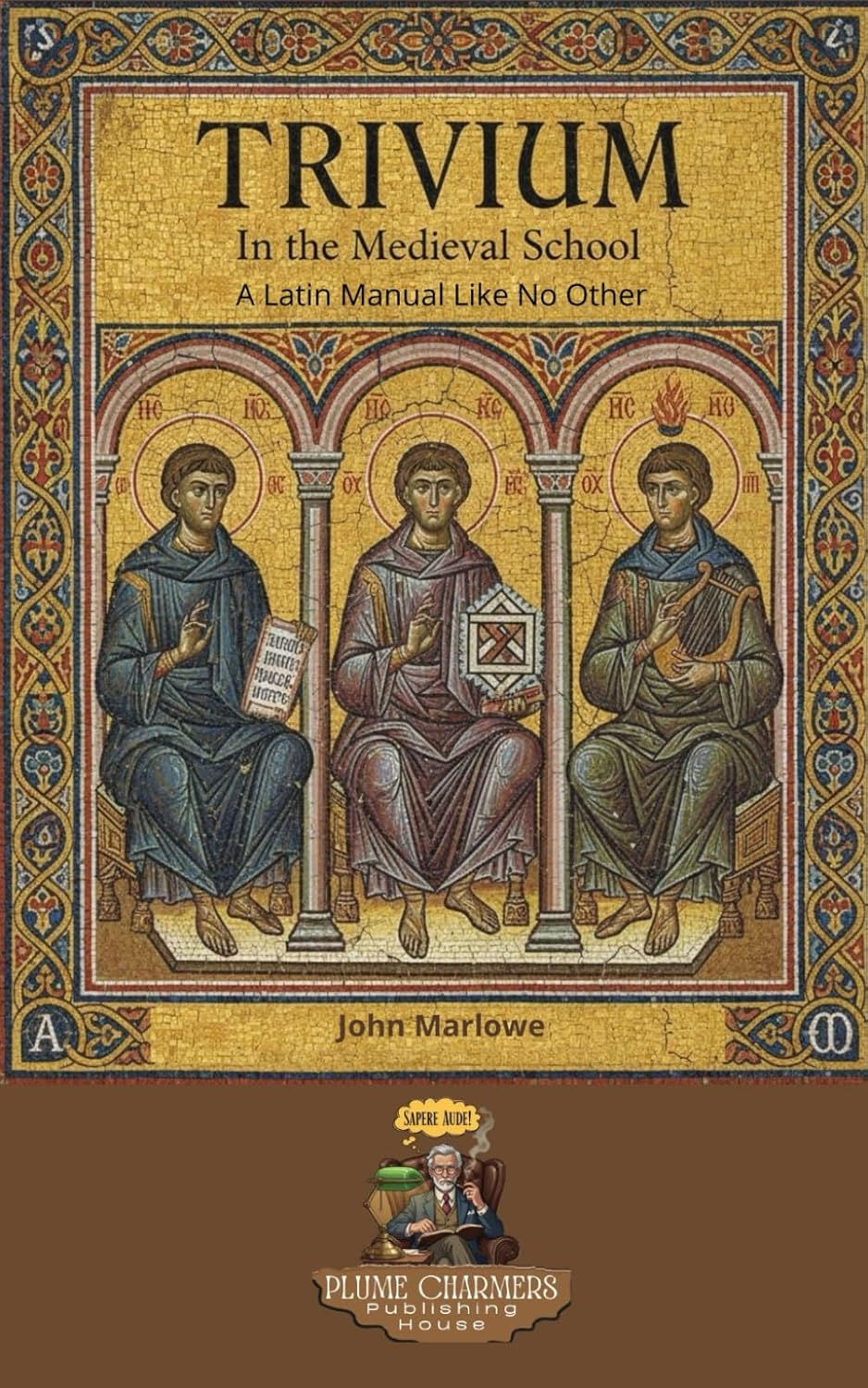
Whether through this volume or our other specialized manuals on the Trivium and Quadrivium, our goal is to make the Liturgy and the Medieval mind transparent to you. The key to the treasure chest of Western civilization is waiting. The door is open. Oremus.


Comments