%20-%20Copie.png)
How to Learn Latin Like a Medieval Scholar: The Trivium and Quadrivium Method

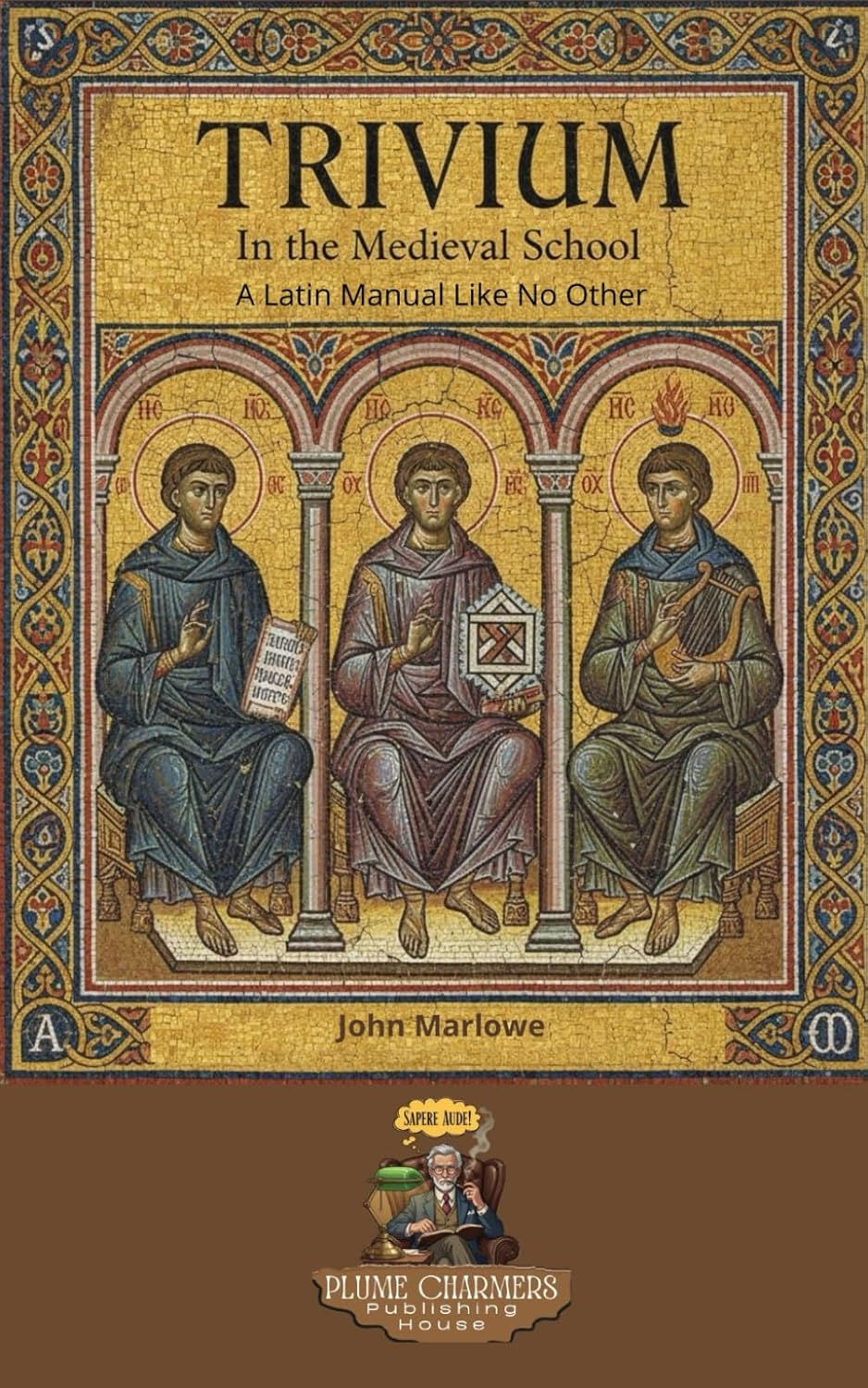
The Medieval Scriptorium: A Paradigm Shift in Latin Pedagogy Through the Trivium and Quadrivium
In the contemporary educational landscape, the study of Latin has often been relegated to the clinical dissection of "dead" grammatical structures—a fragmented process of decoding static data tables and archaic military chronicles. However, a transformative movement in linguistic instruction seeks to restore the language to its rightful place as the living heartbeat of Western intellectual tradition. By reconstructing the pedagogical framework of the medieval school, scholars can now immerse themselves in a method where language acquisition is inseparable from the arts of thought, harmony, and persuasion.
This immersive approach is exemplified in two foundational manuals: Trivium: In the Medieval School and Quadrivium: A Latin Manual of Universal Harmony. Together, these works function not merely as textbooks, but as a "cathedral of the mind," allowing the modern student to adopt the mantle of the universal scholar.
The Linguistic Trinity: Mastering the Art of the Trivium
The Trivium manual represents a departure from modern, isolated grammatical study by integrating the three-fold path of Grammar, Logic, and Rhetoric. This methodology treats Latin as a rigorous tool for defining reality and navigating the complexities of human reason.
Grammar as the Art of Symbol: Mastered not through rote memorization, but as the essential vocabulary of existence, where declensions and conjugations form the primary building blocks of reality.
Logic as the Art of Thought: Students explore the philosophical functions of syntax; for instance, how the "Ablative Absolute" establishes the context for a logical premise, or how the "Subjunctive Mood" facilitates the navigation of hypothesis and possibility.
Rhetoric as the Art of Persuasion: The curriculum culminates in the "Periodic Style," teaching the scholar to arrange words for rhythm, emphasis, and psychological impact, mirroring the masters of prose from Cicero to Aquinas.
The pedagogical structure follows a "Master-Apprentice" model across thirty expansive chapters. Each lesson builds upon a "Grammatical Pillar," subjects it to "Logical Inquiry," adorns it with "Rhetorical Ornament," and concludes with practical "Scriptorium Exercises" to bridge the gap between abstract rules and the living word.
The Music of the Spheres: Universal Harmony in the Quadrivium
While the Trivium establishes the mechanics of thought, the Quadrivium manual utilizes Latin as the essential key to unlocking the four liberal arts: Arithmetic, Geometry, Music, and Astronomy. In this framework, Latin is viewed as the "living code" used by cathedral builders, astronomers, and philosophers to describe a universe seen as coherent mathematical poetry.
Arithmetic and Geometry: The study begins with the metaphysics of number—the Monad and the Dyad—before progressing to the visualization of space through the Latin terminology of points, lines, and triangles.
Harmonic Resonance: Language transcends rules to become a vibration. Students utilize Latin to understand the science of the Monochord and Pythagorean intervals, experiencing the language as a heard and felt rhythm.
Celestial and Earthly Application: The final stages of the journey apply linguistic mastery to the stars, the movements of the tides, and the architecture of the Gothic Cathedral.
The Quadrivium is structured as "Thirty Chambers" of integrated wisdom. By the final chamber, the student has moved beyond "studying" the language to "living" within it, using Latin to calculate celestial movements and understand the "Music of the Human Soul".
Conclusion: An Intellectual Scriptorium
By adopting these medieval methodologies, the modern student avoids the fragmentation of contemporary language learning. Whether mastering the "Sacred Grammar" of the Trivium or navigating the cosmic order of the Quadrivium, the scholar undergoes a reconstruction of perception. These manuals offer a unique opportunity to learn Latin through the very subjects that gave the language its historical purpose—philosophy, science, and the pursuit of universal harmony.


Comments