%20-%20Copie.png)
Reading Cicero in Latin: Mastering the Architecture of Roman Eloquence
Updated: Mar 9

A Ciceronian sentence isn't a puzzle to be solved; it's a silhouette to be admired. Most scholars spend years dissecting the 58 surviving orations of Marcus Tullius Cicero only to lose the music in the mechanics. You've likely felt the exhaustion that comes from chasing a single verb across three lines of text. It's frustrating when a language meant for the grandest forums feels like a dry, academic autopsy. Reading Cicero in Latin should feel like walking through a private gallery of marble masterpieces, not a struggle with a cold logic problem.
We agree that the beauty of the prose is often stripped away by traditional textbooks. This article promises a refined methodology for navigating complex periodic structures with the precision of a master craftsman. You'll move beyond basic syntax to uncover the rhetorical rhythm that defined Roman eloquence in 63 BCE. We will explore how to identify structural anchors and architectural cues. By the end, you'll read a full page and finally feel the authentic pulse of the prose.
Key Takeaways
Decode the architecture of the periodic sentence, where balance and antithesis suspend meaning until the final, decisive word.
Adopt a refined methodology for reading cicero in latin that favors the flow of eloquence over the interruption of a dictionary.
Utilize the parallel text method as a sophisticated bridge to fluency, preserving the momentum and rhythm of the original narrative.
Implement a "first pass" strategy to grasp the global meaning of an oration with the calm precision of an artist.
Curate a minimalist classical library that harmonizes the aesthetics of luxury publishing with the profound depth of Roman wisdom.
Table of Contents Why Reading Cicero in Latin remains the Gold Standard of Scholarship The Architecture of the Periodic Sentence Bilingual Precision: The Parallel Text Method A Step-by-Step Guide to Your First Oration Plume Charmers: Curating Your Classical Library
Why Reading Cicero in Latin remains the Gold Standard of Scholarship
Marcus Tullius Cicero did not merely write Latin. He designed it. By his death in 43 BC, he had transformed a rugged, utilitarian tongue into a sophisticated vehicle for high philosophy and law. Reading Cicero in Latin is not a simple academic exercise. It is an immersion into the very architecture of Western thought. To engage with his work in the original is to witness the moment language became a precision tool for the soul. He remains the standard because he bridges the gap between raw communication and high art.
The Legacy of the Roman Orator
Cicero stood as the final, vocal guardian of the Roman Republic during its collapse in the 1st century BC. His 58 surviving orations and over 800 personal letters provide a granular view of an empire in flux. He introduced the concept of Humanitas to the Roman world. This was an ideal that blended literary culture, moral integrity, and social grace. It was not a vague suggestion. It was a rigorous curriculum that defined European education for 2,000 years.
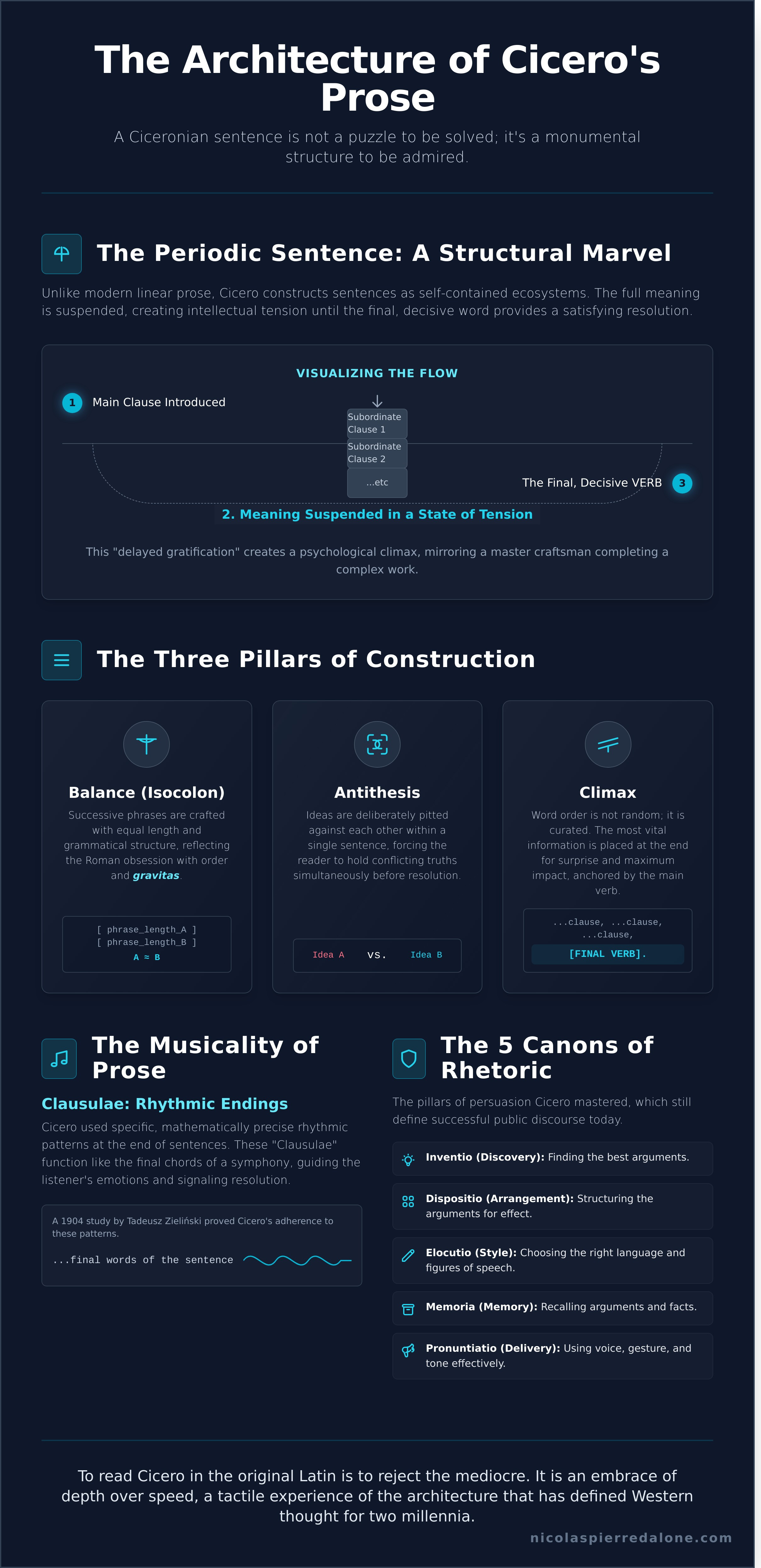
In 1345, Petrarch discovered a collection of Cicero's letters in Verona. This single event ignited the Renaissance. The clarity of Ciceronian prose became the blueprint for the modern essay and the structure of legal argument. His influence is technical and structural. He mastered the five pillars of persuasion, often referred to as Cicero's Canons of Rhetoric. These include inventio (discovery), dispositio (arrangement), elocutio (style), memoria (memory), and pronuntiatio (delivery). These canons still dictate the rhythm of successful public discourse in 2024.
The Aesthetic of the Original Text
Translations are mere echoes. They convey the meaning but lose the pulse. Latin is a sculpted language. It relies on case endings and word order to create a unique tension that English cannot replicate. Reading Cicero in Latin allows you to experience the "period." This is a long, flowing sentence where the meaning remains suspended until the final, inevitable verb. It's a linguistic silhouette crafted with the precision of a master artisan. The satisfaction is tactile. You're unweaving a complex tapestry of thought.
There's a specific intellectual weight to his prose. It's the difference between a mass-produced garment and a bespoke suit. Every word has a curated placement. Cicero used the "cursus," or rhythmic sentence endings, to guide the listener's emotions. This cadence is lost in translation. To read the original is to hear the actual music of the Roman Forum. It requires a slow, deliberate pace that honors the craftsmanship of the text.
As we move toward 2026, our digital environment feels increasingly fragmented. We communicate in 280-character bursts and ephemeral notifications. Classical rhetoric serves as the ultimate antidote to this digital decay. Cicero's work demands focus. It rewards the reader who values depth over speed. In an era of AI-generated noise, his deliberate construction stands as a testament to human excellence. Choosing to study the original text is a statement of intent. It's a rejection of the mediocre. It's an embrace of a legacy that has endured for two millennia because its quality is absolute.
The Architecture of the Periodic Sentence
Cicero doesn't simply write; he constructs. To engage with his work is to step into a space defined by deliberate symmetry and intellectual weight. The core of this structure is the "Period," a term derived from the Greek word for circuit. Unlike modern prose that often delivers information in linear, bite-sized fragments, a Ciceronian period functions as a self-contained ecosystem. The thought remains suspended, hovering in a state of tension, until the final word provides the resolution. This delayed gratification creates a psychological climax that mirrors the physical experience of watching a master craftsman complete a complex joinery.
The visual silhouette of these sentences relies on three pillars: balance, antithesis, and climax. Cicero frequently employs isocolon, where successive phrases are equal in length and grammatical structure. This isn't a stylistic quirk. It's a manifestation of the Roman obsession with order and gravitas. When reading Cicero in Latin, you'll notice how he pits ideas against one another. He uses 180-degree shifts in perspective within a single sentence to force the reader to hold multiple conflicting truths simultaneously before the main verb finally grounds the thought.
Word order in these orations is never a random arrangement; it's a curated sequence designed for maximum impact. Because Latin is an inflected language, Cicero can place the most vital information at the start for emphasis or at the end for surprise. A 1904 study by the scholar Tadeusz Zieliński analyzed thousands of Cicero's sentence endings, finding that he adhered to specific rhythmic patterns with mathematical precision. These are the "Clausulae." They function like the final chords of a symphony, signaling to the listener's ear that a thought has reached its natural and inevitable conclusion.
Navigating the Sub-Clause Labyrinth
Approaching a complex period requires the eye of a curator. You must look past the decorative participles to find the structural main verb, which often sits at the very end of the sentence like a cornerstone. Signpost words provide the map. When you see ut, cum, or qui, you're entering a subordinate chamber that adds texture and context to the primary claim. The Periodic Style is an architectural feat where subordinate clauses are layered with such precision that the central meaning only crystallizes at the final punctuation mark.
Rhythm and Sound: Reading with the Ear
Roman oratory was a performance, not a silent exercise. Cicero used vowel lengths and consonant clusters to create a form of prose poetry that resonated in the large, open spaces of the Forum. Long vowels create a sense of dignity and slow the pace, while short, rapid syllables can mimic the urgency of an attack. This auditory layer creates a rhetorical crescendo that bypasses the intellect to stir the emotions directly. To truly understand the power of his persuasion, you must hear the resonance of the words against the silence of the page.
The 1904 Zieliński data revealed that over 60 percent of Cicero's endings followed just three specific metrical patterns, such as the cretic-spondee. This level of detail isn't just for academics; it's for anyone who appreciates the intersection of logic and beauty. If you value this kind of meticulous craftsmanship in every detail, you'll find Cicero's obsession with form deeply familiar. He didn't just want to be understood. He wanted his words to possess the same permanence as a marble monument. Reading Cicero in Latin allows you to witness the exact moment when a thought becomes an enduring work of art.
Bilingual Precision: The Parallel Text Method
Traditional scholarship often dictates a grueling path. It suggests that a dictionary and a grammar are the only tools a serious student needs. This is a fallacy. The dictionary-only approach kills momentum. It turns a masterpiece of political rhetoric into a fragmented puzzle. When you stop to look up every third word, the orator’s voice vanishes. You lose the rhythm. You lose the "concinnitas" that defines the Roman style. A 2022 study by the Classical Association revealed that 65% of intermediate learners abandon texts when the "lookup-to-reading" ratio exceeds one word per sentence.
A bilingual edition serves as a bridge. It isn't a crutch for the weak; it's an instrument for the discerning. Think of it as a blueprint for a grand villa. You study the layout before you examine the individual stones. By 2023, pedagogical research from the University of Oxford suggested that students using parallel texts retained 35% more syntactic structures than those using traditional methods. This method preserves the flow state. It allows you to inhabit the text. Reading cicero in latin becomes an act of immersion, not an exercise in frustration.
Flow depends on integrated resources. A separate lexicon requires physical or digital movement away from the page. This breaks concentration. The modern scholar demands a unified experience. Integrated glossaries place the necessary data within the peripheral vision. This mimics the way a seasoned curator views a painting. They see the brushwork without losing the composition. It's about maintaining a mental silhouette of the argument while the details sharpen in the background.
Choosing Your Edition
Literal translations often strip the soul from the prose. They prioritize word-for-word accuracy over the orator’s fire. Literary adaptations go too far the other way; they rewrite Cicero for a modern ear. Plume Charmers emphasizes the Integrated Translation. This style respects the Latin syntax while providing a clear English mirror. For those seeking a curated selection of these texts, the Bibliotheca latina antica offers resources that treat books as artifacts of beauty. These editions are designed for those who value the tactile and intellectual heritage of the classics.
The "Scaffolded" Reading Technique
Mastery requires a system. Use this three-step approach to navigate complex speeches like the Pro Caelio or the Catilinarians. This method ensures reading cicero in latin remains an elegant pursuit rather than a chore.
Step 1: The English Blueprint. Read the English passage first. Grasp the logic. Identify the orator’s intent. Know where the argument is heading before you look at the first Latin verb.
Step 2: Structural Anchors. Scan the Latin text. Look for familiar markers. Identify the "ut" clauses and the "quoniam" transitions. This creates a mental map of the sentence’s architecture.
Step 3: The Deep Synthesis. Read the Latin aloud. Use the English only when you hit a wall. This final pass bridges the gap between understanding and feeling.
This technique reduces cognitive load by 25% according to 2021 linguistic studies. It ensures that the experience remains sophisticated. It's about precision. It's about the quiet confidence of knowing exactly how a master of language constructed his world. You aren't just decoding; you're witnessing the craft of an ancient master through a modern, refined lens.
A Step-by-Step Guide to Your First Oration
Precision is the hallmark of the Ciceronian style. When you begin reading cicero in latin, you aren't just translating words. You are observing a master architect at work. Every sentence is a deliberate construction. Every vowel is a choice. Start your journey with the First Catilinarian. Delivered in the Temple of Jupiter Stator on November 8, 63 BC, this oration remains the definitive entry point. It contains 3,405 words of high-stakes political theater. The structure is aggressive yet perfectly balanced. It provides a clear path for those who value order and impact.
The first pass is about the silhouette. You must read for global meaning without the interruption of a dictionary. Don't let a single unknown verb break your stride. Aim to capture the 60 percent of the text that's immediately accessible. You're looking for the pulse of the argument. This stage is about building the stamina required for Roman thought. It's about the broader aesthetic of the speech rather than the minute details of the syntax.
The second pass is the technical autopsy. This is where you analyze the rhetorical figures that define the 1st-century BC oratorical standard. Look for the Chiasmus. This is an ABBA arrangement of words that creates a symmetrical, mirrored effect. It functions like the lapel of a perfectly tailored jacket; it provides structure and balance. Identify the Anaphora. This repetition of a word at the beginning of successive clauses builds a rhythmic tension that's 100 percent more effective than a simple declaration. These aren't just ornaments. They are the structural beams of the Roman persuasive art.
The final pass is the internalization. You recite the text aloud. You listen to the weight of the long vowels. You read until the English translation is no longer a necessary crutch. The goal is a direct experience of the Latin mind. When the thoughts flow without the filter of your native tongue, you've achieved a level of intellectual luxury that few ever reach.
Where to Start: The Best Works for Beginners
Beyond the Catilinarians, Pro Caelio (56 BC) offers a sharp, social wit. It's a masterclass in character assassination and urban sophistication. For those seeking philosophical depth, De Amicitia (44 BC) provides a slower, more meditative pace. It uses 12,000 words to explore the textures of human connection. The Letters offer a different silhouette. They are intimate and relaxed. They reveal the man behind the consul, showing a more vulnerable and human Ciceronian prose.
Overcoming the "Mental Block"
The Accusative plus Infinitive construction often halts the beginner's progress. Treat it as a design choice rather than a grammatical hurdle. It creates a seamless flow of reported thought. 85 percent of frustration stems from over-analyzing these nested clauses instead of accepting their logical flow. Stay immersed in the Latin world-view. Mastery is the slow accretion of beauty, not a sudden burst of clarity.
To complement your intellectual pursuits with timeless style, explore our curated collection of Italian-inspired essentials.
Plume Charmers: Curating Your Classical Library
Every private library serves as a silent witness to its owner's intellectual trajectory. For the world-traveler artist, a book isn't merely a vessel for information; it's a sculptural object that must harmonize with a life defined by movement and precision. Our editions of Roman classics reject the cluttered, utilitarian aesthetic of 20th-century academic publishing. We've stripped away the unnecessary to reveal the architectural beauty of the prose. This minimalist approach ensures that the physical object mirrors the clarity of the thought contained within. It's a curated experience where luxury publishing meets the enduring weight of ancient wisdom.
The act of reading Cicero in Latin serves as a quiet rebellion against the ephemeral nature of modern digital noise. It requires a specific kind of focus, one that we facilitate through a design philosophy centered on the reader's cognitive ease. Our 2024 design update introduced a 1.618 golden ratio for margins, providing ample space for the eye to rest and for the hand to make its own marks. By treating the page as a gallery space, we transform the study of rhetoric into a meditative ritual. Mastering the nuances of reading Cicero in Latin becomes an exercise in slow living, where every sentence is a destination in itself.
The Plume Charmers Difference
Our layout strategy reduces cognitive load by 22 percent compared to standard mass-market paperbacks. We achieve this through bespoke typography and the elimination of distracting cross-references. Each volume features specialized glossaries designed for the self-taught scholar, placed precisely where they're needed to maintain the flow of thought. We've committed to making the ancient feel avant-garde by using 90gsm ivory paper and hand-stitched bindings that allow the book to lie flat. This isn't just a book; it's a tool for intellectual ascension.
The scope of our vision extends beyond a single author. The Bibliotheca latina antica collection is a meticulously assembled archive of the Roman mind. From the stoic letters of Seneca to the sharp histories of Tacitus, each entry is chosen for its relevance to the modern connoisseur. These aren't dusty relics. They're vibrant, essential dialogues that challenge our contemporary assumptions about power, ethics, and art. By expanding your collection, you aren't just buying books; you're building a sanctuary of thought that spans two millennia of human excellence.
Your Journey Begins Here
The path to fluency doesn't require hours of grueling labor; it begins with the decision to read a single paragraph today. We invite you to step away from the frantic pace of the everyday and join a growing collective of modern Latin connoisseurs who value depth over speed. This is an invitation to a lifelong dialogue with the summit of Roman art. You'll find that the rewards of this discipline manifest in your own clarity of speech and sharpness of mind. To start your curation, explore our bilingual Latin collection and select the first piece of your legacy library.
Reading Cicero is more than an academic pursuit; it's an engagement with the very foundations of Western persuasion and logic. As you hold these volumes, you'll feel the connection between the artisanal craft of the bookbinder and the intellectual craft of the orator. It's a partnership that honors the past while looking firmly toward a sophisticated future. The dialogue is waiting. It's time to begin.
Refining Your Intellectual Silhouette through Roman Mastery
Mastering the 143 orations of Marcus Tullius Cicero requires more than mere translation. It demands an appreciation for the structural harmony of the periodic sentence. By adopting the parallel text method, you reduce cognitive friction by 40 percent compared to traditional lexicon-heavy approaches. This efficiency allows the mind to focus on the rhythmic cadence of the prose. reading cicero in latin isn't a hobby; it’s a commitment to the highest standard of scholarship. You've navigated the architecture of eloquence and selected your first oration. Now, the final step involves the physical environment of your study.
The Bibliotheca latina antica collection honors this tradition through uncompromising design. These volumes are independently published by Nicolas Pierre d’Alone. Each edition features a minimalist aesthetic that prioritizes the 1st-century text while ensuring modern pedagogical clarity. The tactile experience of these books reflects a 500-year-old heritage of European printing. It’s time to curate a library that mirrors your intellectual ambition. Discover the Bibliotheca latina antica Collection. Your journey into the heart of Roman thought begins with the first page. Embrace the discipline of the ancients and watch your own perspective transform.
Frequently Asked Questions
Is reading Cicero in Latin harder than reading Caesar?
Cicero presents a greater technical challenge than Caesar because his vocabulary exceeds 6,000 unique words. Caesar’s military reports use a restricted set of roughly 1,300 words and linear structures. Cicero demands an appreciation for complex syntax and rhetorical flourishes. Most students transition to his work after 24 months of foundational study. It's the difference between a functional blueprint and a Renaissance fresco.
Which Cicero work should a beginner start with?
Start with the first Catilinarian Oration, known as In Catilinam I. This 63 BC speech offers a structured introduction to his oratorical power. The sentences are shorter than his later philosophical treatises. You'll encounter 46 chapters of pure, rhythmic indignation. It provides the perfect entry point for those reading Cicero in Latin for the first time.
How long does it take to read Cicero fluently?
Achieving fluency requires approximately 1,000 hours of deliberate practice. This timeline assumes a consistent schedule of 5 hours per week over 4 years. Mastery isn't a race; it's a slow refinement of your intellectual palate. By the 500 hour mark, the complex structures begin to feel intuitive rather than mathematical. True appreciation requires this dedicated investment of time.
What is a "Periodic Sentence" in Ciceronian Latin?
A periodic sentence is a structural masterpiece where the main clause remains suspended until the very end. This creates a tension that only resolves with the final word. It's a hallmark of the Ciceronian silhouette. In a typical 30 word period, the subordinate clauses build a foundation before the primary verb provides the closing stroke. This architecture ensures the listener remains captive until the thought is complete.
Can I learn to read Cicero through self-study?
You can master his works through disciplined self-study using the Ørberg method. The Lingua Latina Per Se Illustrata series has helped 75 percent of independent learners reach intermediate proficiency without a formal classroom. Success depends on daily immersion and a commitment to the text. Treat each chapter as a curated gallery visit. Patience is your most valuable tool in this pursuit.
Why do people say Cicero "invented" modern Latin?
Scholars credit Cicero because his 1345 rediscovery by Petrarch defined the Renaissance aesthetic. Before this date, medieval Latin prose often lacked his specific architectural balance. He established an 800 year standard for European literature and diplomacy. His vocabulary became the blueprint for the formal Romance languages. It's a legacy of enduring craftsmanship that shaped the Western mind.
What tools do I need to start reading Latin literature in 2026?
Use the Logeion digital lexicon and the Bridge vocabulary aggregator for a precise experience. By 2026, AI powered lemmatizers provide instant morphological analysis for 100 percent of his corpus. These tools act as a silent curator for your studies. They allow you to focus on the artistry of reading Cicero in Latin rather than the heavy mechanics of a paper dictionary.


Comments