%20-%20Copie.png)
Reading Caesar in Latin: Mastering the Architecture of Roman Prose

The labyrinth of Caesar’s indirect statements. The monotonous cadence of military dispatches. The moment the narrative thread is lost to the cold mechanics of syntax. These are not failures of intellect, but encounters with a formidable literary architecture. The discipline of reading Caesar in Latin is often presented as a brute-force exercise in grammar, yet this approach overlooks the artistry inherent in the work. It misses the stark, deliberate elegance of the prose.
This guide offers a different perspective. A refined, strategic method that transforms a daunting academic task into an aesthetic and intellectual triumph. We will deconstruct the logic behind the Commentarii de Bello Gallico, revealing a system for navigating its most complex passages with fluency and confidence. You will develop not just the ability to translate, but the sensibility to appreciate the ‘plain style’ in its purest form-mastering the foundational structure of Roman prose and acquiring a system you can apply to any classical text that follows.
Key Takeaways
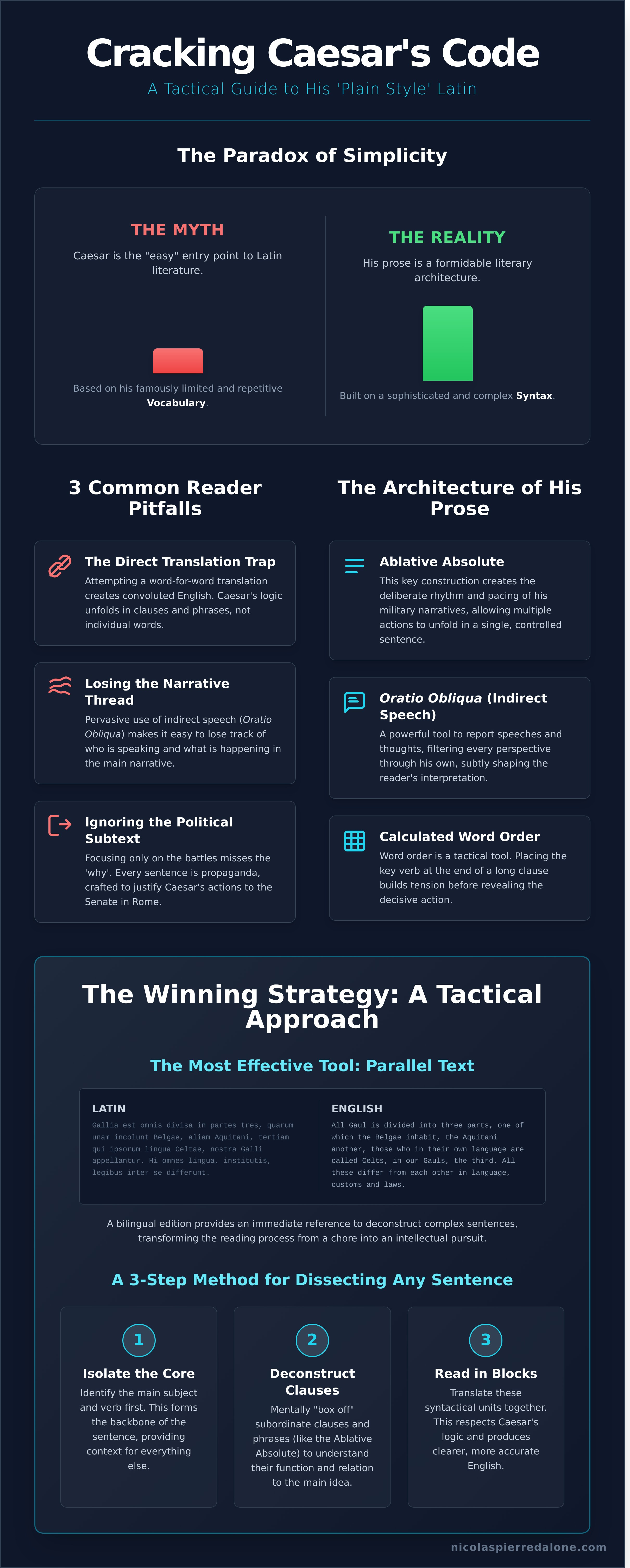
Deconstruct the paradox of Caesar’s prose-simple vocabulary masking a complex syntactical architecture.
Master the Ablative Absolute to understand the deliberate rhythm and pacing of his military narratives.
Learn why a bilingual edition is the most effective tool for transforming the process of reading Caesar in Latin from a chore into an intellectual pursuit.
Acquire a tactical method for dissecting any Latin sentence, starting with the iconic 'Gallia est omnis divisa'.
Table of Contents The Myth of the 'Easy' Caesar: Why Readers Struggle The Architecture of Caesar's Latin: A Stylistic Analysis The Parallel Text Advantage: Why Bilingual Editions Work Tactical Reading: A Strategy for the First Page Beyond the Battlefield: The Bibliotheca Latina Antica
The Myth of the 'Easy' Caesar: Why Readers Struggle
For generations, Julius Caesar has been the traditional gateway to authentic Latin literature. His prose, stripped of Ciceronian flourishes, is presented as a clear, accessible entry point for the intermediate student. This is a persistent and unhelpful myth. The perceived simplicity of Caesar is an illusion, one that masks a profound structural complexity that frequently frustrates new readers.
The challenge of reading Caesar in Latin is not one of vocabulary, which is famously repetitive and limited. Instead, the difficulty lies in a sophisticated syntax designed for clarity, but on his own terms. His work is a masterclass in controlled narrative, where the architecture of the sentence is as crucial as the words themselves.
The Deceptive Simplicity of the Commentarius
Caesar wrote in the genre of the commentarius, a term for unadorned field reports or military dispatches. This was a functional, not a literary, format. Yet, Caesar elevates this raw material into an art form. His 'plain style' is a calculated rhetorical choice, projecting an image of objective, military precision. This elevation of a functional format is precisely what makes Caesar's Commentaries on the Gallic War a masterpiece of political propaganda, not just a historical account.
Common Pitfalls for the Modern Reader
Navigating Caesar's prose requires a shift in approach. The modern reader often falls into predictable traps that obscure the text's clarity and artistry. The primary hurdles include:
The Trap of Direct Translation: Attempting a word-for-word translation inevitably leads to convoluted English. Caesar's logic unfolds in clauses and phrases; one must learn to read in these syntactical blocks, not individual words.
Losing the Narrative Thread: The most significant challenge is the pervasive use of indirect speech (Oratio Obliqua). Long passages reporting speeches or thoughts can cause readers to lose track of who is speaking and what is happening in the main narrative.
Ignoring the Political Subtext: Focusing solely on the 'what'-the battles, the marches-means missing the 'why'. Every sentence is crafted to justify Caesar's actions to the Senate in Rome. Understanding this purpose transforms the experience of reading Caesar in Latin from a grammatical exercise into a political analysis.
To truly read Caesar is to move beyond the schoolbook caricature. It requires recognizing him not as a simple starting point, but as a master of narrative control whose minimalist style conceals immense depth and persuasive power.
The Architecture of Caesar's Latin: A Stylistic Analysis
To approach Caesar's Commentarii is to encounter a masterclass in literary engineering. Cicero famously described his prose as nuda et venusta-naked and beautiful. This is not the language of elaborate flourish but of intentional restraint. Every sentence is crafted with the precision of a military architect, where form is dictated by function. The result is a narrative of immense power, built upon a foundation of clarity and control. For the student, this presents a unique challenge: to look beyond the seemingly simple surface and appreciate the sophisticated structure within.
This structural integrity is achieved through two primary devices: syntactic economy and a calculated third-person perspective. Caesar conveys complex military and political maneuvers with a stark efficiency, stripping away any adjective or clause that does not serve the narrative's forward momentum. He presents "Caesar" as a character, an objective agent of Roman will, which masks the deeply personal and political nature of his account. This economy is often mistaken for simplicity, and while the straightforward grammar in Caesar's prose makes it a common entry point for students, its rhetorical depth is profound.

The Mechanics of Military Precision
Caesar's prose mirrors the discipline of his legions. Word order is a tactical tool; placing a key verb at the end of a long clause builds tension before revealing the decisive action. He masterfully employs participles and ablative absolutes to create cinematic sequences, allowing multiple actions to unfold simultaneously within a single, controlled sentence. His renowned description of the Rhine bridge is the ultimate expression of this style: a technical, almost detached account of an unprecedented engineering feat, its power lying entirely in its unadorned factual precision.
Oratio Obliqua: Decoding the General's Voice
One of the greatest challenges when reading Caesar in Latin is mastering oratio obliqua, or indirect speech. Caesar uses this tool to report the speeches, thoughts, and justifications of both allies and enemies. In doing so, he filters every perspective through his own, subtly shaping the reader's interpretation while maintaining a veneer of impartiality. To navigate these passages, you must learn to identify the core pattern:
A main verb of speaking, thinking, or perceiving (e.g., dicit, putat, sentit).
The speaker or subject of the reported clause in the accusative case.
The main action of the reported clause as an infinitive verb.
Mastering this structure is essential for tracking the complex diplomatic narratives and understanding the political subtext that defines Caesar's genius.
The Parallel Text Advantage: Why Bilingual Editions Work
The journey of reading Caesar in Latin is not a trial of endurance, but an exercise in precision. To approach this text with the requisite craft, one must select the proper tools. The bilingual, or parallel text, edition is not a concession to difficulty; it is a sophisticated instrument for accelerated comprehension. This is the core of our philosophy: excellence through integrated translation, where the English text serves not as a crutch, but as a calibrated guide illuminating the Latin original.
For the intermediate scholar, this method provides a powerful form of ‘comprehensible input.’ The immediate availability of a professional translation removes the cognitive load of constant dictionary work, allowing your focus to remain on Caesar’s syntax and flow. The objective is not to replace the work of parsing, but to frame it. An English translation, used with discipline, becomes a safety net that encourages bolder engagement with the Latin, preventing the frustration that halts progress.
This disciplined approach also highlights the necessity of a specialized lexicon over a general dictionary. A lexicon tailored to Caesar’s works provides context-specific definitions for military terms, political offices, and idiomatic phrases-nuances a general dictionary often misses. It is the difference between a bespoke tool and a generic one.
The Parallel Text Method Explained
To use a bilingual edition without compromising linguistic growth requires a deliberate process. This three-stage method ensures the Latin remains the primary focus.
Step 1: Context. Read the English translation of a passage first. Understand the narrative, the characters, and the strategic situation. This establishes a clear mental landscape.
Step 2: Analysis. Turn to the Latin. With the narrative context secured, parse the sentences. The English page is your immediate reference for unfamiliar vocabulary or complex clauses, a silent partner in your analysis.
Step 3: Immersion. Return to the Latin alone. Read the passage again, this time for its inherent rhythm and cadence. With the meaning now clear, you can appreciate the architecture of Caesar’s prose as it was intended.
Choosing Your Edition: What to Look For
The quality of your parallel text is non-negotiable. An essential feature is the facing-page translation, offering immediate feedback without breaking your focus. Be wary of editions featuring 19th-century English translations; their ornate, archaic prose often obscures the very clarity it aims to provide. Instead, seek a modern, crisp translation. The ideal English text mirrors Caesar’s own celebrated brevity and force, providing a clean reflection of the Latin masterwork and enhancing the experience of reading Caesar in Latin.
Tactical Reading: A Strategy for the First Page
The first sentence of the Commentarii is not an obstacle. It is a key. Gallia est omnis divisa in partes tres. Isolate the essential architecture: the subject (Gallia), the verb (est divisa), and the result (in partes tres). This direct structure-Subject, Verb, Predicate-is the foundation. Master it, and the text reveals its logic with stark clarity.
The subsequent list of peoples-Belgae, Aquitani, Celtae-is crucial detail, but it is ornamentation, not the core grammar. Your task is to hold the grammatical thread while navigating these ethnographic notes. Caesar provides markers. Phrases like inter se ("among themselves") and possessives like suis ("their own") are not mere words; they are signals of division and identity, the very themes that drive the narrative. Recognizing them is essential for reading Caesar in Latin with precision.
The First Paragraph: A Blueprint for the Whole Work
Caesar’s opening is a masterclass in Roman ethnography, a precise cartography of conflict. He establishes the three main Gallic divisions, defining them by language, customs, and laws. This is not simple description; it is a strategic assessment of the landscape he intends to master. In this context, Caesar’s virtus is not mere courage, but a calculated measure of martial prowess and political resilience.
Daily Reading Habits for Fluency
Fluency is not born from hours of passive skimming. It is cultivated through focused, daily practice. This discipline is foundational to the art of understanding Caesar's prose.
Intensive Focus: Fifteen minutes of deep, analytical reading yields more than two hours of casual review. Deconstruct every clause and question every ending.
Oratorical Rhythm: Read the Latin aloud. Caesar wrote for the ear as much as the eye. Hearing the cadence reveals the rhetorical structure and clarifies complex phrases.
The Caesarian Lexicon: Maintain a personal glossary of recurring verbs and military terms-proficiscor, castra, legio. This becomes your curated toolkit for decoding the text.
Beyond the Battlefield: The Bibliotheca Latina Antica
Mastering Caesar is a significant milestone. It is not, however, the final destination. The experience of reading Caesar in Latin opens a door to the broader landscape of the Roman Republic-a world of complex politics, profound philosophy, and unparalleled oratory. At Plume Charmers, we believe the vessel must honor the text. Our editions are crafted not merely to be read, but to be experienced, connecting the modern scholar to the rich intellectual heritage of Rome.
From the disciplined prose of the battlefield, the path leads to the intricate elegance of Cicero. Our approach is to make this transition seamless, providing tools and texts that are both academically rigorous and aesthetically beautiful. This is the philosophy behind the Bibliotheca Latina Antica.
Curated Classics for the Modern Scholar
Our design philosophy is one of intentional minimalism. Each element-from the weight of the paper to the clarity of the typeface-is chosen to serve the Latin text without distraction. Our bilingual editions feature a unique layout designed for deep study, while the glossaries are tailored specifically to Caesar's military and political vocabulary, creating a focused and efficient learning tool. These are not disposable textbooks; they are the foundational volumes of a lifelong classical library.
Join the World of Nicolas Pierre d'Alone
The Latin language is not a relic. In our world, it is a living medium for modern storytelling, a bridge between ancient heritage and future narratives. We invite you to explore this intersection, where the timeless words of the classics stand alongside original works of Latin science fiction. It is a space for those who appreciate the fine art of language and the enduring power of a well-told story. Discover a new dimension of classical and contemporary literature.
An Invitation to Mastery
The path to fluency in Caesar is not paved with simplicity, but with a deep understanding of structure. To master his work is to first appreciate its architecture-the deliberate, tactical precision that defines every sentence. We have dismantled the myth of the 'easy' Caesar, revealing instead a stylist whose clarity is a product of immense craft. True progress in reading Caesar in Latin comes not from rote memorization, but from strategic engagement with the text, supported by tools designed for deep analysis.
This intellectual pursuit demands instruments of equal caliber. As an independent publishing house, Nicolas Pierre Dalone is committed to this vision of accessible scholarship. Our bilingual editions are curated artifacts, meticulously designed for the modern scholar. Featuring specialized lexicons that facilitate self-study and a parallel format that illuminates complex syntax, they are crafted to bridge the gap between antiquity and today. We invite you to explore our Bilingual Latin Classics and equip your library with works of uncompromising quality.
The architecture of Roman prose awaits your discovery. Begin the work.
Frequently Asked Questions
Is Caesar's Latin really the easiest for beginners?
The notion of Caesar's simplicity is a common misconception. His grammar is direct, a model of clarity. However, the military context introduces specialized vocabulary and complex tactical descriptions. The true challenge lies in this deceptive simplicity, where straightforward syntax conveys sophisticated military and political narratives. Mastery requires attention to both linguistic structure and historical context.
What is the best edition of Caesar's Gallic Wars for self-study?
For dedicated self-study, the Bryn Mawr Classical Commentaries offer an unparalleled focus on grammar and syntax. They are a tool for the purist. For a more comprehensive experience, Hans-Friedrich Mueller's edition provides essential vocabulary assistance and historical notes on the page. The choice depends on your objective: pure linguistic analysis or a more integrated historical reading.
How long does it take to read the Gallic Wars in Latin?
The timeline for completing the Gallic Wars is a matter of personal discipline and prior experience. An academic course often covers the text in a single semester. For the self-directed student, a pace of several pages per week suggests a commitment of six months to a year. Consistent, focused effort is the key determinant, not the clock.
Do I need to know Roman military history to understand Caesar?
A deep knowledge of military history is not a prerequisite, but it is a significant advantage. Understanding concepts like the legion, siege works, and Roman command structures transforms the text from a mere linguistic exercise into a vivid historical account. A quality commentary will provide the necessary context, but independent study is highly recommended for true comprehension.
Why does Caesar write about himself in the third person?
Caesar’s use of the third person is a deliberate rhetorical strategy. This narrative choice constructs an image of objectivity and detachment, positioning his account as impartial history rather than personal memoir. It distances the author from the general, allowing "Caesar" the character to be praised without the appearance of vanity. This technique masterfully shapes his public persona and legacy.
Can I use Caesar's Latin to improve my own writing style?
Caesar's prose is an exceptional model for developing clarity and precision in writing. His style prioritizes directness over ornamentation. Students should analyze his use of the ablative absolute for concise expression and his logical, uncluttered sentence structure. Emulating Caesar is not about imitation but about mastering the art of impactful, economical language.
What should I read after finishing Caesar?
After completing the challenge of reading Caesar in Latin, a logical progression is essential. For continued study of historical prose, the works of Cornelius Nepos or Sallust offer a similar stylistic clarity. Alternatively, Cicero's less complex orations, such as Pro Archia, provide a bridge to more ornate rhetorical styles. Each path builds upon the foundational skills honed by Caesar's directness.
What is the 'parallel text' method and does it actually work?
The parallel text method places the original Latin and a translation on facing pages. It is a highly effective tool for accelerating vocabulary acquisition and grasping complex syntax. Its success, however, depends entirely on the reader's discipline. It must be used as a reference to clarify meaning, not as a substitute for the essential work of translation.


Comments