%20-%20Copie.png)
Modern Latin Books: A Guide to Contemporary Classics and New Narratives

The study of Latin is often an exercise in heritage. A dialogue with antiquity. Yet, a language confined to the past risks becoming a relic, its vocabulary and narratives frozen in time. True mastery demands engagement with the present. This is the world of modern latin books-a landscape of new creation, where the ancient tongue finds a contemporary silhouette. It is a space often fragmented, difficult to navigate for the discerning reader seeking more than the standard curriculum.
This guide is a curated exploration. We move beyond the familiar canon to reveal a vibrant, evolving literary scene. Discover original science fiction masterpieces and thoughtful translations of pop-culture classics. Here, you will find narratives that challenge your fluency with new ideas and a living vocabulary. We present a collection of essential works, many in beautiful bilingual editions, for the modern classicist’s library. An invitation to experience Latin not as an echo, but as a voice.
Key Takeaways
Understand the distinction between historical Neo-Latin and the living language of today to move your reading beyond classical confines.
Discover the curated landscape of modern latin books, from celebrated pop-culture translations to pioneering original narratives.
Develop a precise framework for selecting your next read by assessing difficulty levels from novice editions to complex scholarly works.
Grasp the artistic vision behind contemporary Latin as fine art, where classical heritage is fused with modern narrative.
Table of Contents What Defines Modern Latin Books in 2026? Why Read Modern Fiction in an Ancient Language? From Harry Potter to Original Sci-Fi: What Is Available? Selecting Your Next Latin Read: A Buyer’s Framework The Plume Charmers Vision: Contemporary Latin as Fine Art
What Defines Modern Latin Books in 2026?
The landscape of Latin literature is not a museum piece. It is a living, evolving art form. When we discuss modern latin books today, we are referencing a curated movement that extends far beyond academic translation. We are speaking of original narrative, contemporary thought, and a renaissance in literary creation that positions an ancient tongue at the forefront of modern storytelling.
Neo-Latin vs. Contemporary Latin
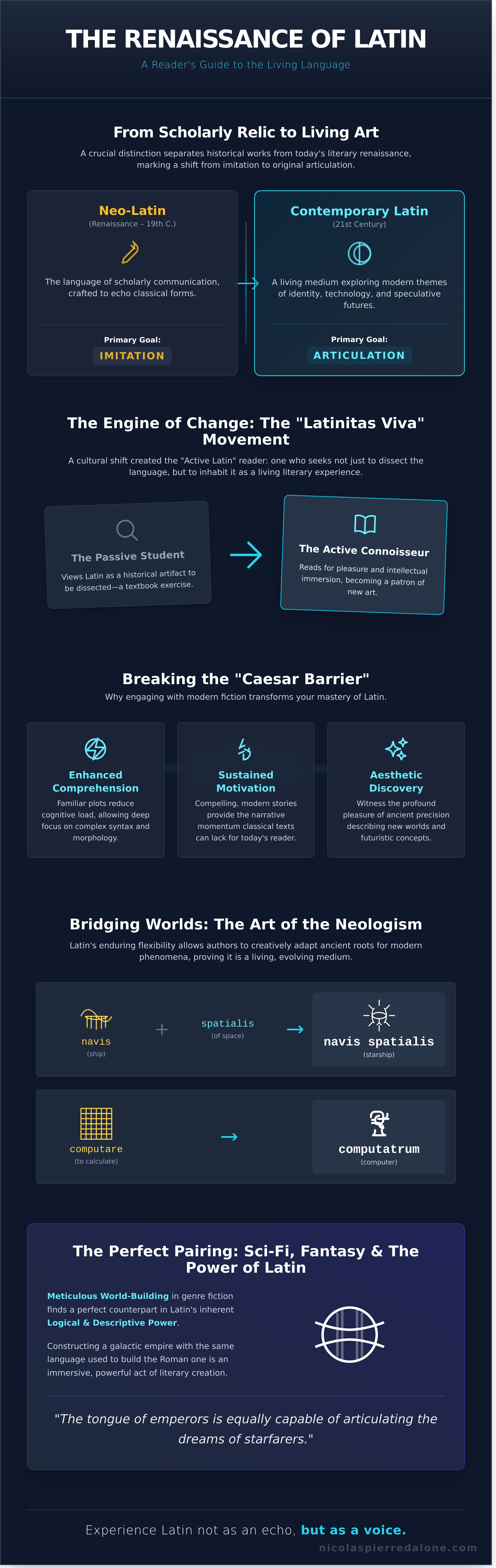
A crucial distinction separates today’s works from their predecessors. The heritage of Neo-Latin, spanning from the Renaissance to the 19th century, was monumental. It was the language of science for Newton and of philosophy for Erasmus, often crafted in a precise, Ciceronian style. Yet its purpose was primarily scholarly communication.
The 21st century marks a deliberate departure. Today’s authors are not merely imitating classical forms; they are using Latin to explore contemporary themes of identity, technology, and speculative futures. This is a shift from imitation to articulation. Contemporary Latin is a living medium for original 21st-century thought, not an echo of the past.
The Living Latin Movement
This literary resurgence was born from a community. The "Living Latin" (Latinitas Viva) movement, with its emphasis on spoken fluency, created a new kind of consumer: one who sought not just to dissect the language, but to inhabit it. This demand for new reading material initially fueled a remarkable wave of translations. The sheer breadth of the available list of modern literature in Latin-from Harrius Potter to Dr. Seuss-demonstrated a vibrant, engaged audience ready for more.
This cultivated the "Active Latin" reader. This profile is not the passive student, but the engaged connoisseur who reads for pleasure and intellectual immersion. For them, a new novel in Latin is not a textbook exercise; it is an immersive literary experience. They are the patrons of this new artistic frontier.
Authors choose Latin today as a profound artistic statement, a challenge to craft modern narratives within a timeless linguistic structure. To make these works accessible, the bilingual edition has become an essential tool. These volumes act as an elegant bridge, inviting both dedicated learners and fluent speakers into the fold. They ensure that the sophisticated world of modern latin books remains an open yet exclusive gallery for a global audience.
Why Read Modern Fiction in an Ancient Language?
The study of Latin is often confined to a curated selection of classical texts. Caesar's military campaigns, Cicero's orations, Virgil's epics. This creates a "Caesar Barrier"-a perception of the language as a historical artifact, exclusively for dissecting ancient politics and warfare. To truly master a language, one must move beyond its museum pieces. Reading modern latin books offers a passage out of this beautiful, yet limited, classical world.
The experience is as much cognitive as it is linguistic. Engaging with familiar genres like science fiction in a highly structured language presents a unique intellectual exercise. The narrative is known; the mind is therefore free to focus on the architecture of the grammar. This approach offers several distinct advantages:
Enhanced Comprehension: Familiar plots reduce the cognitive load, allowing for a deeper focus on syntax and morphology.
Sustained Motivation: Compelling, modern stories provide the narrative momentum that classical texts sometimes lack for contemporary readers.
Aesthetic Discovery: There is a profound pleasure in witnessing the precision of ancient syntax describe new worlds and futuristic concepts.
Bridging the Vocabulary Gap
The most immediate challenge in modern Latin is vocabulary. How does one describe a smartphone or a starship? This is the art of the neologism. Authors and academics creatively adapt ancient roots to describe modern phenomena-a spacecraft becomes a navis spatialis, a computer a computatrum. This is not a corruption of the language but a testament to its enduring flexibility, a practice supported by initiatives like Trinity College Dublin's Living Latin project. Seeing Latin applied to a 2026 context transforms it from a relic into a living, evolving medium of expression.
Genre Fiction as a Learning Tool
Science fiction and fantasy are uniquely suited for this linguistic renaissance. The genre’s reliance on meticulous world-building finds a perfect counterpart in Latin's logical and descriptive power. Constructing a galactic empire or a magical realm with the same language used to build the Roman one is an immersive act. It proves that the tongue of emperors is equally capable of articulating the dreams of starfarers. For those beginning this journey, curated Latin Science Fiction Adaptations provide an essential and compelling bridge from ancient texts to new frontiers.
From Harry Potter to Original Sci-Fi: What Is Available?
The landscape of modern latin books is a curated gallery of old and new. It presents a deliberate choice between the familiar rendered in classical tones and the truly novel, born from the language itself. For the discerning student, understanding this distinction is paramount.
The Era of Great Translations
The 20th century established a tradition of translating beloved children's classics. Works like Winnie Ille Pu and Hobbitus Ille served as elegant proof-of-concepts, demonstrating the language's enduring flexibility. The arrival of Harrius Potter et Philosophi Lapis solidified this trend, offering a familiar narrative framework for learners to navigate complex grammar. These translations are the established entry point-a gateway into reading complete, compelling narratives in Latin.
Yet, their strength is also their limitation. They are master-class exercises in adaptation, not original composition. The challenge of rendering modern idioms and technologies into a classical lexicon can result in neologisms that feel more functional than organic. They offer a Latinized pop culture, a valuable but distinct experience from engaging with a text conceived entirely within the language's own artistic logic.
Original Contemporary Works
A more recent, vital movement champions original creation. Authors now write directly in Latin, crafting poetry, novellas, and even science fiction without an English-language blueprint. These pieces are not pedagogical exercises; they are works of art. This commitment to Latin as a living, creative medium is echoed in academic circles, with institutions like the Trinity College Dublin's Living Latin Project exploring its use for contemporary discourse.
This new wave of modern latin books moves beyond the simplified prose of classroom readers. While "Simple Latin" texts serve the crucial purpose of building vocabulary and grammatical foundations, original literary works offer stylistic nuance and thematic depth. They demand more from the reader but deliver an authentic intellectual and aesthetic reward, proving that Latin’s narrative power was never confined to the ancient world.
Selecting Your Next Latin Read: A Buyer’s Framework
Navigating the world of modern Latin books requires a discerning eye. The choice is not merely about subject matter, but about the integrity of the language and the quality of the object itself. A structured approach ensures your selection aligns with your skill and aesthetic sensibility.
First, assess the linguistic challenge. We propose a simple four-tier system to guide your acquisition:
Tier 1 (Novice): Graded readers with controlled vocabulary and simplified syntax. Designed for foundational learning.
Tier 2 (Intermediate): Adapted classics or original novellas. The prose is fluid but avoids complex subordinate clauses.
Tier 3 (Advanced): Unadapted prose from authors like Caesar or Sallust. The full grammatical range is present.
Tier 4 (Scholarly): The complex, stylized Latin of authors like Tacitus, or the dense verse of Lucretius. A test of true mastery.
Beyond difficulty, consider the quality of the translation. Authentic Latin composition possesses a distinct rhythm and structure. It avoids the awkward, literal syntax of machine translation. A well-crafted text honors the language’s heritage; a poor one merely mimics its words.
Bilingual vs. Monolingual Editions
For the self-learner, a parallel text is an indispensable tool. The "Facing Page" method, with Latin on the left and English on the right, offers immediate clarification, preserving the immersive flow of reading. Alternatively, the "Glossary Method" places vocabulary support in the margins or footnotes. This approach encourages active recall. The editions found at Bibliotheca latina antica are excellent examples of this integrated, minimalist style.
Physical Craftsmanship in Modern Publishing
Digital formats offer convenience, yet many Latinists prefer the physical book. This is the domain of the "Plume Charmers"-a modern sensibility that values the book as a tactile, luxury object. A renaissance in independent classical publishing now produces editions that are works of art. Look for acid-free paper, sewn bindings for durability, and elegant typography. A truly fine edition is not just a container for text; it is an experience, a piece of heritage designed to endure.
The Plume Charmers Vision: Contemporary Latin as Fine Art
The work of Nicolas Pierre d’Alone is not mere translation. It is an act of artistic curation, a philosophy where classical heritage is fused with modern dynamism. Plume Charmers was founded on a singular, declarative belief: Latin is not a relic, but a living medium for contemporary art. Each volume is a testament to this vision, an object crafted with the precision of Italian expertise and an unwavering commitment to aesthetic and intellectual integrity.
The Art of the Latin Sci-Fi Adaptation
Why does science fiction resonate so deeply in an ancient tongue? Because Latin, the language of empire, stoicism, and law, provides the perfect, unyielding framework for exploring futuristic themes of power, humanity, and societal collapse. Our process is meticulous, honoring linguistic integrity while charting new narrative territory. The Sci-Fi collection is a silhouette of classical elegance meeting cosmic imagination.
This philosophy of accessible artistry extends beyond complex narratives. The "Cornelia et..." series redefines the learning experience, offering a modern, narrative-driven path for a new generation of Latinists. It moves beyond rote memorization, inviting readers into a story. This makes the acquisition of language both intuitive and profound, an experience of discovery rather than a task.
Your Journey into Modern Latin
To begin is to curate. We encourage you to build a library that reflects both ancient wisdom and your own modern curiosity. Seek out unique editions from the independent publishers who are shaping the future of the language. This is how you assemble a truly personal collection of modern latin books, where each spine represents a deliberate bridge between eras and a commitment to enduring quality.
Latin is an evolving art form. Its future is written not in stone, but on the pages of innovative works that challenge convention. The journey into this world is one of discovery, intellectual discipline, and refined taste. Your collection starts here. Explore the Bibliotheca latina antica and find your next modern Latin classic.
An Invitation to the Living Word
The landscape of Latin is no longer confined to antiquity. As we have explored, it is a vibrant canvas for contemporary narratives, from familiar sagas to original science fiction. The act of choosing a text becomes an aesthetic pursuit, a statement of intellectual curiosity. This is the essence of the Plume Charmers vision: to treat modern latin books not as mere translations, but as objects of art.
Each volume is a testament to this philosophy. Meticulous independent craftsmanship from France gives form to bilingual editions, where integrated glossaries create a seamless reading experience. These are not simply books; they are curated artifacts-including original science fiction adaptations-designed to bridge the classical and the contemporary.
Your journey into this exclusive world of literature begins here. Discover the Curated Collection of Modern Latin Books and select a piece that speaks to your own narrative.
The story continues with you.
Frequently Asked Questions About Modern Latin Literature
Is modern Latin considered a "real" language or just a hobby?
Modern Latin is a living application of a classical language. While not natively spoken, it is actively used for scholarship, literature, and communication within dedicated communities, including the Vatican. It transcends being a mere hobby, functioning as a sophisticated medium for engaging with contemporary culture. Its reality is defined by its purposeful and continued use by a global intellectual circle, proving its enduring relevance in the modern world.
Where can I find modern books translated into Latin like Harry Potter?
Curated editions of modern works are available through specialized publishers and major online retailers. Houses like Bolchazy-Carducci Publishers and Septentrio are premier sources for both popular and academic translations. Global platforms such as Amazon provide direct access to renowned titles, including the celebrated translation Harrius Potter et Philosophi Lapis. These volumes offer a direct portal to contemporary narratives rendered in classical prose.
Are modern Latin books good for beginners or only for advanced scholars?
The utility of a modern Latin text is determined by the work itself. Illustrated children’s books, such as Winnie Ille Pu or Dr. Seuss translations, present accessible grammar and vocabulary, making them ideal for novices. Conversely, complex philosophical or science fiction works demand significant proficiency. The discerning learner selects a text that aligns precisely with their current command of the language, ensuring a rewarding intellectual pursuit.
What is the best way to read a bilingual Latin book to actually learn?
An effective methodology requires a disciplined, three-stage process. First, read a passage in Latin, attempting to deduce meaning from context and structure alone. Next, consult the facing-page translation to verify your interpretation and analyze new vocabulary or syntax. Finally, reread the original Latin text. This active engagement transforms passive reading into a deliberate act of acquisition, cementing a deeper, more intuitive understanding.
Why are many modern Latin books focused on science fiction or fantasy?

These genres present a unique intellectual crucible for the language. Translating concepts like interstellar travel or arcane magic demands the artful creation of neologisms, showcasing Latin’s profound flexibility and capacity for evolution. This creative challenge attracts a modern audience that might otherwise overlook classical texts, forging a compelling and unexpected bridge between ancient literary traditions and contemporary imaginative worlds.
Can I find modern Latin books in digital/e-book formats?
Certainly. The accessibility of modern latin books has expanded significantly with the advent of digital publishing. Many contemporary translations and original compositions are available as e-books on platforms like Amazon Kindle and Google Play Books. Furthermore, specialist publishers often offer digital editions directly from their own websites, providing the modern classicist with the convenience of a portable, instantly accessible library.
How does modern Latin handle words that didn’t exist in ancient Rome?
Modern Latin vocabulary expands through principled neologism. Translators create new terms by repurposing existing words, forming compounds from classical roots, or Latinizing international words. For example, a "computer" might become instrumentum computatorium or simply computatrum. This methodical approach ensures new concepts are integrated into the language’s existing etymological and grammatical framework with precision and intellectual elegance.
Who is the most famous author of modern Latin books today?
In the world of translation, Peter Needham is arguably the most recognized figure for his masterful Latin renderings of the Harry Potter series. His work introduced the expressive power of Latin to a vast new generation. For original narrative compositions, authors such as Nancy Llewellyn are highly regarded within the Living Latin community for creating new fiction that thoughtfully expands the canon of Latin literature.


Comments