%20-%20Copie.png)

A Scholar's Introduction to Latin Literature
Updated: Mar 8
To stand before the edifice of Roman letters is to feel both wonder and a profound sense of scale. The names echo through millennia: Cicero, Virgil, Ovid, Seneca. For the aspiring scholar, the sheer volume of their work can seem an impassable terrain, a library of intimidating genius where the path forward is anything but clear.
This guide offers a curated journey through that landscape. We will distill the vast tradition of Latin literature into its essential architecture-uncovering the defining epochs, the most vital authors, and the enduring works that form its very foundation. Consider this an introduction not to everything, but to the essential.
Here, you will gain a clear map of the canon, appreciate the profound historical context of these masterworks, and feel equipped to approach the original texts with newfound confidence. This is an invitation to intellectual discovery, a quiet appreciation for a legacy crafted with rigor and enduring artistry.
Key Takeaways
Trace the origins of Roman literary art, from its Greek influences to its definitive written forms.
Distinguish the classical zenith of the Golden Age from the rhetorical intensity of the Silver Age.
Navigate the canonical genres of latin literature, understanding the unique artistic and social purpose behind each form.
Appreciate the profound and lasting influence of Roman authors on the architecture of Western thought.
Table of Contents The Genesis: Literature of the Roman Republic The Golden Age: The Zenith of Roman Literary Art The Silver Age: Literature Under the Empire Navigating the Major Genres of Roman Literature The Enduring Legacy: Reading Latin Literature Today
The Genesis: Literature of the Roman Republic
The story of latin literature begins not as an act of pure invention, but of masterful adaptation. Roman authors engaged in a deliberate dialogue with established Greek models, translating and transforming Hellenistic art for a new, ambitious audience. This foundational period witnessed the crucial transition from ephemeral oral traditions to a codified written canon. For those seeking a broad chronological framework, Wikipedia provides a comprehensive overview of Latin literature, detailing its key authors and epochs. It was in the Republic that the essential genres of comedy and historical prose were forged, establishing an artistic vocabulary that would define Western culture.
Early Drama: Plautus and Terence
The Roman stage was the first great crucible for this new literary tradition. The comedies of Plautus, with their boisterous energy, stock characters, and slapstick humor, captured the popular imagination. In contrast, the plays of Terence offered a more refined and introspective experience, focusing on nuanced character development and elegant Latin for a more educated elite. Both playwrights masterfully adapted Greek New Comedy, yet their works became foundational pillars of the Western dramatic tradition. Their influence is a direct throughline to the comedies of Shakespeare and Molière, proving the enduring power of their archetypes.
The Dawn of Latin Prose: Cato and Early Historians
Parallel to the development of drama, Latin prose emerged from a place of profound pragmatism. Marcus Porcius Cato, or Cato the Elder, is rightfully considered the father of this tradition. His works, such as the historical Origines and the agricultural manual De Agri Cultura, were not crafted for aesthetic pleasure alone. Their purpose was functional: to instruct, to record, and to persuade. This utilitarian focus on clarity and purpose defined the work of early annalists and orators, establishing a direct and unadorned style. This practical foundation created the bedrock upon which the ornate, artistic prose of the later Golden Age would be built.
The Golden Age: The Zenith of Roman Literary Art
The Golden Age of latin literature (c. 70 BC - AD 18) stands as the undisputed pinnacle of Roman artistic expression. This era witnessed a level of stylistic perfection and thematic depth that would define the Western literary canon for millennia. The period's creative flourishing was fueled by immense societal change: the violent collapse of the Republic and the subsequent stability of the Augustan peace created a fertile ground for reflection, patronage, and monumental artistry. For any student, a firm grasp of this period is essential, as detailed in any scholarly overview of Latin literature.
This epoch is best understood through its two distinct phases: the Ciceronian Period, which captured the final, turbulent years of the Republic, and the Augustan Age, which celebrated the new imperial order.
The Ciceronian Period: Oratory and Philosophy
Marcus Tullius Cicero is the central figure of this age. A statesman, lawyer, and philosopher, he perfected Latin prose, establishing a standard for clarity and elegance that remains influential. His orations, such as the In Catilinam, are masterworks of rhetoric, while his letters and philosophical essays reveal the intellectual life of a Roman aristocrat. In stark contrast stands Julius Caesar, whose Commentarii de Bello Gallico offers a model of spare, objective prose. The era also produced the passionate lyric poetry of Catullus and the philosophical epic of Lucretius, De Rerum Natura.
The Augustan Age: The Great Poets
With the rise of Emperor Augustus came an unparalleled era of poetic genius, often supported by imperial patronage. Virgil emerged as Rome’s national poet, his epic, the Aeneid, a foundational myth for the new empire. Horace crafted meticulously polished Odes and insightful Satires, embodying the era's classical restraint. The technically brilliant and endlessly inventive Ovid explored mythology in his seminal Metamorphoses. This period was further enriched by the elegies of Tibullus and Propertius and the monumental historical prose of Livy, who chronicled the history of Rome from its foundation.
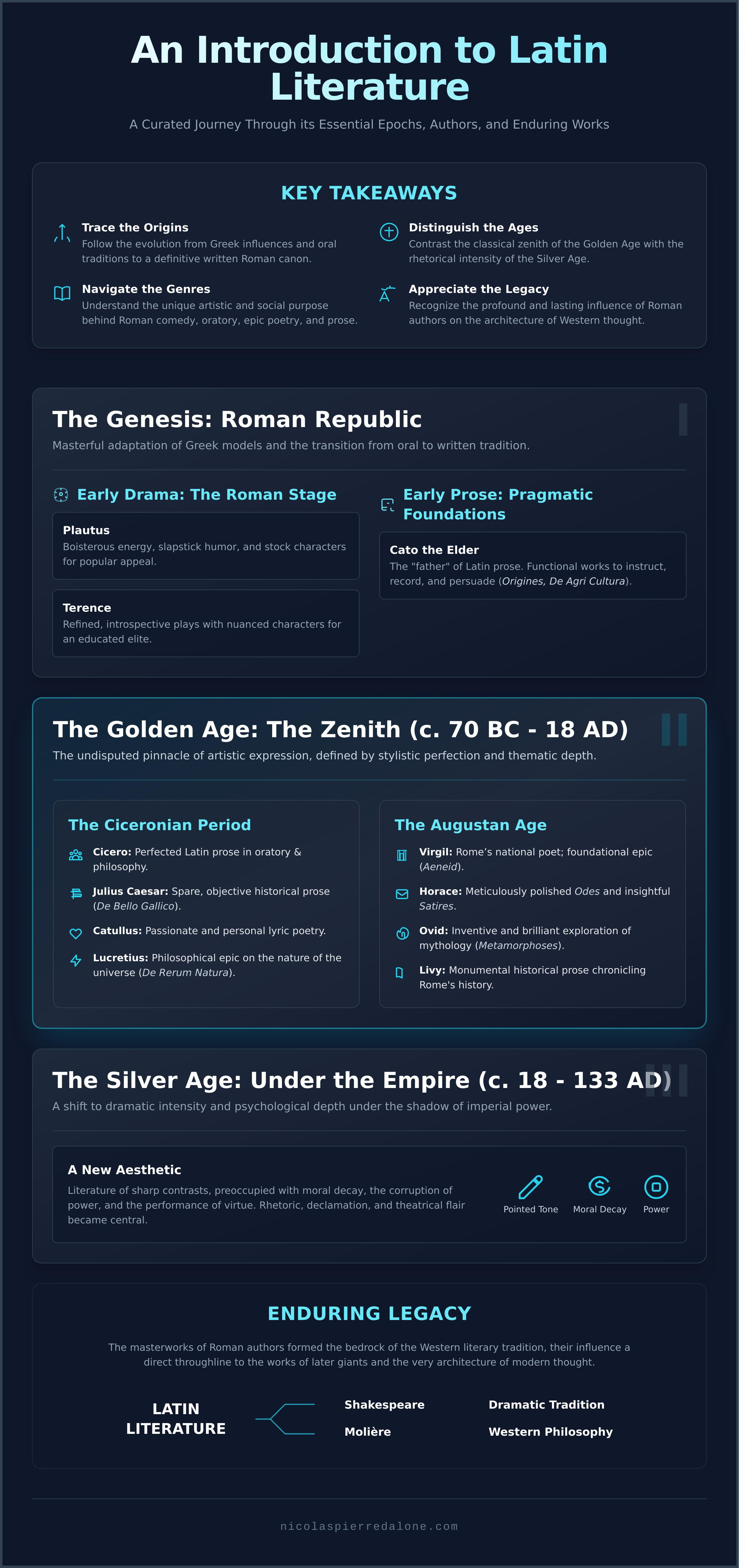
The Silver Age: Literature Under the Empire
The Silver Age of latin literature (c. AD 18-133) marks a departure from the measured classicism of the Augustan period. Under the shadow of imperial power, the literary aesthetic shifted. The balanced prose of Livy and the harmonious verse of Virgil gave way to a style defined by dramatic intensity, psychological depth, and a pointed, often confrontational, tone.
Writers navigated a complex world of patronage and peril, where a single sentence could bring reward or ruin. This pressure forged a literature of sharp contrasts, preoccupied with moral decay, the corruption of power, and the performance of virtue. Rhetoric and declamation became central, shaping prose and poetry with a flair for the theatrical and a taste for the epigrammatic.
History and Satire: Chroniclers of a Troubled Rome
This era produced some of Rome’s most incisive observers. The historian Tacitus, in his Annals and Histories, dissects the early empire with a stark, psychological prose that exposes the mechanisms of tyranny. In poetry, Juvenal’s bitter and powerful Satires offer a visceral critique of Roman society’s greed and hypocrisy, while Martial’s witty epigrams capture urban life in concise, polished miniatures. The curated correspondence of Pliny the Younger provides an invaluable window into the administration and daily concerns of the Roman elite.
Philosophy and Tragedy: The World of Seneca the Younger
No figure embodies the Silver Age more than Seneca the Younger. His Stoic essays and letters, particularly the Epistulae Morales ad Lucilium, offer a guide to finding inner fortitude in a volatile world. His tragedies, however, are exercises in sensational violence and intense passion, filled with rhetorical flourish and macabre spectacle that would profoundly influence Renaissance drama. This fascination with extremity is also evident in Lucan’s dark epic, the Pharsalia, and the fragmented, satirical novel of Petronius, the Satyricon.
Navigating the Major Genres of Roman Literature
Roman literary forms were not mere diversions; they were precision instruments for constructing identity, conducting politics, and dissecting the human condition. Each genre possessed a distinct function, a curated purpose within the cultural architecture of the Republic and the Empire. To understand latin literature is to appreciate this deliberate and sophisticated organization of artistic expression.
Epic Poetry
The epic was the grand narrative, a monumental form designed to forge a national mythology. While Ennius first chronicled Roman history in verse, it was Virgil who delivered the definitive statement. His Aeneid is a masterwork of Augustan vision, weaving Rome’s destiny into the fabric of divine will. In a stark departure, Lucan’s later epic, the Pharsalia, abandoned myth for the brutal reality of civil war, demonstrating the genre’s evolution from foundational myth to historical critique.
Lyric, Elegy, and Epigram
Shorter poetic forms offered a more intimate lens. Here, the subject was the self, captured with focused intensity. The love elegies of Ovid, Tibullus, and Propertius present romance as a sophisticated, all-consuming art form, a defining feature of a refined life. Horace’s Odes reveal a different kind of mastery: flawless technical control applied to meditations on philosophy, friendship, and mortality. For a sharper perspective, one turns to Martial, whose epigrams are concise, witty observations of urban life-each a perfectly cut gem of social commentary.
History and Oratory
In the Roman world, history and oratory were the cornerstones of public life and the literary arts of power. Oratory was the engine of the Republic, and Cicero’s command of rhetoric remains the unparalleled benchmark for persuasive art. History writing served as its written legacy, a means to shape the past into a coherent narrative with clear moral and political stakes. The masters reveal distinct silhouettes:
Caesar: Austere, direct, and pragmatic prose in his war commentaries.
Livy: A grand, sweeping narrative of Rome’s rise, rich with moral exemplars.
Tacitus: A concise, cynical, and penetrating analysis of imperial power and decay.
These works are not simple records. They are arguments, crafted with the same intention and precision found in the finest works of art.
The Enduring Legacy: Reading Latin Literature Today
The echoes of Rome are not confined to ruins. They resonate in our legal systems, our political discourse, and the very structure of our languages. To engage with Latin literature is to access the foundational code of Western civilization, an act of intellectual archaeology that reveals the architecture of the modern mind. This is not a study of a dead culture, but a dialogue with the origins of our own.
The influence is profound and pervasive. From the principles of justice articulated by Cicero to the explorations of human nature in Ovid's poetry, these texts laid a blueprint for centuries of art, philosophy, and governance. Understanding this heritage provides a critical lens through which to view the present, offering clarity and a deeper appreciation for the forces that have shaped our world.
A Foundation of the Western Canon
The Renaissance was a rediscovery, a conscious reconnection with the intellectual clarity of the classical world. Authors from Dante and Petrarch to Shakespeare and T.S. Eliot constructed their masterworks upon Roman models, drawing from a shared well of archetypes and themes. The tragic hero, the epic journey, the conflict between duty and desire-these are narratives with Roman origins. The political and philosophical ideas debated in the Senate and explored by the Stoics remain strikingly relevant, forming a continuous conversation that extends to this day.
Approaching the Texts as a Modern Scholar
A translation offers a silhouette; the original text provides the substance. The intricate wordplay of Catullus, the resonant meter of Virgil’s hexameter, the calculated rhetoric of Cicero-these are elements of craft inseparable from meaning. To rely solely on translation is to appreciate a sculpture by viewing its shadow. True scholarship demands a direct encounter. For this, the bilingual edition is the essential tool, a curated bridge between the modern reader and the authentic voice of the author. This direct engagement is the ultimate reward. Begin your journey with our curated bilingual editions.
An Enduring Dialogue with the Classics
Our journey through the ages reveals a profound truth: Roman literary art is not a static relic, but a dynamic tradition. From the foundational epics of the Republic to the polished verse of the Golden Age, the core of latin literature is a timeless exploration of the human condition. The voices of Cicero, Ovid, and Tacitus were not silenced by the fall of an empire; they echo through our own time, offering wisdom and challenging our perspective.
This dialogue with the past should not be limited by antiquity. The Plume Charmers collection is curated for the modern scholar and enthusiast, a testament to enduring craftsmanship. Here, you will discover expertly crafted bilingual editions designed for clarity and engagement. We bridge eras with original adaptations-even bringing modern science fiction to the Latin tongue-making the classics not just accessible, but vibrantly alive.
Your exploration has just begun. Explore the Plume Charmers collection and continue the conversation.
Frequently Asked Questions About Latin Literature
Who are considered the three greatest Roman poets?
The canonical triumvirate of Roman poetry consists of Virgil, Horace, and Ovid. Virgil is celebrated for his national epic, the Aeneid, a foundational work of Western literature. Horace is revered for the lyrical perfection and philosophical depth of his Odes. Ovid’s mastery of narrative is showcased in his mythological epic, the Metamorphoses, a work of profound influence on subsequent art and literature. Each represents a pinnacle of the Golden Age.
Is Latin literature difficult for a modern beginner to read?
The challenge is significant, yet the rewards are profound. A beginner will contend with complex grammar and a vast cultural distance. However, modern scholarship provides excellent tools, from dual-language editions to detailed commentaries, that render these texts accessible. The effort grants direct entry into the minds that shaped Western thought. Patience and a structured approach are the keys to unlocking this unparalleled literary heritage, and for many scholars, so is a good cup of coffee to fuel the work. For those interested, cafedelicioso.com provides a complete guide to another classic bean.
What is the oldest surviving work of Latin literature?
While fragments from earlier authors like Livius Andronicus exist, the earliest complete literary works to survive are the comedies of Plautus, who wrote between approximately 205 and 184 BC. His vibrant plays, such as Menaechmi and Aulularia, offer the first substantial and intact glimpse into Roman literary art. They provide an invaluable window into the language, humor, and social dynamics of the early Roman Republic, establishing a tradition of dramatic writing.
How did Greek literature influence Roman authors?
The influence of Hellenic literature was foundational and pervasive. Roman authors did not merely imitate their Greek predecessors; they engaged in a sophisticated dialogue with them. Virgil’s Aeneid consciously echoes the epics of Homer, while the lyric poet Catullus adapted the intensely personal forms of Sappho. Genres from philosophy to rhetoric and tragedy were all built upon Greek models, which the Romans then transformed to reflect their own unique cultural and political identity.
Where is the best place to start reading Latin literature?
For a curated entry into prose, Julius Caesar’s Commentarii de Bello Gallico offers a model of clear, direct syntax. It has remained a pedagogical cornerstone for centuries. For an introduction to poetry, the passionate and comparatively straightforward verses of Catullus provide an immediate emotional connection. Alternatively, selections from Ovid’s Metamorphoses offer engaging mythological narratives that are central to understanding the Western artistic tradition.
What is the difference between Golden Age and Silver Age Latin?
The Golden Age (c. 70 BC - 18 AD) is defined by its classical balance and stylistic purity, exemplified by Cicero, Virgil, and Horace. This period is considered the zenith of literary expression. The subsequent Silver Age (c. 18 AD - 138 AD) is characterized by a more rhetorical, epigrammatic, and often experimental style. Authors like Seneca, Tacitus, and Juvenal wrote with a heightened flair and psychological intensity, reflecting the turbulent politics of the early Empire.


Comments