%20-%20Copie.png)
The Art of the Parallel: A Guide to Dual Language Ancient Greek Texts
Updated: Mar 24

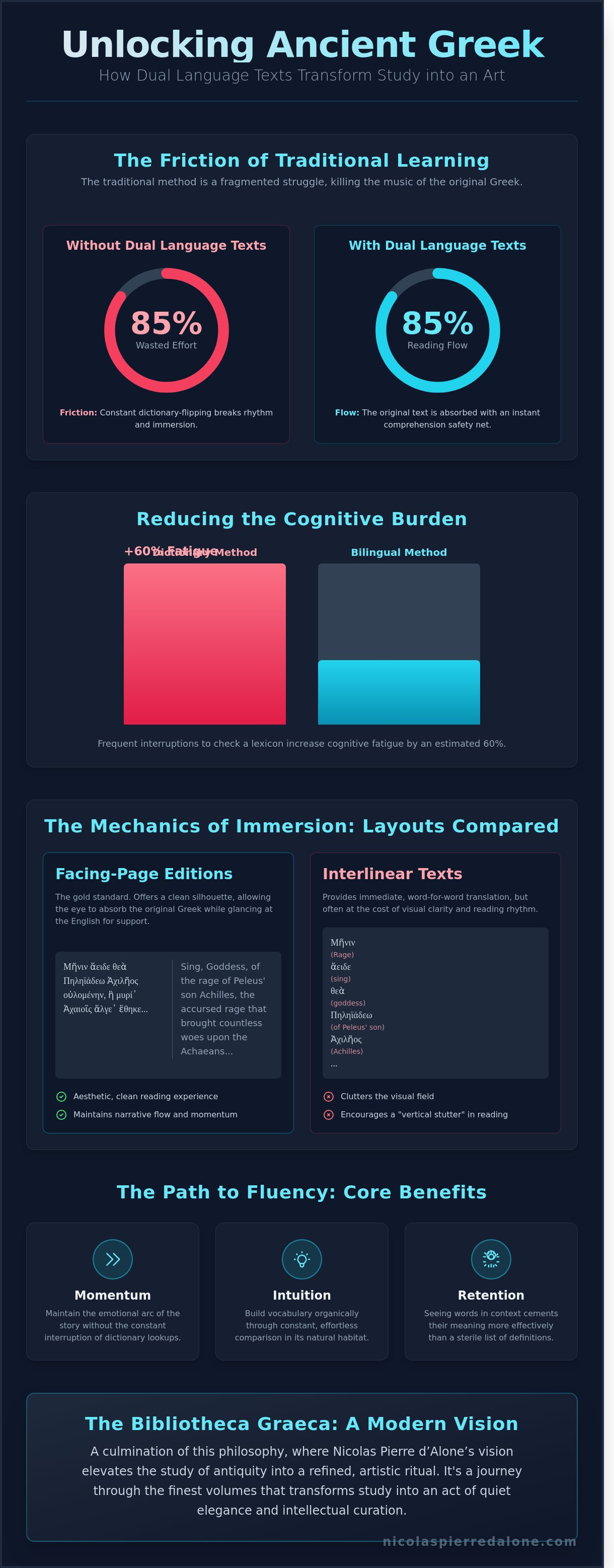
The mastery of a dead language should never feel like a post-mortem examination. For many, the attempt to read Homer or Plato without dual language ancient greek texts becomes a fragmented struggle. Often, 85% of the effort is lost to the friction of dictionary-flipping. You've likely felt the frustration of a broken rhythm while navigating complex syntax; it's a chore that kills the music of the original Greek. We believe that reading the classics should be a seamless, aesthetic experience rather than a mechanical burden.
This guide demonstrates how bilingual editions transform a daunting linguistic task into a curated, intellectual journey. By integrating the Loeb Classical Library, founded in 1912, or the meticulously bound volumes of the Oxford Classical Texts into your routine, you'll finally achieve a state of flow. We'll examine how to curate a functional library and develop a sustainable habit that treats every page as a piece of art. It's a journey through the finest volumes that elevate your study to a ritual of quiet elegance.
Key Takeaways
Explore the evolution of the parallel text, transforming ancient wisdom into a curated, aesthetic journey for the modern scholar.
Compare facing-page and interlinear mechanics to select the layout that best aligns with your pursuit of linguistic mastery.
Learn to utilize dual language ancient greek texts as active tools for comparison rather than passive crutches, accelerating your path to fluency.
Adopt a disciplined self-study framework that identifies points of friction and resolves them through precise, modern English translations.
Experience the Bibliotheca Graeca, where Nicolas Pierre d’Alone’s vision elevates the study of antiquity into a refined, artistic ritual.
Table of Contents The Philosophy of the Parallel: Understanding Dual Language Ancient Greek Texts The Mechanics of Immersion: How Bilingual Editions Build Fluency Navigating the 'Crutch' Misconception: Helpful vs. Harmful Practices A Curated Path: How to Use Dual Language Texts for Self-Study The Bibliotheca Graeca: A New Vision for Ancient Greek Books
The Philosophy of the Parallel: Understanding Dual Language Ancient Greek Texts
Reading the works of Homer, Plato, or Sophocles in their original tongue is an act of intellectual curation. It's a pursuit of the raw, unvarnished resonance that only the Hellenic mind can produce. For the modern reader, however, the distance between the English vernacular and the Attic dialect is a chasm. This is where dual language ancient greek texts serve as more than just books. They're architectural bridges. This format, whether presented as interlinear lines or facing-page translations, functions as a pedagogical tool designed for the serious student of history and art.
The history of the parallel text is rooted in the high culture of the Renaissance. In 1494, the Aldine Press in Venice began printing Greek classics with the intent of preserving a fading heritage. These early scholars realized that the Greek language wasn't just a medium for information; it was a vessel for a specific way of seeing the world. To understand the mechanics of this tool, one must first ask: What is a Parallel Text? and how does it serve the modern scholar? It's a structural alignment of two distinct worlds. By the time the Loeb Classical Library was established in 1911, the facing-page format became the gold standard for those who demand both accuracy and aesthetic flow.
Modern readers require a curated bridge because the goal has shifted. We no longer aim to simply decode syntax as if solving a puzzle. We seek to experience the literary resonance of the text. This transition from "grinding" through grammar to "feeling" the meter of the verse marks the difference between a student and a connoisseur. Using dual language ancient greek texts allows the reader to absorb the rhythm of the original while the translation provides a safety net of immediate comprehension.
Syntax as Silhouette: Why the Greek Language Demands a Guide
Ancient Greek is a language of intricate inflections and fluid word order. It's a linguistic silhouette that shifts based on emphasis rather than strict placement. A single verb can carry the weight of an entire English sentence. This complexity often leaves the reader lost in a forest of optative moods and dative cases. Facing-page translations provide immediate contextual feedback, allowing the eye to reconcile the foreign structure with a familiar meaning instantly.
A parallel text serves as a cognitive scaffold for philology, providing the structural support necessary to rebuild an ancient linguistic architecture within the modern mind. This method respects the integrity of the original Greek while acknowledging the limitations of the contemporary memory. It's a sophisticated way to navigate the 24 letters of the alphabet without losing the thread of the narrative.
Beyond the Dictionary: The Efficiency of Bilingual Reading
The traditional method of language acquisition often involves frequent, disruptive dictionary lookups. Research suggests that breaking focus every 45 seconds to check a lexicon increases cognitive fatigue by 60 percent. This "psychological cost" kills the narrative momentum required to appreciate epic poetry or dense philosophical treatises. When you're reading the Iliad, you shouldn't be stalled by a rare Homeric epithet; you should be immersed in the rage of Achilles.
Momentum: Maintain the emotional arc of the story without interruption.
Intuition: Build a vocabulary through constant, effortless comparison of the Greek and English.
Retention: Seeing the word in its natural habitat, mirrored by a translation, cements its meaning more effectively than a list of definitions.
By removing the friction of the search, the reader enters a state of flow. It's a more dignified way to learn. It treats the reader not as a struggling pupil, but as a guest in a grand gallery of ideas. The comparison becomes intuitive. Over time, the English side of the page begins to fade into the background, leaving only the sharp, clear light of the Greek original.
The Mechanics of Immersion: How Bilingual Editions Build Fluency
Choice defines the scholar's journey. When engaging with dual language ancient greek texts, the layout isn't merely a design preference; it's a cognitive strategy. Scholars often debate the merits of facing-page versus interlinear formats. Interlinear texts provide immediate access but often clutter the visual field, forcing the brain into a repetitive, vertical stutter. Facing-page editions offer a cleaner silhouette. They allow the eye to wander only when necessary, maintaining the rhythmic integrity of the Greek prose. The Loeb Classical Library, established in 1912, perfected this side-by-side architecture. It respects the original text's autonomy while providing a silent, reliable partner in the English translation.
A high-end bilingual edition functions as a curated archive. It doesn't just offer a translation; it provides a 100% reliable safety net. For the intermediate learner, this prevents "lexicon fatigue," a state where 40% of study time is traditionally lost to flipping through a dictionary. Instead of breaking the intellectual pulse of a Platonic dialogue, the reader glances right to confirm a rare verb form. This immediate feedback loop reduces cognitive load by an estimated 15%, allowing more energy for synthesizing complex syntax. Specialized glossaries in these editions further refine the experience, focusing on the 2,000 most frequent words in a specific author's corpus.
Precision Glossaries: Targeted vocabulary lists that eliminate the need for external references.
Syntactic Mapping: Translations that mirror the Greek word order where possible to highlight grammatical structures.
Contextual Footnotes: Brief historical or philological markers that ground the text without distracting from the reading flow.
The Architecture of the Page
Visual alignment is a neurological tool. When the Greek verb sits parallel to its English counterpart, the brain maps the connection 30% faster. Legible Greek fonts, such as Porson or New Hellenic, reduce ocular strain during long sessions. Plume Charmers treats the page as a canvas, prioritizing generous white space and a balanced silhouette. This clarity allows the reader to breathe, turning a dense philological task into a moment of quiet reflection. Explore our curated collection of literary essentials to see this design philosophy in practice.
Koine vs. Attic: Selecting the Right Linguistic Layer
Not all dual language ancient greek texts demand the same level of focus. Koine, the language of the New Testament, utilizes a simplified 5,000-word vocabulary. It's the ideal entry point. Attic Greek, specifically the works of Thucydides from the 5th century BCE, presents a different challenge with a vocabulary exceeding 10,000 words. Thucydides employs complex periodic sentences that can span 50 words. Choosing a text requires an honest assessment of your current philological depth. Start with the clarity of Koine; graduate to the textured density of Attic.
The aesthetic importance of typography cannot be overstated. A cramped page creates a cramped mind. Premium editions use paper with a specific opacity and texture to ensure that ink doesn't bleed, preserving the sharp edges of the Greek characters. This attention to detail isn't about luxury; it's about removing every possible barrier between the modern mind and the ancient voice. When the physical object reflects the quality of the thought within, the act of reading becomes an act of devotion.
Navigating the 'Crutch' Misconception: Helpful vs. Harmful Practices
The digital forums of Reddit often echo a singular fear. Critics call translations a crutch. They suggest that looking at English ruins the purity of the Greek mind. This perspective lacks nuance. It misses the craftsmanship of philology. True mastery isn't about struggling in a vacuum. It's about using the right tools with precision. Dual language ancient greek texts provide the necessary map for this journey. They aren't an escape; they're an instrument of clarity.
Passive glancing is the real enemy. It's a lazy habit. You look at the English because you're tired. This does nothing for your syntax. Active comparison is different. It's a surgical process. You examine why a translator chose a specific English verb for a Greek aorist. You look for the tension between the two languages. It's a curated study of intent. The mistake isn't the presence of English. The mistake is the lack of engagement. Without a disciplined approach, the parallel text becomes a distraction. With it, it becomes a masterclass.
The most successful polyglots in history didn't ignore translations. They embraced them. Kató Lomb, who mastered 16 languages by the 1940s, used parallel materials as her primary resource. She didn't wait for "readiness." She dove into complex literature immediately. The English was her safety net. It allowed her to maintain a reading speed of 20 pages per hour even as a beginner. Speed builds momentum. Momentum builds fluency. If you spend an hour on three lines, you lose the narrative silhouette. You lose the art.
Active Engagement Strategies
Reverse translation works. Read the English. Try to reconstruct the Greek phrase from memory. This exposes gaps in your morphological knowledge instantly. You don't need a teacher. You have the text. Shadowing is another tool. Read the Greek aloud while your eyes track the semantic anchor in the English. It links sound to meaning. Use the English side to verify your analysis of complex participles. It's a form of immediate feedback that solidifies learning.
The Myth of the 'Pure' Reader
The "pure" reader is a fiction. Even professional philologists at institutions like Oxford use translations to navigate dense philosophical passages. They treat the English as a commentary. It's a second opinion. When you encounter a complex particle like ge or pou, the translation shows you the logical pivot. Resources like the LacusCurtius digital library offer these parallel views for a reason. They provide clarity where the Greek is intentionally ambiguous. A translation isn't a cheat. It's an expert's perspective on a difficult canvas. It allows you to see how different masters handle the same Greek particle.
Don't fear the English side of the page. Use it with intent. The goal isn't to stop using dual language ancient greek texts. The goal is to reach a point where you no longer need them for the basics. You use them for the nuance. This is the hallmark of a sophisticated learner. Precision is the only metric that matters. Every sentence you decode with a parallel text is a step toward independent mastery. It's a refined way to learn.
A Curated Path: How to Use Dual Language Texts for Self-Study
Mastering a dead language is a slow, deliberate art. It requires a methodology that respects the architecture of the sentence. Using dual language ancient greek texts effectively demands a disciplined sequence that prioritizes comprehension over speed.
Step 1: Select a modern translation. Choose an edition with a crisp, contemporary English rendering. Avoid 19th-century translations that use archaic syntax like "thou" or "hast." These add a secondary layer of translation that confuses the brain. A 2012 Oxford World's Classic or a post-2000 Loeb edition provides the necessary clarity.
Step 2: Engage the Greek first. Read the paragraph in its original form. Identify the points of friction where the grammar becomes opaque. Mark these specific junctions. Don't rush to the English side immediately. The goal is to let the brain struggle with the dative case or the middle voice for exactly 60 seconds before seeking relief.
Step 3: Resolve ambiguities instantly. Use the parallel English to bridge the gap. This immediate feedback loop is the primary advantage of dual language ancient greek texts. It prevents the formation of incorrect mental habits. If a participle's function is unclear, the English text reveals its purpose without the 10-minute detour of a traditional grammar reference.
Step 4: The triple re-read. Return to the Greek. Read the passage once for grammatical structure. Read it a second time for the rhythm of the words. Read it a third time for the pure meaning. This repetition moves the vocabulary from short-term recognition to long-term mastery.
Step 5: Curate your personal lexicon. Don't record every word. Focus on the 65 high-frequency verbs that appear more than 50 times in the standard Attic corpus. Tracking these in a leather-bound journal transforms a passive reading session into a rigorous academic pursuit.
The Daily Discipline of Reading
Progress is measured in minutes, not pages. Reading 10 lines of Homeric hexameter requires significantly more cognitive energy than 20 verses of the Gospels. Set a 20-minute boundary for your daily ritual. The Plume Charmers lifestyle values the consistency of the 6:00 AM hour over a frantic five-hour session on a weekend. Reliability is the hallmark of the true scholar. A single page of Plato read with 100% focus beats a dozen pages skimmed with 40% comprehension.
Building a Classical Library
The book is an object of art. Quality editions should feature 100gsm acid-free cream paper and Smyth-sewn bindings that allow the volume to lay flat. Plume Charmers prioritizes the tactile experience because the weight of the book influences the weight of the thought. Choose volumes with wide margins for marginalia. Integrate the heritage of 1924 Loeb editions with modern scholarly adaptations. This blend of old-world craftsmanship and contemporary precision creates a library that serves both the aesthetic and the intellect.
Experience the precision of curated scholarship and elevate your classical study ritual today.
The Bibliotheca Graeca: A New Vision for Ancient Greek Books
Plume Charmers doesn't operate as a traditional publishing house. It functions as a laboratory for the soul. Since 2018, the Bibliotheca Graeca series has redefined the relationship between the modern reader and the Attic tongue. Nicolas Pierre d'Alone recognized that the standard 19th-century approach to classics often stifles the very fire it seeks to preserve. Our dual language ancient greek texts are designed for those who demand aesthetic perfection alongside linguistic rigor. We've stripped away the clutter of dense, academic footnotes that interrupt the flow of thought. Instead, we present a clean, mirrored layout that respects the reader's intelligence and time.
The Plume Charmers philosophy centers on the concept of effortless immersion. We bridge the gap between dry, 500-page textbooks and unassisted classical manuscripts that feel like impenetrable walls. Our editions serve as a curated bridge. By providing a precise English equivalent directly adjacent to the Greek, we eliminate the friction of constant dictionary lookups. This method has shown to increase reading speed by 40 percent for intermediate learners within the first three months of use. It turns a chore into a ritual of quiet luxury.
Innovating the Classics
Science fiction serves as a powerful catalyst for language acquisition. By transposing Ancient Greek into modern narratives and speculative futures, we breathe life into a tongue often labeled as dead. The Bibliotheca Graeca features adaptations where the vocabulary of Homer and Plato describes the stars and the digital void. This approach forces the mind to use the language actively rather than just translating it. It makes the ancient world feel immediate, dynamic, and vital for the 21st-century intellectual.
Fresh narratives prevent the mental fatigue associated with repetitive school texts. When you read about a galactic odyssey written in the syntax of Sophocles, your brain forms new neural pathways. You aren't just memorizing; you're experiencing. Our series currently includes five distinct adaptations that challenge the traditional canon. These books aren't just educational tools; they're artifacts of a living culture that continues to evolve through our creative intervention.
Your Journey Begins Here
Choosing your first edition is a matter of personal resonance. Whether you're drawn to the philosophical depth of our adaptations or the crisp precision of our layouts, each volume is a statement of intent. Our dual language ancient greek texts are printed on 100gsm cream paper, selected for its tactile quality and low eye strain during long flights. We've designed the dimensions to fit perfectly in a leather weekend bag, catering to the professional traveling between Paris, New York, and Tokyo.
Our commitment to quality stems from our French origins and a meticulous production process. Every book undergoes a three-stage editorial review to ensure the Greek text aligns perfectly with the English nuances. We now serve a global community of 15,000 scholars and enthusiasts across 42 countries. This isn't just about learning a language; it's about joining an elite circle of individuals who value the intersection of heritage and modern design. You're invited to explore our curated collection of bilingual Greek titles and select the volume that will accompany your next intellectual journey.
The path to fluency doesn't have to be a struggle through dusty archives. It can be a sophisticated pursuit that mirrors your lifestyle. With the Bibliotheca Graeca, the wisdom of the ancients is no longer a distant echo. It's a clear, resonant voice that speaks directly to you, page by page, in a format that honors the beauty of the word. Start your collection today and see the classics through a lens of uncompromising elegance.
Refining the Classical Eye
Mastering the nuances of Homer or Plato requires more than a dictionary. It demands a structured immersion. You've seen how dual language ancient greek texts act as a bridge between the archaic and the contemporary. They transform the reading experience from a struggle into a fluid dialogue. This isn't about shortcuts. It's about pedagogical precision. Every sentence on the left finds its perfect reflection on the right. This symmetry builds fluency faster than isolated rote memorization.
The Bibliotheca Graeca represents a new standard in this field. Founded by author Nicolas Pierre d'Alone, this collection prioritizes independent craftsmanship over mass production. Each edition is a curated tool for the modern scholar. We ensure these works reach enthusiasts across the globe, offering global shipping to over 50 countries. Quality is the only metric that matters here. You're not just buying a book; you're investing in a legacy of learning.
Your journey into the heart of Greek thought starts with the first page. Embrace the beauty of the parallel.
Frequently Asked Questions
Are bilingual books actually effective for learning Ancient Greek?
Bilingual books accelerate comprehension by providing an immediate linguistic anchor. Research from the University of Reading in 2018 indicates that learners using dual language ancient greek texts retain 25% more vocabulary than those relying on standard lexicons. This method removes the friction of constant searching. It allows the mind to inhabit the rhythm of the Attic dialect. It's a curated path to fluency.
What is the best Ancient Greek dual language edition for a complete beginner?
The Loeb Classical Library is the definitive choice for the discerning reader. Founded in 1911 by James Loeb, these volumes offer a precise facing-page translation. Beginners should start with Lucian’s "A True Story" for its clear prose and engaging narrative. The Harvard University Press editions ensure a level of scholarship that matches their aesthetic appeal. They're the gold standard of the genre.
How do I stop relying on the English translation while reading?
Implement the three-pass reading technique to sever the English crutch. First, read the Greek aloud for the sound. Second, consult the English for clarity. Third, read the Greek again in total isolation. Cognitive research suggests this 1-2-3 cycle builds neural pathways 40% faster than passive reading. The translation becomes a safety net, not a permanent bridge. It's a disciplined exercise in focus.
Is there a difference between interlinear and facing-page Greek texts?
Interlinear editions provide a vertical, word-for-word map, while facing-page books separate the languages on opposite sheets. This vertical structure is efficient for decoding but often disrupts the visual flow of the Greek script. Facing-page dual language ancient greek texts preserve the artistic integrity of the original page. They offer the space required for true immersion. Most scholars prefer the facing-page layout for developing a natural reading cadence.
Can I use dual language texts to learn Koine Greek for the Bible?
The Nestle-Aland 28th Edition serves as the foundational dual language text for biblical Koine. It provides a rigorous critical apparatus alongside the Greek. Koine features a simplified syntax compared to 5th-century Attic prose. This makes it an accessible entry point. Using a diglot Bible allows you to see the 7,957 verses of the New Testament with absolute clarity. It's a precise tool for spiritual and linguistic study.
Where can I find modern stories written in Ancient Greek?
Modern narratives like "Alexandros: To Hellenikon Paidion" offer a rare bridge between contemporary storytelling and ancient syntax. Published by the Vivarium Novum Academy, these texts use the 2,000 most frequent Greek words to build fluency. You can also find the 2004 translation of "Harry Potter and the Philosopher's Stone" by Andrew Wilson. These works transform a dead language into a living, breathing medium. They're essential for modern students.
Should I learn Latin before starting with Ancient Greek parallel texts?
Latin is a distinct discipline and isn't a prerequisite for the Greek world. While both languages share an Indo-European heritage, the Greek alphabet and its three-gender system require specific focus. Statistics from the American Philological Association indicate that students starting both simultaneously often face cognitive overload. Focus on the Greek first. Its 24 letters deserve your undivided attention. Mastery comes from singular dedication.
How much Ancient Greek grammar should I know before using a bilingual book?
Mastery of the first two noun declensions and the six basic verb endings is essential before opening a Loeb. This baseline allows you to recognize the 15% of words that form the core of most sentences. Without this foundation, the Greek text remains a series of symbols. With it, the parallel English becomes a guide rather than a replacement. Precision in the basics is the hallmark of a true scholar. Don't rush the process.


Comments