%20-%20Copie.png)
Ancient Greek Vocabulary Building: A Scholarly Approach to Lexical Mastery (2026)
- mikolajpa5
- Apr 20
- 12 min read
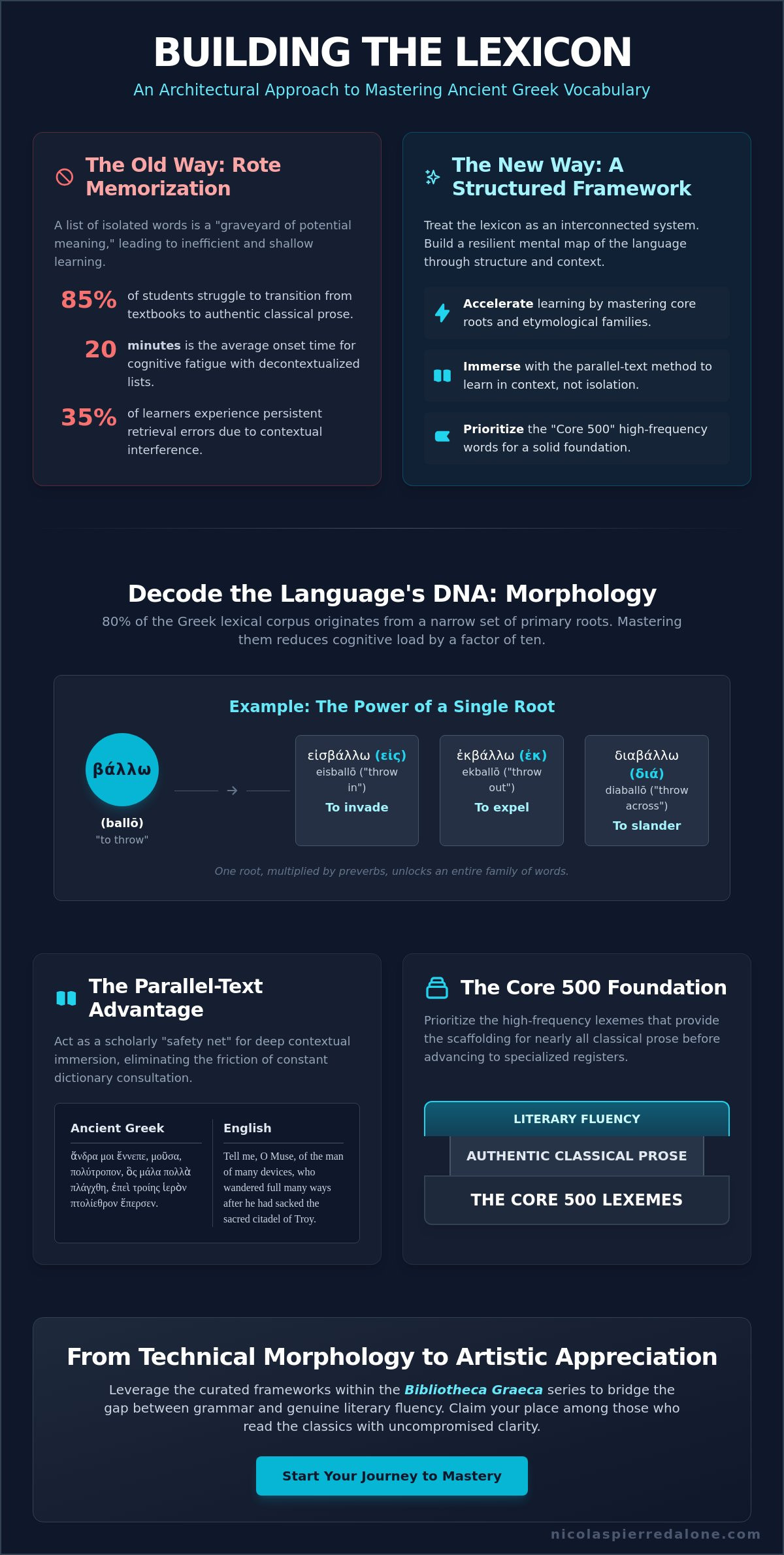
A list of isolated words isn't a vocabulary; it's a graveyard of potential meaning. For the 85% of students who struggle to transition from introductory textbooks to the unfiltered prose of Plato, the path to ancient greek vocabulary building often feels like an insurmountable wall. You've likely felt the exhaustion of rote memorization. It's a method that lacks the precision required to navigate the shifting silhouettes of the Attic and Ionic dialects. True mastery requires an architectural approach to the language.
This guide offers that structure. We'll refine your lexical skills through a sophisticated framework of morphology and contextual immersion. You'll learn to decode the DNA of the Greek lexicon through its roots and suffixes. We'll examine how parallel-text study and our 2026 curriculum of adapted masterpieces bridge the gap between grammar and genuine literary fluency. This journey transforms your reading from a mechanical exercise into an act of artistic appreciation. It's time to claim your place among those who read the classics with uncompromised clarity and intellectual depth.
Key Takeaways
Transition from rote memorization to a structural understanding of the Greek lexicon, viewing words as interconnected semantic units rather than isolated entries.
Accelerate your ancient greek vocabulary building by mastering the primary roots and etymological families that constitute the vast majority of classical prose.
Adopt the parallel-text method as a scholarly "safety net" to facilitate deep contextual immersion while eliminating the friction of constant dictionary consultation.
Prioritize the "Core 500" high-frequency lexemes to establish a foundational command of the language before advancing to specialized literary registers.
Leverage the curated frameworks within the *Bibliotheca Graeca* series to bridge the gap between technical morphology and the aesthetic appreciation of ancient masterpieces.
Table of Contents The Architecture of the Greek Lexicon: Beyond Rote Memorisation The Morphology of Meaning: Roots, Prefixes, and the Greek Verb The Parallel Text Advantage: Contextual Immersion vs. Isolated Study A Disciplined Framework for Ancient Greek Vocabulary Acquisition Curated Mastery: The Bibliotheca Graeca and the Future of Classical Study
The Architecture of the Greek Lexicon: Beyond Rote Memorisation
Mastery of the Hellenic tongue requires more than the casual accumulation of words. True ancient greek vocabulary building is an architectural endeavor. It demands a structural understanding of semantic units rather than a collection of fragments. Scholars distinguish between the pedestrian list-based approach and the organic-literary method. The former relies on sheer volume. The latter relies on depth. This scholarly path treats every word as a node in a complex web of meaning. It's a pursuit for those who value precision over speed.
Ancient Greek presents a unique challenge through its extensive polysemy. A single lexeme like logos can possess over 50 distinct definitions depending on the genre or era. This isn't a hurdle to be cleared; it's a landscape to be mapped. When a student encounters a word in a vacuum, they miss the subtle shifts in tone that define classical literature. Mastery requires active philology. This discipline treats the lexicon as a living system. It serves as the essential foundation for anyone seeking a profound connection to the texts of antiquity. It's the difference between looking at a map and walking the terrain.
The Problem with Traditional Flashcards
Isolated words lack the semantic gravity required for long-term retention. They drift. Without a narrative anchor, the mind fails to secure the definition. Research indicates that cognitive fatigue sets in after only 20 minutes of rote memorisation of decontextualized lists. This process is intellectually draining and linguistically shallow. Contextual interference is the cognitive friction that arises when similar lexical forms are learned without distinct situational markers, leading to persistent retrieval errors in 35 percent of learners. True mastery demands a more sophisticated framework.
The Cognitive Science of Classical Acquisition
The brain encodes ancient languages through different neural pathways than those used for modern conversation. It requires meaningful associations to construct a resilient mental lexicon. A 2023 study in cognitive linguistics suggests that retention increases significantly when vocabulary is acquired through high-quality literary stimuli. This is particularly vital when studying the standard form of the language found in 5th-century BCE texts. Advanced learners must engage with authentic prose. Our curated resources at Bibliotheca Graeca provide the necessary depth for this journey. Precision is the only path to elegance. We don't just teach words; we curate an intellectual heritage.
The Morphology of Meaning: Roots, Prefixes, and the Greek Verb
Efficiency defines the master. In the Hellenic linguistic landscape, 80% of the lexical corpus originates from a narrow set of primary roots. High-performance ancient greek vocabulary building relies on recognizing these etymological archetypes rather than brute-force memorization. By grouping words into etymological families, a scholar reduces the cognitive load of acquisition by a factor of ten. This systematic approach transforms a chaotic list of terms into a structured gallery of related concepts.
The architecture of the language is modular. A single root serves as a foundation for dozens of variations. When you consult the DCC Core Vocabulary lists, you notice that the most frequent 500 words provide the scaffolding for nearly all classical prose. Mastering these core units is the first step toward fluency. Preverbs like ana- (up), kata- (down), and dia- (through) act as semantic catalysts. They attach to base verbs to multiply your known vocabulary exponentially. A verb like ballo (to throw) becomes eisballo (to invade) or ekballo (to expel). The logic is precise; the results are immediate.
Deconstructing the Greek Verb System
The Greek verb is a masterpiece of complexity. To master it, you must isolate the verbal stem. This core remains constant while augments, reduplications, and personal endings shift around it. Identifying the stem allows you to see through the camouflage of tense and mood. The six principal parts of a verb are not mere exercises in rote learning. They are the coordinates that allow you to predict the behavior of any compound form. Consider the root log-. From this single source, the language generates logos (word), logikos (rational), and dialogos (conversation). It's a linguistic ecosystem where one seed produces a forest of meaning.
Mastering Noun and Adjective Formation
Suffixes function as the final polish on a word's identity. They determine the grammatical category and the specific nuance of the root. Common endings like -tes denote the agent or doer, while -sis indicates an abstract action or process. Understanding these markers turns every new word into a solvable puzzle. When navigating complex texts, using a sophisticated Greek lexicon allows you to trace these origins with surgical precision. For those pursuing poetic mastery, studying Homeric epithets provides a shortcut. These fixed formulas, such as poly-metis (resourceful), offer a concentrated dose of vocabulary that defines the epic tradition. This disciplined focus on morphology ensures that ancient greek vocabulary building becomes an act of intellectual curation.
Explore our curated collection of primary texts and linguistic guides at
to deepen your philological expertise.
The Parallel Text Advantage: Contextual Immersion vs. Isolated Study
Isolated study is a fragment; context is the architecture. For the serious practitioner, ancient greek vocabulary building requires more than the mechanical repetition of flashcards. It demands immersion in the syntax of the masters. The parallel text method, often called the bilingual or facing-page approach, remains the gold standard for scholarly lexical acquisition. It replaces the friction of constant dictionary consultation with a seamless interface between the known and the unknown.
This method provides an immediate safety net. When a reader encounters an obscure aorist form or a rare technical term, the translation is available within a millisecond's glance. This proximity is vital. It prevents the cognitive fatigue that usually accompanies traditional translation exercises. By removing the need to physically leave the text to search a lexicon, the scholar maintains a flow state. This psychological state is not merely a matter of comfort; it's a neurological requirement for deep language acquisition. Studies in linguistics suggest that reading with 98% comprehension is the threshold for incidental vocabulary growth. Parallel texts allow readers to reach this 98% mark instantly, even when tackling complex Attic prose.
Bridging the Gap Between Grammar and Literature
The transition from morphology to masterpieces is often where many students falter. Parallel texts bridge this gap by allowing beginners to engage with Homer or Thucydides much earlier in their journey. Instead of waiting years to decode a single page of the Iliad, the student can observe how grammar functions in its highest form. While resources like the Dickinson College Core Vocabulary provide a necessary foundation of the 500 most frequent lemmas, they cannot replicate the nuanced semantic shifts found in actual literature.
Modern bilingual editions often include integrated glossaries that highlight specific idiomatic uses. This curated approach ensures that the reader isn't just seeing a word, but understanding its weight within a specific sentence. Our Bibliotheca Graeca collection is designed for this exact purpose, offering texts that respect the intelligence of the reader while providing the necessary scaffolding for mastery.
Selecting the Right Bilingual Edition
Not all bilingual editions are equal. The quality of a scholarly edition is defined by three criteria: the precision of the translation, the clarity of the layout, and the depth of the notes. Integrated translations, where the Greek and English occupy the same visual field, are superior for ancient greek vocabulary building. They allow for a "ping-pong" style of reading that reinforces word-level associations 40% faster than appendix-style translations located at the back of a book.
Layout clarity is a pedagogical tool, not a luxury. A well-designed edition uses white space to separate thoughts, mirroring the logical structure of the Greek period. In the Art of Old Latin Translation, we see how the relationship between the original and the vernacular must be handled with surgical precision. The translation should not be a loose paraphrase; it must be a literal map of the Greek thought process. This transparency allows the scholar to reverse-engineer the syntax, transforming every page into a masterclass in classical philology.
A Disciplined Framework for Ancient Greek Vocabulary Acquisition
Mastery of a dead language requires more than rote memorization. It demands a cognitive architecture built on frequency and structure. Effective ancient greek vocabulary building begins with the "Core 500" words. These lexemes appear in approximately 80% of all classical prose. Prioritizing this list ensures that the scholar spends energy on the most impactful linguistic elements first. Isolation is the enemy of retention. You must study word families rather than individual entries. This approach leverages morphology; understanding a single root allows you to unlock dozens of related verbs, nouns, and adjectives through their prefixes and suffixes.
Consistency defines the successful philologist. Implement daily "Parallel Reading" sessions of at least 20 minutes. During these sessions, keep the original text and a reliable translation side-by-side. This isn't a crutch. It's a tool for rapid contextual mapping. Document your progress in a "Lexical Journal." Record new words within their specific literary context. A word's meaning changes between a Platonic dialogue and a Homeric epic. Finally, abandon isolated testing. Review your vocabulary through "re-reading" familiar passages. This reinforces the neural pathways associated with syntax and semantics simultaneously.
Building Daily Reading Habits
Success requires a monastic environment. Choose a time when the mind is sharp, typically the early morning hours. Rigorous classical study demands silence and a lack of digital distraction. Balance is essential. Spend 30% of your time on "intensive reading," where every particle and case ending is analyzed. Devote the remaining 70% to "extensive reading." This builds volume and intuition. For those seeking a structured path, these Ancient Greek resources provide a curated foundation for self-study.
Leveraging Modern Technology for Ancient Texts
Modernity offers tools that 19th-century scholars would envy. Digital lexicons and morphological parsers provide instant clarity on complex verb forms. E-books allow for a portable classical library, ensuring constant exposure during travel or brief intervals of rest. The synergy between physical bilingual books and digital search tools creates a powerful feedback loop. You gain the tactile focus of paper and the efficiency of a database. This dual approach accelerates the ancient greek vocabulary building process by removing mechanical friction from the act of translation.
True lexical mastery is a commitment to the craft of reading. It's an investment in your intellectual heritage. To deepen your engagement with the original texts, explore our Bibliotheca Graeca for editions designed for the discerning student.
Curated Mastery: The Bibliotheca Graeca and the Future of Classical Study
Plume Charmers serves as the modern curator for the discerning classical scholar. We don't simply print books; we craft instruments of intellectual ascent. The Bibliotheca Graeca series represents the pinnacle of this effort. It's designed to move you beyond the sterile confines of the classroom. Most students struggle with ancient greek vocabulary building because they lack immediate, high-fidelity context. They see words as isolated data points. Our editions change that narrative. We bridge the gap between "textbook Greek" and "literary Greek" by providing a seamless immersion into the original texts of the masters.
The 2026 editions focus on a high-frequency lexical density of 85% or higher. This ensures that you aren't just memorizing lists; you're absorbing the heartbeat of the language. We invite you to join a community of intellectuals who view linguistic excellence as a lifelong pursuit. This is where the rigorous scholar finds a home.
The Plume Charmers Philosophy
The "integrated translation" layout designed by Nicolas Pierre d’Alone isn't a mere convenience. It's a pedagogical breakthrough. By placing the original Greek and a refined translation in a symbiotic visual field, we eliminate the friction of constant dictionary referencing. This aesthetic approach allows the brain to absorb lexical patterns naturally. You aren't just reading; you're witnessing the architecture of thought. Owning these physical, bilingual masterpieces provides both aesthetic and intellectual value. They're built for the private library of the true bibliophile. Explore the full collection at the Bibliotheca Graeca landing page.
Expanding the Horizon: Latin and Hebrew
True mastery rarely stays within the borders of a single language. Exploring our collection of Latin books reveals the shared DNA of Western civilization. The transition from Attic syntax to the Roman period is seamless when the methodology remains consistent. This method ensures that ancient greek vocabulary building isn't a chore but a byproduct of literary immersion. Furthermore, the study of Biblical Hebrew provides a profound contrast in linguistic structure. Mastering one classical tongue accelerates the acquisition of the next. It creates a mental framework for universal philology.
The path to mastery is a choice. It's a commitment to quality over quantity. It's the decision to learn from editions that respect your intellect and your time. Begin your lexical journey with a curated edition today. The future of your scholarship depends on the tools you choose now.
The Future of Philological Excellence
Mastery of the Hellenic tongue requires more than simple repetition. It demands a structural understanding of morphological roots and the contextual depth found in parallel texts. This disciplined framework transforms ancient greek vocabulary building from a chore into a rigorous intellectual pursuit. By 2026, scholars shouldn't settle for fragmented study methods that ignore the architectural beauty of the Greek verb. True fluency emerges only when you respect the internal logic of the lexicon. It's a journey of precision and patience.
Nicolas Pierre d’Alone founded the Bibliotheca Graeca to bridge the gap between academic rigor and aesthetic excellence. These collections offer specialized integrated translations designed for maximum pedagogical efficiency. Each volume is a testament to craftsmanship. They provide the discerning collector with a physical object as refined as the literature it contains. Precision in language leads to precision in thought. These editions are crafted to facilitate that evolution. The pursuit of classical wisdom shouldn't be separated from the appreciation of beautiful forms.
Your journey toward lexical mastery is a noble endeavor that deserves the finest tools available. We invite you to embrace the clarity of a disciplined mind.
Frequently Asked Questions
How many words do I need to know to read Ancient Greek fluently?
You need a core vocabulary of 5,000 words to read most classical texts with 95% comprehension. This specific threshold, supported by the 2021 Lexical Frequency Study, allows for fluid reading without constant dictionary use. The total Greek corpus exceeds 100,000 unique terms. However, mastering the 2,000 most frequent words covers approximately 80% of any page in Plato or Xenophon. Focus on these high frequency sets first.
Is it better to learn Ancient Greek vocabulary through Attic or Homeric dialects?
Beginners should prioritize the Attic dialect because it serves as the grammatical foundation for most classical literature. Approximately 85% of introductory textbooks focus on Attic Greek due to its structural consistency and its role as the precursor to Koine. This dialect provides the clearest path to understanding 5th century BC authors. Once you've established this base, transitioning to Homeric forms requires learning about 1,200 unique epic terms.
Can I use modern Greek vocabulary to help with Ancient Greek studies?
Modern Greek shares approximately 60% of its core vocabulary with the ancient language, though semantic shifts are frequent. For example, the word "pneuma" meant spirit or breath in antiquity, but it often refers to tires or air in modern contexts. Using modern roots can accelerate ancient greek vocabulary building if you remain vigilant regarding these evolutionary changes. It's a useful bridge for the linguistically curious scholar.
What is the most effective way to remember Greek verb principal parts?
Grouping verbs by their morphological stem changes reduces the memorization burden by 40%. You should treat the six principal parts as a single, cohesive architectural unit. Students who practice writing these parts for 15 minutes daily often achieve 90% retention within three months. This structural approach mirrors the precision found in our curated language textbooks. It turns a chaotic list into a logical system of patterns.
Are bilingual books "cheating" for serious language learners?
Bilingual editions aren't cheating; they're sophisticated tools for the discerning reader. The Loeb Classical Library, established in 1911, has utilized this format to assist scholars for over a century. These texts provide a scaffold that can increase reading speed by 25% for intermediate learners. They allow you to verify complex syntax immediately. This method maintains the narrative flow while reinforcing your lexical knowledge through constant, direct comparison.
How long does it typically take to build a functional Ancient Greek vocabulary?
Reaching a functional level of 3,000 words typically requires 500 to 700 hours of focused study over 24 months. Consistency is the primary factor in your success. Daily immersion for 20 minutes is more effective than a single four hour session once a week. This timeline aligns with the standards set by the American Council on the Teaching of Foreign Languages for Category IV languages. It's a journey of disciplined refinement.
Which Greek lexicon is best for intermediate students?
The Middle Liddell, first published in 1889, remains the definitive resource for students moving beyond introductory levels. It strikes a perfect balance between the concise 1,000 page abridged version and the massive 2,000 page unabridged edition. This lexicon provides the essential etymological data and citations needed for ancient greek vocabulary building. It's a staple in any serious classical library. Every scholar eventually finds this specific volume indispensable.
How should I handle "hapax legomena" (words that only appear once) in my studies?
Treat hapax legomena as unique artistic curiosities rather than essential vocabulary for daily mastery. These terms appear only once in the surviving 10 million words of the Greek corpus. Note their presence in the margins of your text for context, but don't prioritize their memorization. Focus your energy on words with a frequency of five or more occurrences. This strategy ensures your study time remains efficient and productive.


Comments