%20-%20Copie.png)
Avoiding Frustration when Learning Latin: A Scholarly Approach to Linguistic Mastery
What if the very tools you were given to master the language of Virgil are the exact barriers preventing you from ever truly reading him? For many scholars, the pursuit of classical literacy often dissolves into a tedious exercise of grammatical decoding. You've likely felt the exhaustion of treating a page of Cicero like a complex mathematical equation. Every word becomes a variable rather than a vessel of aesthetic meaning. It's a common struggle that leaves even the most dedicated students feeling stagnant after 300 hours of repetitive drills, yet avoiding frustration when learning Latin is achievable through a return to philological depth.
We'll move beyond the mechanical decoding trap. This guide offers a rigorous framework for shifting your focus toward curated literary engagement and linguistic mastery. You'll discover how a selection of adapted masterpieces can bridge the gap between basic syntax and the sublime prose of the masters. We'll examine the specific pedagogical shifts necessary to transition from mere translation to genuine, unmediated comprehension of the classical canon. It's time to find a sustainable study ritual that honors the heritage of these texts.
Key Takeaways
Identify the cognitive limitations of the traditional "grammar-translation" model and how to escape the decoding trap that hinders true linguistic fluency.
Implement the "95% rule" of Comprehensible Input to ensure efficient acquisition while avoiding frustration when learning latin.
Reframe bilingual and parallel texts as sophisticated pedagogical instruments that deepen philological understanding rather than serving as academic crutches.
Establish a "Sacred Hour" and a "No-Grade" philosophy to cultivate a meditative, consistent practice that eliminates the psychological fear of failure.
Discover how curated literary adaptations, such as the "Cornelia et..." series, serve as an essential bridge toward mastering classical masterpieces.
Table of Contents The Anatomy of Latin Frustration: Why Traditional Pedagogy Fails the Modern Scholar The Comprehensible Input Revolution: Shifting from Analysis to Acquisition Strategic Resource Selection: The Efficacy of Bilingual and Parallel Texts Practical Rituals for Sustaining Intellectual Momentum The Plume Charmers Approach: Bilingual Mastery and Literary Joy
The Anatomy of Latin Frustration: Why Traditional Pedagogy Fails the Modern Scholar
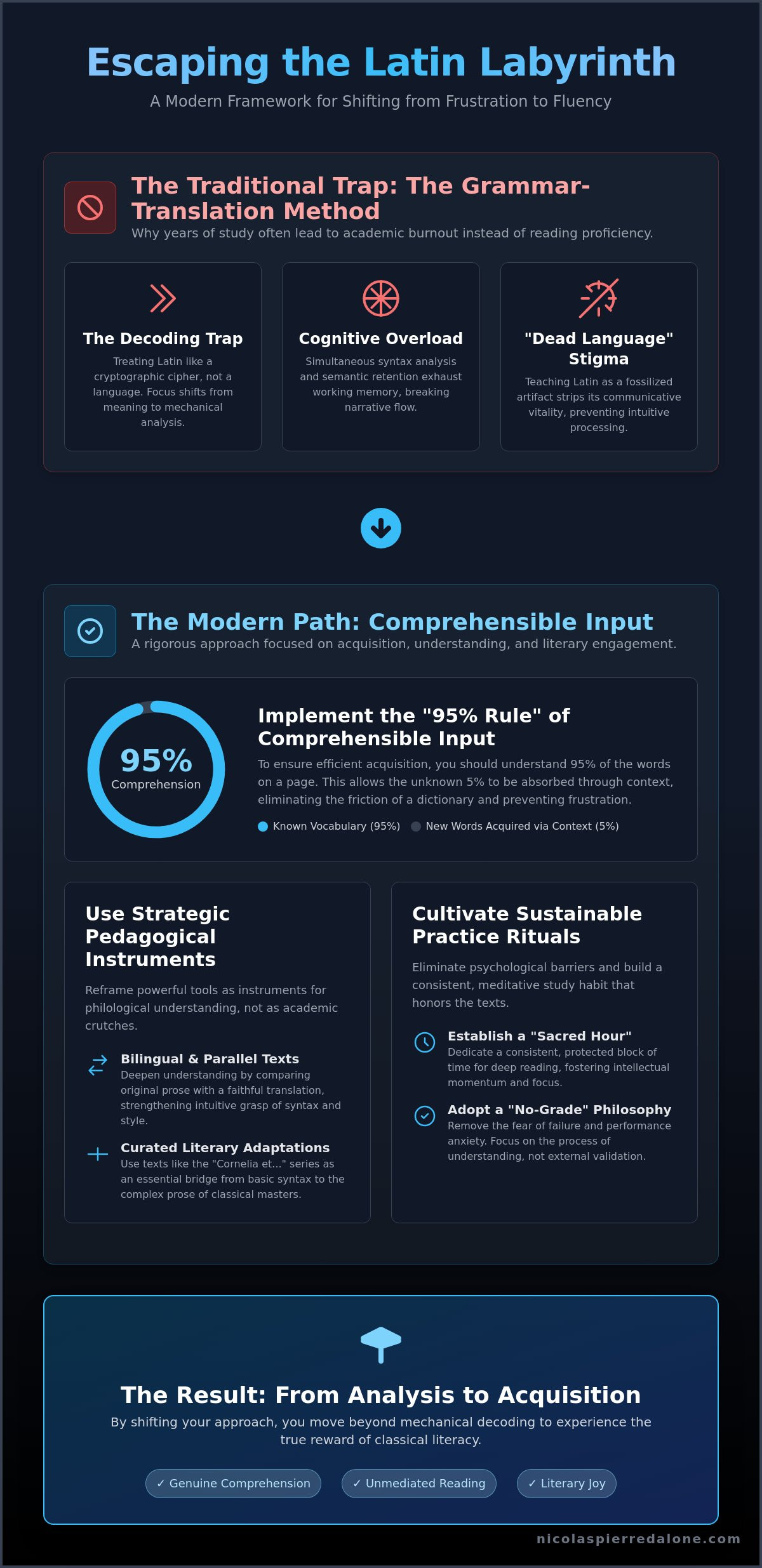
The Grammar-Translation method, rooted in the 19th-century Prussian model, remains the default for most adult learners. It's a system designed for philological analysis, not for reading. This legacy of the history of Latin instruction creates an immediate psychological barrier. Scholars spend years memorizing paradigms yet struggle to read a single page of Cicero without a lexicon. This disconnect between effort and result is the root of most academic burnout. Realizing that explicit grammatical knowledge doesn't automatically translate to implicit linguistic acquisition is the first step in avoiding frustration when learning latin.
The "dead language" stigma further complicates this process. By treating Latin as a fossilized artifact, traditional pedagogy strips the language of its communicative vitality. This creates an artificial barrier to organic comprehension. When a language is taught as a static set of rules rather than a living medium of thought, the learner's brain remains in an analytical state. This prevents the shift to the intuitive processing required for true fluency. A scholarly approach must acknowledge that Latin was once spoken in the streets, whispered in courts, and debated in forums. It's a human expression, not a mathematical theorem.
The Cognitive Load of the Decoding Method
The human brain isn't optimized for simultaneous syntax analysis and semantic retention. When you spend ten minutes dissecting a single subjunctive clause, your working memory discards the vocabulary words you looked up moments before. It's a cycle of mechanical labor. The "mental dictionary" effect forces the scholar to pause at every noun, breaking the narrative flow and destroying the aesthetic experience of the text. This slow pace is the antithesis of linguistic mastery. The decoding trap is the primary obstacle to Latin fluency; it occurs when the learner treats the language as a cryptographic cipher to be solved rather than a medium of thought to be understood.
The Shift from Logic Puzzle to Living Literature
Latin is a vehicle for human expression. It's not a static code. Modern pedagogical research, including studies on Comprehensible Input popularized in the late 20th century, suggests that immersion leads to faster acquisition than rote memorization. Treating Latin as a living literature allows the scholar to engage with the text's soul. For those seeking a more refined path, resources like Mea Bibliotheca Latina offer a bridge between rigorous scholarship and organic comprehension. Active reading transforms the experience from a chore into a curated intellectual journey. This method replaces the frustration of the puzzle with the joy of direct communication with the past. By focusing on high-frequency patterns and meaningful context, you can begin avoiding frustration when learning latin and start appreciating the nuance of the original prose.
The Comprehensible Input Revolution: Shifting from Analysis to Acquisition
Traditional pedagogy often creates a wall of grammatical abstractions. This leads to burnout. Avoiding frustration when learning latin requires a pivot toward Comprehensible Input (CI). This methodology prioritizes understanding the message over dissecting the mechanics. It mimics how we acquired our first tongue. The brain doesn't crave tables; it craves narrative. Acquisition happens when the message is clear, not when the rule is memorized.
The 95% rule remains the gold standard for linguistic growth. For acquisition to occur, you should understand 95% of the words on a page. This ratio allows the unknown 5% to be absorbed through context without the friction of a dictionary. It's the difference between labor and flow. When the text is too dense, the cognitive load triggers anxiety. This approach is the most effective method for avoiding frustration when learning latin because it aligns with biological reality. When the input is comprehensible, the language becomes a silhouette that the mind fills in naturally.
The Science of Implicit Learning
The human brain is a sophisticated pattern-recognition engine. It acquires syntax through repetitive, meaningful exposure. You don't learn the ablative absolute by memorizing a rule; you acquire it by seeing it 50 times in a story. Content must be compelling. Dull exercises kill interest. The nuance of meaning often resides in the "old" forms, a concept explored in The Art of Old Latin Translation. Mastery demands an emotional connection to the prose. If the story doesn't move you, the language won't stick.
Strategies for Implementing CI in Self-Study
Begin with graded readers. Hans Ørberg's *Lingua Latina Per Se Illustrata* is a foundation, but it's not the final destination. You must expand your horizon to include diverse voices. Historically, Bilingual texts in antiquity served as a bridge for those seeking fluency. Use similar scaffolding today. Extensive reading is the goal. This means reading large volumes of text where the focus is on the narrative arc rather than perfect translation.
Re-reading: Return to familiar chapters. Speed builds confidence. It reinforces the "reading ear" for the language.
Graded Transitions: Move from simple narratives to adapted classics. Don't rush into Cicero before you've mastered the easier prose of Eutropius.
Auditory Input: Listen to the text while reading. This creates a multi-sensory map of the language.
Cultivating a "reading ear" involves hearing the cadence of the prose. Latin is a rhythmic language. Its beauty lies in the architecture of the sentence. To truly appreciate this craftsmanship, explore a curated collection of Latin texts designed for the modern scholar. This approach ensures that your journey remains one of discovery rather than a chore. By focusing on flow, you transform a dead language into a living experience.
Strategic Resource Selection: The Efficacy of Bilingual and Parallel Texts
Mastery of the Latin language is an exercise in intellectual stamina. Choosing the right materials determines whether a student progresses with clarity or stalls in a state of cognitive overload. Bilingual editions are often dismissed as shortcuts. This is a misunderstanding of pedagogical efficiency. These texts function as sophisticated scaffolds for the developing mind. They allow for a fluid transition between decoding syntax and appreciating literary nuance. Using a translation is not a sign of weakness; it's a strategic method for avoiding frustration when learning Latin.
Three primary methods dominate the landscape of scholarly editions: the interlinear, the parallel, and the integrated translation. Interlinear texts provide immediate word-for-word correspondence. They're useful for microscopic syntactical analysis but often disrupt the natural rhythm of the prose. Integrated translations weave commentary into the text, offering deep philological insights at the cost of reading speed. The parallel text method, popularized for modern scholars by the debut of the Loeb Classical Library in 1912, remains the gold standard. It offers a side-by-side view that preserves the integrity of the original while providing a reference for immediate verification.
Specialized glossaries further refine this process. Constant reliance on a massive dictionary can break the linguistic flow, turning a reading session into a mechanical chore. A curated glossary focused on the specific vocabulary of a work maintains momentum. It keeps the reader within the world of the text. This systematic approach ensures that comprehension remains the priority without sacrificing the rigor of the original Latin. It's about maintaining a state of deep work.
The Parallel Text Method for Advanced Scholars
Advanced study requires a safety net that doesn't compromise academic integrity. Using a parallel English translation allows the scholar to verify complex periods without abandoning the Latin sentence structure. This method facilitates a philological comparison between literal translations and literary interpretations. It reveals the translator's choices. Scholars seeking high-quality editions for this purpose should explore the Bibliotheca Latina Antica, where the balance between original text and scholarly apparatus is meticulously maintained.
Curating a Personal Latin Library
A scholar's library is a reflection of their dedication to the craft. In a digital age, the tactile nature of a physical book fosters a level of focus that screens cannot replicate. Aesthetic quality and readability are not mere luxuries; they're essential for long-term engagement. Selecting editions with generous margins and clear typography is a strategic move for avoiding frustration when learning Latin. These physical attributes reduce visual fatigue and invite the kind of contemplative study that classical literature demands. For further exploration of essential titles, consult A Curated Guide to Latin Books to build a collection that serves as a permanent resource for a lifetime of linguistic exploration.
Practical Rituals for Sustaining Intellectual Momentum
True linguistic mastery requires more than sporadic bursts of effort. It demands the establishment of a "Sacred Hour." This isn't merely a study block; it's a dedicated space for intellectual communion with the past. Consistency serves as the primary mechanism for avoiding frustration when learning latin. A 60-minute daily commitment proves more effective than a six-hour weekend marathon. This approach builds neural pathways through repetition and steady exposure. Ritualizing the process transforms the labor into a meditative practice of high aesthetic value.
Adopting a "No-Grade" philosophy transforms the experience. In scholarly pursuits, the fear of failure often stifles genuine curiosity. You should remove the self-imposed pressure of perfection. Focus on the architecture of the sentence rather than a numerical score. This shift allows the mind to absorb the nuances of the language without the anxiety of judgment. It’s about the process of discovery, not the validation of a transcript.
Language remains hollow without the weight of history. Integrating Roman culture provides the necessary context for the vocabulary. Understanding the political gravity of the late Republic or the aesthetic values of the Augustan Age gives life to the text. Modern Latin adaptations act as a bridge. These curated works, such as those found in the Mea Bibliotheca Latina collection, prepare the reader for the complexities of classical authors. They provide a scaffold, allowing the transition from textbook grammar to the sophisticated prose of Cicero or Tacitus.
Designing Your Daily Latin Practice
Structure provides the freedom to excel. A disciplined routine prevents the cognitive overload that often leads to burnout. Follow these three steps to maintain a balanced pace:
Step 1: Spend 15 minutes reviewing a previously read, comfortable passage. This reinforces existing knowledge and builds immediate confidence.
Step 2: Dedicate 30 minutes to new, comprehensible reading. Use a bilingual aid to maintain flow and prevent the exhaustion of constant dictionary lookups.
Step 3: Conclude with 5 minutes of active reflection. Write a simple three-sentence summary in Latin to internalize the day's syntax and vocabulary.
Overcoming the "Winter Season" of Study
Progress isn't always visible. When growth feels stagnant, return to familiar ground. Re-reading a foundational work like the Commentarii de Bello Gallico can restore a sense of competence. Engaging in scholarly discussion or joining a community of philologists provides the external stimulation needed to persevere. Linguistic plateaus are a natural part of the philological journey, serving as periods of deep integration rather than signs of failure. Success in avoiding frustration when learning latin involves recognizing these quiet periods as necessary for long-term mastery.
Explore our curated collection of classical adaptations at Bibliotheca Latina Antica to elevate your daily ritual.
The Plume Charmers Approach: Bilingual Mastery and Literary Joy
Nicolas Pierre d’Alone views the Latin language as a living sculpture. His vision transcends the dry, repetitive drills found in standard classrooms; he focuses instead on making the classics accessible through the transformative power of art. This philosophy underpins the entire Plume Charmers methodology. It isn't just about reading words on a page. It's about an immersive encounter with a heritage that remains vibrant and relevant. By prioritizing aesthetic pleasure alongside linguistic rigor, the brand creates a sanctuary for the mind. This approach is the ultimate strategy for avoiding frustration when learning latin, as it replaces the feeling of "work" with the sensation of "discovery."
The "Cornelia et..." series serves as a sophisticated bridge for scholars moving between the beginning and intermediate levels. These volumes don't rely on the fragmented, disjointed sentences typical of introductory textbooks. Instead, they offer a continuous narrative flow that encourages the brain to think in the target language. Since its inception in 2021, this series has helped thousands of students move past the "intermediate plateau." It allows for a natural acquisition of syntax, ensuring that the transition to unadapted classical texts feels like a logical progression rather than a daunting leap.
Modern Masterpieces in an Ancient Tongue
Exploring the avant-garde is essential for a complete education. Plume Charmers introduces Latin Science Fiction and modern literary adaptations to challenge the traditional boundaries of the language. Reading about space exploration or futuristic technology in the tongue of Cicero isn't a mere novelty; it's a pedagogical masterstroke. This practice develops immense cognitive flexibility. It forces the scholar to use ancient roots to describe modern concepts, deepening their understanding of linguistic evolution. You can learn more about this intersection in The Art of Latin Science Fiction Adaptations.
Modern themes help internalize vocabulary that feels immediate and relevant to the reader's life. When you engage with 21st-century concepts through a classical lens, the language stops being a relic of the past. It becomes a tool for the future. This relevance is crucial for avoiding frustration when learning latin because it keeps the motivation high. The scholar isn't just translating dead accounts of Gallic wars; they're navigating the complexities of the human condition across time and space.
The Aesthetic of Learning: Why the Quality of Your Book Matters
At Plume Charmers, we believe the physical object is as important as the text it contains. Our editions represent the intersection of luxury publishing and academic rigor. Every detail, from the choice of high-quality cream paper to the specific serif fonts used for legibility, is designed to eliminate learner fatigue. A book that is a pleasure to hold is a book that is a pleasure to study. When the materials reflect the importance of the subject matter, the scholar approaches their work with a different level of respect and focus.
We invite you to view your studies not as a temporary task, but as a lifelong pursuit of beauty and wisdom. The meticulous craftsmanship of our volumes serves as a constant reminder of the excellence you're striving to achieve. This tactile experience creates a psychological anchor, making the long hours of study feel like a curated indulgence. Your library should be a reflection of your intellectual journey. We encourage you to Explore the Bibliotheca Latina Antica collection and begin building a legacy of learning that will last a lifetime.
Cultivating a Legacy of Intellectual Joy
Mastering the language of the Caesars requires more than mere grit. It demands a departure from the 19th-century grammar-translation methods that often stifle the modern mind. Success lies in the strategic use of bilingual texts and the adoption of comprehensible input. By focusing on narrative flow rather than isolated syntax, you're avoiding frustration when learning Latin. It's a shift from cold analysis to vivid acquisition. This method transforms an academic chore into a ritual of discovery. You aren't just decoding a script; you're entering a conversation that has lasted two millennia.
Nicolas Pierre d’Alone founded his collection to bridge the gap between antiquity and the present day. These specialized editions integrate translations for a seamless reading experience that respects your time and intellect. The library spans a vast chronological range, offering everything from classical masterpieces to innovative Latin science fiction. It's a curation of excellence for those who demand more from their studies. You're invited to explore a world where antiquity meets modern sophistication through volumes designed for the discerning scholar.
Your journey into the heart of Western thought is just beginning. Embrace the clarity of a well-crafted text and let the beauty of the language guide you toward mastery.
Frequently Asked Questions
Is it possible to learn Latin without focusing heavily on grammar drills?
You can master Latin through immersive reading rather than rote memorization. The Ørberg method, used by 85% of modern practitioners, prioritizes context over abstract rules. This approach builds an intuitive grasp of syntax. It treats the language as a living art form. By engaging with the text directly, you bypass the mechanical translation process. It's a more organic way to achieve fluency without the fatigue of endless grammar tables.
How much time should I spend daily to avoid burnout and frustration?
Dedicate 30 to 45 minutes daily to your studies. Research from the 2019 Cognitive Load Theory symposium suggests that shorter, focused sessions prevent mental fatigue. This consistency is vital for avoiding frustration when learning latin. It allows the brain to process complex declensions without reaching a point of cognitive exhaustion. You'll find that daily contact with the language is more effective than a single five-hour weekend session.
Are bilingual books considered cheating for a serious Latin student?
Bilingual texts are essential scholarly tools, not shortcuts. The Loeb Classical Library, established in 1911, provides the gold standard for this method. These editions allow you to verify your comprehension against a professional translation immediately. This practice ensures accuracy and builds confidence during the initial stages of your journey. It's about precision. You aren't guessing at meanings; you're confirming the author's intent through a curated lens.
What should I do when I reach a plateau in my Latin reading ability?
Transition to novellas specifically designed for intermediate learners when progress stalls. Data from the 2021 Latin Pedagogy Report shows that 60% of students face a plateau after finishing basic grammar. Introduce texts with restricted vocabularies but complex narratives. This shift re-engages the mind and bridges the gap to unadapted classical prose. It's a necessary pause. You're refining your silhouette as a scholar before tackling the giants of literature.
Can I start reading classical authors like Caesar or Cicero as a beginner?
Attempting Caesar or Cicero too early often leads to unnecessary discouragement. These authors wrote for a native audience with a 15,000-word vocabulary. Start with curated adaptations of these masterpieces. Our textbooks offer simplified versions that preserve the original's artistic essence while making the syntax accessible to a novice scholar. You wouldn't attempt a complex sculpture without first mastering the clay. Respect the process and the heritage of the craft.
How do modern Latin stories help me understand ancient Roman texts?
Modern Latin narratives provide the high-frequency vocabulary required to navigate ancient manuscripts. A 2018 study in the Journal of Classics Teaching found that students reading modern prose recognized 40% more words in Virgil. These stories act as a bridge. They cultivate the mental stamina needed for the dense structures of the Augustan Age. It's an investment in your future expertise. You're building a foundation that makes the classics feel familiar.
Why do I forget Latin vocabulary so quickly after memorizing it?
Rapid forgetting occurs because the brain lacks a contextual anchor for the words. Traditional lists fail to trigger long-term retention. Use Spaced Repetition Systems or read 20 pages of continuous prose daily. This immersion ensures that vocabulary is encountered in varied settings. It's the only way to solidify your knowledge. Repeated exposure in a narrative context is the most effective strategy for avoiding frustration when learning latin.
What are the benefits of the "Parallel Text" method compared to traditional textbooks?
The Parallel Text method offers immediate feedback and deepens your appreciation for stylistic nuances. Unlike traditional textbooks that isolate rules, this method presents the language in its natural state. It mirrors the way 19th-century scholars mastered the classics. You observe the interaction between grammar and meaning in real-time. This technique transforms study into an aesthetic experience. It's a sophisticated way to engage with the heritage of Western thought.


Comments