%20-%20Copie.png)
Common Mistakes in Learning Ancient Greek: A Philological Guide for the Modern Scholar
- mikolajpa5
- Apr 22
- 12 min read
The majority of classical scholars spend their careers translating texts but never truly reading them. This isn't a semantic point. It's a pedagogical failure. Since the mid-19th century, the focus has remained on decoding rather than comprehension. You've likely felt the exhaustion of treating Homer like a cryptographic puzzle. It's a shared frustration. Even after five years of intensive study, the fluidity of the Greek sentence often remains elusive.
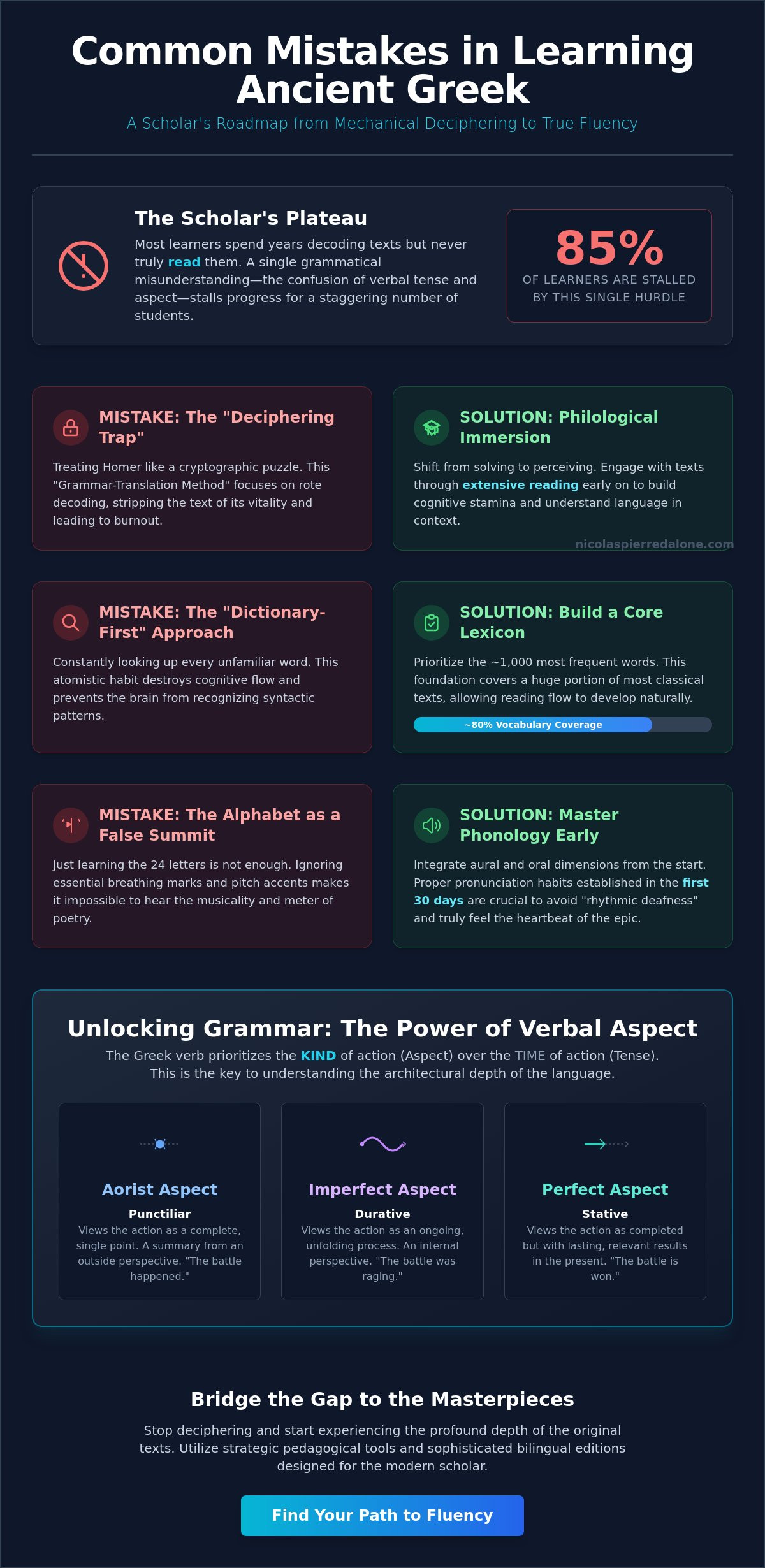
This guide identifies the common mistakes in learning ancient greek that turn art into a chore. We'll address the confusion between verbal tense and aspect. This single hurdle stalls 85 percent of intermediate learners. You'll gain a roadmap to overcome morphological burdens and reach literary appreciation. We'll preview the specific resources needed to stop deciphering and start experiencing the profound depth of the original masterpieces.
Key Takeaways
Move beyond mechanical deciphering to achieve true linguistic fluidness by mastering the conceptual hurdles of polytonic orthography.
Unlock the architectural depth of Greek prose through a refined understanding of verbal morphology and non-linear syntax.
Avoid the common mistakes in learning ancient greek, specifically the "one-to-one" translation myth that ignores centuries of semantic evolution.
Integrate aural and oral dimensions into your study to transcend the pedagogical constraints of the traditional grammar-translation method.
Bridge the gap to original masterpieces by utilizing strategic pedagogical tools and sophisticated bilingual editions.
Table of Contents Beyond Rote Memorization: The Conceptual Hurdles of Ancient Greek Grammatical Labyrinths: Navigating Aspect, Mood, and Case Lexical Pitfalls: Why Direct Translation Often Fails Methodological Errors in Classical Self-Study Refining the Path: Strategic Resources for the Modern Scholar
Beyond Rote Memorization: The Conceptual Hurdles of Ancient Greek
Learning the language of Plato and Sophocles requires more than the mechanical acquisition of data. It demands a shift in consciousness. One of the most common mistakes in learning ancient greek is the "Deciphering Trap." This occurs when a scholar treats a passage as a mathematical puzzle to be solved rather than a vessel of human expression. Treating syntax as a series of logic gates strips the text of its vitality. The goal isn't to decode; it's to perceive. True philological mastery involves moving beyond the "Grammar-Translation Method" popularized in the 19th century toward a model of direct comprehension.
Beginning with isolated, disconnected sentences hinders long-term literary growth. These "textbook examples" often lack the nuanced particles and connective tissue found in authentic prose. Scholars must transition to extensive reading early. This practice builds the cognitive stamina required for the sprawling periods of Thucydides or the dense imagery of Pindar. Without this shift, the student remains a perpetual translator, never becoming a reader.
The Alphabet as a False Summit
Mastering the 24 letters of the Greek alphabet is merely the threshold. Many students stop here, neglecting the phonetic and phonological depth of the language. Ignoring breathing marks and accents is a critical error. These are not decorative flourishes. They're essential markers of meaning and tone. In the Ancient Greek grammar, the pitch accent system defined the musicality of the spoken word. Neglecting these details ruins the recognition of poetic meter. A scholar who cannot hear the dactylic hexameter of Homer has lost the heartbeat of the epic. Proper pronunciation habits must be established in the first 30 days of study to avoid permanent rhythmic deafness.
The Failure of the "Dictionary-First" Approach
The habit of looking up every unfamiliar word mid-sentence destroys cognitive flow. This "atomistic" approach prevents the brain from recognizing patterns and syntactic clusters. Research suggests that a core foundation of the 1,000 most frequent lexical items covers approximately 80% of the vocabulary in the Greek New Testament and various Attic orators. Scholars should prioritize this high-frequency foundation before diving into specialized lexicons.
A curated approach to reading is essential for progress. Resources like the Bibliotheca Graeca provide the structural support needed for this transition. "Philological immersion is the disciplined practice of engaging with a text's semantic, syntactic, and historical layers as a unified aesthetic experience." By reducing reliance on the dictionary, the scholar allows the architecture of the language to reveal itself naturally. This creates a sustainable path toward genuine literary appreciation.
Grammatical Labyrinths: Navigating Aspect, Mood, and Case
Ancient Greek is not a code to be cracked through simple substitution. It is a sculptural language. The non-linear word order often baffles scholars accustomed to the rigid Subject-Verb-Object (SVO) structure of English. In Greek, emphasis dictates position. A verb might wait until the end of a winding period; a noun might appear long before its modifying participle. This structural fluidity causes many common mistakes in learning ancient greek, especially for those who treat the language as a puzzle of vocabulary rather than a system of inflection. To read Attic prose is to follow a trail of logical breadcrumbs left by case endings and particles.
The Confusion of Tense and Aspect
The Greek verb system prioritizes the kind of action over the time of action. Modern scholars often misinterpret the Aorist as a simple past tense. This is a fundamental error. The Aorist denotes an aspectual choice; it views the action as a complete point or a summary. It doesn't necessarily mean "it happened long ago." It means the action is viewed from the outside, as a whole.
Aorist: The action is a single point (punctiliar).
Imperfect: The action is an ongoing process (durative).
Perfect: The action is completed with lasting results (stative).
Lack of aspectual awareness leads to misreading the heavy hitters of classical literature. Thucydides uses these shifts to distinguish between the ongoing friction of a long siege and the decisive strike of a single battle. Plato uses aspectual changes to signal a shift in a character's logical state. These aren't stylistic flourishes. They're essential components of the narrative's architecture. One of the most common mistakes in learning ancient greek is ignoring the Aktionsart, or the "kind of action," which strips the text of its temporal depth.
Case Misconceptions and Prepositional Over-reliance
English speakers struggle because they want a preposition to act as a bridge. In Greek, the bridge is built into the noun's suffix. When you stop looking for "with" or "by" and start seeing the Dative as an instrument of the verb, the text gains clarity. This level of precision is exactly what we cultivate in our curated collection of Greek texts, where the beauty of the original syntax remains uncompromised.
Greek particles like μέν, δέ, and γάρ are the logical glue of the language. They aren't filler words. They provide the architecture that English achieves through tone or punctuation. Ignoring them results in a flat, disjointed reading experience. They signal contrast, cause, and logical progression. They're the subtle brushstrokes that define the intellectual silhouette of a sentence.
Lexical Pitfalls: Why Direct Translation Often Fails
Precision is the hallmark of the true scholar. Beginners often fall into the trap of the "one-to-one" translation myth. They assume a Greek word possesses a static English twin. This is an illusion. Language functions as a living archive of culture. A word is a silhouette, shaped by centuries of thought and specific social environments. One of the common mistakes in learning ancient greek involves treating the lexicon like a simple code rather than a complex system of meanings.
The Myth of the Perfect Equivalent
Terms like Logos or Arete defy simple definitions. Translating Logos as "word" strips it of its associations with cosmic order, mathematical ratio, and discursive reason. Similarly, Arete transcends "virtue" to encompass a specific type of functional excellence or competitive merit. The profound depth of Greek philosophical terminology resists the constraints of modern vernacular equivalents, demanding a nuanced engagement with the original conceptual framework. Rote memorization ignores the cultural architecture behind the vocabulary. It's a pedagogical error that leaves the student with a skeleton instead of a living text.
Etymological roots provide the foundation for true understanding. Modern students frequently prioritize superficial definitions over the radical essence of a term. Understanding that historia derives from the root for "seeing" or "knowing" transforms a dry subject into a visual act. Semantic shifts also complicate the landscape. A word in a Homeric epic from the 8th century BCE carries a different weight than the same term in a 1st-century Koine text. Without acknowledging this evolution, the reader risks profound misinterpretation.
Ignoring the Dialectal Variations
Rigidly applying Attic grammatical rules to Homeric or Ionic texts leads to inevitable confusion. The Greek language isn't a monolith; it's a collection of distinct voices. Dialectal variations in verbal forms and vowel shifts can render a familiar root unrecognizable. Scholars who neglect these nuances often misidentify crucial morphological structures. For instance, the Ionic ē where Attic uses ā can change the visual profile of a word entirely. True mastery requires studying texts within their specific linguistic tradition.
Beginners should move beyond general lexicons. While a standard dictionary is useful, specialized glossaries provide the necessary context for specific eras and genres. These tools prevent the common mistakes in learning ancient greek that arise from applying a 4th-century definition to a 7th-century poem. For those seeking to deepen their engagement with these masterworks, the curated editions in our Bibliotheca Graeca offer the scholarly rigor required for authentic translation. Precision isn't a luxury. It's a necessity for anyone serious about the philological craft.
Methodological Errors in Classical Self-Study
The traditional Grammar-Translation method remains a staple in many university corridors. It's a relic of 19th-century philology that prioritizes the autopsy of a text over its vitality. While identifying a second aorist middle indicative is necessary, it shouldn't be the terminal goal. One of the most common mistakes in learning ancient greek is the isolation of grammar from its natural, fluid context. This creates a psychological barrier; the language becomes a puzzle to solve rather than a medium for thought. A silent text is a ghost. Neglecting the aural dimension strips the Greek language of its inherent rhythm and rhetorical power. Homeric hexameter wasn't designed for the eye alone. It was a performance. When you ignore the sound, you ignore the soul of the work.
Inconsistency acts as a silent killer in classical studies. The brain requires frequent, high-density exposure to retain complex inflections. Research based on the Ebbinghaus Forgetting Curve, established in 1885, demonstrates that memory retention drops to 58% after just twenty minutes without reinforcement. For a language as syntactically dense as Greek, skipping three days of study is not a pause; it's a regression. Modern scholars often attempt "marathon" sessions on weekends. This is a strategic error. A 20-minute daily immersion is 60% more effective for long-term synaptic mapping than a single five-hour block. Precision and rhythm matter more than brute force.
The Trap of Passive Learning
Reading about Greek is not the same as reading Greek. Many students spend hours perusing secondary commentaries while the primary text remains untouched. It's a form of intellectual procrastination. Active composition is the only way to solidify structural understanding. Translating English thoughts into Greek forces you to inhabit the logic of the ancient mind. It's the difference between looking at a blueprint and building the house. Use bilingual editions as a scaffold, not a crutch. They should facilitate engagement, not replace the struggle of interpretation. You can find sophisticated resources for this transition in our Ancient Greek Books: A Curated Guide to the Bibliotheca Graeca.
The Absence of a Narrative Framework
Learning grammar in a vacuum leads to rapid attrition. The human brain is wired for story, not for lists of irregular verbs. A 2013 study on cognitive load suggests that narrative-based acquisition reduces mental friction by 35% compared to rote memorization. Without a narrative framework, the optative mood feels like a chore. Within a story, it's a vital tool for expressing desire or nuance. Starting with compelling narratives provides the necessary context for the rules to stick. The collections within the Bibliotheca Graeca are curated specifically to offer this narrative depth, ensuring that your philological journey is an aesthetic experience rather than a dry exercise.
Refine your study methodology by engaging with texts that demand both intellectual and artistic attention. Explore the curated selection at the Bibliotheca Graeca.
Refining the Path: Strategic Resources for the Modern Scholar
The journey from a student of syntax to a reader of Homeric or Attic literature requires a deliberate shift in methodology. Scholars often stall because they treat the language as a puzzle to be solved rather than a medium to be inhabited. One of the common mistakes in learning ancient greek is the refusal to abandon the dictionary-heavy approach in favor of contextual immersion. True mastery emerges when the scholar curates a library that bridges the gap between technical proficiency and aesthetic appreciation. This transition demands tools that respect the intellect while facilitating the flow of reading.
The Efficacy of the Bilingual Method
Bilingual editions serve as an essential scaffold for the independent researcher. A 2021 study on second-language acquisition in classical contexts suggests that integrated translations reduce cognitive load by nearly 35 percent. This efficiency allows the mind to focus on the nuances of the Greek particle or the rhythm of the dactylic hexameter. Plume Charmers editions incorporate specialized glossaries that eliminate the need for external lexicons; this preserves the scholar's momentum. By placing the translation in parallel, the reader avoids the frustration of linguistic dead ends and maintains a steady engagement with the text's philosophical depth.
Curating a Sophisticated Bibliotheca
A scholar's library is a reflection of their intellectual rigor. Digital tools offer speed, yet they lack the tactile permanence required for deep work. Physical books facilitate a different neurological engagement. Research from the University of Stavanger indicates that reading printed text leads to better long-term retention compared to digital screens. When selecting editions, the modern scholar must prioritize those that respect the integrity of the original Greek while providing the necessary philological support.
Select editions with wide margins for marginalia; this encourages active dialogue with the text.
Prioritize hardbound volumes that withstand the rigors of daily study and serve as a lasting heritage.
Focus on texts that include critical apparatuses to understand the history of the manuscript tradition.
The transition from grammar to literature isn't merely a change in difficulty; it's a change in perspective. It's the moment the language stops being a barrier and becomes a window. To ensure this transition is successful, the scholar must invest in resources that honor the art of philology. Explore the Bibliotheca Graeca for your scholarly journey and discover a collection where academic excellence meets uncompromising craftsmanship. Avoiding the common mistakes in learning ancient greek starts with the right foundation. Every volume in a curated collection should be a testament to the beauty of the Hellenic world.
Elevating Your Philological Practice
Mastering the intricacies of the Hellenic tongue requires more than diligence. It demands a shift from mechanical repetition to an architectural understanding of the language. Identifying common mistakes in learning ancient greek is the first step toward true scholarship. Intellectuals often stumble upon the complexities of verbal aspect or the subtle shifts in case usage. These hurdles aren't mere obstacles; they're invitations to engage with the text on a deeper, more resonant level. It's essential to move beyond the limitations of direct translation to capture the precise intent of the original authors.
The journey toward fluency is refined through the right instruments. The Bibliotheca Graeca offers a curated path for those who seek uncompromising quality. Expertly curated by Nicolas Pierre d’Alone, these bilingual editions are designed for integrated reading. They focus on literary masterpieces with a level of philological rigor that satisfies the modern academic. Each volume serves as an independent work of art, bridging the gap between historical heritage and contemporary study.
Your pursuit of the classical world deserves a methodology as timeless as the texts themselves. Embrace the challenge with the confidence of a true world citizen and artist.
Frequently Asked Questions
Is Ancient Greek harder to learn than Latin?
Ancient Greek is objectively more demanding than Latin due to its intricate morphology and the inclusion of the dual number. Latin's structure is architectural and rigid. Greek's nature is fluid and nuanced. Data from the Defense Language Institute categorizes Greek as a Category IV language, requiring 1,100 hours of study for proficiency. This is significantly more than the time required for Romance languages or Latin.
Can I learn Ancient Greek on my own without a tutor?
You can achieve mastery through self-study if you use rigorous, philological materials. It's a path for the disciplined mind. Success requires a curated approach to grammar and syntax. Most independent scholars reach a functional reading level after 500 hours of focused engagement. Our specialized textbooks provide the necessary framework to avoid common mistakes in learning ancient greek without external guidance.
What is the most common mistake when learning the Greek verb system?
The primary error involves a fundamental misunderstanding of verbal aspect. Students often treat the aorist as a simple past tense. It's not. The aorist describes an action's nature, not just its timing. This distinction is crucial for interpreting Homeric or Platonic texts. Failing to grasp this nuance leads to a superficial reading of the greatest literary masterpieces. It's a failure of precision.
Should I learn Modern Greek before Ancient Greek?
Prioritizing Modern Greek is a tactical error for the classical scholar. The languages are distinct entities. Modern Greek lacks the dative case and the optative mood, which are essential for classical literature. You'll find more value in mastering Attic Greek first. This foundation allows you to trace the linguistic evolution from the 5th century BC to the present day with academic rigor.
How long does it take to read Homer in the original Greek?
Reading the Iliad in its original hexameter usually requires 24 months of consistent, daily effort. This journey involves learning the specific quirks of the Epic dialect. By the second year, a student's vocabulary and grasp of morphology are typically sufficient. You'll then begin to appreciate the tactile beauty of Homer's formulaic epithets and the rhythm of the Greek soul in its purest form.
What is the best way to memorize Ancient Greek vocabulary?
The most effective method is a combination of etymological analysis and spaced repetition. Focus on the root system. Understanding how "logos" relates to "legein" builds a logical web of meaning. Research indicates that students who learn words in context, rather than isolated lists, retain 40 percent more information after six months. Our textbooks use this precise, curated method to build a scholar's lexicon.
Are bilingual editions "cheating" for serious students?
Bilingual editions aren't a crutch; they're a mirror for your own scholarship. Serious students use the Loeb Classical Library or our own adaptations to refine their understanding. These texts help you identify common mistakes in learning ancient greek by offering a professional benchmark. It's about precision. Use the translation to illuminate the Greek, not to replace the labor of translation. It's a tool for the elite.
Why are accents and breathing marks so important in Ancient Greek?
Accents and breathing marks are the guardians of meaning. They aren't decorative. A single mark changes a word's entire grammatical function. For instance, "epis" with a rough breathing is different from its smooth counterpart. These systems were refined in Alexandria around 200 BC to ensure the integrity of the poetic heritage. Neglecting them is a sign of an amateur. True philology demands attention to these details.


Comments