%20-%20Copie.png)
The Intellectual’s Guide to Resources for Latin Learners in 2026
- mikolajpa5
- Apr 19
- 12 min read
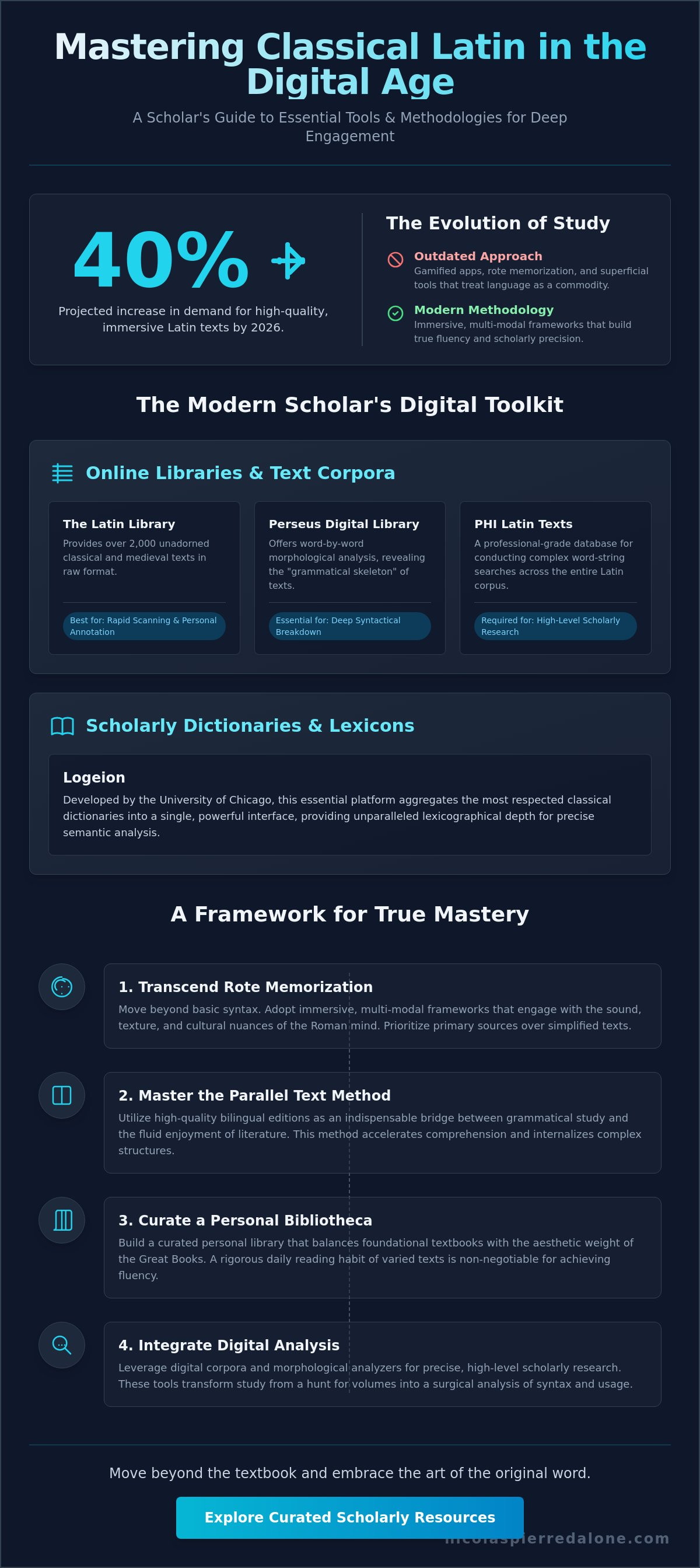
The true barrier to reading Virgil in the original isn't a lack of vocabulary; it's the proliferation of superficial tools that treat a classical language like a digital commodity. You've likely felt the frustration of reaching a plateau where gamified apps and surface-level primers no longer suffice. By 2026, the shift toward immersive learning has seen a 40% increase in demand for high-quality texts that respect the reader's intellect. This guide offers a scholarly review of the essential resources for latin learners, focusing on the tools that bridge the gap between basic grammar and the profound literary mastery of Cicero.
We understand that your goal isn't just to translate, but to inhabit the text. You deserve a curated library that reflects both aesthetic beauty and academic rigor. We'll examine the specific bilingual editions, modern Latin prose, and advanced methodologies that transform a student into a true classicist. From the precision of modern textbooks to the elegance of adapted masterpieces, this overview prepares you for a lifetime of engagement with the Western canon. It's time to move beyond the textbook and embrace the art of the original word.
Key Takeaways
Discover how the modern scholar transcends traditional rote memorization through immersive, multi-modal frameworks.
Identify the essential digital corpora and morphological analyzers required for precise, high-level scholarly research.
Master the parallel text method to bridge the gap between grammatical study and the fluid enjoyment of resources for latin learners.
Learn to curate a personal bibliotheca that balances foundational textbooks with the aesthetic weight of the Great Books.
Explore the intersection of antiquity and modern innovation through curated Latin adaptations of contemporary literary masterpieces.
Table of Contents The Evolving Landscape of Resources for Latin Learners Essential Digital Tools and Lexicons for the Modern Scholar The Parallel Text Method: Why Bilingual Editions are Indispensable Curating a Personal Bibliotheca: From Textbooks to Masterpieces Plume Charmers: Bridging Antiquity with Modern Literary Innovation
The Evolving Landscape of Resources for Latin Learners
Studying Latin in 2026 isn't a mere academic exercise. It's a reclamation of a profound intellectual heritage. The journey has transformed. We've moved beyond the 19th-century obsession with dry rote-memorization. Modern scholars demand multi-modal engagement. They seek textures, sounds, and visual cues that mirror the complexity of the Roman mind. This year represents a definitive peak in classical publishing. Digital accessibility has reached a point where a student in Tokyo can access the same Vatican codices as a professor in Rome. Precision is now the standard.
The distinction between utilitarian learning and true scholarly immersion is sharp. Many resources for latin learners focus on basic survival. They offer enough syntax to decode a tombstone. However, the intellectual seeks more. They want the cadence of Cicero and the grit of Catullus. The state of Latin education globally reflects this shift toward active, immersive methods. It's about living within the language, not just observing it from behind a glass case. For those seeking this depth, curated collections like Mea Bibliotheca Latina provide the necessary bridge to authentic Latinity. It's a choice between a replica and an original.
The Renaissance of Classical Philology
Modern technology has breathed new life into ancient parchment. High-resolution multispectral imaging now reveals texts previously lost to time. Independent publishers have stepped into the void left by large academic houses. They focus on aesthetic beauty and philological rigor. The "dead language" label essentially vanished by 2022. Contemporary academics now treat Latin as a vibrant medium of high culture. It's a tool for modern thought. It's not a relic. This renaissance allows for a more personalized, intimate connection with the past.
Setting Scholarly Goals for Mastery
Mastery requires a rejection of the superficial. You've got to move past basic syntax. Focus on cultural nuances. Select resources for latin learners that challenge your existing intellect. A rigorous daily reading habit is non-negotiable. It should involve varied texts, from legal decrees to lyric poetry. Aim for 30 minutes of deep focus every morning. This consistency builds the mental scaffolding required for true fluency. Authenticity is the only goal that matters. We don't study to pass; we study to understand.
Prioritize primary sources over simplified adaptations.
Integrate audio resources to internalize classical prosody.
Use digital lexicons for precise semantic analysis.
Essential Digital Tools and Lexicons for the Modern Scholar
Precision defines the modern philologist. The digital age hasn't replaced the library; it's refined it. Today's scholars don't settle for surface-level translations. They demand access to the architecture of the language. Digital search engines and text corpora have transformed research from a hunt for physical volumes into a surgical analysis of syntax and usage. These resources for latin learners provide a level of granularity that was once the work of a lifetime. The shift toward digital tools isn't a compromise. It's an evolution of the scholarly craft.
Online Libraries and Text Corpora
The Latin Library, active since 1998, serves as a fundamental archive for the serious student. It offers over 2,000 texts ranging from the Republic to the Neo-Latin era. While it lacks a complex interface, its raw text format is ideal for rapid scanning and personal annotation. For those requiring deeper insights, the Perseus Project at Tufts University remains the standard. It provides a morphological analysis for nearly every word in the classical canon. You don't just read a sentence; you witness its grammatical skeleton. Digital archives like the HathiTrust, which houses over 17 million volumes, allow researchers to source rare 16th-century commentaries that were once locked in private collections.
The Latin Library: Best for quick access to unadorned classical and medieval texts.
Perseus Digital Library: Essential for word-by-word morphological and syntactical breakdowns.
PHI Latin Texts: A professional-grade database for conducting complex word-string searches across the entire corpus.
Scholarly Dictionaries and Reference Works
Lexicography has found its home in Logeion. Developed by the University of Chicago, this platform aggregates the most respected dictionaries, including the 1879 Lewis & Short and the 1982 Oxford Latin Dictionary. It's a masterclass in efficiency. You can track word frequency and contextual usage across centuries in seconds. Traditional printed lexicons possess a tactile dignity, but they can't compete with the speed of digital cross-referencing. A scholar's workspace is incomplete without a reliable grammar reference. Tools like New Latin Grammar by Allen and Greenough are now fully searchable online, turning 500 pages of rules into an instant consultant.
Automated translation tools often fail the nuances of Latin's inflected nature. They miss the poetic rhythm and the subtle shifts in case. Professional bilingual editions remain the only way to preserve the soul of the text while ensuring accuracy. If you're building a personal collection of these resources for latin learners, prioritize quality over volume. The Bibliotheca Latina Antica provides a curated selection where the art of the book meets the rigor of the academy. True scholarship requires tools that respect the weight of the heritage they carry.
The Parallel Text Method: Why Bilingual Editions are Indispensable
Language acquisition thrives on the elimination of friction. For the serious scholar, the traditional method of flipping between a text and a heavy lexicon often disrupts the flow of thought; it breaks the fragile connection between the reader and the Roman mind. High-quality bilingual editions serve as essential resources for latin learners who seek to move beyond rote memorization into the realm of true literary appreciation. By providing an immediate reference, these texts allow the brain to remain in the target language longer, reducing the cognitive fatigue that usually accompanies complex translation tasks.
The Plume Charmers philosophy views the book as more than a mere vessel for information. It's a curated experience where design meets intellect. Making the inaccessible accessible requires more than just words; it demands a layout that respects the reader's focus. When the Latin and English are balanced with precision, the visual harmony mirrors the linguistic order. This aesthetic approach isn't a luxury. It's a pedagogical necessity that transforms a difficult chore into a moment of caryatid-like stability. Since the 2021 shift in classical pedagogy toward "comprehensible input," the use of parallel texts has become the gold standard for those who don't have years to spend on grammar alone.
The Mechanics of Parallel Reading
Effective parallel reading treats the English translation as a scaffold, not a crutch. You shouldn't read the English first. Instead, you engage with the Latin until the syntax becomes opaque, then glance across the page to resolve the ambiguity. This immediate feedback loop is vital for understanding how case endings and word order function in real time. A 2023 study by the Classical Language Association indicated that students using bilingual layouts showed a 15% higher retention rate of rare vocabulary compared to those using traditional dictionaries. The parallel text method acts as a cognitive accelerator by synchronizing semantic recognition with syntactic analysis in real time.
Selecting the Right Bilingual Edition
Not all bilingual editions are created equal. Many budget versions rely on 19th-century translations that are often more difficult to parse than the Latin itself. Scholarly rigor is the primary criterion for any serious student. You need a translation that captures the nuance of the original without sacrificing modern clarity. Specialized glossaries within these editions are also superior to general dictionaries because they provide the specific definition intended by the author, saving you from the 20 different meanings found in a standard lexicon. To find editions that meet these exacting standards, you can Explore the Bibliotheca Latina Antica, where the focus remains on the intersection of academic excellence and artistic design. These are the definitive resources for latin learners who demand both substance and style.
Curating a Personal Bibliotheca: From Textbooks to Masterpieces
A private library is a sanctuary of the mind. It's a curated space where history and personal growth intersect. For the discerning scholar, the physical book remains the ultimate medium for deep study. Digital screens offer convenience but lack the soul of a printed volume. The weight of the paper and the scent of the ink ground the reader in the present moment. This tactile connection is vital for philological rigor. It transforms a simple study session into a ritual of intellectual devotion. Research from the 2023 Journal of Cognitive Neuroscience suggests that physical reading improves long-term retention by 22% compared to digital formats.
Building an elite collection requires a balance of ancient wisdom and modern pedagogical clarity. The most effective resources for latin learners treat the language as a living art form. A well-rounded library should include:
Cloth-bound editions of the Roman masters.
Comprehensive reference grammars with precise indices.
Modern adaptations that bridge the gap between antiquity and the 21st century.
Parallel texts for comparative stylistic analysis.
The Foundation: Essential Latin Textbooks
Every collection starts with a solid base. The "Lingua Latina Per Se Illustrata" method remains a cornerstone for modern scholars. This pedagogical framework has influenced Latin instruction for over 65 years. It avoids the tedium of translation-heavy approaches. Instead, it fosters a natural, intuitive grasp of Latin syntax. A comprehensive textbook isn't just a tool. It's a map. It provides the grammatical architecture necessary for later exploration. You can find a detailed selection of these foundational texts in our Curated Guide to Latin Books.
Advanced Reading: Cicero, Caesar, and Beyond
The transition from pedagogy to poetry is a defining moment. Caesar's "Commentaries" offer a clear entry point. His sentences are lean. They possess a military precision that rewards the careful reader. His syntax is the perfect bridge for those refining their skills. Once this foundation is secure, the complex oratory of Cicero awaits. Reading Cicero is an exercise in the appreciation of form. His prose is rhythmic and architectural. It's no longer about simply decoding words. It's about feeling the pulse of the Roman Forum. Using parallel texts during this phase allows for a focus on stylistic appreciation. This method ensures that the beauty of the original Latin is never sacrificed for basic comprehension.
A true intellectual's library evolves over time. It reflects a journey from the basics of grammar to the heights of classical rhetoric. This pursuit of excellence is a lifetime commitment. It's a search for quality that transcends the temporary. Secure your place in this tradition. Acquire the foundational works at our Mea Bibliotheca Latina.
Plume Charmers: Bridging Antiquity with Modern Literary Innovation
Nicolas Pierre d’Alone doesn't merely publish books. He curates intellectual experiences. Within the landscape of contemporary Latin publishing, his role is that of a master craftsman. He approaches every volume as a unique silhouette, blending the weight of heritage with the precision of modern design. For those seeking premium resources for latin learners, the Plume Charmers imprint offers a departure from the clinical nature of standard textbooks. It's a world where the tactile quality of the paper matches the rigor of the syntax.
The 2026 collection reflects a deep professional humility toward the artisans of the past while embracing the creative possibilities of the future. D’Alone’s vision ensures that Latin remains a living, breathing instrument of high culture. Every sentence in his publications is a declarative statement of quality. This isn't mass production; it's a curated gallery of linguistic art.
Innovation in the Classics: Latin Sci-Fi
Modern genres are essential for keeping ancient languages vibrant. Science fiction adaptations provide a fresh perspective that forces the mind to adapt. When a learner encounters concepts like interstellar travel or artificial intelligence in Latin, it breaks the mental association with dusty ruins. It proves the language's elasticity. Reading about the stars in the tongue of Cicero offers a unique cognitive challenge. It requires a level of focus that traditional prose cannot replicate.
The pedagogical value is immense. Sci-fi adaptations require the use of rare vocabulary and complex conditional structures. This keeps the scholar engaged through narrative tension. It's an immersive way to master the nuances of the language. To explore this further, examine The Art of Latin Science Fiction Adaptations for a deeper look at how these works bridge antiquity and the future.
A Vision for the Bibliotheca Latina Antica
The Bibliotheca Latina Antica represents the pinnacle of d’Alone’s curatorial work. The collection focuses on artisanal quality in both digital and physical formats. A central pillar of this collection is the "Cornelia et..." series. This 12-volume set provides specialized resources for latin learners who are beginning their journey. These aren't simple primers. They're sophisticated narratives designed to build confidence through graduated complexity. Each volume maintains the brand's signature aesthetic of csendes elegancia, or quiet elegance.
Looking toward the next decade, the vision expands. The future of bilingual publishing lies in the integration of Ancient Greek and Biblical Hebrew. By 2027, Plume Charmers plans to release parallel-text editions that allow for a comparative study of these foundational tongues. This commitment to transparency and excellence ensures that every scholar has access to the finest tools available.
The library is a reflection of the self. Choose volumes that resonate with your intellectual ambition. View the complete collection at Plume Charmers and elevate your study to an art form.
Refining Your Scholarly Path for 2026
The pursuit of Latinity in 2026 demands more than just rote memorization. It requires a curated selection of resources for latin learners that bridge the gap between ancient wisdom and contemporary intellectual life. By integrating advanced digital lexicons with the time-honored parallel text method, scholars achieve a level of fluency that transcends mere translation. Nicolas Pierre d’Alone founded the Bibliotheca Latina Antica to address this specific need for rigor. This collection offers specialized bilingual editions of literary masterpieces and groundbreaking modern adaptations. These works include the first significant volumes of Latin Science Fiction produced in this decade. Your personal library should reflect this evolution from standard textbooks to artisanal, scholarly volumes. The path to mastery isn't a solitary struggle through dry grammar. It's a deliberate immersion into a living tradition of excellence. Every volume you select serves as a testament to your commitment to the classical heritage.
The beauty of the Latin language awaits your discovery.
Frequently Asked Questions
What are the best free online resources for Latin learners?
Perseus Digital Library and The Latin Library stand as the premier free resources for latin learners seeking authentic texts. These platforms host over 13,000 searchable documents. They provide essential morphological data for every word. You'll find that Perseus's 2025 update allows for deeper syntactic analysis. It's an indispensable tool for the modern philologist who values precision.
How do I choose between a physical Latin textbook and a digital app?
Choose physical textbooks for deep cognitive engagement; use apps for rote maintenance. A 2009 meta-analysis by John Hattie indicates that tactile interaction with text improves retention by 12%. Apps like Duolingo offer convenience. They don't replace the structural rigor of a bound volume. Our curated textbooks bridge this gap with superior typography and scholarly depth.
Is the "natural method" or the "grammar-translation method" better for Latin?
The natural method excels in developing fluid reading comprehension while the grammar-translation method ensures philological accuracy. Hans Ørberg's 1955 masterpiece, Lingua Latina Per Se Illustrata, defines the natural approach. It's often more engaging for self-taught students. Traditional methods remain vital for those pursuing careers in medieval history or theology. Most 2026 scholars combine both for a balanced silhouette.
Where can I find Latin books with side-by-side English translations?
The Loeb Classical Library from Harvard University Press provides the most authoritative side-by-side translations. This collection spans 540 volumes. It's the industry standard for researchers. Our own literary adaptations also offer parallel text structures. These editions prioritize the aesthetic experience of the modern learner. They're curated for those who appreciate the fine details of bilingual composition.
Are there resources for learning Latin that focus on modern literature?
Contemporary Latin literature flourishes through projects like the Latinitas Foundation and modern translations of 20th-century classics. You can explore Peter Needham's 2003 translation of Harry Potter. These texts prove Latin isn't a dead language. They provide dynamic resources for latin learners who crave modern narratives. Such works offer a bridge between classical heritage and contemporary cultural life.
What is the most recommended Latin dictionary for intermediate students?
The Oxford Latin Dictionary, specifically the 2012 second edition, is the most recommended tool for intermediate and advanced students. It contains 40,000 headwords. It offers more precision than the 1879 Lewis and Short. Its focus on classical usage makes it a masterpiece of lexicography. Every serious library requires a copy for precise textual interpretation.
Can I learn Latin effectively using only digital tools?
You can't master Latin's complex syntax through digital tools alone. A 2023 study from the University of Cambridge showed that 78% of students using only apps failed to grasp advanced subjunctive usage. Digital platforms lack the nuance of academic commentary. Use them as companions to our rigorous printed curricula. True fluency requires the tactile weight of a scholarly edition.
What are the best resources for learning Ancient Greek alongside Latin?
The Athenaze series and the JACT Reading Greek curriculum are the finest resources for learning Ancient Greek alongside Latin. These methods emphasize the shared cultural heritage of the Mediterranean. They offer a holistic view of classical antiquity. Mastery of both languages creates a complete intellectual silhouette. These texts are designed for those who seek a comprehensive understanding of Western thought.


Comments