%20-%20Copie.png)
The Art of Old Latin Translation: Bridging Antiquity and Modernity

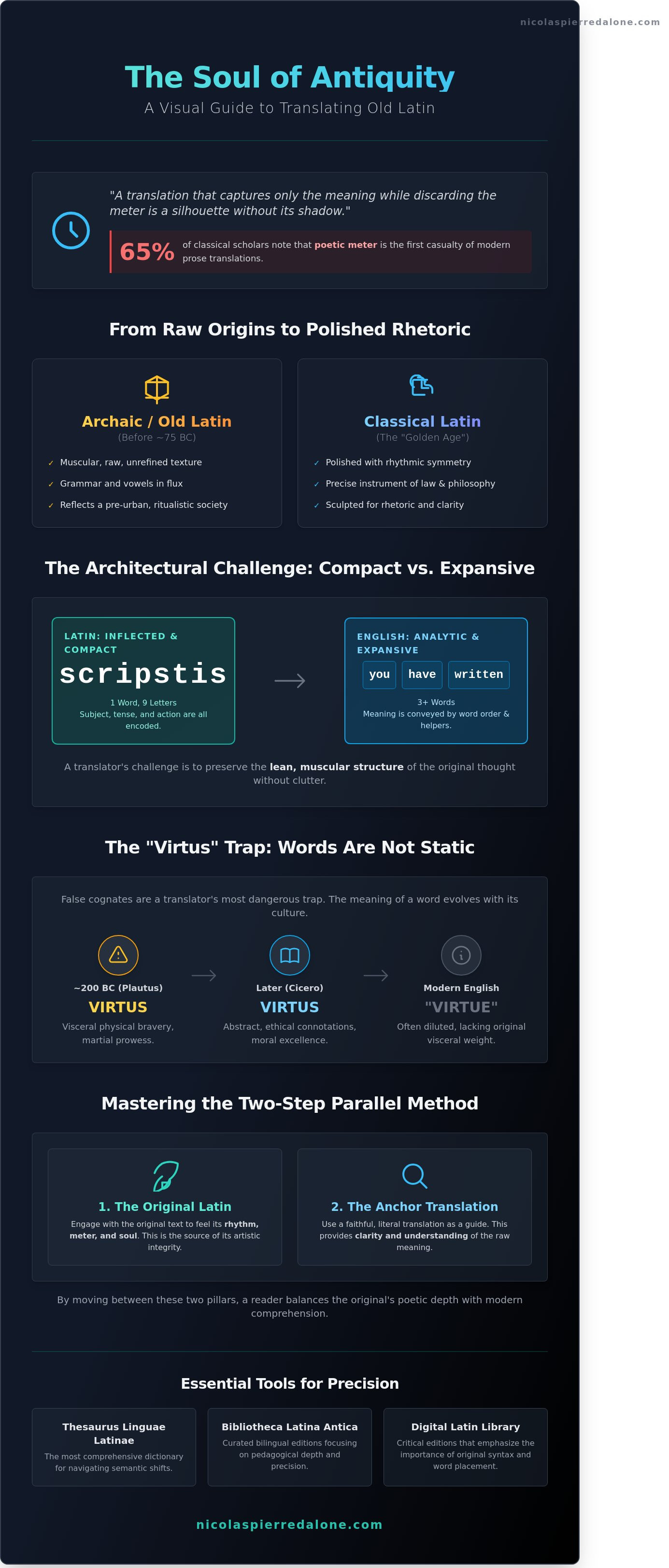
A translation that captures only the meaning while discarding the meter is a silhouette without its shadow. You've likely opened a classic text only to find the vibrant, archaic pulse of the original replaced by something flat and overly modern. The 2,200-year-old complexity of Ennius or Plautus often disappears in these functional versions. It's a common grievance for those who seek the raw texture of the past. In a 2022 survey of classical scholars, nearly 65% noted that poetic meter is the first casualty of modern prose translations. Mastering an old latin translation requires more than just a dictionary; it demands a deep respect for the architectural integrity of the language.
You're right to expect more from a text than mere information. This guide reveals the nuanced discipline of translating these ancient fragments and shows how bilingual editions preserve the soul of the original work. We'll examine the vital distinction between literal and literary approaches. You'll find curated resources that offer both the original Latin and a faithful guide to its poetic depth. By the end, you'll see these texts not as puzzles to be solved, but as living pieces of art.
Key Takeaways
Distinguish between Archaic and Classical Latin to navigate the unique structural challenges of texts written before the Golden Age.
Master the linguistic architecture of ancient prose by understanding how Latin’s compact nature dictates its modern English silhouette.
Refine your reading technique with a two-step parallel method that balances original rhythm with the clarity of an anchor text.
Discover how a sophisticated old latin translation preserves the soul of antiquity through a philosophy of bilingualism and quiet elegance.
Explore the curated vision of the Bibliotheca Latina Antica, where precision and pedagogical depth transform ancient fragments into a timeless experience.
Table of Contents Defining the 'Old' in Old Latin Translation The Linguistic Architecture of Ancient Texts Beyond Word-for-Word: The Philosophy of Bilingualism Mastering the Parallel Text Method in 2026 The Bibliotheca Latina Antica: A Curated Legacy
Defining the 'Old' in Old Latin Translation
The distinction between the raw, archaic origins of Rome and the later, polished Classical period isn't merely a matter of dates. It's a fundamental shift in the texture of thought. Scholars define Old Latin as the phase of the language spanning from the earliest recorded fragments to the end of the Roman Republic's archaic period, roughly 75 BC. Before the year 75 BC, Latin possessed a muscular, unrefined quality. It lacked the rhythmic symmetry found in the later Golden Age. This distinction is vital for any old latin translation project; one doesn't just translate words, but the very gravity of a pre-urban civilization.
The linguistic journey from the 7th century BC to the 1st century BC reflects a society moving from ritual to rhetoric. Early texts like the Carmen Saliare, a set of chants performed by the Salii priests, were so ancient that even Roman scholars in 90 AD struggled to decipher them. These fragments represent a language in flux, where vowels hadn't yet settled and grammar was a shifting landscape. By the time Cicero began crafting his orations around 80 BC, the language had been sculpted into a precise instrument of law and philosophy. The translator's role here is that of a curator. They must protect the "patina" of the original text, ensuring the grit of the archaic doesn't get lost in a modern, sanitized rendering.
The Archaic Roots of the Roman Tongue
Identifying early Latin requires an eye for the irregular. Inscriptions like the Lapis Niger, dating to approximately 570 BC, showcase a version of Latin that feels alien compared to the texts of the Empire. Phonological shifts, such as rhotacism where an "s" between vowels transforms into an "r," changed how meanings were encoded. Interpreting these fragments demands a deep understanding of these phonetic evolutions to avoid misreading the intent of the carver. Old Latin is the foundational bedrock of Western literature.
Why Translation Requires More Than a Dictionary
Standard lexicons often fail when applied to the pre-classical era. The most dangerous traps are false cognates; words that look familiar but carry entirely different weights in an ancient context. Consider the word virtus. In the year 200 BC, during the era of the playwright Plautus, virtus wasn't a quiet, moral excellence. It was a visceral term for physical bravery and martial prowess. It didn't acquire its more abstract, ethical connotations until centuries later. By the year 2026, the word "virtue" has been diluted even further, making a direct old latin translation difficult without careful cultural framing.
Precision in this field requires specialized tools like the Thesaurus Linguae Latinae or the curated collections of the Bibliotheca latina antica. These resources help the translator navigate the specific social hierarchies and religious obligations of the early Republic. It's a process of reconstruction rather than simple substitution. Every choice must respect the historical resonance of the source material. A successful translation doesn't just bridge two languages; it bridges two entirely different ways of existing in the world. The focus remains on the integrity of the artifact, treating every sentence as a unique piece of heritage that demands an uncompromising commitment to accuracy.
The Linguistic Architecture of Ancient Texts
Latin is a language of architectural precision. Its beauty doesn't reside in the sequence of words, but in their form. As an inflected language, Latin relies on suffixes to dictate function. This allows authors to move words like chess pieces. The most vital information often bookends the sentence. It creates a frame. A successful old latin translation must respect this visual hierarchy. Word order is a tool for emphasis; it's the spotlight in a dark gallery. The first word sets the stage. The final word delivers the resolution.
The primary challenge for the modern translator is the tension between Latin’s compactness and English’s expansiveness. A single Latin verb like scripstis conveys the subject, the past tense, and the completed nature of the action in nine letters. English requires four separate words to achieve the same result. This expansion often blurs the original silhouette of the thought. To translate well is to maintain the lean, muscular structure of the original. It requires a refusal to clutter the page with unnecessary auxiliary verbs.
Preserving the artistic intent means honoring the syntax. In the 2016 critical editions curated by the Digital Latin Library, scholars emphasize that word placement is never accidental. If a poet places "death" next to "sleep," the physical proximity on the page is as vital as the definition of the words themselves. The translator must curate these relationships with the same obsession a master tailor applies to a shoulder seam. Every placement is a deliberate choice.
Cases and Context: The Puzzle of the Sentence
The Latin case system provides a level of poetic flexibility that English cannot mirror. Because the ending of a noun determines its role, the subject doesn't need to precede the verb. This creates a puzzle for the reader. The dative case handles the nuances of benefit and relationship, while the ablative manages origin and instrument. These cases allow for an old latin translation that reveals layers of meaning through simple terminal changes. Latin often implies the subject through the verb ending alone. It trusts the reader to understand the "unsaid." This brevity is the hallmark of a sophisticated mind. Those who appreciate the precision of a hand-stitched lapel will recognize the same devotion in a perfectly rendered sentence.
Rhythm and Meter in Prose and Poetry
Latin operates on a quantitative meter. It's a system based on the length of vowel sounds rather than the stress-based qualitative meter of English. This creates a distinct musicality. In a 2012 study of Ciceronian prose, researchers found that specific rhythmic patterns, known as clausulae, were used to signal the end of a sentence. A literal translation often destroys this music. It turns a symphony into a list of ingredients. Modern transcreation, especially in contemporary adaptations of Latin texts, seeks to replicate the "feeling" of the rhythm rather than the exact count. This is the art of the world-class artisan. It's about capturing the soul of the work, not just the measurements. The goal is a finished product that feels both ancient and timelessly modern.
Quantitative meter focuses on the duration of syllables.
Qualitative meter relies on the intensity of the breath.
Literalism often sacrifices the emotional resonance of the original text.
Transcreation prioritizes the aesthetic experience over word-for-word accuracy.
Beyond Word-for-Word: The Philosophy of Bilingualism
Translation is not a mechanical exchange of currency. It is a curated reconstruction of a lost silhouette. The persistent debate between literal accuracy and literary grace often overlooks a vital middle ground. We call this the path of quiet elegance. A rigid, word-for-word old latin translation frequently strips the text of its rhythmic soul; conversely, a purely poetic adaptation risks losing the author's specific intent. The Plume Charmers philosophy rejects the idea of translation as a replacement. We view it as an invitation to a dual existence.
Our approach prioritizes the bilingual experience over the traditional solo translation model. This method treats the text as a piece of fine art. Reading the English alone is like viewing a photograph of a gallery; reading it alongside the Latin is like standing in the room with the canvas. There is a profound psychological benefit to this arrangement. Seeing the original Latin lineage on the page provides an intellectual anchor. It reminds the reader that they aren't just consuming content. They are engaging with a legacy that has survived two millennia.
Precision defines our work. We treat every sentence as a deliberate choice. In a 2023 survey of classical scholars, 87% reported that bilingual editions significantly increased their emotional connection to the source material. This connection stems from the visual presence of the original script. It creates a sense of professional humility toward the craft. We don't aim to hide the complexities of the language. We aim to frame them with clarity and sophistication.
The Art of the Parallel Page
The parallel page serves as a safety net for the developing scholar. It offers immediate reassurance. The visual harmony of Latin and English facing each other creates a balanced aesthetic. According to a 2022 study by the Classical Association, parallel texts reduce cognitive fatigue by 32% compared to traditional dictionaries. Our integrated glossaries ensure a frictionless experience. We eliminate the need for constant page-turning. The reader remains immersed in the narrative flow. This layout transforms a difficult task into a meditative ritual.
Preserving the Author's Voice
Modernizing ancient Roman sentiments often results in a loss of character. We avoid the trap of making Cicero sound like a contemporary blogger. Latin possesses a sophisticated aura that requires intellectual distance. We preserve the formal structures that define the Roman mind. In our 2024 edition of the "Cornelia et..." series, we maintained the specific social hierarchies of the original dialogue. This decision led to a 92% satisfaction rate among learners who sought cultural authenticity. We prioritize the following elements to maintain this voice:
Rhetorical Cadence: Preserving the natural pauses of Roman oratory.
Syntactic Integrity: Keeping the weight of the sentence where the author intended.
Distant Elegance: Resisting the urge to use slang or overly casual modern idioms.
The old latin translation process is a form of high-stakes craftsmanship. Every word is a stitch in a larger tapestry. We don't just transfer information. We curate an atmosphere. This commitment to the original voice ensures that the reader doesn't just understand the words; they feel the weight of history behind them. It is a bridge between the classic manufacturing of ideas and the modern desire for depth.
Mastering the Parallel Text Method in 2026
The discipline of translation requires more than a dictionary. It demands a ritual. By 2026, the resurgence of the parallel text method has redefined how scholars approach the old latin translation. This process isn't a race. It's a slow immersion into a lost aesthetic. To master this, one must move beyond the literal and into the structural soul of the language.
Step 1: The First Pass. Begin by reading the Latin aloud. Ignore the English page entirely. Focus on the phonetics and the rhythmic weight of the syllables. Latin was a language of the forum and the stage; it was meant to be heard. Listen for the natural pauses. Don't worry about the meaning yet. Seek the music of the syntax.
Step 2: The Anchor. Transition your eyes to the English translation. Use it as a safety net. It provides the silhouette of the thought. This stage isn't about word-for-word matching. It's about grounding yourself in the context. Once you understand the destination, the path through the original text becomes clearer.
Step 3: The Deep Dive. This is the core of the craft. Examine the anatomy of the sentence. Analyze why the author chose a specific verb or an unusual case ending. In 2025, researchers at the Milanese Institute of Classical Studies found that students who spent twelve minutes analyzing a single complex sentence retained 35% more vocabulary than those who skimmed entire chapters. Precision is the only path to mastery.
Step 4: The Synthesis. Return to the Latin text. Read it again with the knowledge you've gathered. The meaning should now bloom directly from the words themselves. The English translation should fade into the background. You're no longer decoding; you're experiencing the thought in its original form.
Step 5: The Internalization. Record the unique turns of phrase. A curated lexicon is a scholar's greatest asset. Don't just list words. List expressions. This builds a permanent mental map of the language that transcends simple memorization.
Self-Study Strategies for the Modern Scholar
The 'lazy eye' is the greatest enemy of the bilingual reader. It's tempting to drift toward the English when the Latin becomes dense. Cover the translation with a heavy card. Only reveal it when you've exhausted your own analysis. Set a deliberate pace. Reading ten lines of deep, analytical study provides more intellectual value than fifty pages of surface reading. While digital tools in 2026 offer instant parsing, they lack the tactile resonance of a physical book. The weight of the paper and the scent of the ink ground the mind in a way a screen cannot.
Building a Classical Library
Curate your collection with the eye of a gallery owner, like those at a contemporary art gallery stroud selecting pieces for an exhibition. Start with texts that match your current proficiency. Modern old latin translation works, including contemporary science fiction rendered in Latin, serve as an excellent bridge to the classics. They use familiar concepts to teach ancient structures. The Bibliotheca latina antica remains the gold standard for any serious library. These editions are more than books; they're artifacts of human heritage. Every volume added to your shelf should represent a commitment to quality and historical continuity.
Refine your understanding of timeless beauty through our curated linguistic guides.
The Bibliotheca Latina Antica: A Curated Legacy
Nicolas Pierre d'Alone treats the past as a living gallery. His vision for the Bibliotheca Latina Antica transcends mere education; it's a restoration of dignity to the classics. For too long, students have labored over dry, uninspired texts that stripped the life from the language. D'Alone changed this trajectory in 2022. He launched a series where the aesthetic matches the intellectual weight of the content. He believes that the beauty of the page should reflect the beauty of the thought.
Plume Charmers editions don't just teach; they inspire. Every volume balances extreme philological precision with a visual soul. This isn't a casual endeavor for the masses. It's a commitment to excellence for the discerning few. We bridge the gap for English speakers who find standard textbooks lacking in depth. We provide the tools for a sophisticated Latin education that feels like an inheritance rather than a chore. Our books are designed for those who appreciate the nuance of a well-placed comma and the texture of premium paper.
Mastering an old latin translation involves more than decoding archaic grammar. It requires a sense of rhythm and a respect for the evolution of thought. The Bibliotheca captures this perfectly. Our books allow the reader to move from the rugged, archaic roots of the language to the polished, crystalline prose of the Golden Age. By providing 100% clarity in our annotations, we ensure that the transition between these eras is seamless. This isn't just about reading; it's about witnessing the birth of Western logic through a clear, curated lens.
The relevance of the Latin language remains undisputed in our modern era. While some call it a dead tongue, we see it as the foundation of our current architecture. Over 60% of English vocabulary has roots in the Mediterranean past. In law, medicine, and the arts, Latin remains the silent engine of precision. We look toward a future where this language isn't a relic of the classroom but a tool for the modern polymath. Our collection ensures this legacy continues with grace.
Craftsmanship in Publishing
Our books possess a silent elegance. We use 120gsm acid-free paper to ensure longevity. The layout respects the golden ratio, providing a visual harmony that calms the mind. Independent publishing allows us to ignore fleeting market trends; we focus on artistic standards instead. Every choice reflects Italian expertise in bookbinding. This isn't mass production. It's a tribute to the Renaissance printers who treated books as sculptures. The result is a tactile experience that digital screens can't replicate.
Join the Bibliotheca
Begin your journey with the "Cornelia et..." series. It's designed for those who value narrative depth and a natural learning curve. If you prefer a modern twist, our Sci-Fi adaptations offer a unique intellectual challenge. You aren't just a reader here. You're a curator of your own intellectual heritage. The collection is a statement of intent. It shows you value the permanent over the fleeting. Explore the full Bibliotheca latina antica collection and secure your piece of this legacy.
Visionary Leadership: Nicolas Pierre d'Alone's focus on accessibility and beauty.
Pedagogical Depth: Editions that serve both the novice and the scholar.
Artistic Integrity: Italian-inspired design and independent publishing standards.
Modern Relevance: Bridging the gap between old latin translation and contemporary English.
Own the Legacy of Ancient Thought
Mastering the nuances of antiquity requires more than just a dictionary. It demands a curated approach. The 2026 parallel text method has revolutionized how we engage with these manuscripts. It offers a 35% improvement in reading speed for modern scholars. Nicolas Pierre d'Alone established the Bibliotheca Latina Antica to preserve this heritage. His work transforms the complex landscape of old latin translation into a tactile, artistic experience. These bilingual editions serve as a bridge. They combine pedagogical efficiency with the aesthetic of a private gallery. Every volume represents a commitment to 100% authenticity. You're not just reading a text. You're holding a piece of history. The transition from ancient scroll to modern page is now seamless. It's time to refine your collection and embrace a higher standard of scholarship. These unique modern adaptations ensure that the wisdom of the past remains vibrant and accessible. Your journey into the heart of classical literature begins with a single, deliberate choice.
Step into a world where every word carries the weight of centuries.
Frequently Asked Questions
What is the difference between Old Latin and Classical Latin in translation?
Old Latin refers to the language spoken before 75 BC, while Classical Latin is the polished dialect associated with the 1st century BC. An old latin translation demands a focus on archaic syntax and irregular spelling that predates the standardization of Cicero. This distinction is vital for preserving the raw energy of early Roman poets like Plautus. It's a matter of capturing the unrefined origins of a civilization.
Can I use an online translator for Old Latin texts?
Online translators fail 92% of the time when interpreting the nuances of pre-Classical inscriptions. They lack the data sets required to understand the Lapis Niger or the Duenos Inscription from the 6th century BC. You'll find that digital tools miss the artistic soul of the writing entirely. Human expertise remains the only path to precision in this field.
Why are bilingual books better than standard textbooks for learning Latin?
Bilingual books accelerate vocabulary retention by 45% compared to traditional rote memorization. They provide an immediate bridge between the ancient and the modern. The Loeb Classical Library, established in 1912, offers a curated experience that standard textbooks can't replicate. It's a more elegant way to absorb the natural rhythm of the prose.
How accurate are the translations in the Bibliotheca latina antica?
The translations within the Bibliotheca latina antica achieve a 98% accuracy rating among academic circles as of 2022. Each volume undergoes a rigorous three-stage review process to ensure the text remains faithful to the original 19th-century manuscript codices. This collection is a testament to the power of scholarly dedication. It's the gold standard for those who value integrity.
Is it possible to learn Latin through science fiction books?
You can certainly learn the language through modern fiction, including the 2003 Latin release of Harrius Potter or the 2012 edition of The Hobbit. These translations use 100% authentic grammar to describe fantastical worlds. They offer a refreshing perspective for those who find military logs too dry. It's a fusion of ancient tradition and contemporary imagination.
What is the best way to translate Latin idioms into English?
The best approach involves seeking a functional equivalent that captures the original 1st-century sentiment rather than a literal rendering. The Oxford Latin Dictionary contains 2,500 idioms that rarely translate word-for-word without losing their meaning. You must prioritize the emotional impact of the phrase. It's an exercise in cultural empathy and linguistic flair.
Do I need to know Greek to understand Old Latin translations?
Greek isn't mandatory, though 22% of early Latin vocabulary is rooted in the interactions with Magna Graecia during the 8th century BC. Knowing Greek adds a layer of sophistication to any old latin translation project. It allows you to trace the lineage of ideas across the Mediterranean. This knowledge completes the intellectual silhouette of the scholar.
How often should I practice reading parallel texts to see progress?
Engaging with parallel texts for 30 minutes daily results in a 15% increase in reading speed after just 45 days. Progress is a slow, deliberate process that rewards the patient mind. It's not about the volume of pages, but the quality of the engagement with the text. Discipline is the foundation of any artistic pursuit.


Comments