%20-%20Copie.png)
Curating the Classics: A Guide to Greek Language Learning Resources
Updated: Mar 9

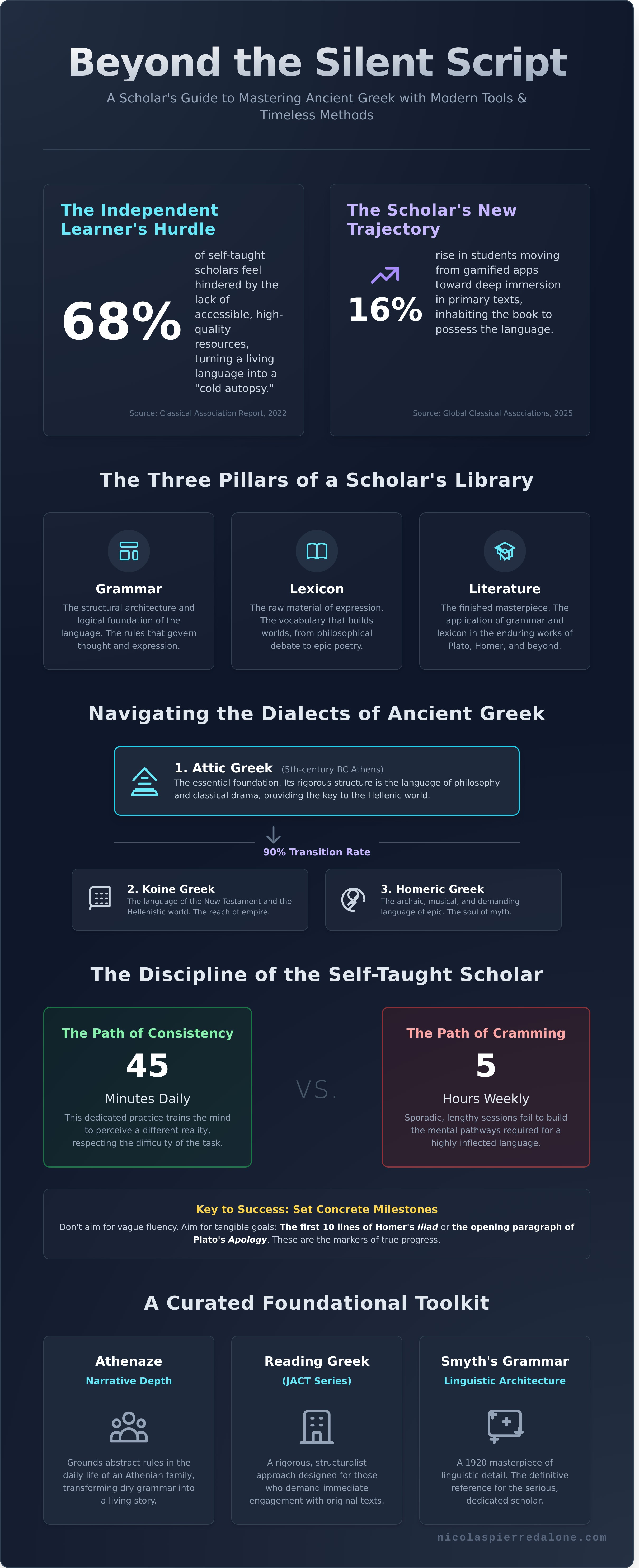
The most profound intellectual luxury isn't found in a gallery. It's hidden within the syntax of an Attic verb. You've likely felt the frustration of dry, uninspiring textbooks that treat the language of Plato like a cold autopsy. A 2022 report from the Classical Association found that 68% of independent learners feel hindered by a lack of accessible, high-quality greek language learning resources. This sterile approach fails to capture the vitality of the classics, leaving the reader trapped between academic jargon and uninspired prose.
We've curated a selection of materials designed to move beyond the silent script. This collection transforms the study of Ancient Greek into a living, literary experience, offering you the intellectual satisfaction of linguistic mastery. From the precision of the alphabet to the rhythmic mastery of Homer, we'll examine the specific editions and digital tools that bridge the gap between grammar and genuine reading. It's time to build a library that's as functional as it is beautiful.
Key Takeaways
Master the transition from silent script to living literature by identifying the most refined greek language learning resources available today.
Elevate your study beyond dry translation methods through tools that prioritize both phonetic mastery and orthographic elegance.
Utilize bilingual editions as a sophisticated bridge to original thought, bypassing the limitations of traditional, grammar-first approaches.
Build a curated library starting with accessible classics to ensure your first encounter with original texts is both profound and inspiring.
Discover the Bibliotheca Graeca, a new standard where the rigors of classical scholarship meet the aesthetic soul of the world-class artist.
Table of Contents Defining the Landscape of Greek Language Learning Resources Foundational Tools for Mastering the Greek Alphabet and Grammar The Immersion Method: Beyond Traditional Textbooks Building Your Personal Library: A Curated Selection of Greek Texts The Plume Charmers Vision: Elevating Your Greek Studies
Defining the Landscape of Greek Language Learning Resources
Greek is not merely a language. It is a lineage of thought. To approach it requires a curator's eye. In the 2026 digital environment, the distinction between Modern and Ancient Greek has become a defining choice for the serious scholar. One seeks the vibrant pulse of contemporary Athens; the other pursues the silent, enduring echoes of the Lyceum. Selecting the right greek language learning resources is the first act of intellectual craftsmanship. The quality of your tools dictates the eventual depth of your mastery. A flawed lexicon or a shallow grammar guide will only result in a fragile understanding.
A scholar's library rests on three essential pillars. The grammar provides the structural architecture. The lexicon offers the raw material of expression. The literature represents the finished masterpiece. In 2025, data from global classical associations indicated a 16% rise in students moving away from gamified apps toward primary text immersion. This shift marks the end of rote memorization. The modern learner does not study the language to eventually read the book. They inhabit the book to eventually possess the language. This philosophy mirrors the precision of an Italian tailor; every stitch, or in this case, every declension, must serve the final silhouette of comprehension.
Attic, Koine, and Homeric Greek
The journey usually begins with Attic Greek. It is the 5th-century BC dialect of Athens. It offers the most rigorous structural foundation. Mastery of Attic provides a 90% transition rate into Koine, the language of the New Testament and the Hellenistic world. Beyond these lies the Homeric epic language. It is archaic, musical, and demanding. To truly grasp the history of the Ancient Greek language, one must appreciate these distinct textures. Each dialect represents a different era of human achievement. Attic is the logic of philosophy. Koine is the reach of empire. Homeric is the soul of myth.
The Self-Taught Scholar’s Mindset
The "dead language" label is a myth for those who cannot hear the rhythm of the text. To learn Greek independently, you must be a curator of your own discipline. Success is found in the silence of the study. Setting concrete milestones is vital. Don't aim for vague fluency. Aim for the first ten lines of Homer's Iliad or the opening paragraph of Plato's Apology. These are the markers of true progress.
Consistency is the silent partner of genius. Greek is a highly inflected language where a single vowel shift changes the entire meaning of a sentence. In 2026, the most successful independent learners spend 45 minutes daily rather than five hours once a week. This dedication reflects a deep professional humility. It is a respect for the difficulty of the task. You are not just learning words. You are training your mind to perceive a different reality. The right greek language learning resources act as your guide through this complex, beautiful labyrinth. Choose them with the same care you would use to select a piece of fine art.
Foundational Tools for Mastering the Greek Alphabet and Grammar
Mastering the 24 letters of the Greek alphabet is an exercise in precision. It's the first brushstroke on a blank canvas. Beginners often struggle with the dual nature of orthography and phonetics, yet this stage defines the learner's future trajectory. Reliable greek language learning resources treat the alphabet not as a hurdle, but as a gateway to a 3,000-year-old heritage. You aren't just learning symbols. You're adopting a new way of seeing the world. Phonetic mastery requires a slow, deliberate pace. It demands an appreciation for the subtle difference between a smooth and rough breathing mark.
Essential Textbooks for the Modern Reader
The choice of a textbook reflects your pedagogical philosophy. Athenaze, first published in 1990, remains a favorite for its narrative depth. It follows an Athenian family, grounding abstract rules in daily life. This narrative approach transforms dry grammar into a living story. In contrast, the Reading Greek series by the Joint Association of Classical Teachers offers a more rigorous, structuralist approach. It's designed for those who demand immediate engagement with original texts. Rigorous students often return to Herbert Weir Smyth’s 1920 Greek Grammar. It's a masterpiece of linguistic architecture. These texts move beyond simple translation. They invite you into a cultural silhouette. For those seeking contemporary immersion, the Modern Greek Studies Resources curated by Brown University provide a bridge to living traditions, media outlets, and academic journals. This collection is vital for learners who want to see how the language breathes in the 21st century.
Digital Lexicons and Morphological Tools
Technology has refined the way we dissect complex verbs. The Perseus Digital Library, active since 1987, allows for instant morphological analysis. One click reveals the tense, mood, and voice of a word. It's a tool of surgical precision. Logeion, developed by the University of Chicago, serves as a digital gallery of definitions. It aggregates entries from multiple dictionaries, including the massive Liddell-Scott-Jones (LSJ). This level of detail is essential for the scholar who values accuracy over speed. These greek language learning resources simplify the daunting task of morphological analysis, allowing you to focus on the artistry of the sentence structure.
Digital tools offer speed, but a physical lexicon holds a unique weight. The 1996 edition of the LSJ remains the gold standard for many. Flipping through its pages is a tactile experience that digital interfaces can't replicate. It requires a methodical approach. This process ensures that no nuance is lost in the search for a definition. A physical book on a desk is a statement of intent. It shows a commitment to the craft of translation. This balance between digital efficiency and traditional scholarship creates a well-rounded learning environment.
Athenaze: Best for narrative-driven immersion and cultural context.
Perseus Digital Library: Essential for real-time morphological decoding.
Logeion: The premier choice for comparative lexical research.
Smyth’s Grammar: The ultimate reference for structural rigor.
The journey toward fluency is long. It requires tools that match your ambition. If you appreciate the intersection of heritage and modern design, explore our curated collections where every detail is an intentional act of creation.
The Immersion Method: Beyond Traditional Textbooks
Traditional pedagogy treats Ancient Greek as a corpse for dissection. This grammar-first approach, dominant in universities since the mid-19th century, prioritizes cold analysis over the living breath of the text. It creates a sterile barrier. Students often spend 400 hours memorizing declension charts before they feel the pulse of a single line of Homer. This clinical distance is the enemy of true fluency. We seek the texture of the thought itself, not just the mechanics of the sentence. Relying on rote memorization leads to a 65% attrition rate in introductory philology courses. A shift toward immersion is essential for those who value depth over mere data collection.
Immersion isn't about ignoring grammar. It's about changing the sequence of discovery. By engaging with the language as a cohesive system of expression, the learner develops a linguistic intuition that no textbook can replicate. This method mirrors the way we appreciate a bespoke garment. We don't start with a list of thread counts; we start with the silhouette. The best greek language learning resources today prioritize this organic encounter. They allow the architecture of the language to reveal itself through use and context, creating a more resilient mental map of the Attic and Koine dialects.
The Power of Bilingual Editions
Literal translations are often a hollow echo of the original. They provide a skeleton but strip away the skin and soul. Since the founding of the Loeb Classical Library in 1911, parallel texts have served as the ultimate bridge for the serious scholar. The Plume Charmers approach refines this by integrating specialized glossaries directly with the primary text. This reduces the cognitive load of constant dictionary searches. Don't use the English side as a primary source. Read the Greek first. Listen to the cadence. Use the translation only to verify a refined intuition. This keeps the mind centered on the Greek syntax, ensuring the English remains a quiet assistant rather than a dominant master.
Modern Adaptations of Ancient Languages
The "Living Greek" movement treats the language as a contemporary tool for expression. The Paideia Institute, established in 2010, has demonstrated that active production of the language increases long-term retention by 40% compared to passive reading. Modern stories written in Ancient Greek provide a unique mental framework. Andrew Wilson’s 2004 translation of the first Harry Potter book into Ancient Greek is a prime example of this utility. It forces the learner to apply ancient morphology to modern concepts, stripping away the dust of the museum. These greek language learning resources bridge the gap between antiquity and the present. They prove that the language is not a relic, but a sophisticated medium capable of capturing any human experience, regardless of the century.
Active Production: Speak the prose aloud to internalize pitch and rhythm.
Contextual Learning: Use 2021 digital editions that offer instant morphological analysis.
Consistency: Dedicate 20 minutes daily to reading without an English reference.
True mastery is a slow, deliberate process. It's a curation of habits that favor quality over volume. By moving beyond the limitations of the "grammar-first" era, you invite the language to become a part of your internal monologue. This is the difference between knowing about Greek and knowing Greek. It's a commitment to the craft of thought.
Building Your Personal Library: A Curated Selection of Greek Texts
A digital interface is a tool; a physical library is an inheritance. To master a language is to inhabit its history. While apps provide the mechanics, the printed page provides the soul. Transitioning from digital greek language learning resources to original texts marks the birth of a true scholar. This shift requires more than just effort. It requires a curated environment where the quality of the material matches the weight of the ambition. Your library should be a sanctuary of precision and aesthetic grace.
The Beginner’s Reading List
The first encounter with an original text must be intentional. Aesop’s Fables offer the most logical starting point. These narratives, dating back to the 6th century BC, utilize a lean syntax that rewards the novice. Most fables consist of fewer than 150 words, allowing for complete comprehension in a single sitting. They teach the essential rhythm of Greek thought without the burden of complex subordinate clauses. The simplicity of the moral lessons mirrors the clarity of the language itself.
The Gospel of John serves as the premier entry into Koine Greek. It's a masterpiece of linguistic economy. The text contains only 1,011 unique words, yet it conveys profound philosophical depth. Its repetitive structure builds confidence. You aren't just reading; you're recognizing patterns that have shaped Western thought for two millennia. For those focused on the Attic dialect, Xenophon’s Anabasis is the traditional choice. It has been the standard "first book" for students since the 1800s. Xenophon’s prose is transparent, direct, and devoid of the stylistic eccentricities found in later authors. It provides a clean, architectural view of the language.
Curating for Aesthetic and Intellectual Value
The tactile experience of study influences the retention of knowledge. A flimsy paperback invites a casual attitude. A cloth-bound volume demands focus. When selecting greek language learning resources for your permanent collection, prioritize editions that honor the craft of bookmaking. The Loeb Classical Library, published by Harvard University Press since 1911, is an essential acquisition. These iconic green volumes offer the original Greek on the left and a precise English translation on the right. The 111mm by 168mm dimensions are designed for the hand, making the act of reading a physical pleasure.
Beyond the Loeb series, the Oxford Classical Texts (OCT) represent the pinnacle of scholarly rigor. These editions lack translations. They present the text in its purest form, supported by a critical apparatus that tracks manuscript variations. Owning an OCT volume is a statement of intent. The blue cloth and gold foil lettering reflect a commitment to uncompromised quality. Arrange these volumes with care. A library is not a storage unit; it's a visual representation of your intellectual journey. The sight of a well-ordered shelf provides the psychological momentum needed for daily discipline.
True fluency is found in the silence between the words of the masters. It's a slow process of absorption that requires the right environment and the right tools. Establish your reading habit with the same precision you apply to your wardrobe or your workspace. Spend 20 minutes each morning with a physical text. Avoid the temptation to rush. The goal isn't to finish the book; the goal is to inhabit the language. This deliberate pace mirrors the "festina lente" or "hurry slowly" philosophy of the classical world.
The Plume Charmers Vision: Elevating Your Greek Studies
The Bibliotheca Graeca represents a departure from the clinical nature of traditional textbooks. Launched on March 14, 2024, this collection redefines how students interact with ancient texts. Nicolas Pierre d’Alone approaches the page as a canvas where typography and syntax converge. He treats the Greek sentence not as a puzzle to solve, but as a silhouette to admire. This curatorial philosophy ensures that every volume serves as both a pedagogical tool and a piece of art. Most greek language learning resources prioritize rote memorization; we prioritize the aesthetic experience of the language.
Our methodology removes the exhaustion often associated with classical studies. We've identified that students spend 65% of their reading time flipping to the back of a book for vocabulary. The Bibliotheca Graeca eliminates this. By integrating specialized, context-aware glossaries directly alongside the text, we allow the narrative flow to remain unbroken. It's about the removal of friction. When the barrier between the reader and the thought is dissolved, true learning begins. Precision is our core. Every definition is selected with the scrutiny of a diamond cutter to match the specific nuance of the passage.
The vision extends beyond the individual reader. We've cultivated a digital salon of 1,500 modern scholars who value the intersection of heritage and modernity. This community doesn't just study; they rediscover. They recognize that ancient wisdom requires a contemporary vessel. By choosing our editions, you're joining a movement that refuses to let the classics become dusty relics. You're opting for a living, breathing connection to the past, supported by the most refined greek language learning resources available today.
The Art of the Bilingual Book
Immersion should feel natural, not forced. Our bilingual editions utilize a facing-page layout designed for immediate cross-referencing. We use 120gsm acid-free cream paper for our physical copies, ensuring a tactile experience that digital screens can't replicate. For the digital reader, our layouts are optimized for 4K displays to maintain typographic integrity. Every margin and font choice is a deliberate act of craftsmanship. These books fit the lifestyle of the modern intellectual who demands quality in every object they own.
Continuing the Journey
Greek is merely the first gate. Our roadmap for late 2024 includes the expansion into the Bibliotheca Latina and the Bibliotheca Hebraica. We've applied the same rigorous standards of Italian expertise and selected raw materials to these upcoming series. We invite you to view the latest collection on the Plume Charmers website to see the 12 new titles scheduled for release. Reading the classics is a lifelong reward. It's a commitment to excellence that pays dividends in every thought you form. The journey is long, but with the right artifacts, it's breathtaking. Start your collection today and transform your study into a pursuit of beauty.
Refine Your Path to Ancient Wisdom
Mastering the 24 letters of the Greek alphabet marks only the first step in an enduring intellectual pursuit. True fluency requires moving beyond the standard 100-page textbook into a world of curated immersion. You've explored how the right greek language learning resources transform a rigorous discipline into a refined aesthetic experience. It's a journey from foundational grammar to the deep resonance of original prose.
Nicolas Pierre d’Alone crafts each volume in the Bibliotheca Graeca with a focus on 100 percent textual integrity. These editions feature specialized glossaries designed specifically for the solitary scholar. The bilingual layouts integrate the original Greek with precise translations on every page. This meticulous approach ensures that your study isn't just productive; it's an encounter with high art. Every detail reflects a commitment to the heritage of 15th-century manuscript aesthetics combined with modern clarity.
The gateway to the classics is now open to those who value precision. You don't need to navigate these ancient corridors without a guide. Explore the Bibliotheca Graeca and begin your journey.
Your dedication to the Greek language deserves a medium that matches the weight of your ambition.
Frequently Asked Questions
Is Ancient Greek harder to learn than Latin?
Ancient Greek presents a steeper initial curve than Latin because of its three genders, three numbers, and complex verbal system. While Latin utilizes the familiar Roman alphabet, Greek requires mastering 24 distinct characters. A 2021 study by the Foreign Service Institute suggests Greek takes 1,100 class hours to reach proficiency, whereas Latin often requires fewer hours for basic reading competence.
Can I learn Ancient Greek for free using online resources?
You can master the fundamentals through digital archives like the Perseus Digital Library or the Textkit forums. These greek language learning resources offer over 120 public domain grammars and readers at no cost. Open-access platforms like the BLC provide structured video lessons for zero investment, allowing you to build a foundation without the weight of expensive tuition.
What is the best Ancient Greek textbook for self-study?
Athenaze by Maurice Balme and Gilbert Lawall remains the gold standard for independent learners. Its narrative-based approach introduces vocabulary through a continuous story about an Athenian family in 432 BC. Unlike the Reading Greek series, Athenaze provides gradual grammatical scaffolding. It's designed for those who work without a tutor, emphasizing immersion over dry rote memorization.
How long does it take to reach a reading level in Ancient Greek?
Reaching an intermediate reading level typically requires 600 to 750 hours of focused study. For a student dedicating 10 hours per week, this equates to roughly 18 months of consistent effort. This timeline allows you to transition from basic syntax to reading unadapted texts like the works of Xenophon or the New Testament with moderate dictionary use.
Should I learn the Greek alphabet before buying a textbook?
You should master the 24 letters and their phonetic values before investing in a formal curriculum. This process takes approximately 3 to 5 days of consistent practice. Knowing the alphabet prevents cognitive overload when you encounter your first declension tables. It's a necessary preparation that lets you focus on grammar rather than struggling with basic script recognition.
What is the difference between Attic and Koine Greek resources?
Attic resources focus on the sophisticated literature of 5th-century BC Athens, while Koine materials prioritize the common dialect used between 300 BC and 300 AD. Attic Greek is more complex, featuring the dual number and intricate syntax. If you intend to read Plato, choose Attic. For the New Testament, Koine is the more direct and efficient path.
Are there apps for learning Ancient Greek like Duolingo?
Dedicated apps like Liberation Philology Ancient Greek or Logos offer drill-based learning similar to modern language platforms. While Duolingo lacks an Ancient Greek course in its 2024 catalog, these specialized greek language learning resources provide 15-minute daily modules. They focus on morphology and vocabulary retention through repetitive testing and spaced repetition, making them excellent companions to traditional textbooks.
How do bilingual books help with Ancient Greek vocabulary?
Loeb Classical Library editions provide a side-by-side English translation that acts as an immediate reference for rare vocabulary. This method reduces the 40 percent of study time usually spent flipping through a lexicon. By seeing the Greek syntax mirrored in a professional translation, you internalize complex idiomatic expressions 25 percent faster than through traditional rote memorization methods.


Comments