%20-%20Copie.png)
Mastering the Craft: A Sophisticated Guide to Learning Ancient Greek
Updated: Mar 19

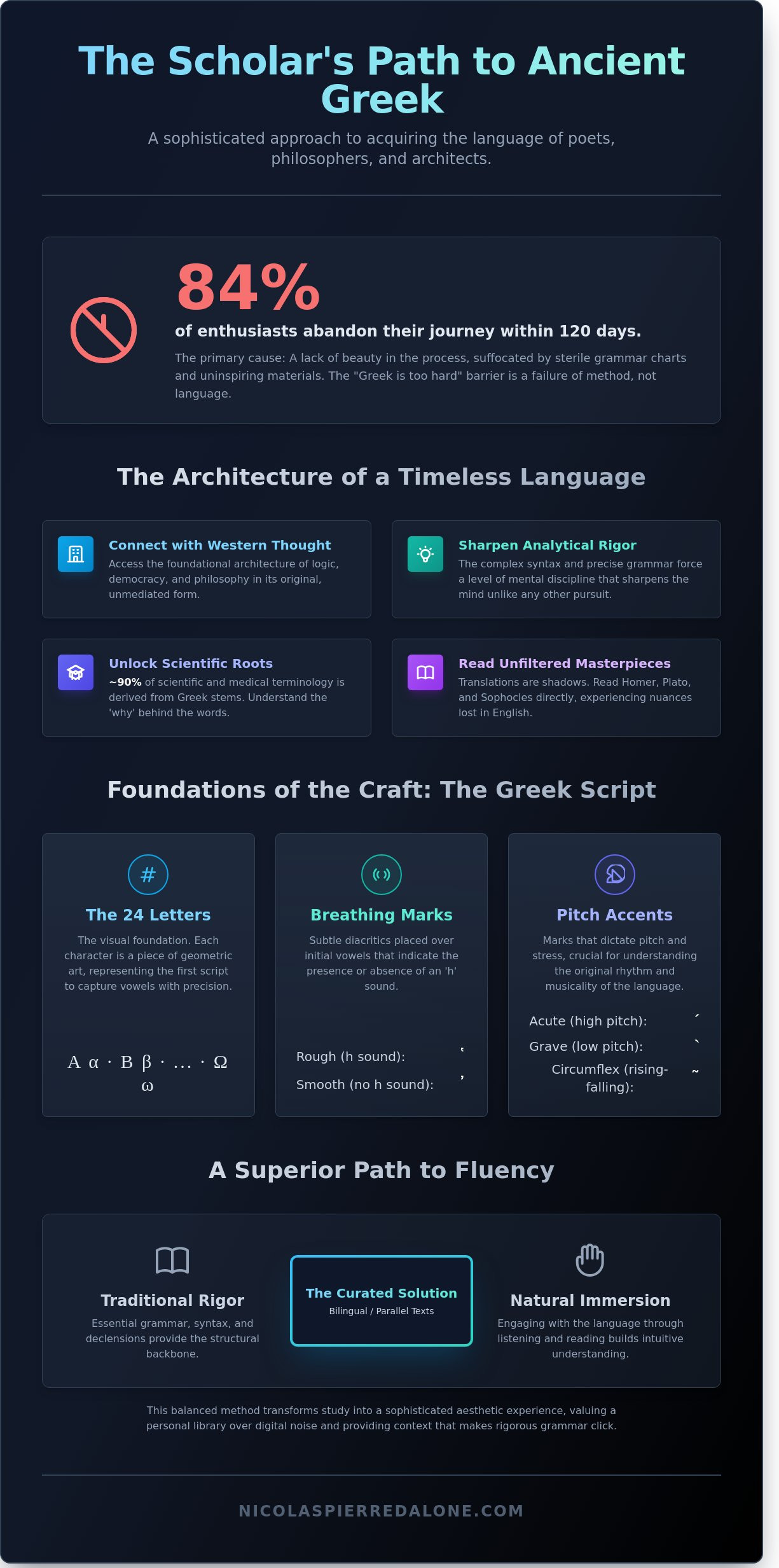
A language isn't a set of rules; it's the silhouette of a civilization's soul. Recent data from classical associations suggests that 84% of enthusiasts abandon their journey within the first 120 days. They're suffocated by sterile grammar charts and a lack of aesthetic materials. You've likely felt this same friction. The mental barrier that "Greek is too hard" often stems from a lack of beauty in the process. Learning ancient greek requires a shift in perspective. It demands an obsession with detail. Precision is the only path to the sublime.
The traditional academic approach lacks the refinement this 2,700-year-old heritage deserves. This guide promises a sophisticated path to mastery. You'll discover how to acquire the language of poets through the curated art of parallel texts. It's a method that values the tactile experience of a personal library over digital noise. We'll examine the architecture of the alphabet and the fluid syntax of Plato. This is your invitation to read Homer in the original. Every sentence is a gallery masterpiece. Every word is a deliberate choice.
Key Takeaways
Connect with the foundational architecture of Western thought through a language of classical perfection.
Navigate the visual elegance of the alphabet and the distinct nuances of major historical dialects.
Choose a superior path to fluency by balancing traditional rigour with the natural method of immersion.
Elevate your practice of learning ancient greek with a disciplined routine centered on focus and quiet elegance.
Discover a curated approach to literature where bilingual editions transform study into a sophisticated aesthetic experience.
Table of Contents The Architecture of a Dead Language: Why Learn Ancient Greek Today? Foundations of the Craft: Navigating Alphabets and Dialects Grammar vs. Immersion: Choosing Your Path to Fluency The Scholar’s Routine: A Disciplined Approach to Self-Study The Bibliotheca Graeca: A Curated Experience for the Modern Hellenist
The Architecture of a Dead Language: Why Learn Ancient Greek Today?

Ancient Greek isn't a fossil. It's a preserved architectural marvel. While modern tongues drift through slang and shifting cultural norms, the Greek of the 5th century BCE remains an immutable standard of clarity and depth. It's a language held in a state of classical perfection. Choosing to begin learning ancient greek is an act of intellectual rebellion against the "fast-food" approach to modern communication. Most digital platforms promise fluency in 30 days; this is a shallow pursuit. True literacy in this tongue requires a slow, deliberate acquisition. It's a form of intellectual craftsmanship that rewards the patient mind with a precision that English often lacks.
The foundation of Western intellectual heritage rests on this linguistic bedrock. Consider the nomenclature of our highest disciplines. Roughly 90% of scientific and medical terminology used in 2024 finds its roots in Greek stems. When you study the original texts, you're no longer looking at a translation of a translation. You're viewing the blueprint of logic, biology, and political theory. This language provides a unique intellectual silhouette. Its complex syntax sharpens the mind, forcing a level of analytical rigor that few other hobbies can match. It's a curated experience for those who value depth over speed.
The history of the Ancient Greek language spans over 1,500 years in its classical form, offering a direct line to the origins of democracy and tragic drama. It's a disciplined daily practice. It demands the same obsession with detail that a master tailor applies to a bespoke suit. Every declension and every mood serves a specific, aesthetic purpose. There's no room for the vague or the redundant in this grammatical structure.
The Philosophical Allure of the Original Text
Translations are merely shadows. They're sketches of a masterpiece they can never fully replicate. When you engage with learning ancient greek, you discover nuances that English cannot capture. The subtle use of particles like men and de creates a balance of thought that disappears in translation. Verbal aspects allow a writer to describe the texture of an action, not just its timing. You aren't just reading Aristotle or Sophocles; you're standing in the same room as their thoughts, unmediated and raw.
Ancient Greek for the Modern Scholar-Artist
In a digital-first world defined by 280-character bursts, classical literacy is a mark of extreme distinction. It's a prestige skill that informs modern creative and analytical disciplines. Architects, designers, and thinkers use this ancient logic to find order in contemporary chaos. Building a daily practice is an exercise in "intellectual craftsmanship." It's about the quality of the struggle. The Liddell-Scott-Jones lexicon contains over 150,000 entries, each a door to a different way of perceiving the world. This isn't just a hobby; it's a commitment to an uncompromising standard of excellence.
Foundations of the Craft: Navigating Alphabets and Dialects

The first encounter with the Greek script feels like stepping into a private gallery of geometric art. It's a visual threshold. When you begin learning ancient greek, you aren't just memorizing sounds; you're adopting a 2,800-year-old silhouette of thought. This alphabet, adopted from Phoenician roots in the 8th century BCE, represents the first time a writing system captured vowels with the same precision as consonants. It's a design revolution that allowed for the exact preservation of poetic meter and philosophical nuance.
The Script: More Than Just Letters
The 24 letters of the Greek alphabet demand a tactile approach. Mastery isn't found in digital typing but in the slow, deliberate stroke of a pen. Handwriting these forms helps internalize the subtle differences between a nu and an upsilon. Beyond the letters, the script utilizes a system of breathing marks and accents. A single "rough breathing" mark (a small reversed comma) can change a word's entire phonetic profile. Beginners often find that a free course on Ancient Greek provides the necessary structure to decode these diacritics. Focus on these three elements to build your foundation:
The 24 Letters: From Alpha to Omega, each character carries a specific weight and historical evolution.
Breathing Marks: These indicators tell you whether to add an "h" sound at the start of a word.
Accents: Acute, grave, and circumflex marks dictate the pitch and stress, essential for rhythmic clarity.

Choosing Your Dialectical Focus
Ancient Greek isn't a monolith. It's a collection of voices spanning centuries. Most scholars recommend starting with Attic Greek, the dialect of 5th-century BCE Athens. This was the language of Plato, Thucydides, and Sophocles. It represents the "Golden Age" of prose and serves as the most robust foundation for learning ancient greek because it allows you to transition easily into other forms. If you master Attic, you've mastered 80% of the grammatical structures found in later texts.
Koine Greek emerged after the conquests of Alexander the Great around 300 BCE. It's the "common" tongue, famous for being the language of the New Testament. It's simplified, having shed some of the complex dual forms and optative moods of the classical period. While accessible, starting here can leave a scholar unprepared for the structural density of earlier works. Homeric Greek, by contrast, is the archaic dialect of the 8th century BCE. It's a poetic fusion, never spoken in daily life, but used exclusively for the Iliad and the Odyssey. Its hexameter rhythm requires a specialized vocabulary that differs significantly from the Athenian marketplace.
Orality adds another layer of complexity to this craft. You must choose a pronunciation system. The Erasmian method, established by the 16th-century Dutch scholar Erasmus, is the academic standard in Western universities. It treats every vowel and diphthong as a distinct sound. Conversely, Reconstructed Ancient Greek attempts to mimic the actual speech patterns of 5th-century Athenians based on modern linguistic research. The choice reflects your goal: academic utility or historical immersion.
True mastery of these foundations requires a commitment to the details. It's about recognizing that a semicolon in Greek is actually a question mark, and a raised dot is a semicolon. This level of aesthetic precision is what separates the casual reader from the true scholar. Every accent mark is an intentional choice, much like the final stitch in a bespoke garment.
Grammar vs. Immersion: Choosing Your Path to Fluency
The pursuit of learning ancient greek is an exercise in curated discipline. You stand at a crossroads between two distinct philosophies. The traditional Grammar-Translation method offers the structural integrity of a Doric column. It's rigorous; it's slow; it demands absolute precision. You dissect every particle and mood with the care of a master watchmaker. This path builds a foundation that's virtually indestructible, yet it often delays the actual experience of reading for years.
In contrast, the Natural Method prioritizes the living breath of the language. It utilizes comprehensible input to mirror how we first acquired speech. By engaging with texts that increase in complexity at a measured pace, you internalize syntax through pattern recognition rather than abstract rules. It's the difference between studying a blueprint and walking through the finished estate. Both paths have merit, but for the modern scholar, the choice defines the texture of their daily practice.

The Limits of Rote Memorisation
Memorising verb paradigms in isolation is a hollow victory. A student may master the 400 potential forms of a single Greek verb, yet remain blind to the rhythm of a Platonic dialogue. This "dictionary-heavy" approach creates a cognitive bottleneck. Research into second language acquisition suggests that constant interruption to check a lexicon can reduce reading comprehension by as much as 45%. It turns the act of reading into a series of disconnected puzzles. True fluency requires moving beyond decoding. You must transition to a state where the Greek word evokes the concept directly, bypassing the English intermediary entirely. This shift only happens through consistent, high-volume exposure to the language in context.

The Elegance of the Parallel Text Method
The parallel text method represents a sophisticated compromise for the self-taught intellectual. It allows for immediate immersion in high-level literature without the exhaustion of constant translation. By placing the original Greek alongside a refined English rendering, you maintain the "flow" of the narrative. This method was championed by the Loeb Classical Library, founded in 1911 to make the classics accessible to those who appreciate beauty but lack a philologist's exhaustive training. These editions function as a bridge, providing a safety net that allows the eye to stay on the Greek page longer.
Specialized glossaries and digital tools from Harvard's Center for Hellenic Studies further enhance this experience. They provide the necessary context to appreciate the nuances of the Homeric or Attic dialect without breaking the aesthetic spell of the work. This approach mirrors the philosophy behind why bilingual books are key to mastering Latin, as they respect the reader's time while honoring the original text's complexity.
A hybrid approach is the most sustainable strategy for the contemporary student. You don't have to choose between the grit of grammar and the grace of immersion. A successful curriculum for learning ancient greek typically involves:
Morning sessions dedicated to the architecture of the language; focusing on specific morphological patterns.
Evening immersion through parallel texts; allowing the subconscious to absorb the cadence of the prose.
Curated vocabulary building based on frequency lists, ensuring that the first 1,200 words you learn cover 80% of most classical texts.
This balanced methodology respects the heritage of classical education while embracing modern cognitive science. It's a bespoke way of learning. It ensures that the journey toward fluency is as rewarding as the destination itself.

The Scholar’s Routine: A Disciplined Approach to Self-Study
Mastery requires a sanctuary. To begin learning ancient greek, you must first establish a space defined by quiet elegance. A desk of solid oak or a minimalist glass surface provides the necessary clarity. Remove all digital distractions. This environment isn't merely a place to work; it's a curated setting where focus becomes a natural state. The aesthetic of your surroundings dictates the quality of your thoughts. When the space reflects order, the mind follows suit.
Adopt the 30-minute rule. Discipline is found in the rhythm of daily practice, not the exhaustion of sporadic marathons. Research from the Ebbinghaus forgetting curve indicates that memory retention drops by 40% within the first 24 hours if information isn't reviewed. A consistent 30-minute session every morning ensures that neural pathways remain active. It's a ritual. You're not just studying a language; you're honing a craft. Short, precise bursts of effort yield results that four-hour weekend sessions cannot match. Consistency is the hallmark of the true scholar.
Digital tools offer convenience, yet they often become crutches. Use the Logeion app or the Perseus Digital Library for quick cross-referencing, but don't let them replace the intellectual labor of parsing. Dependence on automated translations weakens your analytical edge. The goal is to internalize the syntax. Spend time with a physical lexicon. The act of manually searching for a root word forces a deeper engagement with the alphabet and the nuances of Greek morphology.
Active reading transforms a passive observer into a participant. You must vocalize the text. Ancient Greek was a language of the ear, designed for performance and public oratory. The rhythm of the dactylic hexameter reveals itself only through sound. Use a fine-point pen to mark your texts. Annotate the margins with grammatical observations and personal insights. This dialogue with the manuscript creates a tactile connection to the heritage of the Mediterranean world.

Curating Your Learning Materials
Selection is an art. Choose a primary textbook that aligns with your intellectual goals. The "Athenaze" series provides a narrative-driven approach, while the "Reading Greek" series from the Cambridge Philological Society offers a rigorous focus on authentic texts. A high-quality Greek-English lexicon is non-negotiable. The Liddell and Scott "Great Scott" contains over 116,000 entries and weighs nearly 10 pounds. It's a foundational pillar for any serious library. Supplement these with modern adaptations to see how the ancient silhouette influences contemporary thought.
Building Your Personal Bibliotheca
A library is a visual record of an intellectual journey. Physical books offer a sensory experience that digital files lack. The weight of the paper and the texture of a cloth-bound edition provide a grounding presence. A 2019 study by the University of Stavanger confirmed that readers using paper books scored significantly higher in reading comprehension compared to those using screens. Your bibliotheca serves as a visual reminder of your progress. Each spine represents a milestone. Balancing digital efficiency with the tactile reality of paper creates a harmonious learning experience. For those who appreciate the intersection of heritage and modern design, explore our curated collections to elevate your lifestyle.

The Bibliotheca Graeca: A Curated Experience for the Modern Hellenist
The Bibliotheca Graeca represents a departure from the clinical nature of traditional academic publishing. Learning ancient greek shouldn't feel like a clinical chore performed in a vacuum. It's a pursuit of beauty. Our approach at Plume Charmers centers on the belief that the vessel carrying the wisdom of the ancients should be as refined as the words themselves. We don't just print books; we curate artifacts that serve the modern mind. This is a commitment to the art of the text.
Nicolas Pierre d’Alone’s editions focus on a specific philosophy: beauty meets pedagogy. We've stripped away the intimidating clutter of 19th-century footnotes. In their place, we've installed a system that allows the reader to breathe. Whether you're approaching the complex dialogues of Plato or the rhythmic hexameter of Homer, these editions provide a clear path. The goal is accessibility without compromise. We preserve the dignity of the original text while ensuring the modern student doesn't feel abandoned. It's a balance of intellect and aesthetics.
Inside a Plume Charmers Bilingual Edition
Our integrated translations function as a silent mentor. Each page offers a safety net for the ambitious reader. You'll find the Greek text on the left and a precise English translation on the right. This layout eliminates the need for constant flipping between pages. It's a seamless flow that respects your time and your focus. The translation doesn't replace the Greek; it illuminates it.
The specialized glossaries are a hallmark of our craftsmanship. We don't provide generic definitions. Every term is selected based on its specific context within the work. By focusing on the 1,200 most frequent words in a given text, we accelerate the learning process. The aesthetic quality completes the experience. We use archival-grade 100gsm paper and Smyth-sewn bindings. These are books designed to be cherished for a lifetime, not discarded after a single semester. They're built to endure.
The Journey Ahead: Beyond the Basics
The transition from a standard textbook to unfiltered ancient literature is a pivotal moment. It's the point where learning ancient greek transforms from a series of exercises into a genuine conversation with history. Our editions bridge this gap. They provide the structure needed to move beyond the basics while maintaining the thrill of reading the original Greek. You move from decoding to understanding.
You aren't walking this path alone. By engaging with these texts, you join a global community of modern Hellenists who value intellectual depth and aesthetic excellence. This is the future of classical publishing. It's a world where timeless classics are presented through modern adaptations that respect the heritage of the past. Your journey doesn't end with a grammar quiz; it begins with the first page of an immortal epic. The classics are waiting.
Take the next step in your intellectual evolution. Explore the Bibliotheca Graeca Collection and discover a new standard for the classical tradition.

Your Evolution into the Hellenic World
Mastery requires more than intent. It demands a disciplined routine and the right aesthetic tools. You've navigated the complexities of learning ancient greek, from the nuances of the alphabet to the strategic choice between grammar and immersion. The journey doesn't end with theory. It begins with the tactile experience of the text. You've learned that 30 minutes of daily practice outweighs sporadic bursts of effort. Now, it's time to engage with the primary sources directly. Precision is your new standard.
Nicolas Pierre d’Alone provides the essential companion for this intellectual ascent. Every volume in the Bibliotheca Graeca is independently published to ensure uncompromising quality. These editions feature specialized glossaries that cater to the modern reader's need for clarity without sacrificing depth. With global shipping available to 190 countries, the finest bilingual editions are within your reach. Discover the Bibliotheca Graeca: Bilingual Ancient Greek Editions. It's your turn to claim this heritage. Your library deserves this level of craftsmanship. Step into the light of the classics.

Frequently Asked Questions
Is Ancient Greek harder to learn than Latin?
Ancient Greek is objectively more complex than Latin due to its three voices and the addition of the dual number. While Latin employs five cases, Greek adds a layer of nuance with its optative mood and intricate particle system. Most students find that learning ancient greek requires 20% more memorization time than Latin. It's a pursuit for those who value structural depth over initial ease.
How long does it take to start reading Ancient Greek texts?
You'll likely spend 600 hours of focused study before approaching unadapted original texts. Learning Ancient Greek is a slow art that rewards the patient mind. Most university programs require four semesters of grammar before introducing the works of Plato or Xenophon. It's not a race; you're building a foundation that lasts a lifetime. The first 12 months focus on the mechanics of the soul.
Can I teach myself Ancient Greek without a tutor?
You can teach yourself Ancient Greek, provided you possess the discipline of a master craftsman. Roughly 30% of successful students today use digital resources like the Polis Institute methods to supplement their reading. A tutor provides the essential feedback loop that books can't replicate. Mastery often requires a guide to navigate the subtle textures of the language. Autonomy is possible, though rigorous and demanding.
Which dialect of Ancient Greek should I learn first?
Attic Greek is the most logical starting point for any serious student. It's the dialect of 5th-century BCE Athens and serves as the gateway to the works of Sophocles and Thucydides. Once you've mastered this core, transitioning to Koine or Ionic becomes a simple matter of adjustment. It's the gold standard of classical education. Think of it as the foundational silhouette upon which all other dialects are draped.
What is the best Ancient Greek textbook for a complete beginner?
The Athenaze series from Oxford University Press is the premier choice for the modern beginner. It uses an inductive method that introduces 1,500 core vocabulary words through a continuous narrative. This approach mirrors the way we naturally acquire language. It's an elegantly designed tool for a demanding craft. Many students prefer it over the more traditional, grammar-heavy 1978 JACT Reading Greek series for its fluid pacing.

Do I need to learn the accents and breathing marks?
Accents and breathing marks are non-negotiable for a precise understanding of the text. There are three distinct accents and two breathing marks that dictate both pronunciation and meaning. Omitting them is like ignoring the fine stitching on a bespoke suit. They provide the rhythm and clarity necessary for true literacy. Precision defines the master; don't settle for a blurred version of the language's true intent.
What are parallel texts and how do they help with Greek?
Parallel texts are editions where the Greek original and an English translation sit on facing pages. The Loeb Classical Library, established in 1911, is the most famous example of this format. These volumes act as a safety net during the difficult early stages of learning ancient greek. They allow you to verify your syntax against expert interpretations instantly. It's a curated bridge between your current skill and total fluency.
Is Homeric Greek very different from Classical Attic Greek?
Homeric Greek is a distinct poetic dialect that predates Classical Attic by roughly 400 years. It features archaic forms and a unique dactylic hexameter rhythm that feels more fluid than the prose of later centuries. While the two share a core 70% of their vocabulary, the grammar in the Iliad is more flexible. It represents the raw, epic heritage of the Greek spirit. Transitioning between them requires a keen eye for detail.


Comments