%20-%20Copie.png)
Ancient Greek for Self-Study: A Guide for the Modern Scholar
Updated: Feb 27

The ambition to read Plato in his own tongue is a noble one. Yet, the path is often obscured by a labyrinth of resources, leaving the modern scholar without a clear direction. This intellectual pursuit requires not just passion, but a curated methodology. The journey of ancient greek for self-study need not be a solitary struggle against chaos; it can be an act of deliberate, rewarding craftsmanship.
This guide is crafted to provide that essential structure. It is a blueprint for the independent learner, designed to transform a daunting challenge into a focused discipline. We will navigate the critical first decision—choosing a dialect, from the epic verses of Homer to the prose of Attic historians. We then present a clear, step-by-step plan, demystifying the process from the alphabet to authentic syntax.
Our purpose is to replace uncertainty with a quiet confidence. To provide the tools and the framework that empower you to engage with your first classical texts, not with hesitation, but with the focused assurance of a true scholar.
Key Takeaways
Define your intellectual objective. This clarity determines your dialect—the essential first step in your Hellenic journey.
Assemble a curated toolkit by understanding the critical distinction between grammar-translation and reading-based methods.
Master a disciplined methodology for ancient greek for self-study; a structured, repeatable routine is the foundation of genuine progress.
Navigate your first year with a clear trajectory, using measurable milestones from the alphabet to your first classical texts.
Table of Contents Before the First Word: Charting Your Hellenic Course Assembling Your Toolkit: Essential Resources for the Independent Scholar A Disciplined Method: Structuring Your Study Sessions From Alpha to Reading: A First-Year Learning Trajectory
Before the First Word: Charting Your Hellenic Course
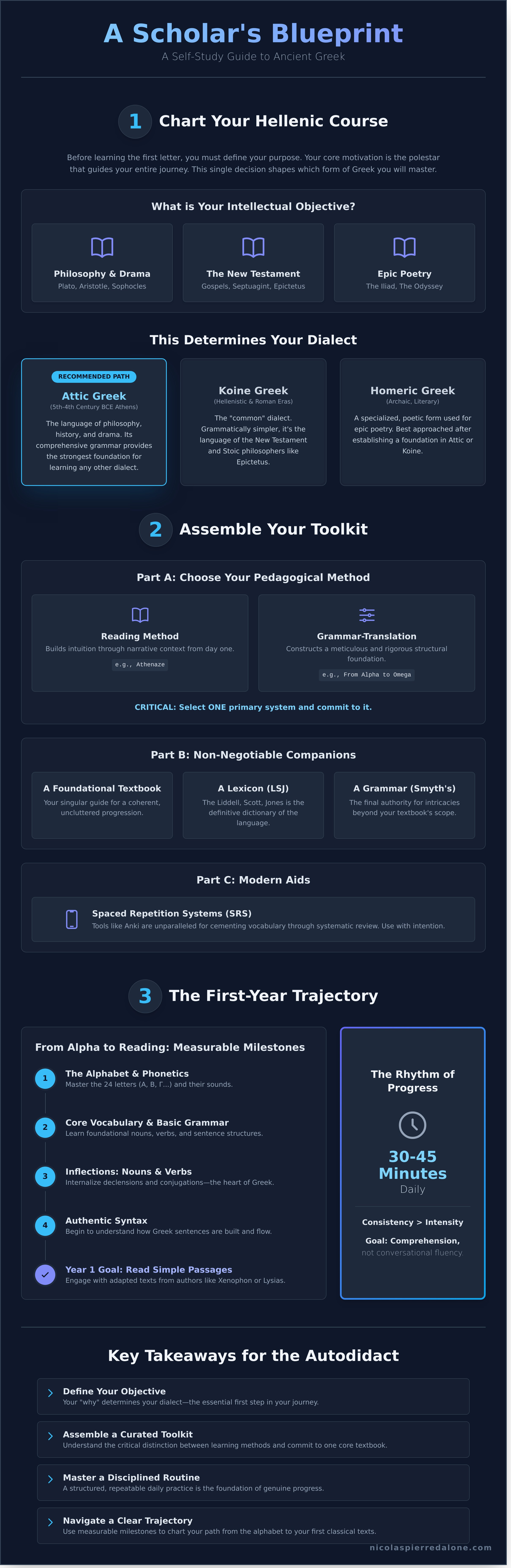
The pursuit of Ancient Greek is a deliberate act of intellectual craftsmanship. Before the first alpha is memorized, you must define your purpose. Are you drawn to the Socratic dialogues of Plato, the foundational narratives of the New Testament, or the epic grandeur of Homer? This core motivation will be your polestar, guiding you through the intricate grammar and vocabulary that await. The path of ancient greek for self-study is a solitary one, demanding a unique discipline to master the architecture of a highly inflected language.
Success is not accidental; it is designed. Your initial decisions will shape the entire trajectory of your learning. The most critical of these is your choice of dialect.
Choosing Your Dialect: Attic, Koine, or Homeric?
Ancient Greek was not a monolith but a collection of distinct literary voices. A foundational understanding of the History of the Greek Language reveals this rich tapestry. The self-learner must choose a starting point with precision.
Attic Greek: The dialect of 5th and 4th century BCE Athens. This is the refined language of philosophy (Plato, Aristotle), drama (Sophocles), and history (Thucydides). Its structure is the bedrock of classical education.
Koine Greek: The "common" dialect of the Hellenistic period and the Roman Empire. It is the language of the New Testament, the Septuagint, and Stoic philosophers like Epictetus. Grammatically simpler than Attic, it offers more immediate access to a vast corpus of later texts.
Homeric Greek: An archaic, literary dialect used exclusively for epic poetry. It is a specialized form, best approached after a foundation in another dialect has been established.
Our recommendation is unequivocal: begin with Attic Greek. It provides the most comprehensive grammatical framework, making the transition to Koine or Homeric a matter of adaptation, not reconstruction.
Setting Realistic Expectations for the Autodidact
The journey of ancient greek for self-study is a marathon, not a sprint. Progress is measured in years, not weeks, and its rhythm is rarely linear. Embrace the plateaus as periods of consolidation, not failure. Your focus should be singular: reading comprehension. The goal is not conversational fluency but direct engagement with the texts themselves.
A worthy and achievable objective for your first year is to read simple, adapted passages from an author like Xenophon or Lysias. This requires consistency over intensity—a disciplined 30-45 minutes each day will yield far greater results than sporadic, multi-hour sessions. Let patience be your guide. The reward is direct access to the consciousness of the ancient world, unmediated by translation.
Assembling Your Toolkit: Essential Resources for the Independent Scholar
The pursuit of ancient greek for self-study demands a curated collection of tools. This is not about accumulation, but about deliberate selection. Your journey requires three core components: a foundational textbook, a comprehensive lexicon, and an authoritative grammar. While digital aids offer convenience, the tactile presence of a physical book is the cornerstone of deep, focused learning. It grounds the intellect and creates a space free from digital distraction, fostering a profound connection with the material.
The Foundational Textbooks: Two Paths to Proficiency
Your first decision is a choice of pedagogical philosophy. The Reading Method, embodied by texts like Athenaze or Reading Greek, immerses you in narrative from the outset, building intuition through context. Conversely, the Grammar-Translation Method, exemplified by From Alpha to Omega, constructs a meticulous structural foundation. For those seeking a rigorous online framework, the University of Texas's Classical Greek Introduction offers an excellent, university-level resource. Each path is valid. The critical step is to select one primary system—your singular guide—and commit. Resisting the impulse to collect multiple beginner books ensures a coherent, uncluttered progression.
Indispensable Companions: Lexicons and Grammars
Beyond your textbook, two companions are non-negotiable. Your lexicon is the Liddell, Scott, Jones (LSJ), the definitive dictionary of the language. While its grand physical edition is an heirloom, its digital forms on the Perseus Digital Library and Logeion offer immediate access. For grammatical intricacies that surpass your textbook's scope, Herbert Weir Smyth’s Greek Grammar is the final authority. These are not texts to be memorized. They are reference instruments, consulted with precision when a question of morphology or syntax arises, much like a cartographer consults an atlas.
Modern Aids: Digital Flashcards and Communities
Discipline finds a modern ally in technology, but it must be applied with intention. Spaced repetition systems (SRS) like Anki are unparalleled for cementing vocabulary through systematic recall, transforming a tedious task into an efficient process. For moments of uncertainty, online forums such as Reddit's r/AncientGreek provide a valuable sounding board. Yet, these tools must remain supplements. They serve the core practice of your independent study of Ancient Greek; they do not replace it. The true work happens away from the screen, with the text itself.
A Disciplined Method: Structuring Your Study Sessions
Mastery is not an accident; it is a product of deliberate structure. The path of ancient greek for self-study demands more than intention—it requires a curated method. This framework balances the essential pillars of the language: grammar, vocabulary, and reading. Crucially, it prioritizes active recall over passive review. You are not a spectator to the language, but its dedicated artisan. True progress lies in a consistent, repeatable routine that transforms study into an intellectual craft.
The Anatomy of a Study Hour
A dedicated hour, properly structured, is more potent than hours of aimless effort. This architecture ensures every component of the language receives focused attention, creating a balanced and robust understanding.
15 minutes: Vocabulary. Begin with active recall using flashcards. Force your mind to retrieve the information, not simply recognize it.
25 minutes: New Grammar. Work methodically through a new lesson in your chosen textbook. Focus on understanding the concept, not just memorizing the rule.
20 minutes: Translation. Apply the new grammar and vocabulary by translating sentences from Greek into English. This is where theory becomes practice.
Conclude each session by briefly reviewing the day's new material, solidifying the connections you have just forged.
Vocabulary Acquisition: Beyond Rote Memorization
A lexicon is not built through brute force; it is cultivated. Absorb words in their natural context, through the sentences you translate. Prioritize the most frequent vocabulary first, as these are the structural pillars of the language. For verbs, the principal parts are non-negotiable from the outset. For a structured introduction to these core concepts, the Open University's 'Getting Started on Ancient Greek' course provides an excellent digital foundation. Curate your own Anki decks—a bespoke learning tool drawn directly from your primary textbook's glossaries.
The Art of Self-Correction
The most critical dialogue is with yourself. Your errors are not failures; they are precise guides for refinement. This process requires a certain ritual, a meticulous attention to detail that is central to any serious pursuit.
Write out your translations by hand. The physical act connects mind and material.
Compare your work meticulously against the provided key. No detail is too small.
For each error, identify the specific grammatical principle you misunderstood or forgot.
Keep a log of recurring mistakes. This document becomes your personal map to mastery.
From Alpha to Reading: A First-Year Learning Trajectory
The path to fluency in a classical language is a disciplined art. This trajectory offers structure for the self-taught scholar—a sequence of milestones from the alphabet to your first authentic texts. The timeline is a guide, not a mandate. Adjust the pace to your own rhythm, but honor the sequence. Mastery is built layer by layer.
Months 1-3: The Foundations
This initial phase is dedicated to the essential architecture of the language. Focus is paramount. Your work here establishes the bedrock for all future progress.
Alphabet and Pronunciation: Master the 24 letters, their sounds, and diacritical marks until they are second nature.
Nouns and Articles: Internalize the declension system. Understand how case, number, and gender function.
Basic Verbs: Learn the present indicative active of regular verbs. This is your first tool for creating meaning.
Your objective: the confident translation of simple, constructed sentences.
Months 4-8: Building the Edifice
With the foundation secure, you begin to construct the intricate upper levels of Greek grammar. This period demands systematic study and repetition. True comprehension in ancient greek for self-study is forged here, moving from isolated components to a connected whole.
You will systematically engage with verb tenses, moods, and voices. Participles, infinitives, and pronouns become familiar tools. Your practice evolves from single sentences to short, adapted paragraphs. It is here you should acquire a reference grammar, not to read cover-to-cover, but to consult for specific, nuanced questions.
Months 9-12: The Transition to Authentic Texts
The final phase of your first year marks the transition from apprentice to practitioner. Upon completing the core curriculum of your primary textbook, you are prepared to encounter the language in its natural state. Begin with a 'reader' containing simplified prose, often from an accessible author like Xenophon.
Introduce a bilingual edition. This is not a crutch, but a calibration tool—a way to check your interpretation against a scholarly translation. It refines your understanding and builds confidence for more complex works. To aid this transition, explore our curated bilingual texts in the Bibliotheca Graeca, designed for the discerning modern scholar.
A Bridge to the Ancient World
Embarking on the path of ancient greek for self-study is an act of profound intellectual discipline. It demands more than mere ambition; it requires a deliberate course, a curated selection of tools, and a structured commitment to the craft. As this guide has outlined, your journey from the first alpha to the authentic texts of antiquity is not a race, but a meticulous process—an art form in its own right.
When the moment comes to transition from grammatical exercises to the living literature of Homer and Plato, the quality of your materials becomes paramount. This is the bridge that must be crossed with the finest of guides. The Bibliotheca Graeca was conceived for this very purpose. Our expertly crafted bilingual editions are designed for the discerning independent learner, serving as a curated bridge from the confines of a textbook to the boundless world of classical literature.
The voice of the ancients awaits your attention. Discover the Bibliotheca Graeca, curated for the modern scholar. Your intellectual legacy begins now.
Frequently Asked Questions
How long does it really take to learn Ancient Greek by yourself?
The path to proficiency is measured in years, not months. A dedicated scholar can expect to achieve a foundational reading ability within two to three years of consistent, daily effort. This timeline is predicated on a rigorous focus on grammar and vocabulary acquisition. The objective is not haste, but a deep, structural comprehension of the language. True command of classical texts is a testament to sustained intellectual craftsmanship and requires a more profound, long-term engagement.
Should I learn to speak Ancient Greek or just focus on reading?
The objective is textual interpretation. The modern scholar's pursuit is to access the vast literary and philosophical heritage preserved in writing. While some pedagogical methods use spoken exercises to internalize grammar, the ultimate aim is reading fluency. Speaking is a tool, not the destination. The true dialogue occurs between the reader and the text, a silent conversation across millennia. Your focus should remain unequivocally on developing a masterful reading capability.
What is the single most common mistake self-learners make?
The most common misstep is impatience. Self-learners often rush to translate complex texts before mastering the grammatical architecture, leading to frustration and a superficial understanding. True progress in ancient greek for self-study is built upon a meticulous foundation of morphology and syntax. One must embrace the deliberate, methodical process of mastering paradigms and grammatical rules. Resisting the allure of shortcuts is the first mark of a serious scholar and the key to lasting success.
Is it better to learn Ancient Greek or Latin first?
The choice is a matter of intellectual affinity, not a prescribed sequence. Latin, with its more rigid structure, can offer a gentler introduction to inflectional languages. Greek, however, presents a more nuanced and philosophically rich entry point. We advise selecting the language whose literature and history most deeply resonate with your personal intellectual project. Your motivation will be sustained by passion for the destination, whether it is the Stoics of Rome or the tragedians of Athens.
How do I stay motivated when I feel stuck?
Motivation is sustained by discipline and a clear vision. When progress feels elusive, return to your foundational purpose. Re-read a beloved work in translation to rekindle your desire to access the original. Set small, achievable objectives—mastering a single verb conjugation, or translating three lines of Xenophon with precision. This is not a race; it is the slow, deliberate craft of intellectual cultivation. Celebrate these small, curated victories as essential steps in your scholarly journey.
Can I learn Ancient Greek for free using only online resources?
A curated selection of free online resources can provide a solid foundation. Digital libraries like the Perseus Project offer invaluable texts and tools, while open-access grammars and university materials can guide your initial steps. However, the path often benefits from a structured, premium textbook. Think of free resources as an atelier's raw materials; a well-crafted textbook provides the expert guidance necessary to shape them into true understanding and a coherent learning experience.


Comments