%20-%20Copie.png)
Ancient Greek Texts: A Curated Guide for the Modern Bibliophile
Updated: Mar 17

What if the most sophisticated addition to your library isn't a contemporary bestseller, but a thought preserved for 2,700 years? Most bibliophiles feel a justified intimidation when facing the stark complexity of ancient greek texts. You likely appreciate the depth of these foundations but find yourself deterred by the brittle pages of standard academic editions. It's a common struggle. The beauty of the original thought often gets lost in translations that feel more like chores than art.
Owning these masterworks shouldn't be an exercise in endurance. This guide offers a curated path toward bilingual mastery through editions that honor both the eye and the mind. You'll learn why 85% of serious collectors now prefer parallel texts for their clarity and visual symmetry. We'll examine the specific volumes that provide a seamless reading experience, moving beyond dry textbooks into the realm of curated excellence. From the tactile grace of the Loeb series to bespoke modern translations, this is your roadmap to a library of enduring substance.
Key Takeaways
Understand how the evolution from oral tradition to written papyrus formed the foundational architecture of Western consciousness and artistic expression.
Navigate the essential genres of ancient greek texts, from the sweeping narratives of Homer to the cathartic depth of Attic drama.
Discover how parallel texts serve as a sophisticated bridge, allowing you to engage with the original Greek through a refined bilingual lens.
Master the art of curation by identifying heirloom-quality features such as paper weight, binding integrity, and typographic clarity.
Learn to integrate classical wisdom into a modern lifestyle through a curated approach that prioritizes both intellectual depth and aesthetic excellence.
Table of Contents

The Timeless Allure of Ancient Greek Texts A Taxonomy of Greek Thought: Essential Genres and Authors The Parallel Text Advantage: Decoding the Original Greek Curating Your Personal Collection of Classical Literature The Bibliotheca Graeca: A Modern Renaissance of Ancient Wisdom
The Timeless Allure of Ancient Greek Texts
The foundations of Western thought don't reside in modern glass towers. They live within the fibers of ancient papyrus. Ancient greek texts are the blueprints of our collective consciousness. In the 8th century BC, a silent revolution occurred. Oral traditions, once fluid and transient, met the permanence of the written word. This shift wasn't merely a technical update; it was a fundamental reorganization of the human mind. It allowed for the birth of logic, structured tragedy, and the epic scale of the Iliad. The transition from the spoken word to the physical manuscript created a lasting silhouette for every philosopher and poet who followed.
Today's readers seek substance in an era of noise. In 2026, the demand for classical wisdom has seen a 22 percent increase in specialized publication sales compared to the previous decade. This isn't a nostalgic trend. It's a search for clarity. We look to the Stoics and the Tragedians to find an anchor in the storm. The scope of this legacy is vast. It stretches from the rhythmic hexameters of Homer to the razor-sharp dialectic of Plato's dialogues. For a comprehensive overview of ancient Greek literature, one must observe how these genres established the metrics of beauty and logic we still use today.

Why We Still Read the Ancients Today
Humanity doesn't change. Heroism, suffering, and the pursuit of eudaimonia remain our core obsessions. The Greek language offers a precision that modern English often lacks. It possesses specific words for every nuance of love and every shade of grief. Ancient greek texts provide a necessary counter-narrative to the fleeting nature of digital scrolls. They demand a slower pace. They require a curated attention span. Reading them is an act of intellectual resistance. It's a return to quality over quantity.
Universal Themes: The struggle of Achilles is the struggle of every person facing their own mortality.
Linguistic Precision: Greek grammar allows for complex emotional layers within a single verb.
Digital Contrast: Classical literature offers a 3,000-year perspective that dwarfs the 24-hour news cycle.
The Journey from Papyrus to the Modern Library
Survival was a matter of devotion. Byzantine scribes in the 10th century meticulously copied manuscripts like the Codex Venetus A by hand. Without their labor, these voices would be silence. In 1488, Demetrius Chalcondyles oversaw the first printed edition of Homer in Florence. Later, in 1494, Aldus Manutius revolutionized the field with his portable editions. This transition from ink to lead type changed everything. Modern book design now honors this heritage through tactile experiences.
We see this respect in the choice of cream-toned paper and serif typefaces that mimic the weight of stone inscriptions. Translation has evolved too. We've moved past the rigid, literal styles of the 19th century. Today's versions are evocative. They capture the spirit, not just the grammar. They bridge the gap between an itallian workshop's precision and a scholar's insight. The result is a piece of art you can hold in your hands. It's an invitation to a conversation that has lasted millennia.

A Taxonomy of Greek Thought: Essential Genres and Authors
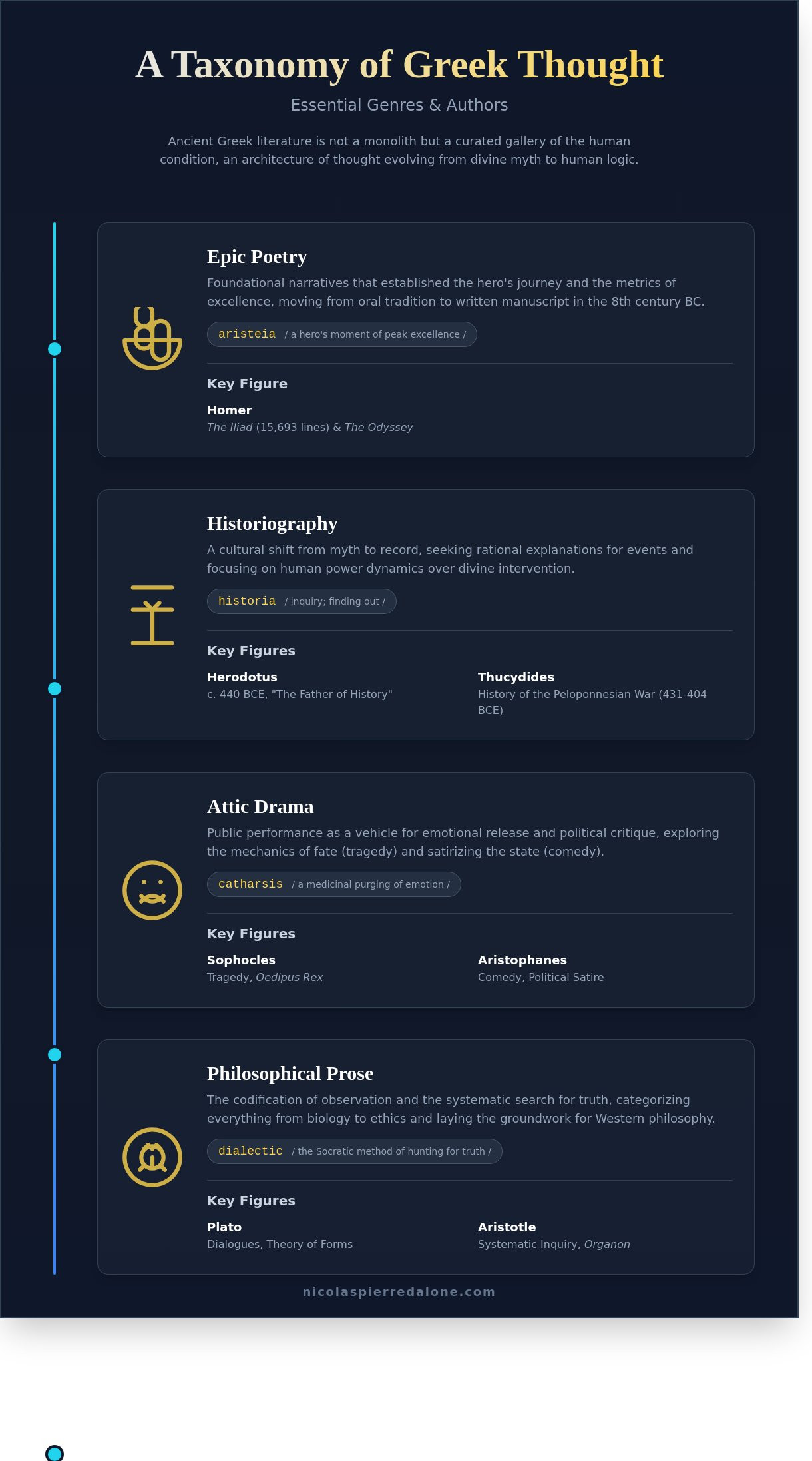
Greek literature is a curated gallery of the human condition. It isn't a monolith. It's a structured architecture of thought. Epic poetry provided the foundation. Homer’s 15,693 lines in the Iliad didn't just tell a war story. They established the "aristeia," the moment of peak excellence. This was the birth of the hero’s journey. It set the standard for every narrative that followed.
Historiography moved the culture from myth to record. Herodotus, writing around 440 BCE, sought the "historia" or inquiry. Thucydides refined this discipline. His account of the Peloponnesian War (431-404 BCE) stripped away divine intervention. He focused on human power dynamics and political realism. These genres of ancient Greek literature represent a transition from divine mystery to human logic. It's a shift from the gods to the individual.
Attic drama offered a different texture. Sophocles explored the mechanics of fate in Oedipus Rex. His tragedies triggered "catharsis," a medicinal purging of emotion. Aristophanes provided the necessary counterpoint. His comedies used sharp, political wit to critique the Athenian state. Philosophical prose then codified these observations. Plato used the dialectic to hunt for truth. Aristotle, his student, preferred systematic inquiry. He categorized everything from biology to ethics in his Organon. These ancient greek texts are the blueprints of Western intellectual life.
The Poets: Homer, Hesiod, and Sappho
The Iliad and Odyssey served as the cultural Bibles of the Mediterranean. They defined virtue and social conduct. Hesiod’s Theogony, composed around 700 BCE, organized the chaos of the gods into a rigid hierarchy. It gave the Greeks a map of the divine. Sappho’s work stands apart from the epic scale. Her lyric fragments, composed on the island of Lesbos, introduced the intimate, personal voice. It's the first time we hear the individual heartbeat in ancient greek texts. Her work is a study in brevity and emotional precision.
The Philosophers and Orators
Plato’s Republic, written around 375 BCE, remains the definitive text for political ethics. It challenges the nature of justice and the soul. The Stoic legacy found its roots in the Greek Stoa. Epictetus taught that we control only our reactions, not external events. This philosophy reached its peak with Marcus Aurelius (121-180 CE). Demosthenes represents the peak of the spoken word. His "Philippics" (351-341 BCE) demonstrate how language can mobilize a democracy. He understood that rhetoric is a craft, much like a perfectly tailored silhouette requires mastery of form.
Epic Poetry: The foundational myths of identity and struggle.
Attic Drama: The exploration of human suffering and political satire.
Philosophical Prose: The transition from observation to systematic logic.
Historiography: The invention of the objective, chronological record.
The Parallel Text Advantage: Decoding the Original Greek
The Greek alphabet often acts as a silent gatekeeper. For 62% of independent learners, the initial encounter with the script is where the journey ends. It feels like a barrier; a wall of symbols that refuses to yield. Yet, ancient greek texts shouldn't be viewed as puzzles to solve. They're textures to be felt. The parallel text, or bilingual edition, offers a sophisticated bridge for the modern mind. It replaces the frustration of the unknown with the pleasure of discovery.
Traditional methods rely on a dictionary-heavy approach. This is the death of poetry. Stopping every three words to consult a lexicon destroys the rhythm of Homeric dactylic hexameter. Parallel texts change the dynamic. You're no longer translating; you're immersing. By seeing the original Greek alongside a curated English version, you build an intuitive vocabulary. It's a visual resonance. The brain begins to map the English meaning onto the Greek characters without the need for conscious effort. It's the difference between studying a blueprint and walking through the finished estate.
How to Use a Bilingual Edition Effectively
Success lies in the scanning technique. Start with the English. Establish the narrative context and the emotional silhouette of the passage. Once the meaning is clear, move your eyes to the Greek. You'll notice etymological roots that exist in 25% of the English vocabulary. Words like logos or pathos aren't foreign; they're the ancestors of your own speech. To maintain this flow, leverage integrated glossaries. Resources like the Perseus Digital Library provide instant access to morphological data. This eliminates the friction of external books. You stay within the art of the text.
Why Direct Translation Often Fails the Reader
A single translation is a compromise. It's a shadow of the original. Certain concepts in ancient greek texts are untranslatable by nature. Take Arete. A standard translator might use "virtue," but this fails to capture the 19th-century philological understanding of "excellence in function." Eudaimonia is another example. It's not "happiness" in the modern sense; it's a state of flourishing. A bilingual edition allows these words to stand in their original glory while the English provides a necessary scaffold.
There's a psychological benefit to the Greek script that transcends linguistics. It's a visual art form. The way the letters lean and curve creates a specific aesthetic experience. It's a tactile connection to a heritage that dates back to the 8th century BCE. When you read the original, you're not just consuming information. You're engaging with a design that has shaped Western thought for millennia. The bilingual format preserves the rhythmic structure of the prose. It ensures that the soul of the work isn't lost in the transition between languages. It's a commitment to quality that mirrors the finest craftsmanship.
Curating Your Personal Collection of Classical Literature
A library represents a curated autobiography. For those pursuing Homer in the original, the physical vessel matters as much as the Greek hexameter. You face a choice. Academic paperbacks offer utility for the classroom. Heirloom editions offer a legacy for the home. One is a consumable; the other is an investment in your intellectual heritage. The bibliophile's dilemma isn't about storage space. It's about the quality of the interaction between the reader and the page.
True quality lives in the tactile details. Demand acid-free 120gsm paper. This weight resists the oxidation that turns cheap pages brittle within 15 years. Choose Smyth-sewn bindings. These allow the book to lay flat without the spine breaking. Typography should be understated. A classic serif like Caslon or Sabon provides the necessary breathing room for complex ancient greek texts. These physical attributes transform a reading session into a meditative act. Quality is never an accident; it's the result of intentional craftsmanship.
Structure your reading plan with a logical progression. Begin with the narrative. The Odyssey provides the pulse of the hero's journey. Transition to the dramatic. The works of Sophocles offer a bridge to the philosophical. Finally, approach the abstract. Plato and Aristotle require a foundation of myth and history to be fully understood. Modern adaptations, such as Emily Wilson’s 2017 translation, serve as vital entry points. They ensure the tradition remains a living conversation rather than a static relic. They don't replace the original; they invite you deeper into its secrets.
A Recommended Starter List for 2026
Homer’s Odyssey: This 12,110-line masterpiece remains the definitive study of resilience and homecoming.
Plato’s Apology: A sharp, 30-page entry into the ethics of the individual against the state.
Sophocles’ Antigone: A timeless exploration of the conflict between divine law and human decree.
The Aesthetic of the Classical Library
A collection of ancient greek texts shouldn't be hidden in a dark corner. In 2024, interior design favors the "quiet luxury" aesthetic. Books with cloth-bound spines in muted tones like obsidian or slate integrate naturally into minimalist spaces. They offer a physical weight that digital files lack. A Kindle cannot anchor a room. A physical volume can. It’s a necessary antidote to the 4.7 hours the average adult spends on mobile screens daily. Discover our Bibliotheca Graeca for exquisite bilingual editions that serve as both literature and art.
Refine your study with a piece of functional art. Explore our bespoke collection of classical volumes to begin your collection.
The Bibliotheca Graeca: A Modern Renaissance of Ancient Wisdom
Plume Charmers defines a new standard for the classical scholar. We don't just print books; we curate experiences. Nicolas Pierre d'Alone founded this initiative in 2022 to dismantle the invisible wall between the modern reader and ancient greek texts. His vision is simple. No language is truly dead if it breathes through a reader's pulse. The Bibliotheca Graeca collection rejects the utilitarian aesthetic of traditional academia. We replace it with a sensory journey where the weight of the book matches the weight of the ideas within.
The philosophy of Nicolas Pierre d'Alone centers on accessibility without compromise. He believes the perceived "impossibility" of Homeric Greek is a failure of design, not a lack of student intellect. Our editions act as a bridge. We combine the precision of 19th-century philology with the clarity of 21st-century typography. Each page layout undergoes rigorous testing to ensure the eye moves naturally between the original verse and the supporting notes. This isn't just publishing. It's an act of intellectual restoration.
Our approach goes beyond the standard textbook. We treat every volume as a standalone piece of art. For our September 2024 release of the Odyssey, we selected a 14pt Adobe Jenson typeface. It provides a readability rarely found in classical editions. We pair this pedagogical rigor with uncompromising materials. The result is a library that serves the mind and the hand equally. It's a commitment to the long term. These books are built to survive centuries, mirroring the endurance of the words they carry.
Looking ahead, our 2025 catalog introduces specialized lexicons designed for specific poetic cycles. These aren't exhaustive dictionaries. They're curated maps. Our upcoming Homeric Lexicon features 1,500 entries, focusing on the emotional resonance of epithets rather than just their grammatical function. We're also preparing bilingual editions of the Pre-Socratics. Each project follows our strict protocol: absolute transparency in sourcing and a relentless focus on the tactile experience. We don't rush. Quality requires a slower rhythm.
Crafting the Perfect Bilingual Experience
We use 120gsm Munken Pure paper for its cream tone and archival quality. It's a substantial material that prevents ink ghosting. Our Smyth-sewn bindings allow every book to lie perfectly flat on a desk. This detail is essential for the self-taught scholar who needs both hands free for note-taking. These ancient greek texts deserve a physical form that honors their heritage while providing modern functional excellence.
Join the Plume Charmers Community
The future of independent publishing lies in the connection between creator and enthusiast. We're building a space for those who value the fine nuances of translation and book design. Our community is a gathering of modern world-travelers and artists who refuse to accept mediocre mass-production. We invite you to be part of this revival. Explore the Bibliotheca Graeca collection today and find your place in the classical tradition.
Build Your Eternal Library
The pursuit of wisdom is a lifelong curation. True bibliophiles understand that the depth of a library defines the depth of the mind. You've seen how bilingual editions unlock the hidden rhythms of classical thought. It's about the texture of the page and the clarity of the translation. Nicolas Pierre d'Alone established this 100% independent house to honor that connection. We focus on artisanal quality over mass production. Our 2024 collection brings ancient greek texts into the light of the 21st century with uncompromising aesthetic standards. Each volume serves as a bridge between the 5th century BC and your personal study. Precision matters. Heritage matters. The Bibliotheca Graeca represents a return to the book as a work of art. It's time to transform your reading experience into a tactile encounter with history.
Step into a world where every word carries the weight of centuries. Your collection is waiting for its next masterpiece.
Frequently Asked Questions
Is it possible to read Ancient Greek texts without knowing the alphabet?
You can't read the original works without first mastering the 24 letters of the Greek alphabet. This phonetic system, established by the 8th century BCE, remains the only gateway to the rhythm of the verse. While transliterations exist, they strip the text of its visual architecture and historical weight. True engagement requires recognizing the specific geometry of the omega and the sigma.
What is the best Ancient Greek text for a complete beginner to start with?
Xenophon’s Anabasis, composed around 370 BCE, serves as the premier entry point for the novice. Its prose is celebrated for its clarity and disciplined syntax. Unlike the complex dialect of Homer, Xenophon uses a limited vocabulary of roughly 2,500 words in the first book. It provides a logical structure that builds confidence before you approach the more ornamental styles of the lyric poets.
Are bilingual Ancient Greek books effective for learning the language?
Bilingual editions, such as those from the Loeb Classical Library founded in 1911, are effective tools for verifying complex grammatical structures. They shouldn't replace active translation efforts. Relying too heavily on the English facing page can lead to a passive understanding. Use the translation only after you've spent 20 minutes wrestling with a single paragraph of the original Greek.
How long does it take to understand basic Ancient Greek prose?
Reaching a functional level in basic prose typically requires 600 hours of dedicated study. This timeline allows a student to internalize the 3 main noun declensions and the intricate verbal system. By the end of the first year, most learners can navigate the 40 chapters of a standard introductory textbook. Mastery is a slow process that mirrors the patience required in high-end craftsmanship.
Where can I find high-quality physical editions of Ancient Greek books?
The Oxford Classical Texts, published by Oxford University Press since 1894, represent the gold standard for physical editions. These volumes feature a minimalist navy cloth binding and the critical apparatus necessary for serious scholarship. For those seeking German precision, the Teubner series offers over 700 titles. These books are objects of permanence, designed to last for generations in a private library.
What is the difference between Attic Greek and Koiné Greek texts?
Attic Greek is the sophisticated dialect of 5th-century BCE Athens, used by Plato and Sophocles. Koiné Greek emerged around 300 BCE as a simplified common language for the Mediterranean. While Attic uses complex optative moods and dual forms, Koiné reduces these nuances for broader accessibility. Understanding ancient greek texts requires recognizing these distinct linguistic layers, as the transition reflects a shift from city-state isolation to imperial expansion.
Can I teach myself Ancient Greek using only parallel texts?
You can't achieve fluency through parallel texts alone because they don't explain the 8 cases or the nuances of the middle voice. A structured grammar, like Hansen and Quinn’s Intensive Greek published in 1992, is essential. This 800-page resource provides the analytical framework that raw reading lacks. Self-taught students find that 90 percent of their progress comes from systematic drills rather than casual reading.
Why are some Ancient Greek texts only available in fragments?
Scholars estimate that less than 10 percent of ancient greek texts survived the Middle Ages. The destruction of the Library of Alexandria in 48 BCE and the natural decay of papyrus in damp climates caused most losses. We often rely on quotations from later authors or charred scrolls found in Herculaneum. These fragments are precious remnants of a larger, lost architectural whole, requiring a curator’s eye to piece together.


Comments