%20-%20Copie.png)

Ancient Greek for Beginners: A Refined Guide to the Language of Philosophers
Updated: Mar 9
The Greek script is often dismissed as an impenetrable mystery-a relic locked behind the heavy doors of dry, technical academia. This guide offers a refined perspective on ancient greek for beginners, stripping away the academic noise to reveal a curated path toward linguistic mastery. To the discerning mind, the language is not a barrier, but a silhouette of ancient thought waiting to be traced with precision and quiet confidence.
We treat the acquisition of Greek not as a repetitive chore, but as a form of intellectual craftsmanship. By moving beyond the clutter of uninspired textbooks, we invite you to explore a heritage where every character carries the weight of a philosopher’s intent. This is an invitation to engage with a timeless aesthetic, where the structure of grammar meets the elegance of art.
Within this exploration, you will master the alphabet with ease and learn to navigate the subtle nuances of historical dialects without confusion. We have curated a selection of high-quality bilingual resources that transform the act of reading into a purely artistic experience. Prepare to bridge the gap between ancient wisdom and modern sophistication through a lens of curated literature.
Key Takeaways
Understand the foundational architecture of Western thought by exploring Greek as the primary source of literature and philosophy.
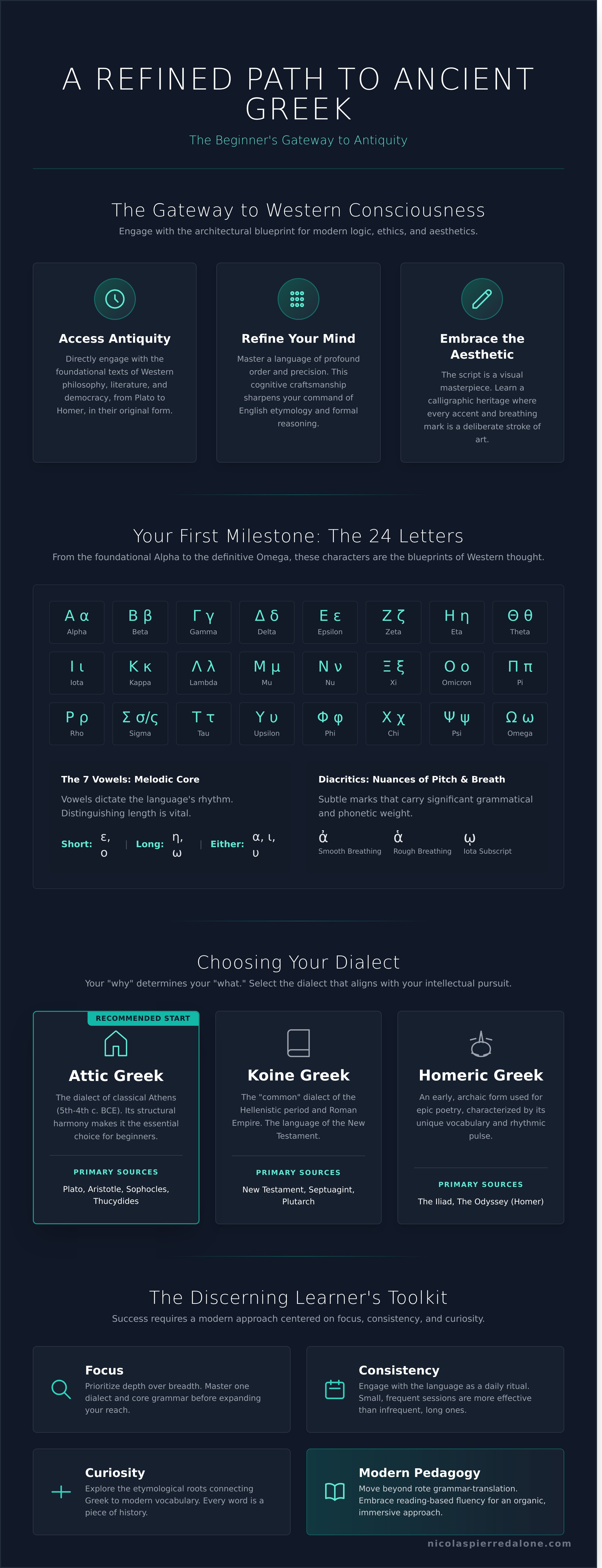
Master the 24 letters of the Greek alphabet as a refined artistic milestone, distinguishing between vowels and breathing marks.
Discover why Attic Greek is the essential choice for ancient greek for beginners due to its structural harmony and historical significance.
Curate a library of specialized resources and lexicons designed to elevate your self-study beyond generic textbooks.
Transition from isolated exercises to the fluid reading of complete sentences through the immersive Bibliotheca Graeca approach.
Table of Contents The Gateway to Antiquity: Why Learn Ancient Greek for Beginners? Mastering the Greek Alphabet: Your First Artistic Milestone Choosing Your Dialect: Attic, Koine, or Homeric Greek? The Discerning Learner’s Toolkit: Resources for Self-Study From Study to Fluency: The Bibliotheca Graeca Approach
The Gateway to Antiquity: Why Learn Ancient Greek for Beginners?
To study Ancient Greek is to touch the raw materials of Western consciousness. It is not merely a language; it is the architectural blueprint for logic, ethics, and aesthetics. While many dismiss it as an impenetrable cipher, ancient greek for beginners is a journey toward profound clarity. By engaging with this Overview of the Ancient Greek language, one begins to see how the structures of Homer and Plato still dictate the silhouette of modern thought.
Beyond the intellectual prestige, the process refines the mind with a jeweler’s precision. Every particle and inflection serves a specific purpose, sharpening your command of English etymology and formal reasoning. It is the ultimate exercise in cognitive craftsmanship. The "It’s all Greek to me" myth dissolves when you realize the language is a system of profound order, waiting for the disciplined observer to unlock its rhythm and depth.
The Aesthetic Appeal of the Greek Script
The Greek alphabet is a visual masterpiece. The polytonic system, with its delicate breathings and accents, offers a calligraphic heritage that transcends simple communication. Learning the script is the first step toward true intellectual intimacy with the text. It is a slow, deliberate process-viewing the language not as a mere tool, but as a curated work of art. To write these characters is to trace the same lines that birthed democracy, tragedy, and the very concept of the soul.
Setting Your Intentions for Fluency
Mastery requires a defined vision. Are you seeking the rhythmic pulse of Epic Poetry, the theological precision of the New Testament, or the stark logic of Philosophy? Defining your "Why" is essential for long-term dedication. Modern pedagogy has shifted; we move away from dry, rote grammar-translation toward reading-based fluency-a more organic and immersive approach to the classics.
As we approach 2026, a year poised for a significant modern classical revival, there has never been a more opportune moment to begin. Ancient greek for beginners is no longer a pursuit of the past, but a statement of contemporary sophistication and a commitment to enduring quality. Success in this field requires:
Focus: Prioritizing depth over breadth.
Consistency: Engaging with the text as a daily ritual.
Curiosity: Exploring the etymological roots of our modern vocabulary.
This curiosity often reveals surprising connections, linking the ancient world to modern concepts of well-being. For instance, the practice of thalassotherapy—a cornerstone of many wellness retreats—draws its name directly from the Greek word for sea, thálassa (θάλασσα). For a modern interpretation of this ancient concept of sea-based rejuvenation, you can check out Promo Thalasso.
Mastering the Greek Alphabet: Your First Artistic Milestone
To study ancient greek for beginners is to engage with a profound visual heritage. The twenty-four letters, from the foundational Alpha to the definitive Omega, are the blueprints of Western thought. This is not merely a task of memorization; it is an exercise in aesthetics. Each character possesses a unique silhouette that requires the precision of a craftsman to master.
True fluency begins with the hand. Writing the script manually builds a tactile connection, grounding the abstract in muscle memory. Observe how the characters shift across various classical fonts. Whether it is the stark clarity of a stone-cut inscription or the fluid elegance of a Renaissance manuscript, recognizing these forms is essential for navigating primary texts. For those seeking a structured entry into this world, this Free introductory course on Ancient Greek offers a curated path through these initial typographic hurdles.
Vowels and the Music of the Language
Seven vowels form the melodic core of the language. Distinction is vital. Long vowels (η, ω) and short vowels (ε, ο) dictate the inherent rhythm of every sentence. Pay close attention to the iota subscript-a subtle, silent stroke beneath a vowel that carries significant grammatical weight. The polytonic system serves as a precise architectural map of pitch and breath, ensuring the language is spoken with its intended resonance and historical integrity.
Consonant Clusters and Phonetic Precision
Consonants provide the structural frame. Approach them with a curator’s eye for detail, grouping them by their phonetic origin: labials, dentals, and palatals. This logical arrangement simplifies the complexity of the script. Double consonants, such as Psi (ψ) and Zeta (ζ), require particular focus to avoid the common pitfalls of English approximations. Achieving phonetic precision is the first mark of a disciplined student of ancient greek for beginners, reflecting a commitment to the nuances of classical expression.
Choosing Your Dialect: Attic, Koine, or Homeric Greek?
The Greek language is not a monolith. It is a living heritage, an evolution of form spanning two millennia. For the scholar approaching ancient greek for beginners, the first task is one of curation. Selecting a dialect is not merely a technical choice; it is a commitment to a specific aesthetic and intellectual horizon. One does not simply learn Greek; one chooses a legacy to inhabit.
The Attic Standard: The Language of Athens
Attic Greek is the gold standard of the classical world. It possesses a structural perfection and a rhythmic precision that remains unsurpassed. Most serious students begin here. It is the language of 5th-century Athens, serving as the essential foundation for all subsequent linguistic study. To master Attic is to master the blueprint of Western thought.
The Foundation: Attic grammar informs the structure of later dialects, making it the most versatile starting point for any serious collection of knowledge.
The Canon: It provides direct access to the uncompromising clarity of Plato and the tragic silhouettes of Sophocles.
Linguistic Rigor: The complexity of its syntax develops an intellectual discipline that mirrors the craftsmanship of fine art.
Koine and Homeric Alternatives
Beyond the Attic standard lie paths of different textures. Koine Greek, the "common" tongue of the Hellenistic era, offers a simplified syntax. It is the gateway to biblical texts and the historical accounts of the post-Alexandrian world. It is accessible, direct, and functional-a language of the people that retains a quiet, historical dignity.
Homeric Greek, by contrast, is the language of the epic. It is archaic, ornate, and deeply musical. To read the Iliad or the Odyssey in its original hexameter is to experience the raw power of the oral tradition. It requires a different ear-one tuned to the cadence of heroes and the textures of the Bronze Age.
Your choice must align with your personal library and intellectual ambitions. Whether you seek the philosophical depth of Athens or the epic resonance of Troy, the journey requires a refined methodology. For those seeking an authoritative guide through these linguistic landscapes, the digital archives of Harvard's Center for Hellenic Studies offer a sophisticated toolkit for the discerning learner. In the study of ancient greek for beginners, precision is the only path to true understanding. Quality, as always, is found in the details.
The Discerning Learner’s Toolkit: Resources for Self-Study
Mastery requires more than a casual interest; it demands a curated selection of instruments. For those embarking on ancient greek for beginners, the library is not merely a shelf of books, but a sanctuary of intellectual heritage. Success in self-study lies in the transition from generic resources to specialized editions that respect the nuances of the language.
Essential Textbooks and Lexicons
The choice of method defines the texture of your progress. Traditional grammar-translation methods offer a skeletal rigidity, essential for structural integrity. However, the "Reading Greek" approach provides a more fluid, narrative-driven silhouette, allowing the learner to encounter the language as a living expression. Precision is paramount. A standard dictionary is often a blunt instrument; a specialized lexicon offers the surgical clarity required to navigate Attic thought. For a refined selection, consult our Ancient Greek Lexicon buying guide to find a volume that matches your scholarly ambition.
Traditional Methods: Focus on morphological precision and syntax.
The "Reading Greek" Approach: Prioritizes context and immediate immersion.
Specialized Lexicons: Essential for capturing the specific semantic range of classical authors.
The Power of Bilingual and Parallel Texts
Parallel texts serve as a sophisticated bridge between the unknown and the familiar. By placing English and Greek in a mirrored dialogue, the learner experiences immediate pattern recognition without the fatigue of constant deciphering. This method reduces the friction of learning, transforming a rigorous exercise into an aesthetic experience.
The "Plume Charmers" method-utilizing integrated glossaries within the text-allows for a seamless flow. It eliminates the interruption of searching for definitions, ensuring the rhythm of the prose remains intact. This dual-language exposure accelerates the transition from ancient greek for beginners to a more intuitive understanding of complex sentence structures.
In 2026, the balance between digital utility and physical presence is a mark of the discerning student. Use digital tools for rapid drills, but reserve the physical book for deep study. The tactile experience of a well-bound volume fosters a deeper connection to the material. Daily exposure to the script is not a chore, but a ritual of refinement. It is the consistent, quiet observation of the characters that eventually reveals their soul.
Discover more about the art of classical living at nicolaspierredalone.com.
From Study to Fluency: The Bibliotheca Graeca Approach
The transition from grammar exercises to literary fluency is often the most precarious stage for the modern scholar. Most curricula for ancient greek for beginners stall at the gates of syntax, leaving the student trapped in a cycle of mechanical decoding. The Bibliotheca Graeca approach changes the trajectory. We move beyond isolated sentences. We embrace the rhythm of the original thought.
The goal is not merely translation. It is the effortless absorption of the text. By shifting focus from the abstract rule to the living sentence, the learner begins to perceive the aesthetic nuances of the language. This is where study ends and true engagement begins.
The Art of the Bilingual Edition
The craftsmanship behind Nicolas Pierre d’Alone’s Greek titles reflects a commitment to intellectual luxury. These are not mere textbooks; they are curated artifacts designed for the discerning mind. Each Plume Charmers edition serves as a bridge between the beginner’s effort and the master’s ease.
Specialized Glossaries: Every volume features contextual definitions, allowing for immediate engagement without the distraction of external lexicons.
Typographic Clarity: Precision in layout ensures that the Greek script and its translation exist in a harmonious, readable balance.
Tactile Heritage: The weight of the paper and the quality of the binding transform the act of study into a sensory ritual.
High-quality physical books are essential. They ground the ethereal nature of an ancient language in a tangible, enduring form. To hold a well-crafted volume is to respect the heritage of the words within.
Your Next Steps in the Greek Journey
Mastery requires a structured ascent. To ensure ancient greek for beginners evolves into a lifelong pursuit, your first month should focus on consistency and cadence. Structure your progress with intention:
Days 1-10: Focus on the phonetics of the verse. Read aloud to internalize the breath of the language.
Days 11-20: Engage with bilingual fragments. Use the specialized glossaries to identify recurring syntactical silhouettes.
Days 21-30: Transition to sustained reading. Attempt a full page within the Bibliotheca Graeca collection without looking at the English side first.
True learning thrives in a community of like-minded enthusiasts. Seek those who value depth, precision, and the quiet elegance of the classics. Your path to the ancients is a journey of refinement. It is time to Explore the Bibliotheca Graeca Collection and curate your own library of wisdom.
The Art of Intellectual Heritage
Mastering the Greek alphabet and selecting a specific dialect are not merely academic tasks; they are the first steps in a curated journey toward antiquity. True fluency requires more than simple memorization. It demands a sustained dialogue with the original text, supported by resources that honor both scholarly precision and aesthetic beauty. For the discerning student of ancient greek for beginners, the path to mastery is paved with intentionality and a refined toolkit.
Bibliotheca Graeca, an independent publishing house founded by author Nicolas Pierre d’Alone, ensures scholarly and artistic integrity in every edition. These bilingual masterpieces offer innovative modern adaptations and specialized glossaries tailored specifically for the self-taught scholar. Every volume is a testament to the belief that the classics should be experienced as art, providing the clarity needed to navigate complex grammatical landscapes without losing the poetic soul of the work.
Your journey into the language of the philosophers deserves a companion of equal stature. Discover the Bibliotheca Graeca: Bilingual Greek Masterpieces and transform your study into a profound encounter with history. The wisdom of the ages awaits your discovery.
Frequently Asked Questions
Is Ancient Greek harder to learn than Latin for a beginner?
Ancient Greek presents a unique architectural challenge. While Latin shares our familiar script, Greek demands the immediate mastery of a new alphabet. For those exploring ancient greek for beginners, the complexity lies in its nuanced verbal system and three distinct voices. Latin is a foundation of logic; Greek is a pursuit of expressive depth. Both require discipline, yet Greek offers a more textured linguistic landscape.
Can I teach myself Ancient Greek using only books?
Self-study is an exercise in intellectual autonomy. With a curated selection of texts, mastery is attainable. Relying on foundational works like Athenaze or the JACT Reading Greek series provides the necessary structure. Success depends on the quality of your materials and the consistency of your practice. It is a solitary craft, much like the work of a master artisan, requiring patience and the right tools.
How long does it take to reach reading fluency in Ancient Greek?
Fluency is not a destination but a gradual unfolding of understanding. For most, reaching a level where Homer or Plato becomes accessible takes two to three years of daily engagement. This timeline is a testament to the language’s intricate heritage. It is a slow process of refinement. Like a fine garment, the ability to read with ease is woven over time through persistent, focused effort.
What is the difference between Ancient Greek and Modern Greek?
The two represent different eras of a single artistic lineage. Ancient Greek possesses a complex system of cases and moods that Modern Greek has simplified over centuries. Pronunciation has shifted from tonal to stress-based. While the alphabet remains a shared silhouette, the structural differences are profound. It is the difference between a classical sculpture and a contemporary installation-both beautiful, yet distinct in their execution.
Which dialect of Ancient Greek should I learn first?
Attic Greek is the definitive starting point. As the dialect of Athens during its Golden Age, it serves as the gateway to the works of Plato, Sophocles, and Thucydides. It is the most refined and widely documented form. Once this foundation is laid, transitioning to the Ionic of Homer or the Koine of the New Testament becomes a matter of subtle adjustment. Focus on the Attic silhouette first.
Do I need to learn the Greek alphabet before starting a textbook?
Mastery begins with the script. Learning the Greek alphabet is the essential first movement in ancient greek for beginners. It is the canvas upon which all further knowledge is painted. One cannot appreciate the texture of the prose without first recognizing the characters. Dedicate your first week to this task. Precision at this stage ensures clarity as you progress into more complex grammatical structures.
Are bilingual books effective for learning Ancient Greek grammar?
Bilingual editions, such as the Loeb Classical Library, are instruments of context. They offer a mirror to the original text, aiding in vocabulary acquisition and flow. However, they cannot replace the rigorous study of a dedicated grammar book. Use them as a guide to appreciate the artistry of the sentence, but return to your textbook to understand the underlying mechanics. They are a supplement, not a substitute.
What are the best Ancient Greek resources for English speakers in 2026?
The modern scholar benefits from a blend of tradition and technology. The Perseus Digital Library remains an indispensable archive for textual analysis. For lexical precision, the Logeion app offers unparalleled access to dictionaries. Pair these digital assets with the timeless authority of Smyth’s Greek Grammar. This curated collection of resources ensures that your study remains both efficient and deeply rooted in academic excellence.


Comments