%20-%20Copie.png)
Learn Ancient Greek: A Curated Guide for the Modern Intellectual

The pursuit of classical knowledge is too often reduced to an academic exercise. Rote memorization from sterile textbooks. A process devoid of beauty, alienating the very intellect it seeks to engage. The intimidation of a new alphabet becomes a barrier, not a gateway to understanding.
We propose a different path. A curated ritual. To learn ancient greek is not to conquer a grammar table, but to engage with a living artistic heritage. It is an aesthetic pursuit, a dialogue with history conducted through objects of profound thought and impeccable design.
This guide presents a sophisticated, reading-first methodology. An approach built around the tactile pleasure of bilingual editions and the quiet immersion into classical art. Here, you will discover a way to read the foundational texts of Western culture with minimal friction, to establish a daily intellectual practice, and to assemble a personal library that is as considered as your ambition. The goal is clarity. The outcome, a direct line to the minds of Homer, Plato, and Sophocles.
Key Takeaways
Discover the intellectual weight of Ancient Greek and its foundational role in Western philosophy and literature.
Move beyond traditional grammar drills by adopting a modern, reading-first methodology for effective self-study.
Curate an essential library of texts and lexicons specifically chosen to help you learn ancient greek with focus and precision.
Experience the classics directly through artistically designed bilingual editions that merge original text with visual art.
Table of Contents The Allure of Ancient Greek: Why Modern Readers Return to the Classics Decoding the Script: Your First Steps into the Greek Alphabet and Phonology Methodology Matters: Grammar-Translation vs. The Immersive Reading Approach Curating Your Library: Essential Textbooks and Resources for Self-Study The Plume Charmers Vision: Bilingual Editions for the Discerning Scholar
The Allure of Ancient Greek: Why Modern Readers Return to the Classics
The decision to learn ancient greek is a commitment to depth over distraction. It is not an excavation of a "dead language," but a direct dialogue with the minds that shaped philosophy, drama, and scientific inquiry. In an age of fleeting digital noise, the study of Greek offers a rare currency: intellectual permanence. It is a deliberate retreat into a world of precision and consequence, where every word carries the weight of a civilization.
This pursuit moves beyond the passive act of reading translations. It is an active immersion into a living library of foundational texts. The slow, meticulous process of deciphering a sentence becomes a meditative practice, sharpening the mind against the ephemeral nature of the modern world and cultivating a profound focus.
Transcending Time: The Intellectual Reward
Certain concepts resist simple translation. To grasp the full resonance of Logos (λόγος) or Arete (ἀρετή) is to understand an entire worldview, not just a single word. The ultimate privilege, however, is to read Plato’s dialogues or Sappho’s verse without the filter of an intermediary. This unmediated encounter with original genius is the core reward. The process itself cultivates superior cognitive and analytical skills-a discipline of clarity that serves any modern endeavor.
Beyond the Alphabet: A New Way of Thinking
Ancient Greek is a highly inflected language, where word endings-not a rigid word order-dictate meaning. Mastering this system is a rigorous intellectual exercise that rebuilds one's understanding of grammar from the ground up. This grammatical architecture, explored in any comprehensive overview of Ancient Greek, is more than a historical curiosity; it is a framework for a different mode of thought. It forces a non-linear logic, revealing how sentence structure itself can shape an argument. This study becomes a gateway, opening a door to the broader landscape of Indo-European linguistics and the very DNA of Western language.
Decoding the Script: Your First Steps into the Greek Alphabet and Phonology
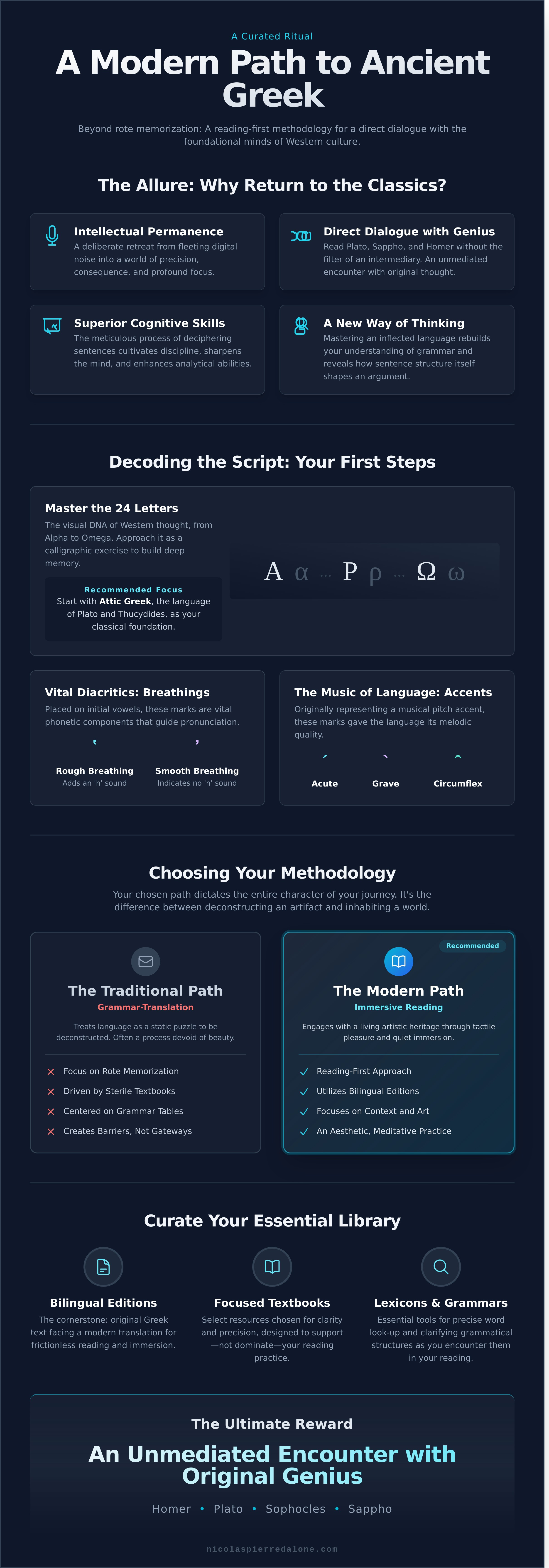
To learn ancient greek is to first master its foundational architecture: the alphabet. This system of 24 letters, from Alpha to Omega, is the direct ancestor of both the Latin and Cyrillic scripts. It is more than a set of symbols; it is the visual DNA of Western thought. Your journey begins here, with the deliberate study of each character's form and sound.
While several dialects exist, the beginner should focus on Attic Greek, the language of Plato and Thucydides. Homeric and Koine Greek present unique features best approached after mastering this classical foundation. Likewise, pronunciation is a matter of scholarly convention. Most academic paths begin with the Erasmian system, a standardized pronunciation that prioritizes clarity for the modern student over a perfect historical reconstruction.
Mastering the 24 Letters
Approach the alphabet as a calligraphic exercise. Practice writing each letter, noting the distinction between similar forms like Nu (ν) and the Latin 'v', or Rho (ρ) and the Latin 'p'. This tactile engagement builds a deeper memory. In classical texts, you will encounter both minuscule (lowercase) and majuscule (capital) letters. While majuscules were used exclusively in early inscriptions, the elegant minuscule script developed later for manuscripts is what you will primarily read.
Breathings and Accents: The Music of the Language
Ancient Greek text is adorned with diacritics that guide its pronunciation. These are not mere decorations but vital phonetic components.
Breathings: Placed on initial vowels, the rough breathing (῾) adds an 'h' sound, while the smooth breathing (᾿) indicates its absence.
Accents: The acute (´), grave (`), and circumflex (ˆ) originally represented a musical pitch accent, a system that gave the language its melodic quality.
Initially, your goal is recognition, not perfect production. Understanding these marks is key to correctly identifying words. The most respected programs, including the self-study courses from Harvard's Center for Hellenic Studies, provide a structured path to mastering these nuances. Focus on the visual rhythm they create on the page, and the sound will follow.
Methodology Matters: Grammar-Translation vs. The Immersive Reading Approach
The path you choose to learn ancient greek dictates the entire character of your journey. It is a distinction between deconstructing an artifact and inhabiting a world. The traditional Grammar-Translation method treats the language as a static puzzle, while the modern Reading Method cultivates an intuitive, direct relationship with the text. The choice is fundamental.
The Reading Method, by contrast, is an immersive experience. It prioritizes comprehension through high-frequency vocabulary and contextual inference. The psychological dividend is immediate and profound: to read a complete, authentic sentence from an ancient author in your first few weeks is a powerful motivator. This approach does not neglect grammar; it simply reframes it. Morphology is studied in service of the narrative, revealing the intricate craftsmanship behind the author’s meaning. While foundational courses like The Open University's Getting Started on Ancient Greek provide an essential grammatical framework, the true objective is to apply that knowledge to sustained, meaningful reading.
The Pitfalls of Traditional Rote Memorization
The Grammar-Translation method demands the memorization of paradigm tables in a vacuum. This clinical approach often leads to "translation fatigue"-a state where the learner can parse a sentence but has lost all connection to its rhythm and intent. Here, grammar becomes an end in itself, a series of abstract rules that obscure the very literature they are meant to illuminate. We must see grammar as a tool for clarity, not as the artwork itself.
The Power of Bilingual and Parallel Texts
For the immersive reader, parallel texts are the essential instrument. A facing-page translation, in the "Loeb style," reduces cognitive load and provides an elegant scaffold. The English is not a destination but a temporary guide, consulted only to resolve ambiguity before the eye returns to the Greek. This process facilitates a gradual release of dependence, moving the learner from interlinear glosses to parallel texts and, finally, to the confidence of monolingual reading.
Curating Your Library: Essential Textbooks and Resources for Self-Study
The journey to master a classical language is an act of intellectual curation. The resources you select are not merely tools; they are the foundation of your study, shaping your understanding and aesthetic appreciation of the Hellenic world. A thoughtfully assembled library, whether physical or digital, becomes a sanctuary for focused scholarship.
The Classics: Foundational Textbooks
The modern student has three distinguished paths for structured learning. Your choice reflects your intellectual temperament. Consider these standards:
Athenaze: An immersive, story-driven approach. This text builds intuition for Attic Greek by following the life of an Athenian family, deferring intensive grammar for a more natural acquisition process.
JACT Reading Greek: A comprehensive suite for the serious scholar. Developed by the Joint Association of Classical Teachers, it combines grammar, vocabulary, and original texts into a university-level curriculum.
Hansen & Quinn's Greek: An Intensive Course: The rigorous, grammar-first method. It is uncompromising in its precision, favored by those who wish to deconstruct the language to its essential mechanics from the outset.
Modern Tools: The Lexicon and Digital Glossaries
Your single most important tool is the lexicon. It is the definitive repository of a word's heritage and nuance. The gold standard remains the Liddell-Scott-Jones (LSJ), a monumental work of scholarship. For immediate analysis, digital platforms like the Logeion app or the Perseus Digital Library provide invaluable morphological data at a click. These modern instruments complement, but do not replace, the authority of the printed lexicon.
As you begin, supplementary readers with integrated glossaries are essential. These carefully edited texts-often excerpts from Xenophon or Lysias-provide the necessary scaffolding to bridge the gap between textbook exercises and authentic literature. They are the apprentice's first encounter with the masters. Ultimately, the quest to learn ancient greek is a personal one. Build a library that inspires discipline and cultivates a deep connection to the enduring legacy of the texts themselves.
The Plume Charmers Vision: Bilingual Editions for the Discerning Scholar
The journey to learn ancient greek is not merely an academic exercise; it is an aesthetic pursuit. At Plume Charmers, the studio of Nicolas Pierre d’Alone, we believe the tools for this journey should reflect the beauty of the destination. Our philosophy is one of artful accessibility: to bridge the chasm between the ancient world and the modern reader through objects of uncompromising quality.
The Bibliotheca Graeca collection was conceived for the modern autodidact-the scholar who seeks knowledge on their own terms. We reject the notion that learning must be a sterile process of memorization and dictionary-flipping. Instead, we present each text as a work of art. The weight of the paper, the clarity of the typography, and the precision of the binding are not incidental details. They are integral to the experience, creating a tactile connection that encourages a deeper, more sustained commitment to the language.
The Bibliotheca Graeca Collection
Our collection consists of bilingual Greek-English editions, meticulously designed to support immersive reading. The original Greek text is presented opposite a faithful English translation, a layout that facilitates the "Reading Method" of language acquisition. This parallel structure allows for constant, fluid reference without breaking your focus. Each work is chosen with curatorial care, selected not only for its historical significance but for its enduring power to resonate with modern sensibilities.
Why Our Integrated Glossaries Redefine Self-Study
Traditional self-study is an exercise in friction, defined by the constant interruption of reaching for a dictionary. We have eliminated this obstacle. Our integrated glossaries are the core of our "no-friction" approach, providing definitions exactly where you need them: on the facing page. This is not a generic lexicon. Each glossary is a bespoke creation, carefully curated for the specific literary work it accompanies, containing every word you will encounter. It is a seamless, elegant solution designed to keep you immersed in the world of the text. This is how you learn ancient greek with focus and grace.
The result is a reading experience that is as intellectually rewarding as it is aesthetically pleasing. Explore the Bibliotheca Graeca and begin your journey today.
Your Odyssey Begins
Your journey into the classical world is a deliberate one, marked not by speed but by depth. It begins with a clear purpose-a desire to commune directly with the origins of Western philosophy, drama, and history. As this guide has outlined, the decision to learn ancient greek is a profound commitment to intellectual clarity, demanding a methodical approach to its alphabet and a thoughtful choice between pedagogical styles.
Your progress, however, is ultimately defined by the quality of your companions. The discerning scholar deserves more than a fleeting digital text or a disposable paperback. You require tools crafted with the same reverence and intentionality as the ancient words themselves. This is the core of our philosophy.
The Bibliotheca Graeca is our answer to this need. Each bilingual edition is an artisan-quality object, conceived for the independent learner. With integrated glossaries for frictionless reading and a design that celebrates the beauty of the language, these books are more than resources-they are artifacts. Begin your classical journey with our curated Bibliotheca Graeca editions.
The dialogue across millennia is open. The texts await.
Frequently Asked Questions
Is Ancient Greek harder to learn than Latin?
Ancient Greek generally presents more initial challenges than Latin. It requires mastering a new alphabet, a more complex verb system-including the unique middle voice-and a system of pitch accents and breathings that have no parallel in Latin. While both languages demand rigorous study of morphology and syntax, the structural intricacies of Greek are often considered more demanding for the modern student. The perceived difficulty, however, remains a subjective measure of a student's dedication.
How long does it take to learn Ancient Greek for self-study?
The timeline to learn Ancient Greek is a testament to personal discipline. With consistent, daily effort, a student can expect to master the fundamentals of grammar and syntax within one to two years. This foundation allows for reading simplified texts. Progressing to unabridged works by authors like Plato or Xenophon requires further dedication. True fluency in reading complex poetry and prose is a long-term intellectual pursuit, a craft honed over many years of devoted study.
Can I learn Ancient Greek if I don’t know any other foreign languages?
Yes. Prior linguistic experience is not a prerequisite; a methodical approach is. Approaching the language without preconceptions can be an advantage, allowing you to build a pure understanding of its unique grammatical structures from the ground up. The journey demands a commitment to understanding fundamental concepts like noun cases, verb moods, and participles. Success is a product of disciplined study, not a reflection of previous knowledge. It is an open path for any dedicated mind.
What is the difference between Attic Greek and Koine Greek?
The distinction is one of period and purpose. Attic Greek is the refined, literary dialect of 5th and 4th century BCE Athens, the language of Plato, Thucydides, and the great tragedians. It is known for its complexity and nuance. Koine Greek, or "common" Greek, was the simplified lingua franca of the Hellenistic and Roman worlds. It is the language of the New Testament and Stoic philosophers like Epictetus, designed for clarity and broad communication.
Do I need to learn the accents and breathings right away?
Yes. The diacritics-accents and breathings-are not decorative elements. They are integral to the language, affecting both pronunciation and meaning. Neglecting them from the start establishes poor habits that are difficult to correct later. A proper foundation requires that these details are mastered from the first lesson. They are a fundamental component of the language's architecture and must be treated with precision from the outset for authentic study.
What are the best books for learning Ancient Greek at home?
A curated selection of texts serves the self-directed student. For a traditional grammar-translation method, Donald J. Mastronarde’s Introduction to Attic Greek offers unparalleled precision and depth. For a more immersive, reading-based approach, Athenaze: An Introduction to Ancient Greek is the established standard. Your choice of textbook is a foundational decision that will define the character of your studies. Each volume represents a distinct, crafted path toward mastering the language.


Comments