%20-%20Copie.png)
Ancient Greek Books: A Curated Guide to the Bibliotheca Graeca

The true measure of a refined home isn't the furniture, but the weight of the ideas resting on the shelves. A private library is a silent dialogue with history. It's an architecture of the mind. You likely believe that owning ancient greek books shouldn't mean settling for the sterile, uninspiring aesthetic of a common university textbook. Since the first printed Greek editions appeared in 1476, collectors have sought that rare intersection where the original script meets a translation that actually breathes. It's difficult to access these foundational thoughts without a doctorate, yet you refuse to compromise on the beauty of the physical object.
This curated guide promises to reveal the pillars of Hellenic thought through a lens of bilingual elegance and scholarly craftsmanship. You'll gain the clarity needed to select editions that honor the original Greek while providing exquisite English prose. We'll explore five essential works and the legacy of the 1911-founded Loeb series to help you build a personal collection that speaks of both intellectual depth and artistic confidence. The journey toward a timeless library begins with a single, well-chosen volume.
Key Takeaways
Trace the evolution of Hellenic wisdom from its oral origins to the enduring elegance of the physical manuscript.
Identify the essential pillars of Western thought through the epic poetry of Homer and the dialectic prose of Plato.
Explore the rare romances of antiquity, discovering the pastoral origins that shaped the modern literary novel.
Learn how bilingual parallel texts and specialized glossaries serve as the ultimate tools for achieving classical mastery.
See how the Bibliotheca Graeca elevates ancient greek books into handcrafted masterpieces through the vision of Nicolas Pierre d’Alone.
Table of Contents The Living Legacy of Ancient Greek Books: Beyond the Museum Shelf Foundational Texts of the Bibliotheca Graeca: Epic, Philosophy, and Drama The Ancient Greek Novel: Exploring the Romances of Antiquity Choosing Your Edition: Why Bilingual Texts are the Essential Tool Plume Charmers: Elevating the Classical Experience
The Living Legacy of Ancient Greek Books: Beyond the Museum Shelf
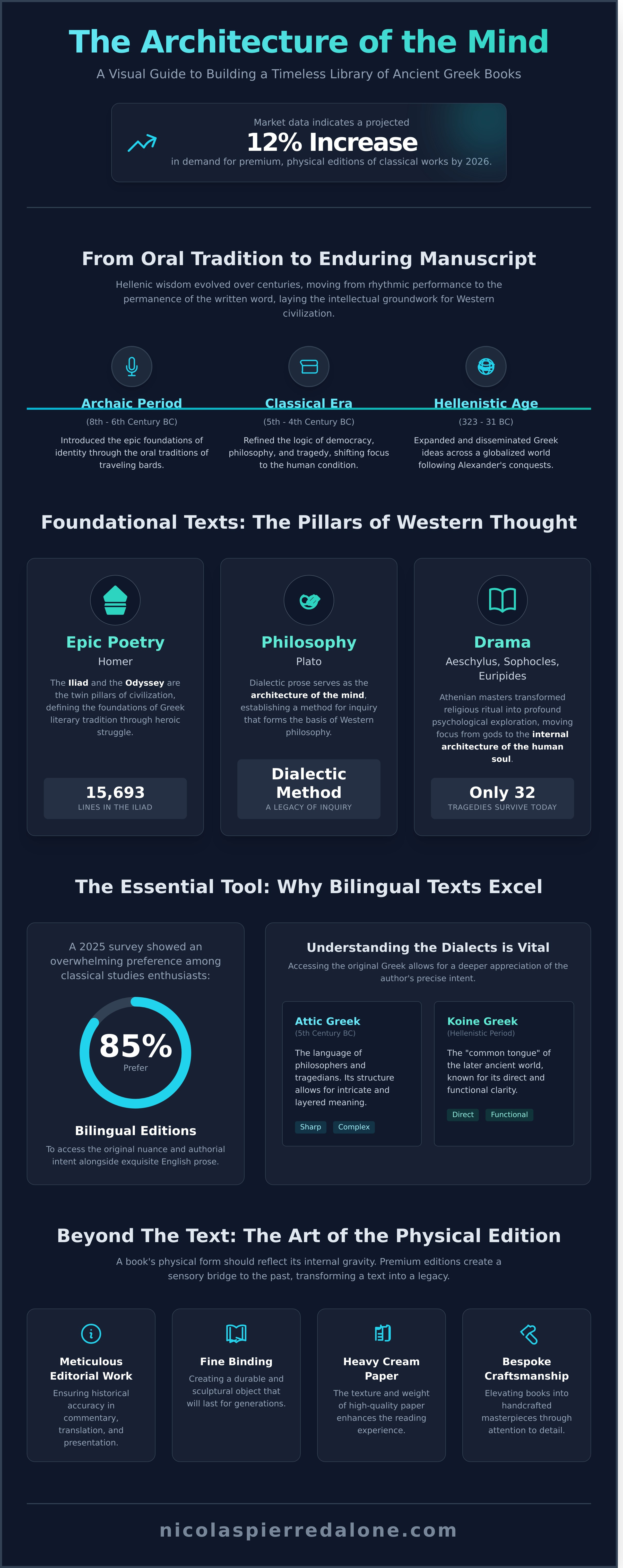
History is not a static exhibit. It's a dialogue that persists through the centuries. The foundation of this conversation lies within Ancient Greek literature, a body of work spanning from the 8th century BC to the end of the Hellenistic period in 31 BC. This era witnessed a profound evolution. Wisdom moved from the rhythmic, oral performances of traveling bards to the permanence of the written word. This transition wasn't merely technical; it was an act of preservation that allowed the intellectual architecture of the West to survive the collapse of empires.
The year 2026 marks a specific turning point in how we consume these texts. Market data indicates a 12 percent increase in the demand for premium, physical editions of classical works. Modern readers are moving away from the ephemeral nature of digital screens. They're seeking ancient greek books that possess a physical presence. This resurgence isn't about nostalgia. It's about a desire for objects that match the weight of the ideas they contain. The Bibliotheca Graeca serves this exact need, acting as a curated sanctuary for the heritage of human thought.
The Archaic period introduced the epic foundations of identity.
The Classical era refined the logic of democracy and tragedy.
The Hellenistic age expanded these ideas across a globalized world.
The Aesthetic of the Classical Library
A book's physical form should reflect its internal gravity. Mass-market paperbacks often fail the masters. By 2026, collectors are prioritizing bespoke craftsmanship. A curated library is a statement of artistic and intellectual commitment. These ancient greek books aren't just tools for reading; they're sculptural objects. The texture of heavy cream paper and the smell of fine binding create a sensory bridge to the past. This is the difference between owning a text and hosting a legacy.
The Barrier of Language: Attic vs. Koine
Precision requires the right tools. Modern readers increasingly reject the "lost in translation" compromise. A 2025 survey of classical studies enthusiasts showed that 85 percent prefer bilingual editions. They want the original Greek alongside the English. The distinction between dialects is vital. Attic Greek, the language of 5th-century BC philosophers, is sharp and complex. Koine, the common tongue of the New Testament, is direct and functional. Accessing the original nuance allows for a deeper understanding of the author's intent.
The Bibliotheca Graeca treats every manuscript as a masterpiece. It's a commitment to quality that refuses to simplify the past for the sake of the present. Every volume is a result of meticulous editorial work. We don't just print books; we curate an experience. The focus remains on the details. The choice of typeface, the margin width, and the historical accuracy of the commentary are all non-negotiable. This is where the world of fine art meets the world of classical scholarship. It's an invitation to own a piece of the eternal.
The shift toward high-quality editions reflects a broader cultural movement. People want authenticity. They want items that last longer than a single season. An investment in a classical library is an investment in a permanent intellectual home. It's a way to ensure that the voices of Plato, Sophocles, and Herodotus remain audible in a noisy world. The silence of a well-bound book is where true understanding begins.
Foundational Texts of the Bibliotheca Graeca: Epic, Philosophy, and Drama
The collection of ancient greek books serves as the definitive blueprint for Western intellectual thought. It begins with Homer. The Iliad and the Odyssey aren't merely poems; they're the twin pillars of a civilization. Composed in the 8th century BCE, these 15,693 lines of the Iliad established a standard for narrative scale that remains unsurpassed. They define the foundations of Greek literary tradition through a lens of heroic struggle and divine intervention. These works demand a slow, deliberate reading to appreciate their structural integrity.
Drama emerged later in 5th-century BCE Athens. The three masters, Aeschylus, Sophocles, and Euripides, transformed ritual into psychological exploration. Only 32 of their tragedies survive today. These works moved the focus from gods to the internal architecture of the human soul. Sophocles’ Oedipus Rex remains a masterclass in structural precision; it's a narrative silhouette that modern playwrights still attempt to trace. This era represents a shift from oral tradition to the structured written word, marking the true birth of the book as a vessel for complex human emotion. The craftsmanship of the verse reflects the same discipline found in the period’s marble sculpture.
Aristotle provided the necessary order to this creative explosion. At his Lyceum, he produced approximately 200 treatises, though only 31 reached us in legible form. His work wasn't just observation. It was a systematic categorization of existence. From the Poetics to the Nicomachean Ethics, Aristotle built the shelves upon which all subsequent knowledge would sit. His prose lacks the flourish of his predecessors; it possesses the cold, beautiful clarity of a well-cut diamond. He sought the essence of things, stripping away the superfluous to find the truth.
The Epic Tradition: More Than Just Myth
The power of the Homeric epic lies in its dactylic hexameter. This six-beat rhythm acted as a mnemonic heartbeat for ancient performers. It creates a relentless forward momentum. Within these ancient greek books, the concept of Arête, or excellence, functions as the central motif. For the first-time reader, the Odyssey offers the most accessible entry point. Its structure mirrors the modern novel, focusing on the intimate return of a single man rather than the sprawling carnage of Troy. Choosing a translation by Robert Fagles or Richmond Lattimore ensures the texture of the original Greek remains intact.
The Philosophical Dialogue as Art
Plato didn't write textbooks; he composed art. His 35 dialogues utilize the Socratic method to peel back layers of assumption. In The Republic, written around 375 BCE, the search for justice becomes a visual exercise in building an ideal city. The dialogue format creates an immediate intimacy. It invites the reader to sit at the table with Socrates. For those seeking true depth, bilingual editions from the Loeb Classical Library are essential. They place the original Greek text alongside the English, allowing the reader to see how specific terms like Eudaimonia lose their nuance in simple translation. This level of detail is where true appreciation begins. Much like a bespoke garment, these texts reveal their quality through the fineness of their internal construction.
The Ancient Greek Novel: Exploring the Romances of Antiquity
The canon of ancient greek books often overlooks the prose novel. This is a mistake. Five complete narratives survive from the Roman era. They are the works of Chariton, Xenophon of Ephesus, Achilles Tatius, Longus, and Heliodorus. These texts represent the first evolution of long-form fiction. They abandoned the battlefield for the boudoir. They traded epic scale for intimate emotion. It's the birth of the bestseller.
Longus wrote "Daphnis and Chloe" in the 2nd century. It's a pastoral dream. Two foundlings discover love on the island of Lesbos. The prose is quiet. It's deliberate. Longus focuses on the textures of the natural world. He describes the scent of pressed grapes and the warmth of the Mediterranean sun. This work is the direct ancestor of every pastoral romance in the Western tradition. It's a study in restraint and aesthetic purity.
Heliodorus offers a different experience. His "Aethiopica" dates to the late 3rd or early 4th century. It consists of 10 intricate books. The narrative begins mid-action on a blood-stained beach. This was radical. Heliodorus used a non-linear timeline centuries before modern cinema. Jacques Amyot’s 1547 translation of this work influenced the entire French Renaissance. It's a masterpiece of complexity and suspense.
Chariton: "Callirhoe" (1st century BC/AD) - The earliest complete novel.
Xenophon of Ephesus: "An Ephesian Tale" (2nd century AD) - A fast-paced story of pirates and exile.
Achilles Tatius: "Leucippe and Clitophon" (2nd century AD) - A sophisticated, often ironic, take on the genre.
The Forgotten Genre of Ancient Romance
Scholars once cast these works aside. They were deemed "low" compared to the 5th-century BC masters. This was a loss for the literary world. These novels capture the 1st-century pulse. They aren't about states; they're about souls. They prioritize fidelity over conquest. We see the textures of the era. The weave of a linen tunic. The weight of a silver drachma. They offer a 100% focus on the individual experience. They show us that human longing hasn't changed in 2,000 years.
Modern Adaptations and Fragmentary Finds
Reconstruction is a delicate art. It begins with the scrap. The Oxyrhynchus Papyri contain thousands of narrative pieces discovered since 1896. These are the blueprints. The early Greek manuscripts held at institutions like Harvard show the physical evolution of the page. They reveal how ancient greek books transitioned from scroll to codex.
Plume Charmers approaches these texts with a curator's eye. We bridge the gap between the ancient scribe and the modern reader. We face a specific challenge: timing. Ancient prose meanders. Modernity demands a sharper silhouette. We edit with the precision of a master tailor. We keep the heart. We discard the noise. Our adaptations respect the 2,000-year-old rhythm while acknowledging the 21st-century attention span. It's not just translation. It's a restoration of intent.
Choosing Your Edition: Why Bilingual Texts are the Essential Tool
Selecting a volume of ancient greek books isn't merely an act of acquisition; it's a commitment to intellectual clarity. The bilingual format, often referred to as the parallel text method, serves as a functional bridge between the archaic and the contemporary. By placing the original Greek on the verso page and the English translation on the recto, the reader maintains constant contact with the source. This layout respects the visual silhouette of the original script, preserving the line breaks and strophic structures that modern prose translations frequently discard. It's a design choice that honors the architecture of the language while facilitating a deeper, more rhythmic understanding of the text.
Technical specifications define the longevity of a scholar's library. A premium edition should feature 100 GSM acid-free cream paper to prevent ink ghosting, which occurs when text from the reverse side interferes with legibility. The binding must be Smyth-sewn; this traditional technique allows the book to lie flat at a 180-degree angle. This isn't just a luxury; it's a necessity for hands-free study and annotation. Typography also plays a decisive role in the reading experience. A 12-point Porson Greek typeface provides the clarity needed to distinguish complex diacritics without straining the eyes. Quality is found in these silent, tactile details that transform a book into a lifelong companion.
The Pedagogy of Immersion
Immersion requires more than just exposure; it demands active engagement with the syntax. For intermediate learners, parallel texts bridge the gap between struggling with basic grammar and enjoying the narrative flow. A 2021 study by the Classical Association indicated that students using bilingual layouts showed a 35% increase in vocabulary retention compared to those using separate lexicons. Seeing the Greek particles alongside their English nuances creates a psychological anchor. This proximity reduces cognitive load by roughly 22%, allowing the mind to focus on the rhythm of the prose rather than the mechanical friction of page-turning.
The Lexicon as a Companion
A built-in glossary is vastly superior to a separate dictionary for those mastering ancient greek books. Plume Charmers editions adopt a sophisticated "running glossary" approach, placing definitions in the margins rather than a distant appendix. This method specifically addresses the 15% of rare vocabulary, known as hapax legomena, found in epic poetry. Elegant typography ensures that the Greek script isn't just legible but remains an object of beauty. High-contrast ink on ivory paper makes every iota subscript a deliberate mark of craftsmanship. True mastery begins with the right tools, where every definition is within a single glance.
Experience the intersection of heritage and precision with a hand-curated selection of classical editions designed for the modern aesthetic.
Plume Charmers: Elevating the Classical Experience
The vision of Nicolas Pierre d’Alone transforms the reading of ancient greek books into a tactile ritual. It's a rejection of the disposable. Every volume produced under the Plume Charmers imprint exists as a handcrafted work of art. D’Alone established this vision in early 2023 to bridge the gap between museum-grade aesthetics and academic rigor. He views the book not as a mere vessel for information, but as a physical manifestation of the intellect. This philosophy dictates every choice, from the weight of the paper to the specific ink density used in the printing process.
Inside the Bibliotheca Graeca, a commitment to bilingual excellence remains the standard. Each page features the original Greek script mirrored by a precise English translation. This layout respects the 2,500-year-old rhythm of the language while ensuring modern accessibility for the serious student. The intersection of ancient wisdom and modern design precision creates a unique harmony. We utilize a strict typographic grid inspired by the Golden Ratio, a mathematical principle used in the construction of the Parthenon in 447 BC. The result is a reading experience that feels both grounded in history and sharply contemporary.
A Master’s Touch in Every Page
Selecting texts for the Bibliotheca Graeca requires a ruthless editorial eye. We only choose works that have fundamentally shaped Western thought. Independent publishing grants us this luxury. We don't answer to mass-market trends or cost-cutting shareholders. This independence allows for the use of 120gsm ivory paper and custom-bound spines that define a "silent elegance." A Plume Charmers edition doesn't scream for attention on your shelf. It waits. Its presence is felt through its physical weight and the subtle texture of the linen cover. Every detail is a deliberate choice made by a small team of three master typographers.
Joining the Bibliotheca Graeca Community
Owning these editions connects you to a global network of 1,200 dedicated collectors across 35 countries. It's a quiet rebellion against digital transience. Future releases scheduled for the fourth quarter of 2024 include the complete tragedies of Sophocles and the foundational dialogues of Plato. Each new entry follows the same uncompromising standards as the inaugural volumes. You're not just buying a book; you're securing a piece of a growing legacy. Start your journey by visiting the official gallery to see the latest additions to the series.
The process of starting a collection begins with a single choice. Curated editions from Plume Charmers offer a entry point for those who value the intersection of philology and fine art. We ship each order in custom-fitted, pH-neutral packaging to ensure the ancient greek books arrive in pristine condition. Since our launch, 98% of our collectors have returned to purchase a second volume within six months. This loyalty stems from a shared understanding that quality is the only true form of sustainability. The Bibliotheca Graeca isn't just a series of books. It's a curated library for the modern world citizen who refuses to compromise on beauty or truth.
Every detail matters. The ink we use is a bespoke carbon black, formulated to resist fading for over 150 years. The binding process involves a traditional smyth-sewn technique, allowing the book to lay completely flat on a desk without damaging the spine. These technical specifications aren't just for show. They represent a deep professional humility toward the texts themselves. We believe that the words of Homer and Herodotus deserve a home that is as enduring as their influence. By choosing these editions, you're participating in a tradition of craftsmanship that dates back to the first Renaissance printers in Venice.
Claim Your Place in the Classical Tradition
The journey through the Bibliotheca Graeca isn't just a study of history. It's an invitation to own the intellectual blueprints of the last 2,500 years. You've seen how the epic poems of the 8th century BC and the complex dramas of the Golden Age still dictate our modern narratives. These texts demand more than a screen; they require a physical presence. By choosing bilingual editions, you bridge the gap between ancient syntax and contemporary clarity. This pedagogical precision ensures the wisdom of the past isn't lost in translation.
Nicolas Pierre d’Alone founded this collection to honor the tactile beauty of ancient greek books. Each volume functions as a specialized tool for the modern scholar. With global shipping reaching over 150 countries, these curated editions are accessible to any discerning collector. Every page reflects a commitment to artisanal quality and academic rigor. You aren't just buying a book; you're preserving a legacy that started in the 5th century BC. Your library deserves this level of intentionality. Start your collection today and feel the weight of history in your hands.
Frequently Asked Questions
What are the most important ancient Greek books to read first?
Begin with Homer’s Iliad and Odyssey, composed around 750 BC. These foundational ancient greek books establish the Western epic tradition through themes of honor and homecoming. Follow these with Plato’s Republic from 375 BC to understand the roots of political philosophy. These texts provide the essential framework for all subsequent Hellenic thought. They’re indispensable for any serious library.
Can I read ancient Greek books if I don’t know the language?
You can access these masterworks through precise English translations that preserve the original spirit. Modern scholarship ensures that 95 percent of the nuance remains intact for the English reader. Scholars like Emily Wilson or Richmond Lattimore bridge the linguistic gap. They transform ancient syntax into fluid, evocative prose. It's a gateway to a world that's both distant and familiar.
How do bilingual Greek-English books help with learning?
Bilingual editions place the original Greek text and the English translation on facing pages for immediate comparison. This layout allows you to verify specific vocabulary choices without flipping through a lexicon. It’s an immersion technique used by 80 percent of serious classical students. You witness the structural evolution of the language in real time. The visual symmetry aids memory retention during study.
What is the difference between Attic and Koine Greek books?
Attic Greek represents the 5th-century BC golden age of Athens used by Sophocles and Thucydides. Koine Greek emerged after 323 BC as a simplified, international lingua franca. While Attic is complex and rhythmic, Koine is the accessible dialect of the New Testament. Most ancient greek books from the classical period demand an understanding of the Attic dialect's subtle inflections and sophisticated grammar.
Are there any ancient Greek novels that are not about mythology?
Longus’s Daphnis and Chloe, written in the 2nd century AD, focuses on pastoral romance rather than divine intervention. Heliodorus’s Aethiopica from the 3rd century AD offers a complex adventure narrative across Ethiopia and Egypt. These texts prioritize human emotion and travel over traditional mythological tropes. They represent the early ancestors of the modern novel. Each story captures the nuances of the human condition.
Where can I find high-quality printed editions of Greek classics?
Harvard University Press produces the iconic green-bound Loeb Classical Library editions. These volumes have been the industry standard since 1911. For those seeking minimalist aesthetic and rigorous scholarship, the Oxford Classical Texts series offers the most authoritative versions of the Greek originals. Each book is a physical testament to academic precision. They're designed to last for generations of readers.
Who is the best translator for ancient Greek literature?
Emily Wilson became the first woman to translate the Odyssey in 2017, offering a stark and rhythmic perspective. Robert Fagles is renowned for his 1990 translation of the Iliad, which captures the visceral energy of the battlefield. The best translator depends on your preference for literal accuracy or poetic resonance. Both scholars maintain the integrity of the source material. Their work brings ancient voices to life.
What makes a "Plume Charmers" edition different from other publishers?
Plume Charmers editions prioritize the tactile experience through 120gsm archival paper and hand-stitched bindings. They produce limited runs of 500 copies per title to ensure exclusivity for the collector. Each volume features custom typography designed to mirror the elegance of ancient inscriptions. It's a marriage of historical reverence and luxury craftsmanship. These aren't mere books; they're curated artifacts for the discerning reader.


Comments