%20-%20Copie.png)
Learning Biblical Hebrew: A Definitive Guide for the Modern Scholar
Updated: Feb 27
The ambition to read the Hebrew Bible in its original language is a profound scholarly pursuit. Yet, the path often appears obscured by the sheer weight of the task-an unfamiliar alphabet, the intricate architecture of ancient grammar, and the overwhelming search for reliable materials. This initial complexity can defer even the most dedicated student.
This guide is crafted to bring clarity to that complexity. It is a curated, structured methodology for the modern scholar who wishes to learn biblical hebrew not merely as an academic exercise, but as an act of intellectual craftsmanship. We dismantle the process into a series of deliberate, manageable steps, providing a definitive framework from foundational concepts to the confidence required to engage with simple biblical texts.
Here, you will not find shortcuts, but a clear, resource-driven path. This is your invitation to move beyond translation and encounter the scripture with newfound precision and understanding. The heritage of the text awaits.
Key Takeaways
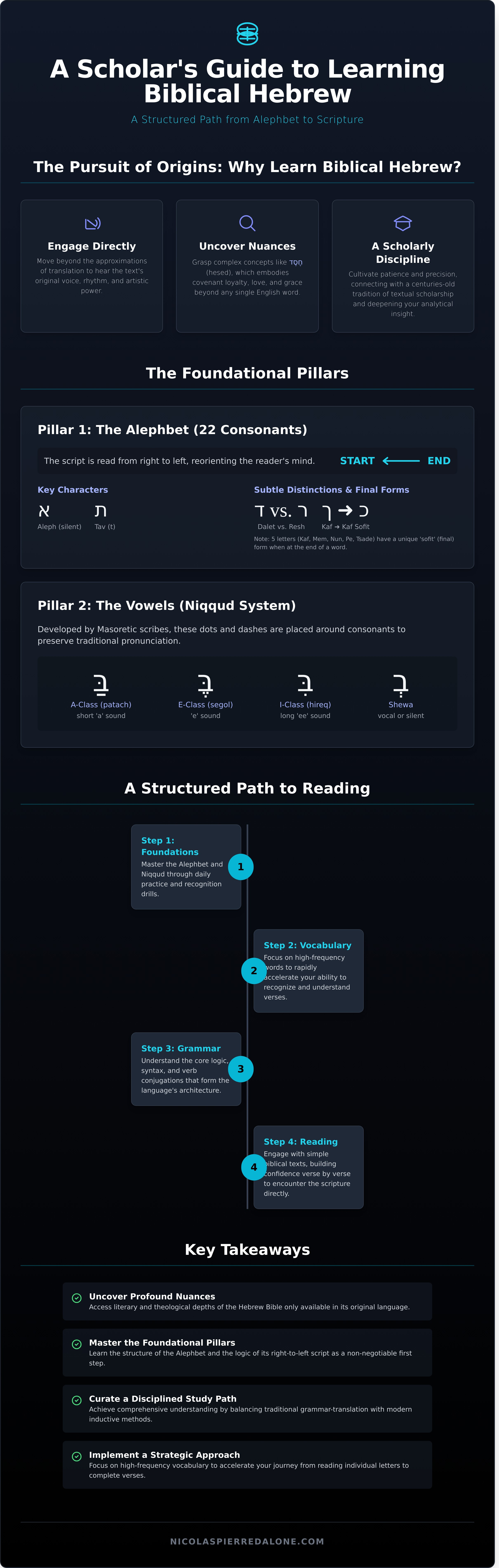
Uncover the profound literary and theological nuances of the Hebrew Bible accessible only through its original language.
Master the foundational pillars of the language, from the structure of the Alephbet to the logic of its right-to-left script.
Curate a disciplined study path to learn biblical hebrew by balancing traditional grammar-translation with modern inductive methods.
Implement a strategic approach to vocabulary, focusing on high-frequency words to accelerate your journey from individual letters to complete verses.
Table of Contents The Pursuit of Origins: Why Learn Biblical Hebrew? The Foundational Pillars: Mastering the Hebrew Alephbet and Vowels Grammar Essentials: Understanding the Logic of Biblical Hebrew Curating Your Study: Methods and Essential Resources From Vocabulary to Verses: A Structured Path to Reading
The Pursuit of Origins: Why Learn Biblical Hebrew?
The decision to learn Biblical Hebrew is a commitment to authenticity. It is a deliberate turning from the echo to the voice, from the copy to the original artifact. This pursuit is not merely academic; it is a pilgrimage to the very origins of the Judeo-Christian worldview, offering direct access to the foundational texts that have shaped civilizations. By stepping behind the veil of translation, you encounter the Hebrew Bible not as a static historical document, but as a living, breathing work of literary and theological genius. This is the ultimate reason for the journey: to hear the text speak in its own tongue.
Beyond Translation: Engaging with the Text Anew
Translation, by its nature, is an act of approximation. The most skilled translator is a master of compromise, forced to choose which facet of the original to convey. Nuances of wordplay, cultural idioms, and poetic resonance are often the first casualties. Consider the Hebrew word hesed (חֶסֶד). While translated as ‘loving-kindness’ or ‘mercy,’ it truly signifies a complex bond of covenant loyalty, steadfast love, and undeserved grace. No single English word suffices. Similarly, the powerful alliteration in Isaiah or the chiastic structures that give the Psalms their architectural beauty are often flattened in translation. Reading in Hebrew allows you to experience this artistry directly, feeling the rhythm and hearing the echoes between words.
A Scholarly and Spiritual Discipline
The process of mastering this ancient language is, in itself, a profound form of study. It is a rigorous intellectual discipline that cultivates patience, precision, and a deep appreciation for detail. As you learn its grammar and syntax, you join a centuries-old tradition of textual scholarship, connecting with the scribes, rabbis, and theologians who have dedicated their lives to preserving and understanding these words. This journey is transformative. Engaging with the complexities of Biblical Hebrew sharpens the mind while deepening one's spiritual insight, turning passive reading into an active, analytical, and ultimately more personal encounter with scripture.
The Foundational Pillars: Mastering the Hebrew Alephbet and Vowels
A journey into Biblical Hebrew begins not with grammar, but with form. The Alephbet is the architectural framework of the language, an ancient system of 22 consonants that provides the skeleton for every word. Unlike Latin-based scripts, Hebrew is read and written from right to left, a directional shift that reorients the learner’s mind from the very first letter. To truly learn biblical hebrew, one must first embrace these foundational characters. Their mastery is not a suggestion; it is the prerequisite for all that follows.
Deconstructing the Alephbet
Each of the 22 consonants possesses a unique name, silhouette, and sound. From the silent majesty of Aleph (א) to the finality of Tav (ת), these forms are the visual vocabulary of the scriptures. This script's evolution is a core component of the History of the Hebrew Language. For memorization, group letters by similar shapes (e.g., Dalet ד vs. Resh ר) to train the eye for subtle distinctions. Note that five letters-Kaf, Mem, Nun, Pe, and Tsade-assume a different, elongated form (sofit) when they appear at the end of a word.
The System of Vowels (Niqqud)
The original Hebrew texts were purely consonantal. Centuries later, a group of scribes known as the Masoretes developed a system of diacritical marks, or niqqud, to preserve traditional pronunciation. These are not letters, but rather a curated collection of dots and dashes placed above, below, or within the consonants. They are best understood in classes of sound:
A-class: a short 'a' sound (e.g., patach ַ)
E-class: an 'e' sound (e.g., segol ֶ)
I-class: a long 'ee' sound (e.g., hireq ִ)
A crucial element is the shewa (ְ), two vertical dots that can either represent a very short vowel sound (vocal) or silence (silent), depending on its placement.
Practical First Steps
Begin with the tangible. Create flashcards for each consonant, writing the character on one side and its name and sound on the other. Use these daily. Practice transliterating simple words like שָׁלוֹם (shalom), identifying each consonant and its accompanying vowel point. This meticulous practice builds recognition. The initial goal is not translation but immediate identification. This visual fluency is the bedrock upon which you will learn biblical hebrew in its authentic, textual context.
Grammar Essentials: Understanding the Logic of Biblical Hebrew
To truly learn biblical hebrew is to appreciate its architecture. The grammar is not a set of arbitrary rules but an elegant, interlocking system built upon a foundation of logic. Understanding this internal structure is the key to moving beyond rote memorization and toward fluent comprehension of the sacred texts. The language operates with a profound efficiency, where every element has a distinct and purposeful role.
The Tri-Consonantal Root System
The soul of the Hebrew lexicon is the tri-consonantal root (shoresh). Nearly every word is derived from a core of three consonants that carries a specific semantic meaning. For example, the root Š-M-R (ש-מ-ר) contains the essential idea of "guarding" or "keeping." This consonantal skeleton is then brought to life by patterns of vowels and affixes. A firm grasp of the Hebrew Alephbet and Vowels is the prerequisite to discerning these foundational roots. These patterns, known as binyanim, modify the root's action, creating different voices and moods (e.g., simple, intensive, causative) with remarkable precision.
Nouns, Adjectives, and Pronouns
Hebrew nouns possess three fundamental properties: gender, number, and state. Every noun is either masculine or feminine, a distinction often marked by its ending. Plurals are typically formed with the suffix -im for masculine nouns and -ot for feminine ones. The most distinctive feature is the construct state (smichut), a grammatical chain that expresses possession without a preposition. For instance, "the word of God" becomes a single unit: d'var-Elohim (דְּבַר־אֱלֹהִים). This principle of direct connection extends to possessive suffixes, which attach to nouns to denote ownership (e.g., susi, "my horse"), further demonstrating the language's compact design.
The Biblical Hebrew Verb
The biblical Hebrew verb system operates on aspect, not tense. It is concerned with the state of an action-whether it is completed (perfect aspect) or incomplete (imperfect aspect)-rather than its placement in time. The most basic and frequent verbal stem is the Qal, representing a simple, active verb. From this foundation, all other stems are built. For narrative flow, the language employs a powerful tool: the waw-consecutive. This particle, a form of the word "and," links verbs together in a sequence, often inverting their aspect to drive the story forward. Mastering this concept is essential for reading biblical prose.
Curating Your Study: Methods and Essential Resources
The path to mastery requires more than discipline; it demands a curated methodology. The way you choose to learn biblical hebrew defines the depth of your engagement. Traditional grammar-translation methods build a systematic understanding of linguistic architecture, while modern inductive approaches prioritize immersion and discovery. The self-directed scholar finds power not in choosing one, but in balancing both-fusing rigorous analysis with intuitive reading. Your library should reflect this philosophy: a few essential, masterfully crafted tools will always eclipse a shelf of mediocre ones.
Choosing Your Primary Textbook
A grammar is your foundational blueprint. A superior textbook for self-study is marked by clarity, logical progression, and substantive exercises. Classics like Gesenius’ Hebrew Grammar or modern standards such as Pratico and Van Pelt’s Basics of Biblical Hebrew each offer a distinct pedagogical vision. Yet, view your textbook as a trusted reference to consult on your journey, not as the journey itself. It provides the rules; true understanding comes from application.
The Power of a Lexicon
A lexicon is not a mere dictionary; it is a cartography of meaning. Where a dictionary offers translation, a lexicon reveals a word’s etymology, its usage across the canon, and its full semantic domain. Authoritative works like the Brown-Driver-Briggs (BDB) or the more modern HALOT are indispensable for deep exegesis. Today, digital lexicons and integrated Bible software have streamlined this process, placing centuries of scholarship at your fingertips and transforming word studies into an act of precision.
Bilingual Editions: The Bridge to Fluency
The most direct path to reading proficiency is through sustained contact with the text. Bilingual editions serve as this essential bridge. By placing the original Hebrew alongside a meticulous translation, they reduce the friction of constant lexicon work, accelerating vocabulary acquisition and fostering an immediate, immersive experience. This method allows you to engage with authentic passages from the outset, moving from academic exercise to an intimate dialogue with the literature. Explore the Bibliotheca Hebraica for curated bilingual texts that embody this principle of elegant, effective learning.
From Vocabulary to Verses: A Structured Path to Reading
The transition from grammatical rules to fluid reading is the defining moment for any student. Success is not a matter of chance, but of deliberate strategy. To truly learn biblical hebrew is to understand the architecture of the text, beginning with its most fundamental components and progressing with disciplined intention. This path transforms academic exercise into an intimate dialogue with the scriptures.
Building a Core Vocabulary
Efficiency is paramount. The Hebrew Bible contains over 8,000 unique words, yet a mere fraction of these comprise the vast majority of the text. Focus your initial efforts on the words that appear 100 times or more. This foundational lexicon provides the scaffolding for comprehension. Digital flashcard systems like Anki are invaluable for this task, but rote memorization is insufficient. True acquisition occurs when words are learned within the context of phrases and simple clauses, embedding their meaning and function.
A Suggested Reading Order
While Genesis 1:1 is an iconic starting point, its complex vocabulary and syntax can be discouraging for the novice. A more considered approach yields greater results. We recommend a progression designed to build confidence and skill:
Simple Narratives: Begin with the books of Ruth or Jonah. Their straightforward prose and compelling storylines provide an accessible entry point.
Narrative Prose: Advance to the historical books, such as Samuel and Kings. The narrative style remains clear, while the vocabulary and grammatical structures expand.
Poetry and Prophecy: Finally, approach the poetic richness of the Psalms and the complex visions of Isaiah. This is where your grammatical mastery will be truly tested and rewarded.
Utilizing Graded and Reader's Editions
The journey from learner to reader is best undertaken with expert tools. A Reader's Hebrew Bible is an essential companion, providing footnotes for words that appear infrequently (e.g., less than 50 times). This eliminates the constant need for a lexicon, preserving the flow of reading. For early practice, graded texts offer simplified passages that systematically introduce new vocabulary and grammar. These resources are not crutches; they are the carefully crafted instruments that enable a seamless transition to the unadapted Masoretic Text, the ultimate goal of your study.
An Invitation to the Source Text
Your journey into the sacred scriptures has a clear trajectory. It begins with the foundational pillars-mastering the alephbet and the internal logic of its grammar-and culminates in a direct, unmediated dialogue with the ancient texts. This is not simply language acquisition; it is the recovery of nuance, poetry, and profound meaning in their most authentic form.
The decision to learn biblical hebrew is a commitment to intellectual depth and scholarly integrity. This pursuit demands more than dedication; it requires tools crafted with equal precision and purpose. For the modern scholar, the quality of one's resources defines the quality of the journey itself.
The Bibliotheca Hebraica was conceived for this very path. Authored by classical language specialists, our bilingual editions offer an accessible, immersive framework for mastery. Each volume is meticulously crafted for the discerning independent learner, transforming study into an act of discovery. The original text awaits.
Frequently Asked Questions
How long does it take to learn Biblical Hebrew?
Mastery is a disciplined pursuit. A dedicated student can acquire foundational grammar and a core vocabulary within one to two years of consistent study. However, true fluency-the ability to engage with the text's nuanced poetry and complex theological arguments-is a lifelong commitment. The timeline is ultimately defined by the learner's devotion to the craft of translation and interpretation, where the process itself is the reward.
Is Biblical Hebrew significantly different from Modern Hebrew?
The two are distinct yet related, like a classical sculpture and its modern interpretation. They share a foundational alphabet and many lexical roots, but diverge significantly in syntax, vocabulary, and verb construction. Modern Hebrew possesses a simplified verb system and an expansive lexicon for contemporary life. To read the Hebrew Bible with precision, one must engage with its ancient, unadulterated form directly.
Can I learn Biblical Hebrew on my own without a formal class?
Independent study is a viable path for the disciplined scholar. A curated selection of premier grammars, lexicons, and digital resources can replace a formal classroom environment. This path, however, demands unwavering commitment and a meticulous approach to the fundamentals. Success when you learn biblical hebrew through self-direction is a testament to personal dedication and intellectual rigor, a truly personal achievement.
What is considered the most difficult aspect of learning Biblical Hebrew?
The primary challenge resides in the intricacies of the verbal system. The seven verb stems, or binyanim, express nuanced shades of action and voice-a concept with no direct parallel in English. Mastering how these stems modify a root's core meaning demands a fundamental shift in linguistic perspective. It is a complex, elegant system that, once understood, unlocks the profound depth and artistry of the biblical text.
What is the best book of the Bible to start reading in Hebrew?
The book of Jonah is the traditional starting point for the aspiring scholar. Its narrative prose is direct and its vocabulary is comparatively contained, offering an accessible entry into authentic biblical texts. The book of Ruth presents a similar, elegantly simple narrative structure. These texts provide the ideal canvas upon which a new student can begin to apply their grammatical knowledge and build reading confidence with clarity and purpose.
Is it necessary to learn the vowel points (niqqud)?
Yes, unequivocally. The niqqud are the Masoretic tradition's essential guide to pronunciation, grammar, and precise meaning. While ancient scrolls lacked these markings, to ignore them is to disregard a millennium of scholarship that preserves the text's vocalization. Learning the vowel points is not an optional step; it is fundamental to an authentic and accurate reading of the Hebrew Bible as it has been transmitted.


Comments