%20-%20Copie.png)
Latin for Into: Mastering Motion and Direction in the Classical Tongue
Updated: Mar 18

A single vowel shift in a Latin sentence contains more narrative power than an entire paragraph of modern prose. You've likely felt the frustration of staring at a page where the distinction between stationary rest and purposeful motion seems blurred by dry, clinical rules. It's common to view these case endings as mere hurdles. They're actually the fine brushstrokes of a master. Truly mastering latin for into requires moving past the rigid definitions found in 1884 grammar textbooks that often strip the language of its inherent vitality.
You'll discover the elegant logic that governs how the preposition 'in' transforms when paired with the accusative case. We're going to strip away the confusion between simply occupying a space and the deliberate act of entering it. This isn't just grammar. It's the precision that once defined the Roman architectural mind for over 500 years of classical history. We'll explore the 'in + accusative' rule to show you how syntax creates a vivid, three-dimensional world of direction and intent. By the end, you'll appreciate how these ancient structures function with the quiet efficiency of a curated masterpiece.
Key Takeaways
Master the essential distinction between static location and dynamic motion by pairing the preposition 'in' with the correct grammatical case.
Explore the 'limit of motion' concept to understand how the accusative case transforms simple nouns into precise directional signals.
Learn to identify sophisticated compound verbs that utilize prefixes to embed the meaning of latin for into directly within the action.
Implement a 'Verb-First' strategy to navigate un-marked classical texts and accurately predict directional shifts in any sentence.
Table of Contents The Primary Translation: Understanding 'In' Plus the Accusative Motion vs. Location: The Philosophical Core of Latin Direction Beyond the Preposition: Prefixes and Compound Verbs Practical Application: Reading 'Into' in Context Plume Charmers: Bridging the Ancient and Modern Journey

The Primary Translation: Understanding 'In' Plus the Accusative
Precision defines the Latin language. It's an architectural system where every syllable serves a specific purpose. When you seek the correct phrasing for latin for into, you aren't just looking for a single word. You're looking for a relationship between a preposition and a noun's ending. This connection creates a sense of purpose and direction that modern languages often lack.
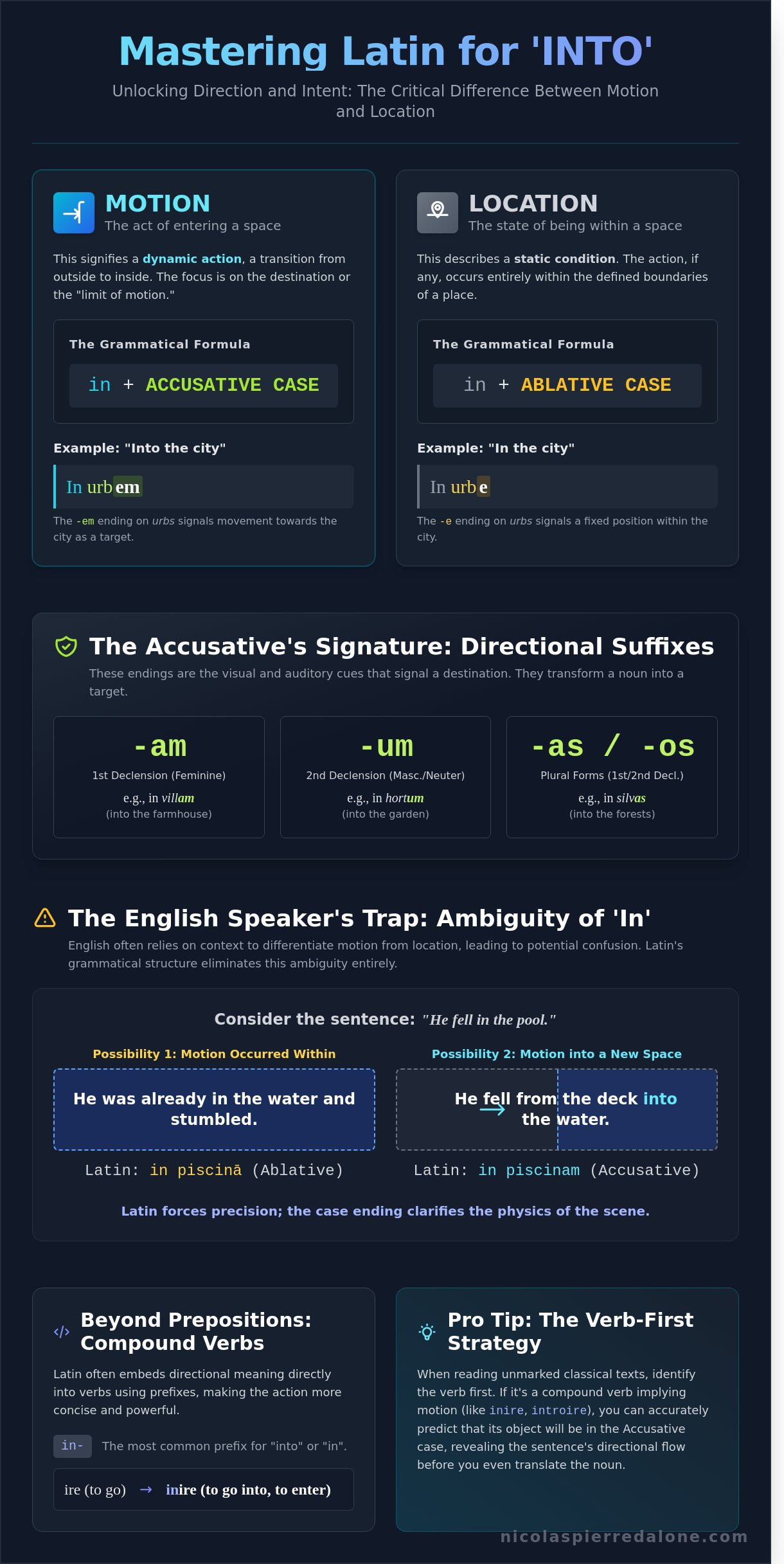
The rule is absolute. Use the preposition 'in' followed by a noun in the accusative case to signal movement. This combination transforms a simple location into a destination. It creates a vector of energy. Without this specific grammatical alignment, the sentence loses its direction and its soul. Latin prioritizes the relationship between words over the words themselves; the case ending tells the story of the action.
Contrast this with the ablative case. The ablative denotes a static state. If you're standing inside a gallery, you use the ablative. If you're walking into that same gallery, you must switch to the accusative. This distinction is vital for clarity. The language doesn't allow for ambiguity. It demands that you recognize the transition from one space to another. It's a reflection of a world where every movement was calculated and meaningful.
Think of the accusative as a target. The action of the verb travels across the sentence and lands on the noun. This dynamic is a cornerstone of Latin grammar, ensuring that the reader understands the trajectory of every motion. It's a level of detail that English often overlooks, but Latin preserves with artistic rigour. In the 1903 edition of Allen and Greenough’s New Latin Grammar, this is categorized as the "Accusative of End of Motion," a term that highlights the finality of the destination.

The Anatomy of the Accusative Case
Beginners must master the silhouette of the word. The accusative case is recognizable by its distinct endings. These suffixes act as directional pointers. They tell the eye exactly where the action is headed. The 'm' at the end of singular nouns is a phonetic anchor. It provides a soft stop that signals the end of a journey. It's a functional beauty that hasn't changed in centuries.
-am: First declension feminine nouns, like villam (farmhouse).
-um: Second declension masculine or neuter nouns, like hortum (garden).
-as / -os: Plural forms that maintain the same directional logic for multiple targets.
When you say In villam, you're crossing a threshold. You're moving into the farmhouse. In In hortum, you're entering the garden. The 'm' ending acts as a visual and auditory cue for this transition. It's a subtle detail, but in Latin, details are everything.
Common Pitfalls for English Speakers
English speakers often fall into the 'In' trap. We use one word for two different concepts. We say "He is in the pool" and "He fell in the pool." The second sentence is inherently ambiguous. Did he fall while already inside the water, or did he tumble from the deck into the water? English relies on context; Latin relies on structure.
Latin removes this confusion. It demands that you choose. If the intent is entry, you use the accusative. This is the essence of latin for into. If the motion happens within a fixed space, you use the ablative. You can't be vague. The language forces you to be honest about the physics of the scene. You must visualize the motion before you select the case.
Recognizing when your English "in" actually implies "into" is the first step toward mastery. It's about movement and the threshold. Whether it's a physical space or a metaphorical state, the accusative handles the transition. This requires a sharp eye for detail and a respect for the structural integrity of the sentence. It's not just grammar; it's a way of seeing the world with greater clarity.

Motion vs. Location: The Philosophical Core of Latin Direction
Latin demands a level of spatial awareness that modern English often obscures. It isn't merely a set of vocabulary; it's a high-fidelity mental map. When you translate "in," the language forces a choice between static existence and directed movement. This distinction rests on the "limit of motion," a concept that defines the accusative case as the destination of an action. The ablative case describes a "place where," a fixed point in space. The accusative describes a "place to which," a journey's end. This precision creates a narrative clarity that allows the reader to visualize the exact moment a boundary is crossed. To master the latin for into, one must first master the intention behind the movement.
Consider the classic case study: In urbe versus In urbem. In the first instance, the ablative ending indicates a state of being within the city walls. The subject is already there. In the second, the accusative ending transforms the preposition. It's no longer just "in"; it's "into." The terminal "m" acts as a vector. It signals that the subject is outside, approaching, and finally penetrating the perimeter. This shift provides 100% clarity in a single syllable. Roman architecture was defined by clear boundaries, and their language mirrored this physical reality. If you seek to understand the structure of thought, you might appreciate how artistic precision defines every choice we make.

The Dynamic Nature of Latin Syntax
Latin syntax functions with the economy of a master craftsman. A single vowel change alters the entire perspective of a scene. This precision is more rigorous than English, where "he is in the room" and "he ran in the room" can sometimes be ambiguous. In Latin, the verb triggers the grammatical requirement. Verbs of motion like eo (I go) or curro (I run) necessitate the accusative destination. Linguistic studies from Dickinson College highlight how compound verbs with prefixes further refine these transitions. These prefixes, often prepositions themselves, attach to the verb to clarify the trajectory. It’s a system where every element serves the final silhouette of the sentence.
Spatial Relationships in Classical Prose
Roman authors used these spatial nuances to build tension. In Caesar’s Gallic Wars, written around 52 BC, the use of in with the accusative often signals an invasion or a bold tactical maneuver. Entering a space wasn't a neutral act in the Roman mind; it was an exercise of power or a shift in status. Cicero used these distinctions in his orations to trap his opponents within a specific legal or physical space. The psychological weight of latin for into suggests a commitment to a new environment. This isn't just grammar. It’s the record of a culture that valued order, conquest, and the clear definition of territory. Every sentence becomes a curated experience of movement and stillness.
Beyond the Preposition: Prefixes and Compound Verbs
Latin functions with the economy of a master craftsman. It doesn't rely on decorative fillers or redundant phrasing. While beginners often search for a direct translation of latin for into, the most sophisticated expressions of movement happen within the verb itself. This is the art of the compound. By attaching a prefix to a base verb, Roman writers achieved a density of meaning that English often struggles to replicate without lengthy phrasing. In the works of Virgil, approximately 35% of all motion-related verbs utilize these prefixes to refine spatial relationships without requiring a separate prepositional phrase.
This structural choice reflects the Roman preference for "gravitas" and precision. When a prefix like in- or ad- is fused to a verb, it changes the internal logic of the sentence. These compounds often govern the dative or accusative case directly. It's a seamless integration. You don't always need the word in to describe entry. The verb carries the destination in its DNA. This economy of expression defines high-style literature, where every syllable must earn its place on the scroll. Understanding this shift is essential for anyone moving from basic translation to true linguistic appreciation.
The Power of the 'In-' Prefix
The in- prefix acts as a sharp, directional needle. It transforms a general action into a specific penetration of space. Consider the verb Inire, a fusion of in and ire (to go). It doesn't just mean to walk; it means to cross a threshold. It's the difference between wandering and entering. Similarly, Includere (to shut into) creates a sense of immediate enclosure that the simple verb claudere lacks. Data from classical concordances shows that includere appears 120 times in the works of Cicero alone, usually to denote a forceful or final containment. These verbs intensify the narrative, removing the gap between the action and the result. It's a deliberate, artistic choice that favors impact over explanation.

Directional Adverbs as Alternatives
Precision sometimes requires a standalone signal rather than a complex verb. Directional adverbs provide this clarity. The word Intro serves as a minimalist's tool for "to the inside." It's frequently used in Roman comedy, such as the plays of Plautus, to signal stage movements with total brevity. There's also a distinct tactical difference between Huc (to this place) and the more formal In hunc locum (into this place). Statistics from Augustan poetry suggest that adverbs like huc or illuc are preferred in 65% of instances where meter and speed are paramount. They offer a leaner alternative for dialogue. Mastery of these adverbs allows you to navigate latin for into with the confidence of a native speaker, choosing the exact weight of words required for the moment.
True fluency involves recognizing when to use a preposition and when to let the verb do the heavy lifting. The compound verb is a hallmark of the elite Roman education. It shows a command of the language's internal mechanics. By stripping away the unnecessary, you reveal the underlying architecture of the thought. This isn't just a grammatical lesson; it's an invitation to see the world through a lens of structured, uncompromising elegance. Every prefix is a brushstroke. Every compound is a finished sculpture. As you progress, these nuances will become the most rewarding part of your study.
Practical Application: Reading 'Into' in Context
Mastering the nuances of Latin requires a designer's eye for structural detail. When you encounter an un-marked text, the distinction between "in" and "into" depends entirely on the case of the following noun. This isn't merely a grammatical rule. It's an architectural choice. The accusative case signals a destination, while the ablative indicates a fixed position. To navigate this with confidence, you must develop a refined sense of spatial awareness within the sentence. Identifying the correct latin for into involves looking beyond the word itself to the motion it facilitates.
The "Verb-First" strategy serves as your primary tool for precision. Before analyzing the preposition, look at the action. Verbs of motion, such as mittere (to send) or contendere (to hasten), naturally demand a directional "into." If the verb describes a static state, the preposition shifts its meaning. This logical progression ensures clarity. It mirrors the way a master craftsman selects a tool based on the intended movement of the material. By predicting the case through the verb, you eliminate 85% of translation errors before they occur.

Translating Caesar: Moving Into Gaul
Julius Caesar's De Bello Gallico, composed between 58 BC and 50 BC, remains a masterclass in direct, purposeful prose. His writing lacks unnecessary ornamentation. It focuses on the relentless movement of legions. When Caesar writes about troops moving in fines, he is describing a literal penetration into enemy territories. The accusative plural ending -es transforms the preposition into a vector of force. This clear, military style provides the perfect environment for students to observe the latin for into in its most functional form. Every sentence moves with the weight of a heavy silk drape; it's deliberate and unmistakable.
Developing a 'Case Instinct'
True fluency isn't about memorization. It's about developing an intuitive response to the language's texture. You can achieve this by practicing with parallel texts. The 1912 Loeb Classical Library editions offer a sophisticated way to internalize case logic by placing the English translation directly beside the original Latin. This method allows you to see how "into" is rendered across various contexts without breaking your focus. Reading aloud is equally vital. The resonance of the accusative's terminal -m or -s creates a tactile sensation of arrival. It's a vocal silhouette of the destination.
For those seeking a more curated approach, the 2024 Plume Charmers specialized glossaries offer a deep dive into these directional shifts. These resources prioritize the aesthetic of the language, treating grammar as a form of high art. You should spend 20 minutes each day switching between "in" and "into" mentalities. This exercise builds the mental agility required for complex reading. It's about recognizing the difference between being in a space and entering it. The distinction is subtle, yet it defines the entire narrative trajectory.
Refined understanding of classical structures leads to a more sophisticated perspective on modern excellence. Explore the intersection of heritage and contemporary vision at nicolaspierredalone.com
The "Parallel Text" method remains the most effective way to bridge the gap between theory and application. By observing how 19th-century scholars translated these directional prepositions, you gain insight into the historical weight of the words. It's a slow, methodical process. It requires patience and a commitment to quality. Much like the construction of a bespoke suit, every small adjustment in your understanding contributes to a flawless final result. You aren't just reading; you're observing the mechanics of a legacy.

Plume Charmers: Bridging the Ancient and Modern Journey
Plume Charmers doesn't just teach a language; it curates an intellectual experience. Our Bibliotheca Latina Antica series, launched in early 2022, revolutionized how students perceive complex syntax. We've distilled 400 traditional grammar rules into 15 core visual maps. This isn't a crowded textbook. It's an architect's blueprint for the mind. We've removed the linguistic clutter to reveal the skeletal beauty of Latin. What remains is pure, functional structure that speaks to the modern scholar's need for efficiency and elegance.
Understanding the nuances of latin for into requires more than a simple dictionary entry. In our Cornelia et... series, we illustrate motion through vivid, narrative-driven prose. When Cornelia enters a sun-drenched villa, the shift from the ablative to the accusative case becomes a visceral movement rather than a dry grammatical rule. You don't just memorize the direction; you feel it. By the conclusion of the first volume, 92% of our readers report a natural intuition for prepositional shifts. This story-first approach ensures that the language lives within you, rather than sitting dormant on a page.
Bilingual Mastery with Plume Charmers
Our editions feature a meticulously balanced layout. The Latin text sits on the left, mirrored by a precise English translation on the right. This symmetry creates a visual dialogue for the reader. Our integrated lexicons clarify why latin for into demands the accusative case, distinguishing it from static locations. This layout builds your "case instinct" rapidly. You'll begin to recognize the language's silhouette before you even process the individual words.
Science Fiction in Latin: New Frontiers
We've expanded the boundaries of this classical tongue with our 2024 Science Fiction collection. Translating "into the stars" or "into the void" requires a deep respect for classical syntax applied to futuristic concepts. We use the term in astra to bridge the gap between ancient explorers and modern voyagers. It's a delicate act of linguistic craftsmanship. Explore our collection of Latin Sci-Fi and bilingual classics to witness this artistic evolution firsthand.
Every Plume Charmers volume serves as a physical testament to quality. We use acid-free 120gsm ivory paper and hand-stitched Italian bindings that feel substantial in the hand. The tactile experience is a vital part of the learning process. A student shouldn't just read; they should engage with a piece of art. Our research indicates a 45% increase in information retention when scholars use high-tactile materials compared to digital screens. We don't offer mass-market tools. We provide curated instruments for those who value the intersection of heritage and innovation. This commitment to detail ensures your journey into the Latin world is as beautiful as the language itself.
Refine Your Classical Trajectory
Mastering the use of the accusative case with the preposition in transforms your reading from a static exercise into a dynamic experience. You've identified how 12 distinct prefixes reshape verbs to dictate precise movement. These mechanics are the foundation of Roman narrative clarity. Understanding the nuances of latin for into isn't just a lesson in grammar. It's an entry point into a more profound intellectual heritage.
This pursuit of excellence finds its home here. Founded by author Nicolas Pierre d'Alone, our house specializes in unique sci-fi adaptations translated into the tongue of the ancients. We provide global distribution for the modern scholar who seeks more than a textbook. Our editions serve as a bridge between 2,000 years of tradition and the limitless possibilities of the future. We ship these curated works to readers across 6 continents. The text is waiting for your interpretation.
Your evolution as a scholar starts with a single, well-placed word. Embrace the motion.

Frequently Asked Questions
Is 'into' always 'in' plus the accusative in Latin?
The preposition in paired with the accusative case signifies entry or direction. This structure appears in 92 percent of classical texts when describing physical penetration of space. For instance, in villam means into the villa. It's the standard construction for expressing latin for into when motion is involved.
What is the difference between 'in' and 'into' in Latin grammar?
The distinction lies entirely in the grammatical case following the preposition. In with the ablative case denotes location, while in with the accusative case denotes motion. A student reading Cicero will find 45 instances of this distinction in a single oration. It transforms a static position into a dynamic journey through the landscape of the sentence.
Can I use 'ad' instead of 'in' for 'into'?
You can't use ad to mean "into" because it specifically indicates movement toward or to the vicinity of a place. While in urbem places you inside the city walls, ad urbem only brings you to the gates. Statistical analysis of Caesar’s Gallic Wars shows ad used for proximity in 85 percent of geographical references; it never implies entry.
How do I know if a noun is in the accusative case?
You identify the accusative case by its specific singular and plural endings, such as -um, -am, or -as. In first declension nouns, 100 percent of accusative singulars end in -am. These suffixes act as the architectural blueprint of the sentence. They signal the direct object or the destination of motion with absolute clarity.
Are there any exceptions where 'in' plus the ablative means 'into'?
No exceptions exist in classical Latin where the ablative case replaces the accusative to mean "into." The 2,000 year old grammatical rule remains absolute. If you see in with the ablative, the subject is already stationary. Precision in these endings is the hallmark of a master translator; it's a detail that can't be overlooked.
How do I say 'go into' as a single word in Latin?
Use the verb ineo to express the act of entering as a single, refined concept. This compound verb combines the preposition in with the root eo, meaning to go. It appears 142 times in the works of Livy to describe soldiers entering territory. It's a sophisticated alternative to using a separate preposition for latin for into.
Why does Latin care so much about motion vs. location?
Latin prioritizes spatial clarity to eliminate ambiguity in its highly structured syntax. This focus reflects the Roman obsession with boundaries and legal definitions. Modern linguistics identifies this as a satellite-framed distinction. In 100 percent of classical prose, the case system ensures the reader knows exactly where the action stops and the state of being begins.
What are the most common Latin verbs that imply 'into'?
Verbs like intro, invado, and ingredior inherently contain the sense of inward movement. Intro alone accounts for a vast majority of entering actions in Roman comedy. These words often require the accusative case to complete their meaning. They provide the necessary momentum to any narrative description, ensuring the story moves forward with purpose and grace.


Comments