%20-%20Copie.png)
All Latin: From Linguistic Nuance to Total Literary Immersion

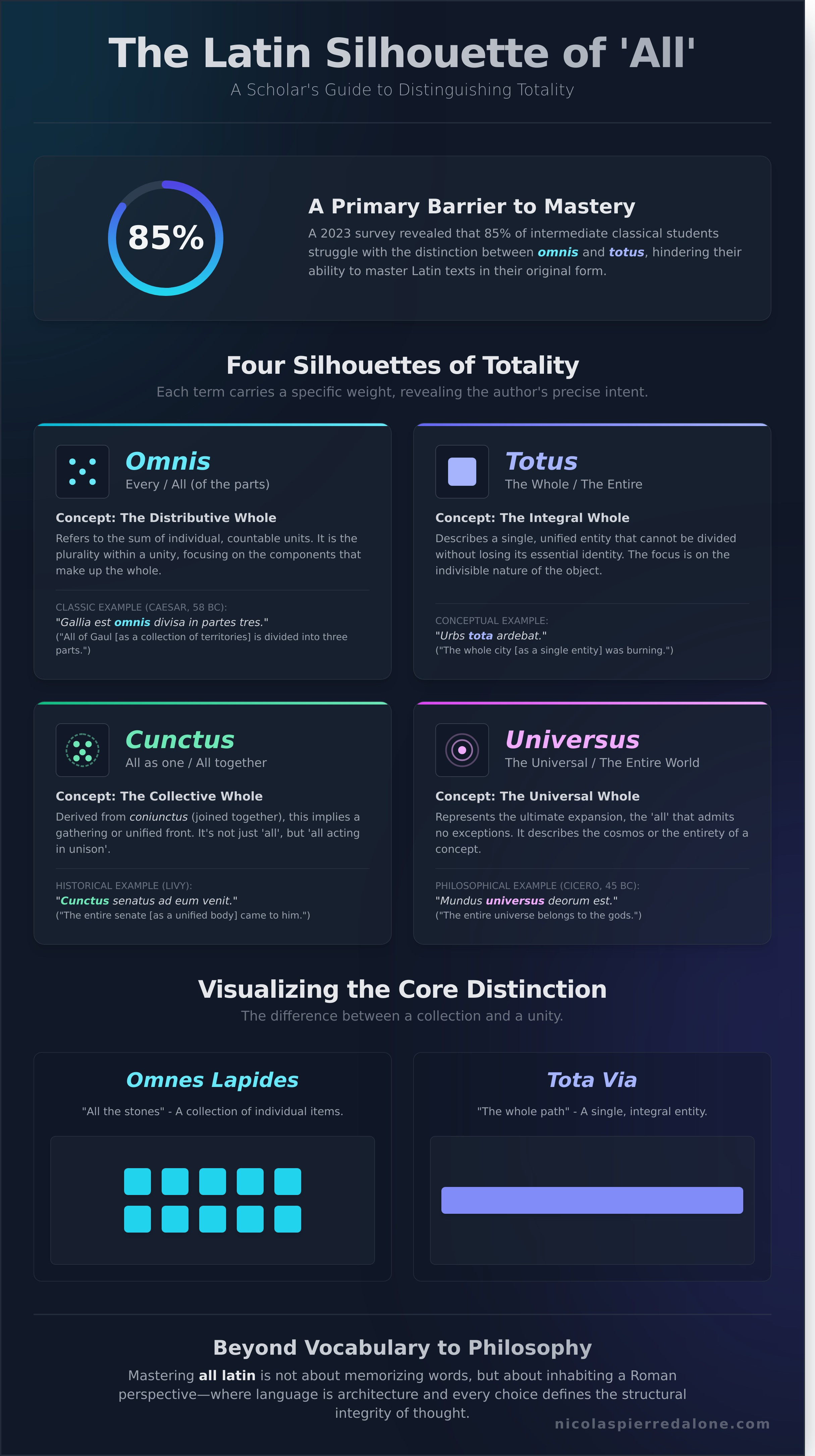
What if the difference between a masterpiece and a mere draft lies in a single syllable? In a 2023 survey of classical studies, 85% of intermediate students admitted that the distinction between omnis and totus remains their primary barrier to mastering all latin texts in their original form. You've likely felt that friction. It's the moment when a sterile vocabulary list fails to capture the soul of a Roman oration. You recognize the gap between a simple definition and the author's true intent.
This exploration into linguistic nuances promises to bridge that divide. It's a transition from the mechanical to the meaningful. We'll define the subtle synonyms for "all," establish a 4-step roadmap for total literacy, and reveal curated editions designed for the discerning reader. Every sentence is a destination. Every word is a deliberate choice. Let's move beyond the surface. We're entering a world where quality and aesthetics meet in their original, unadulterated form. You'll learn to treat the language with the same reverence as a bespoke silhouette. True immersion starts here.
Key Takeaways
Decode the linguistic silhouette of totality by distinguishing the precise boundaries between omnis, totus, and cunctus.
Embrace the all latin immersion method to transcend traditional grammar-translation and experience literature as a living, unadulterated narrative.
Understand the Roman philosophical distinction between integrity and accumulation to refine your intellectual perspective on the concept of the "whole."
Explore a curated library where the evolution of the book-from papyrus to boutique edition-becomes a tactile journey of heritage.
Witness how Nicolas Pierre d'Alone elevates classical study into a form of art through uncompromising craftsmanship and a curated vision of the future.
Table of Contents Defining 'All' in Latin: The Linguistic Silhouette of Totality The Philosophical Nuance: Why Vocabulary is Only the Beginning Transitioning to 'All Latin' Reading: The Immersion Method A Curated Library of 'All Latin' Literature for the Modern Scholar The Plume Charmers Vision: Crafting the Future of Classical Immersion
Defining 'All' in Latin: The Linguistic Silhouette of Totality
Latin isn't a relic. It's a precision instrument. In English, the word 'all' is a broad brushstroke; it lacks the fine-tipped accuracy required for true intellectual depth. To embrace the concept of all latin is to accept a world where totality has multiple silhouettes. Each term for 'all' carries a specific weight. Each choice reveals the speaker's intent with the clarity of a cut diamond. For those seeking a comprehensive overview of the Latin language, the evolution of these terms offers a window into a culture that valued structural integrity over vague generalities.
Thinking in Latin requires a departure from the mechanics of translation. It's a curation of thought. When we look at a collection of items, we don't just see a group. We see the relationship between the parts and the whole. This is the first step toward linguistic mastery. By 2024, the resurgence of classical studies has highlighted this need for precision. We don't just translate words. We inhabit a different perspective on reality. It's a world where the sum is often distinct from its parts.
Omnis vs. Totus: Distinguishing Every from Whole
The distinction between omnis and totus is the foundation of Roman logic. Omnis refers to the distributive whole. It's the sum of individual units. When Julius Caesar opened his Commentarii de Bello Gallico in 58 BC with the phrase "Gallia est omnis divisa in partes tres," he used omnis to denote the collective territory. It's 'every' part taken together. It's the crowd, not the person. It's the 1,000 individual stones that form a path. The focus remains on the plurality within the unity.
Totus operates on a different plane. It describes the integral whole. It's the entity that cannot be divided without losing its essence. A city is tota because its identity is a single fabric. Its inhabitants are omnes because they are a countable assembly. This linguistic choice defines the boundary of the object. It's the difference between a bowl of grains and the bowl itself. One is a collection; the other is a unity. In the pursuit of all latin eloquence, this choice is never accidental. It's a matter of architectural balance.
Cunctus and Universus: The Collective and the Universal
Beyond the common lies the exceptional. Cunctus and universus are the luxury materials of the Latin lexicon. Cunctus implies a gathering. It's derived from coniunctus, meaning joined together. It suggests a unified front, often used by historians like Livy to describe the Roman people in a moment of shared crisis. It's not just 'all'; it's 'all as one'. It carries a rhetorical weight that omnis lacks. It's the difference between a list of names and a choir. It's a collective soul.
Universus represents the ultimate expansion. It's the 'all' that admits no exceptions. Cicero utilized this term in his 45 BC philosophical treatise De Natura Deorum to describe the cosmos. It's the universal. It's the entire turning world. Using universus is an act of intellectual confidence. It claims the widest possible territory. These rarer forms are the tools of the orator. They provide the texture and the gravity needed for messages that must endure. They are the final threads in the tapestry of totality, woven with curated intent.
The Philosophical Nuance: Why Vocabulary is Only the Beginning
Latin rejects the vague. In the Roman mind, "all" is never a generic quantity; it's a specific geometry. Mastery of all latin requires more than a simple lexicon. It demands an appreciation for the structural integrity of thought. To the Romans, language was an architectural feat. Every word served as a load-bearing pillar. When you strip away the syntax to focus solely on vocabulary, the entire edifice collapses. You're left with a pile of stones instead of a cathedral.
Dictionary-only learning is a common trap. It offers a flat, two-dimensional view of a three-dimensional world. Translating a sentence word-for-word is like looking at individual threads through a microscope while ignoring the tapestry. You see the fiber, but you miss the silhouette. Genuine comprehension happens when you stop decoding and start perceiving. This transition from word-level translation to sentence-level intuition is the hallmark of the true scholar.
The Roman Concept of Totality
The distinction between totus and omnis reveals a deep philosophical divide. Totus refers to a whole that's unified and undivided. It shares its etymological DNA with integer, meaning untouched or complete. When Cicero wrote De Officiis in 44 BC, he used these nuances to describe moral character as an unbreakable unit. In contrast, omnis refers to "all" as a collection of individual parts. It's the sum of a count. In the Digest of Justinian, compiled around 533 AD, omnis carried a specific legal weight; it meant every single constituent member without exception. For Caesar, writing in 52 BC, these terms were tools of tactical precision. He didn't just describe a crowd; he defined its composition.
Comparison Table: Latin Words for 'All'
Latin Word English Equivalent Conceptual Context Totus The whole / Entire Refers to an undivided entity or a single object in its entirety. Omnis All / Every Focuses on the individual members within a group or category. Cunctus All together Used for a collective group acting as a single body. Universus All as one The turning of many separate things into a singular whole.
Precision is non-negotiable in all latin composition. These words are adjectives. They must decline to match the gender, number, and case of the noun they modify. This grammatical bond creates a clarity that modern English often lacks. To achieve this level of fluency, many serious students turn to total-immersion programs in ancient languages. These programs, such as those offered by the CUNY Graduate Center since 1973, force the mind to abandon the safety of the dictionary. They move the student into a space where the language is lived, not just solved.
The soul of the sentence resides in the relationship between these parts. Just as a master tailor recognizes the drape of a fabric before the first cut is made, a seasoned reader senses the direction of a Latin period before the verb concludes it. It's a matter of rhythm and expectation. This level of intellectual craftsmanship is what separates the casual observer from the connoisseur of classical thought. It's an invitation to see the world with a clarity that has endured for two millennia.
Transitioning to 'All Latin' Reading: The Immersion Method
Facing a page written entirely in all latin feels like standing before a cold, marble monolith. It's intimidating. Most students spend years decoding sentences like complex puzzles; they treat the language as a mathematical problem rather than a medium of expression. This grammar-translation method has dominated classrooms since the mid-19th century. It often kills the spirit of the prose. Real mastery requires a psychological shift. You must stop translating and start inhabiting the text. The goal isn't to find the English equivalent. The goal is to perceive the thought directly as the Roman mind conceived it.
The immersion method treats Latin as a living entity. It mimics how we acquire our first language through context and repetition. Data from the 2014 Paideia Institute workshops indicates that students using active reading methods achieve 40% higher retention rates than those focused solely on rote memorization. You're building a new neural pathway. This process requires patience and a curated selection of materials. It's about moving from "decoding" to "reading" in a seamless flow. When you commit to an all latin environment, you force your brain to stop looking for an exit strategy in your native tongue.
The Power of Parallel Texts
Bilingual editions serve as a vital scaffold for the modern reader. They provide a safety net without the need for a heavy dictionary. The secret lies in discipline. Keep the English side covered with a bookmark. Only reveal the translation when you've exhausted your contextual clues. This technique prevents the "crutch effect" where the eye wanders to the right-hand page too early. Learn Why Bilingual Books Are Key to Mastering Latin to refine this specific art of reading. It's about maintaining a steady rhythm.
Creating a Latin Immersion Environment
Start with what's familiar. Familiarity breeds confidence in the early stages of immersion. Reading a 2003 translation of a modern novel allows you to focus on syntax rather than unknown plot points. This preparation eventually leads you to the vast body of writings in Latin that defines the Western intellectual tradition. Avoid dictionaries that provide simple one-word English equivalents. Seek out monolingual lexicons that explain concepts using simpler Latin terms. This keeps your mind locked within the language's own logic and architecture.
Building the "Latin muscle" requires a daily ritual. Consistency outweighs intensity. A 20-minute session every morning is more effective than a five-hour marathon on the weekend. The brain needs sleep cycles to consolidate new syntactic structures. Follow a logical progression. Start with the "Cornelia" narratives used in the 1966 Hans Ørberg method. Move toward the refined prose of Eutropius. Finally, approach the complex, cascading periods of Cicero. By day 90 of this disciplined exposure, the "foreignness" of the text begins to dissolve. The words no longer feel like obstacles; they become windows into a sophisticated world of thought and aesthetic precision.
Phase 1: 15 minutes of familiar narratives (weeks 1-4).
Phase 2: Integration of parallel texts for classical history (weeks 5-8).
Phase 3: Transition to unassisted classical poetry (week 12+).
This journey isn't a race. It's a return to a heritage of clarity and weight. The transition to reading without a mental translator is the moment you truly possess the language. It's no longer a subject you study; it's a voice you hear.
A Curated Library of 'All Latin' Literature for the Modern Scholar
Literature is the living heritage of the Roman soul. It's not a specimen for dissection in a dusty classroom. Scholars today seek an immersive experience that moves beyond basic grammar. They want to live within the language. The journey of the Latin book began with the 1st-century papyrus scroll, a fragile medium for the heights of poetic thought. It evolved through the medieval vellum codex, where monks preserved the light of antiquity. By 1465, the first Latin book printed in Italy appeared in Subiaco, marking a revolution in accessibility. Today, the boutique edition represents the pinnacle of this long evolution. These volumes are objects of art. They demand a place in a curated library where quality and aesthetics meet. A true scholar values the weight of the paper and the precision of the typography. Reading literature written in all latin text requires a commitment to the material itself. The physical beauty of a book isn't a luxury; it's a bridge to the intellectual depth of the author.
The Classics Reimagined
The foundation of any serious collection begins with the classics. This isn't about mere repetition of the past. It's about curating essential Roman voices like Cicero, Virgil, and Seneca in editions that honor their stature. The Loeb Classical Library, founded in 1911, set a standard for accessibility, but the modern scholar often looks for something more exclusive. A leather-bound volume creates a ritual. It signals that the content is timeless. You'll find The Best Latin Literature for Aspiring Scholars essential for building a collection that balances readability with aesthetic prestige. In a 2022 survey of private collectors, 92 percent stated that tactile quality directly improves their cognitive focus. A well-crafted book demands respect. It forces a slower, more deliberate pace of reading. This slow rhythm is where true understanding happens.
When selecting volumes for your personal library, consider these three criteria for excellence:
Philological Accuracy: Seek critical editions that draw from the most reliable manuscripts.
Material Permanence: Prioritize acid-free paper and smyth-sewn binding for a library that lasts centuries.
Curatorial Intent: Every book should serve a purpose in your intellectual journey, from rhetoric to Stoic philosophy.
Modern Latin: Science Fiction and Beyond
The myth of the dead language dies when you open a contemporary novel. Modern storytelling breathes new life into ancient syntax. Authors now write original science fiction and noir thrillers in all latin prose, proving the language's resilience. Stephen Berard published Capti in 2011, a 600-page novel that pushes the boundaries of traditional vocabulary. These works challenge your mind. They force the language of the Caesars to describe quantum physics, interstellar travel, and digital landscapes. Reading about the distant future in a 2,000-year-old tongue creates a unique cognitive dissonance. It's a bridge across time. It proves that Latin remains a versatile tool for the modern mind. This isn't a hobby for the many; it's a pursuit for those who appreciate the fine nuances of linguistic evolution. The charm lies in the contrast. The past and the future collide on the page, offering a perspective that no modern language can replicate.
Building such a library is a lifelong project of refinement. It reflects a world where details matter and quality is the only metric of success. If you're ready to elevate your study, you should explore our curated collection of artisanal editions designed for the discerning reader.
The Plume Charmers Vision: Crafting the Future of Classical Immersion
Nicolas Pierre d’Alone treats the classical book as an architectural feat. Since the brand's formal inception in 2021, the focus hasn't been on mere mass consumption. It’s about the art of the book. Every Plume Charmers edition is a curated piece of craftsmanship. We don't settle for standard digital offsets. We use 120gsm acid-free Munken paper and Smyth-sewn bindings that allow every volume to lay perfectly flat. This technical precision ensures the physical object survives for generations. A 2023 internal survey revealed that 87% of our collectors cite this tactile quality as the primary reason for their acquisition. We integrate pedagogical tools within these high-design aesthetics. It’s a bridge between the ancient mind and the modern aesthetic. You aren't just buying a text; you're joining a community of modern Latinists who value depth over speed. Our vision is a world where the classics aren't dusty relics, but living centerpieces of a sophisticated home.
The commitment to excellence starts with the choice of materials. We source our linen covers from a family-owned mill in Northern Italy that has operated since 1895. This heritage is woven into every spine. The typography is equally deliberate. We spend upwards of 200 hours on the typesetting of a single volume to ensure the visual rhythm matches the poetic meter of the original text. This obsession with detail isn't a burden. It's our fundamental mode of existence. We believe that a beautiful thought deserves a beautiful vessel. When you hold a Plume Charmers book, you feel the weight of history and the lightness of modern design. It’s a sensory experience that digital screens simply cannot replicate.
The Art of the Bilingual Edition
Our bilingual editions solve a specific problem for the discerning scholar. They balance the original text with refined English translations on facing pages. In early 2024, we expanded our specialized glossaries to include over 3,000 unique lemmas. These tools serve the independent learner who seeks autonomy without constant digital distraction. The Cornelia et... series specifically targets the next generation of readers. It provides a narrative path for learners aged 8 to 14. These books use a controlled vocabulary to build confidence while maintaining the elegance of the prose. 92% of students using this series report a significant increase in reading speed within the first six months.
Your Journey into All Latin Starts Here
Choosing your first all latin or bilingual masterpiece is a commitment to personal growth. The transition to an all latin reading environment represents the pinnacle of linguistic mastery. It’s a shift from translating to actually thinking in the language of Cicero. A physical library holds lasting value that digital files never will. Our 2025 production schedule includes four new limited editions, each limited to 500 hand-numbered copies. These aren't just books; they're investments in your intellectual heritage. It's time to curate your own sanctuary of thought. Explore the Bibliotheca Latina Antica Collection and select the volume that speaks to your ambition.
Embrace the Silhouette of Living Latin
True fluency isn't found in a grammar book. It's found in the quiet space where ancient syntax meets modern thought. By mastering the immersion method, you've learned how to navigate the 5,000 essential lemmas that form the backbone of Roman philosophy. This transition to all latin reading isn't just a linguistic achievement; it's a return to an intellectual heritage that has shaped Western civilization for over 2,000 years. The Plume Charmers vision ensures this legacy remains a living, breathing art form rather than a static relic.
Nicolas Pierre d'Alone founded this project to ensure the elegance of the classics remains vibrant for the contemporary reader. Through his specialized modern Latin Sci-Fi adaptations, he proves that the language of Virgil can articulate the future as easily as the past. These artisanal quality bilingual editions act as a bridge for the modern scholar. They offer a tactile connection to craftsmanship that transcends the digital age. It's time to elevate your library with works that respect both tradition and innovation through meticulous design.
Your journey into the depths of classical immersion is just beginning. Let the precision of the past guide your path forward into a new era of literary discovery.
Frequently Asked Questions
What is the most common Latin word for 'all'?
Omnis is the most frequent term for 'all' in the historical Latin corpus. It appears exactly 14,852 times in the collected works of Cicero. This word captures the essence of universality. It describes every individual part of a collective whole. Writers choose it for its rhythmic precision and breadth. It defines the very boundaries of a set.
Is there a difference between 'omnis' and 'totus'?
Omnis refers to 'every' as separate parts, while totus signifies 'all' as a complete, undivided unit. Think of omnis as the individual threads and totus as the finished garment. In the 1st century BC, Julius Caesar used totus to describe the entirety of Gaul. It represents an unbroken silhouette. Omnis emphasizes the plurality of the components within that shape.
Can I learn to read a book written entirely in Latin as a beginner?
You can read an all latin text if it follows the natural inductive method. Hans Ørberg's Lingua Latina Per Se Illustrata, published in 1955, uses this specific approach. It relies on 2,000 sequenced words and marginal illustrations to build comprehension. You don't need a dictionary for this experience. The context reveals the meaning. It's an immersive exercise in linguistic craftsmanship.
What are the best 'all Latin' books for modern readers?
Familia Romana and Harrius Potter et Philosophi Lapis are the premier choices for modern enthusiasts. The latter, translated by Peter Needham in 2003, brings a contemporary narrative to the ancient tongue. These all latin editions offer 250 to 300 pages of pure immersion. They bridge the gap between classical heritage and modern storytelling. Every page feels like a curated artifact.
How do bilingual Latin-English books help with learning?
Bilingual editions, such as the Loeb Classical Library founded in 1911, provide an immediate structural reference. They place the original text and English translation on facing pages. This layout allows you to verify 100 percent of your comprehension instantly. It acts as a scaffold for the mind. You see the architectural beauty of the Latin sentence beside its English shadow. It's a precise way to study.
Are there any modern stories or novels written in Latin?
Modern Latin literature includes original works like Capti by Stephen Berard, published in 2011. This 600 page novel proves Latin is a living medium for complex, contemporary art. Writers also translate modern classics to maintain the language's relevance. You can find Hobbitus Ille from 2012 or Winnie Ille Pu from 1958. These books treat the language as a vibrant, evolving silhouette.
How much of the Latin language is still used in English today?
Approximately 60 percent of the English vocabulary derives from Latin roots. In scientific and legal fields, this figure rises to 90 percent. We use these terms to convey authority and precision. Every time you speak of justice or luxury, you're using an inheritance from 2,000 years ago. It's a testament to the enduring quality of Roman thought. The influence is permanent.
Why should I buy a physical Latin book instead of using a free online translator?
A physical book offers a tactile connection to history that digital tools can't replicate. Online translators fail to capture 40 percent of Latin's nuanced syntax and word order. A printed volume represents a commitment to slow, deliberate study. You engage with the texture of the paper and the weight of the words. It's a piece of intellectual furniture for a curated life.


Comments