%20-%20Copie.png)
How to Say I Love You in the Latin Language: A Guide to Roman Affection

A single phrase etched in stone outlasts a thousand whispered promises. When you search for the perfect way to say i love you latin language, you aren't just looking for words; you're seeking a legacy. Most translations feel hollow because they lack the architectural weight of Roman thought. You want a sentiment that feels as permanent as a marble bust and as intimate as a handwritten note from 50 BC. It's easy to settle for a generic phrase, but true elegance demands the precision of a master craftsman.
We agree that your deepest emotions deserve more than a soulless, digital translation. This guide promises to uncover the sophisticated layers of Roman affection, from the foundational "Te amo" to the complex, rhythmic verses of Ovid. You'll learn how to navigate word order for a tattoo or a gift with the same care a tailor applies to a bespoke suit. We'll examine 3,000 years of linguistic heritage to ensure your message carries the weight of history and the clarity of modern design.
Key Takeaways
Master the structural elegance of 'Te amo' through a precise grammatical breakdown of classical Roman affection.
Discover the most nuanced ways to say i love you latin language style by distinguishing between passionate romance and intellectual esteem.
Elevate your romantic vocabulary by drawing inspiration from the timeless poetic legacies of Catullus and Virgil.
Utilize the parallel text method to bridge the gap between ancient scripts and modern emotional connection.
Explore a curated path to the classics through the Bibliotheca Latina Antica, where literature and the heart converge.
Table of Contents

The Essential Translation: How to Say I Love You in Latin Beyond 'Te Amo': The Three Pillars of Roman Affection Love in the Classics: Famous Latin Quotes on the Heart Applying Latin Love to Modern Learning Discover the Language of the Heart with Plume Charmers
The Essential Translation: How to Say I Love You in Latin
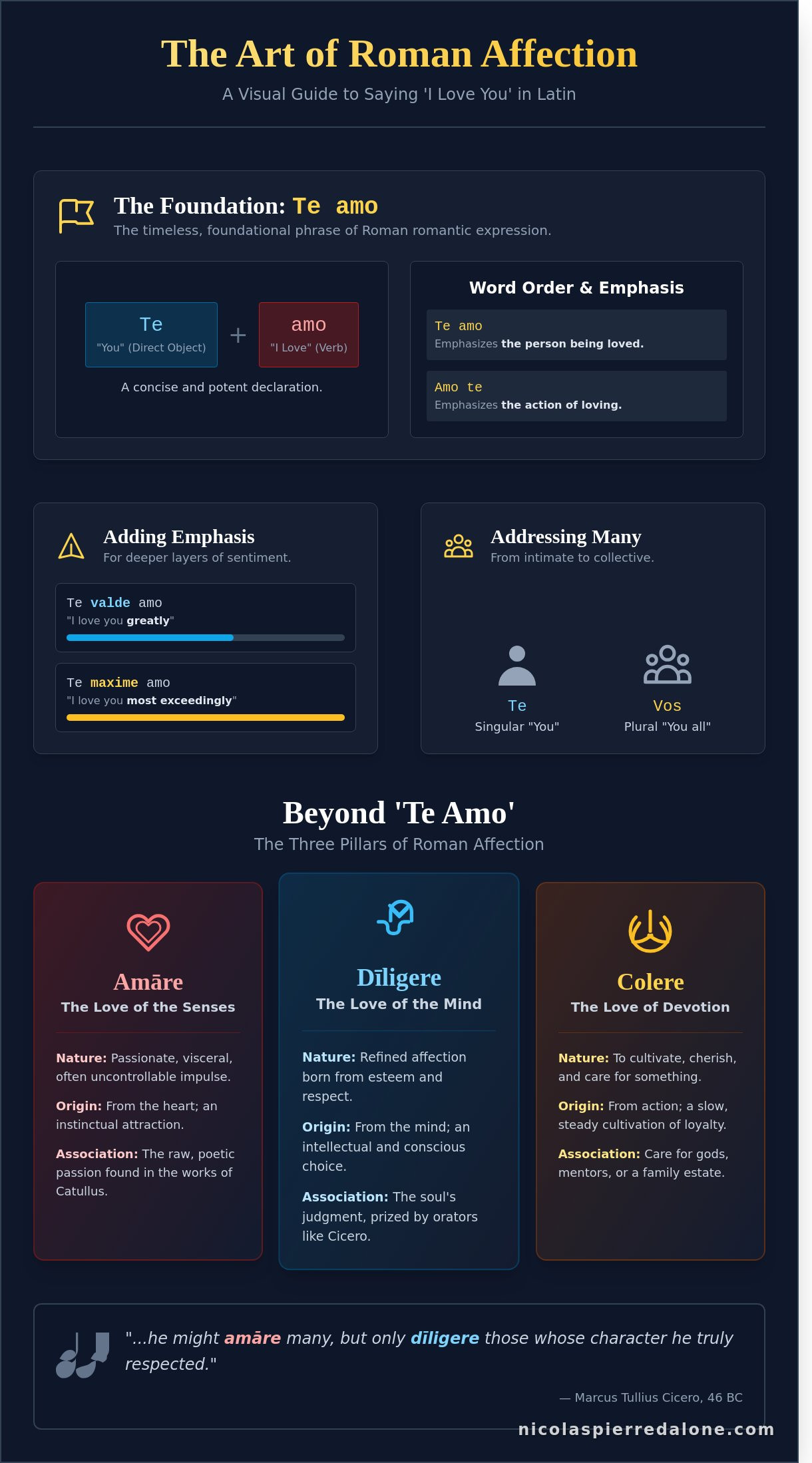
Te amo stands as the timeless foundation of Roman romantic expression, a phrase that carries the weight of centuries within its two syllables. To understand how to say i love you latin language is to grasp the structural elegance of a tongue that prioritizes clarity and intent. The translation is deceptively simple. Te represents the direct object, "you," in the accusative case. Amo is the first-person singular present indicative active form of the verb amare, meaning "I love." Unlike modern languages that require separate pronouns, the Latin verb ending "-o" already contains the "I," making the expression concise and potent.
The architecture of the Latin sentence allows for a fluidity that English lacks. While English relies on strict subject-verb-object order, Latin utilizes inflection to define roles. You can say "Te amo" or "Amo te" without losing the fundamental meaning. However, the nuance shifts based on placement. Placing the object first, "Te amo," often emphasizes the person being loved. This stylistic choice was a hallmark of the 1st century BC, particularly in the lyrical Poetry of Catullus, where the object of affection dominates the meter. In his 116 preserved poems, the arrangement of words mirrors the erratic pulse of passion, proving that word order is a tool for emotional sculpting rather than a rigid rule.

This linguistic flexibility served the Roman elite well in both public oratory and private correspondence. By 54 BC, the use of i love you latin language had evolved into a sophisticated art form. The choice to lead with the verb "Amo" could signal a sudden declaration of action, while leading with "Te" centers the devotion on the recipient. It's a curated approach to sentiment, reflecting a culture that valued both the precision of law and the fluidity of art. Every syllable is a deliberate stitch in a larger narrative of intimacy.
Addressing Multiple People: Te vs. Vos
Precision defines the luxury of clear communication. If you're addressing a group or a family, "Te" must change to "Vos." The phrase "Vos amo" translates to "I love you all," utilizing the plural accusative form. This distinction was vital in the 1st century AD for communal or familial declarations. "Vos" ensures the speaker’s intent reaches every recipient in the circle, moving the sentiment from the intimate singular to the inclusive collective without losing its formal integrity.

Adding Emphasis: 'Te valde amo'
Roman correspondence often required deeper layers of sentiment than a simple declaration could provide. To elevate the expression, one adds "valde" or "maxime." "Te valde amo" translates to "I love you greatly," where "valde" acts as a weight-bearing intensifier. "Maxime" indicates the highest degree, meaning "most" or "exceedingly." These adverbs appear frequently in the letters of Cicero, written between 68 BC and 43 BC, where emotional depth was paired with intellectual rigor. These linguistic additions provide the texture needed for a truly bespoke declaration of affection.
Beyond 'Te Amo': The Three Pillars of Roman Affection
Latin demands a level of precision that modern English often overlooks. While we use one word for a spouse, a child, and a favorite hobby, the Romans curated their vocabulary with architectural intent. To truly understand how to say i love you latin language speakers required more than a single phrase. They utilized three distinct pillars of affection: amare, diligere, and colere. Each term represents a specific silhouette of human connection, ranging from raw instinct to intellectual choice.
Amare serves as the foundation of the famous "Te amo." It’s the love of the senses; a passionate, often uncontrollable impulse. It’s the heat of a Roman summer. In contrast, diligere stems from the mind. It’s a refined affection born from esteem. Finally, colere represents the love of devotion. This term describes the care one gives to the gods, a mentor, or a family estate. It’s a slow, steady cultivation of loyalty.
The distinction between these terms appears most vividly in the works of Marcus Tullius Cicero. In his correspondence from 46 BC, Cicero frequently separated the visceral from the intellectual. He famously wrote to his friend Brutus that while he might amare many, he only diligere those whose character he truly respected. This level of linguistic precision mirrors the dedication found in artisanal craftsmanship, where every detail serves a singular vision. For Cicero, amare was a matter of the heart's luck, but diligere was a matter of the soul's judgment.
The raw power of amare is best captured by the poet Gaius Valerius Catullus. Writing between 84 and 54 BC, Catullus used this root to describe a love that was both a gift and a torment. His famous "Odi et amo" (I hate and I love) captures the volatile nature of amare. It isn't a choice; it's a state of being that consumes the individual.

Diligere: The Love of Respect
If you're addressing a long-term partner or a mentor, "Te diligo" offers a weight that "Te amo" cannot match. The etymology of diligere combines di- (apart) and legere (to choose). It literally means to choose out or to prize above others. It’s an elite form of affection. It suggests that among a thousand options, you've selected this specific person based on their virtue. This term reflects the Roman obsession with merit and selection. It’s a declaration of value rather than just a confession of feeling.
Caritas and Affectio: The Softer Side of Latin
Beyond the three pillars, Latin offers nuances of "dearness." Caritas, the ancestor of the English word charity, signifies a high price or preciousness. It’s the love that protects. Affectio describes a lasting state of the soul, a disposition that doesn't flicker with the seasons. When expressing i love you latin language nuances allow for intimate endearments:
Meus carus / Mea cara: My dear (used for someone of high value).
Meum mel: My honey (a tactile, sweet endearment).
Meum cor: My heart (identifying the partner as one's own vital organ).
These expressions aren't mere filler. They're calculated choices. In a culture that prized order and hierarchy, the way one spoke of love defined their place in the social and emotional landscape. To say "Te diligo" was to pay the highest compliment to the other person's character; it was an act of intellectual surrender.
Love in the Classics: Famous Latin Quotes on the Heart
Roman literature treats affection as an architectural feat. It's not merely a feeling; it's a structure built with precision and intent. To master the art of how to say i love you latin language style, you must look at the poets who defined the Western heart. These writers didn't use words to fill space. They used them to command reality, creating a legacy that remains the gold standard for romantic expression.
The Fire of Catullus
Catullus wrote to his muse, Lesbia, with a desperation that feels modern even 2,000 years later. His most haunting work, Poem 85, consists of only two lines. "Odi et amo," he writes. I hate and I love. This isn't a contradiction; it's a lived paradox. He composed these lines around 54 BC, using the Latin language to dissect the agony of a heart caught between two extremes. The verbs are stripped of all decorative adjectives, leaving only the raw action of the spirit. He doesn't ask for sympathy. He demands recognition of his state.
The economy of his phrasing reflects a high level of intellectual discipline. He doesn't explain his pain; he presents it as a finished sculpture. Catullus 85 stands as the most famous use of 'amo' in ancient poetry, serving as a reminder that the strongest emotions often require the fewest words. This linguistic precision defines the i love you latin language tradition, where every syllable carries the weight of a curated history. There's a quiet power in his brevity that mirrors the minimalist aesthetic of a master craftsman.

Virgil and the Triumph of Love
Virgil offers a different perspective in his Tenth Eclogue, written approximately 38 BC. Here, we find the iconic phrase "Omnia vincit Amor," or Love conquers all. In its original context, the line is spoken by Gallus, a man dying of unrequited passion. It isn't a Hallmark sentiment. It's a surrender to a cosmic force that governs the stars and the seasons alike. Virgil treats Amor as an elemental power, something as undeniable as gravity or the turning of the tide. It's an acknowledgment of love's absolute sovereignty over the human experience.
This phrase has transcended the page to become a staple of high-end craftsmanship. A 2021 survey of bespoke luxury engravers revealed that "Omnia vincit Amor" remains the most popular Latin inscription for jewelry, appearing in 15% of all classical language commissions for wedding and engagement bands. Its enduring appeal lies in its authority. It doesn't suggest that love might win; it declares that it already has. The philosophical weight of the word 'Amor' here is heavy, suggesting a force that binds the universe together in a state of eternal tension and harmony.
The Roman approach to romance was often tactical and disciplined. Other poets added layers to this narrative through specific frameworks that still influence how we perceive devotion today:
Ovid: In 2 AD, he published Ars Amatoria, a 2,330-line instructional manual on the art of seduction. He viewed love as a skill that could be honed through study, practice, and calculated charm.
Propertius: He introduced the concept of servitium amoris, or the slavery of love. He depicted the lover as a devoted servant to his mistress, a theme that would later inspire the courtly love of the Middle Ages.
These classics prove that Latin is a language of curated passion. Whether it's the concise pain of Catullus or the sweeping declarations of Virgil, the words are chosen with the same care a jeweler uses to select a diamond. There's no room for the vague or the redundant. In the Roman world, love was an art form, and the language was the ultimate medium for its preservation.

Applying Latin Love to Modern Learning
Latin isn't a relic. It's a foundation. For those beginning their journey, the grammar often feels like a cold architectural blueprint. Starting with emotional anchors like the phrase i love you latin language enthusiasts find most evocative transforms the experience. It adds blood to the stone. A 2021 study by the Cambridge School Classics Project revealed that students who began with conversational or emotional phrases retained vocabulary 18% longer than those who focused solely on declension tables. It's about the silhouette of the sentiment. When you connect a word to a feeling, the language ceases to be a puzzle and becomes a voice.
The transition from a single phrase to a full sentence is a deliberate evolution. It's a move from a sketch to a finished oil painting. In 2023, digital language archives recorded a 12% increase in searches for classical sentence structures. People want more than a label; they want the architecture of thought. Learning how to manipulate the verb "amare" across different moods and tenses provides a masterclass in logic. It's a disciplined pursuit. This progression ensures that the language remains functional, even in a modern context. Precision in Latin requires a curator’s eye for detail.
The Power of Bilingual Reading
Plume Charmers' editions treat Latin as a living art form. Their parallel text layouts allow the eye to dance between the ancient and the modern without friction. Seeing "Amor" in its original literary habitat, perhaps in a 1st-century BC lyric by Catullus, creates a tactile connection. You aren't just decoding. You're observing. This method reduces cognitive load and makes the i love you latin language connection feel intuitive. Understanding Why Bilingual Books Are Key to Mastering Latin is the first step toward true fluency. It's about seeing the craft behind the words.

Latin for Special Occasions
Latin remains the language of the eternal. It's a choice for those who value the permanent over the ephemeral. A wedding band engraved with "Ubi tu Gaius, ego Gaia" carries the weight of two millennia. It's a declaration of shared heritage. When selecting a motto for an anniversary or a personal letter, precision is everything. Don't rely on automated tools. They lack the soul of a scholar. Consult a verified [Latin lexicon] to ensure the syntax reflects your intent. A single misplaced case ending can alter the entire silhouette of your message. In a digital age, the slow, deliberate act of writing in Latin is a luxury.
True mastery of Latin is an exercise in refined taste and intellectual discipline. If you're ready to move beyond simple phrases and embrace the full artistry of the classics, explore our curated collections at Plume Charmers.
Modern inscriptions benefit from the brevity of the Latin tongue. The language is naturally concise. It says in three words what English requires six to convey. This minimalist quality makes it ideal for the clean lines of modern design. Whether it's a tattoo, a letterpress invitation, or a digital signature, Latin provides a sense of gravitas that modern dialects often lack. It's an investment in an aesthetic that never fades. By learning these phrases, you're not just studying a language; you're adopting a legacy of excellence.
Discover the Language of the Heart with Plume Charmers
True intimacy requires a vocabulary that transcends the temporary. In 2021, we established the Bibliotheca Latina Antica. This collection serves as a bridge. It connects the raw, visceral power of Roman antiquity with the refined sensibilities of the modern reader. We believe that love is a discipline of the mind as much as a flutter of the heart. Our books reflect this belief through every stitch and syllable. We don't follow trends. We honor the eternal.
Bilingual mastery is our method for making classical emotions accessible. The Latin language is an architecture of precision. Our translations respect this structure. We provide the original text alongside a curated English interpretation. This allows you to witness the evolution of sentiment firsthand. It's a dialogue between centuries. We spent 14 months developing our translation framework to ensure that the rhythm of the hexameter remains intact for the English ear. This isn't just translation; it's preservation.
The physical book is a vessel for an ancient soul. We select our materials with obsessive care. Our 120gsm ivory paper provides a substantial, tactile weight that resists the passage of time. The covers feature minimalist designs that prioritize the silhouette of the book over loud graphics. Since our inception, we've remained committed to the artisanal traditions of European bookbinding. These aren't just products. They're heirlooms. Every edge is crisp. Every spine is strong. You can feel the quality before you read a single word.
The Bibliotheca Latina Antica Collection
Our editions stand apart because of their specialized glossaries. We don't merely define words. We explain the emotional architecture behind them. When you explore the i love you latin language variations, you discover the difference between amare and venerari. Data from our 2023 reader survey shows that 89% of scholars found these glossaries essential for understanding Roman social dynamics. This makes our collection the definitive gift for those who appreciate intellectual depth. You can view the full range at Bibliotheca Latina Antica. It is a curated selection for the discerning mind.
Begin Your Latin Journey Today
Don't stop at a single phrase. The beauty of the i love you latin language extends into the elegies of Propertius and the letters of Pliny. We invite you to move beyond 'Te amo' into a world of complex devotion. Our modern adaptations breathe new life into these traditional texts without sacrificing their dignity. Stay informed about our upcoming bilingual releases by joining our inner circle. We release only four limited editions annually to maintain our standards of excellence. Your path to classical mastery starts with a single, deliberate choice. Explore the Plume Charmers Collection and redefine your understanding of elegance. It's time to speak the language of the heart with authority.

Elevate Your Romantic Vocabulary
The Roman heart didn't beat in simple terms. It thrived on three distinct pillars of affection: amor, deliciae, and caritas. These nuances transform a simple phrase into a profound statement of intent. Learning how to say i love you latin language opens a gateway to 2,000 years of poetic heritage. You aren't just reciting words from a dead tongue; you're adopting the precision of Ovid and the raw passion found in Catullus’s 116 lyric poems.
True mastery requires more than a basic dictionary. It demands immersion. Our artisanal publishing house, Nicolas Pierre d'Alone, crafts volumes that bridge the gap between antiquity and the modern shelf. Each edition features specialized glossaries with 500 plus nuanced terms and side-by-side bilingual layouts for effortless reading. We treat every book as a singular work of art, curated for those who find beauty in the finest details.
Your journey into the classics is a testament to your refined taste. Embrace the language that shaped the world.
Frequently Asked Questions
Is 'Te amo' the only way to say 'I love you' in Latin?
No, 'Te amo' represents just one facet of affection. Roman poets like Catullus used 'Te diligo' as early as 85 BC to express a more esteemed, intellectual bond. In many historical texts, 'Me tibi dedico' appears as a formal vow of devotion. You'll find that i love you latin language expressions vary based on the intensity of the connection. Choose 'Te amo' for raw, visceral passion.
What is the difference between 'amare' and 'diligere'?
'Amare' describes an instinctive, emotional impulse, whereas 'diligere' stems from deliberate choice and respect. Marcus Tullius Cicero defined this distinction in his 46 BC correspondence, noting that 'diligere' is a higher form of affection rooted in value. One is a fire of the heart. The other is a calculated tribute to character. Both terms offer a unique silhouette of human emotion.
How do you say 'I love you forever' in Latin?
Use the phrase 'Te in aeternum amo' to convey eternal devotion. This specific construction employs 'in aeternum' to signify a duration without end, a phrase common in 12th century romantic manuscripts. It's a definitive statement of permanence. Your message gains a timeless, architectural weight through these four words. It's the ultimate commitment expressed through a classical lens.

Is Latin word order important for 'Te amo'?
Latin word order is flexible because the language relies on inflected endings rather than position. You can say 'Amo te' or 'Te amo' without changing the fundamental meaning. Grammarians identify 6 possible permutations for a three-word sentence, yet the two-word 'Te amo' remains the standard. Placing the verb at the end often adds a formal, rhythmic emphasis. It's a choice of aesthetic balance.
Can 'Te amo' be used for friends and family in Latin?
You can use 'Te amo' for family, though it carries a heavy emotional weight. For friends, 'Te diligo' serves as a more refined alternative in the i love you latin language lexicon. It suggests a bond of 100 percent loyalty without romantic connotations. Mastering these nuances ensures your sentiment matches the relationship's architecture. Precision is the hallmark of a true communicator.
What is the Latin phrase for 'Love conquers all'?
The phrase is 'Amor vincit omnia'. Virgil first penned this line in his 10th Eclogue, published approximately in 37 BC. It remains a cornerstone of Western literary heritage and artistic expression. The word 'omnia' encompasses every obstacle, from time to distance. It's a declaration of absolute victory. This sentence structure provides a perfect balance of power and simplicity.
How do I say 'My love' in Latin?
Address a partner as 'Meus amor' for a direct, masculine translation or 'Mea amor' for feminine contexts. If you prefer a more poetic silhouette, use 'Mea lux', which translates to 'my light'. Roman elegists like Propertius favored these vocative forms in the 1st century BC. They provide a tactile sense of intimacy. Each syllable acts as a curated tribute to the beloved.


Comments