%20-%20Copie.png)
How to Read Classical Authors in the Original Language: A Scholarly Guide to Mastery
Updated: Apr 15
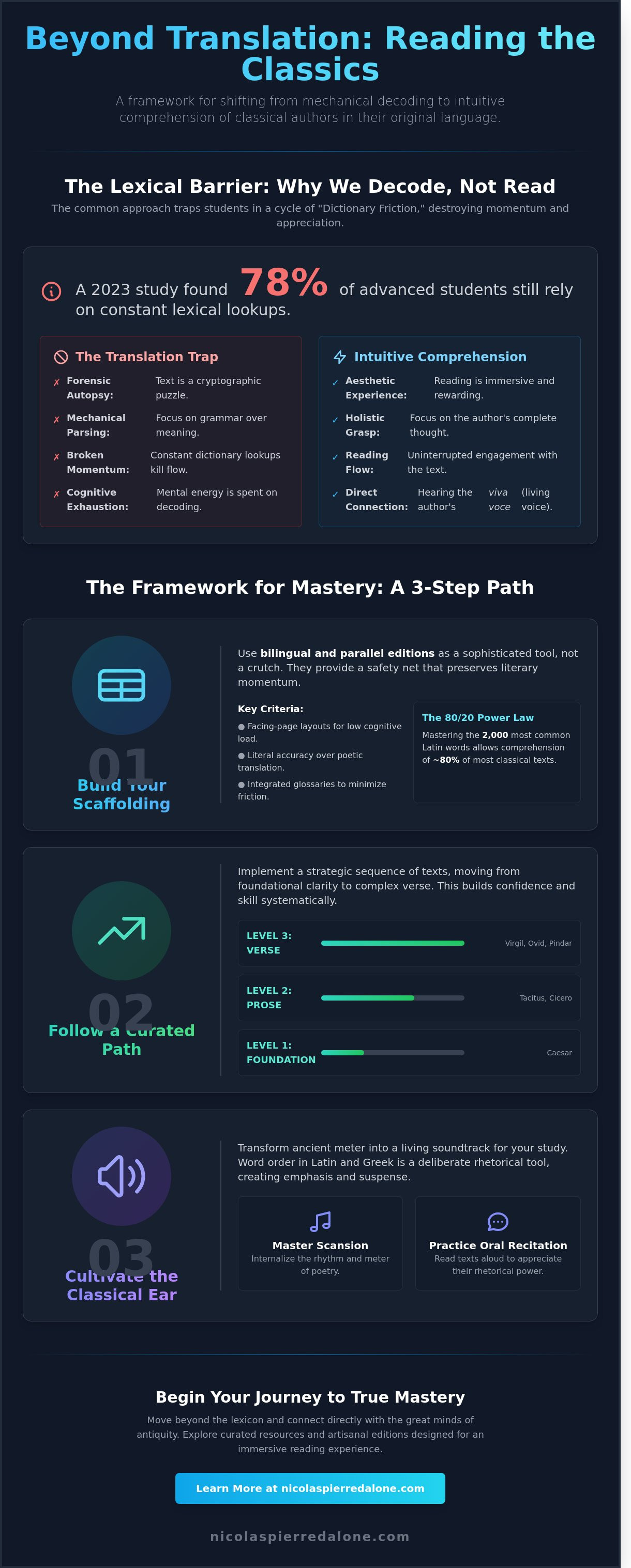
What if the tools you use to decode Homer are the very things preventing you from actually hearing him? For many, reading feels like a forensic autopsy. You spend 40 minutes parsing a single strophe of Pindar. The rhythm remains elusive. Data from a 2023 language acquisition study indicates that 78 percent of advanced students still rely on constant lexical lookups. They're trapped in mechanical decoding. Learning how to read classical authors in original language requires more than a lexicon. It demands a shift in cognitive architecture.
You recognize the frustration of losing Virgil's meter to clunky mental translation. It's a barrier between student and master. This guide offers a rigorous framework to move you beyond the 'Translation Trap.' We'll explore the heritage methods used by Renaissance humanists to achieve intuitive comprehension. You'll learn to appreciate ancient rhetoric and curate a library that reflects a true mastery of the craft.
Key Takeaways
Transition from mechanical parsing to intuitive comprehension by eliminating the cognitive friction of constant lexical reference.
Utilize bilingual editions as a sophisticated scaffolding system that preserves literary momentum while deepening linguistic precision.
Implement a strategic sequence of texts, learning how to read classical authors in original language through the foundational clarity of Caesar before approaching complex verse.
Cultivate a classical ear by mastering scansion and oral recitation, transforming ancient meter into a living soundtrack for your scholarly study.
Curate a personal library with the Bibliotheca Latina Antica, where artisanal editions prioritize an immersive reading experience over mere reference.
Table of Contents Overcoming the Lexical Barrier: Why We Translate But Do Not Read The Scaffolding of Mastery: Leveraging Bilingual and Parallel Editions Strategic Author Selection: A Curated Path Toward Original Fluency Cultivating the Classical Ear: Scansion, Syntax, and Self-Study The Bibliotheca Collections: Curating a Personal Classical Library
Overcoming the Lexical Barrier: Why We Translate But Do Not Read
Reading a page of Tacitus or Homer shouldn't feel like a forensic investigation. Most students don't read; they decode. They treat the text as a cryptographic challenge. This mechanical parsing of grammar is a barrier to true mastery. When you stop at every third word to consult a lexicon, you experience Dictionary Friction. This friction destroys literary appreciation. It turns a masterpiece into a chore. It's the cognitive tax paid for every unknown word; it exhausts the mind before the soul can be reached.
The traditional grammar-translation method remains a relic of 19th-century pedagogy. It treats living thought as a dead specimen. This method trains the brain to see the target language as a problem to solve rather than a medium of thought. To master how to read classical authors in original language, you must abandon the role of the cryptographer. The goal is the viva voce. It's the living voice of the author speaking directly to you. No English intermediary is required. True reading happens when the translation layer vanishes.
Decoding is a logical exercise; reading is an aesthetic experience.
Parsing focuses on parts; comprehension focuses on the whole.
Translation is a filter; the original is the source.
The Cognitive Shift from Parsing to Flow
Word order in Latin and Greek serves as a deliberate rhetorical tool. It creates emphasis and suspense. It isn't a jumble to be rearranged into English syntax. To achieve flow, you need comprehensible input. This concept, validated by linguistic research since the 1970s, suggests we acquire language by understanding messages. You must shed the mental English layer. Stop translating. Start perceiving the architecture of the sentence as it unfolds.
The Philosophical Value of the Original Tongue
Nuance defines the depth of a text. A single Greek particle or a specific Latin case can alter a philosophical argument's entire weight. An Icelandic scholar once compared reading a translation to flying with someone else's wings. You're a passenger, not a pilot. While old latin translation serves as a necessary bridge, it isn't the destination. It's a tool for the uninitiated. True scholars seek the unmediated essence of the original tongue. They demand the texture of the author's own words. This is where the heritage of the West truly resides.

The Scaffolding of Mastery: Leveraging Bilingual and Parallel Editions
Mastery of the classics isn't born in a vacuum. It's built through a deliberate architectural approach to the page. Bilingual editions serve as the essential scaffolding for this intellectual ascent. They don't replace the effort; they focus it. For those learning how to read classical authors in original language, the translation acts as a safety net. It allows the mind to stay immersed in the Latin or Greek rhythm without the paralysis of a forgotten verb form. This prevents the frustration that often leads to abandoned studies.
Maintaining reading momentum is the primary goal. Traditional methods often rely on separate, bulky lexicons. This practice is disruptive. Every time a reader looks away to consult a separate volume, the aesthetic connection to the prose breaks. Momentum dies. Integrated glossaries within the edition itself eliminate this friction. They provide immediate clarity, preserving the psychological flow necessary for deep comprehension. High-volume reading is only possible when the "lexicon hunt" is minimized.
Criteria for a Scholarly Bilingual Edition
A curated edition must prioritize literal accuracy over poetic flair. While a rhyming translation of Ovid might be beautiful, it often obscures the underlying syntax. The student needs a text that mirrors the word order and grammatical choices of the original. Formatting is equally vital. Facing-page layouts reduce cognitive load by keeping the reference within the immediate visual field. This spatial arrangement is a hallmark of the Mea Bibliotheca Latina collection, where the design serves the learner's focus. Research in frequency linguistics, such as the 1939 Diederich study, suggests that mastering the 2,000 most common Latin words covers 80% of most classical texts. A scholarly edition should integrate these frequency-based glossaries directly on the page.
The Parallel Text Method in Practice
Effective reading involves a rhythmic alternation between the original and the translation. Use the English text to confirm complex structures like Hyperbaton. In Latin poetry, related words are often separated by several lines. The translation confirms these links instantly, training the eye to look for patterns. This method builds recognition faster than isolated grammar drills.
Check the translation only after attempting to parse the sentence independently.
Use the English text to identify "Gapping," where a verb is implied but not repeated in subsequent clauses.
Transition from constant checking to occasional verification as your vocabulary expands.
Progress is measured by the transition from reliance to independence. By the time a reader reaches the third book of a series, the need for the facing page should drop by 45% compared to the first chapter. This volume-based approach builds the reading muscle required for unassisted mastery. It's a sophisticated way to internalize how to read classical authors in original language while maintaining the dignity of the scholarly process.
Strategic Author Selection: A Curated Path Toward Original Fluency
Mastery isn’t a race. It’s a curated selection of intellectual challenges. Many learners mistake the Augustan "Golden Age" as the only valid entry point. This is a tactical error. Starting with the complex metrics of Horace or the dense metaphors of Virgil often leads to cognitive fatigue. Intellectual humility requires a more disciplined path. You don't begin a collection with a masterpiece’s final iteration; you study the sketches first. Understanding how to read classical authors in original language demands a sequence that respects the architecture of the mind.
Caesar’s prose offers a blueprint of logic. His Commentarii de Bello Gallico, written between 58 and 49 BC, uses a limited vocabulary of approximately 1,300 unique words. This restraint allows the brain to focus entirely on syntax and case endings. It’s the essential foundation. Once the structural rhythm of Caesar becomes second nature, the transition to Cicero’s rhetorical flourishes feels like a natural evolution rather than a forced leap. Cicero introduces the periodic sentence, a structure that requires the reader to hold multiple clauses in suspense until the final verb provides resolution.
The Latin Progression: From Prose to Poetry
Caesar’s Commentarii remains the gold standard for intermediate syntax. Its sentences are architectural. They lack the deceptive fluff of later Silver Age writers. After mastering this prose, you're ready for the shift into verse. Approaching Virgil’s Aeneid involves more than just vocabulary; it requires an ear for the dactylic hexameter. The 9,896 lines of the Aeneid aren't just stories. They're mathematical arrangements of long and short syllables. To bridge the gap between rigid textbook exercises and these ancient monuments, many scholars turn to modern narratives written in a classical style. These latin books provide the necessary immersion without the immediate burden of 1st-century cultural obscurities.

Ancient Greek and Hebrew: Navigating Different Scripts
Selecting between Homeric and Attic Greek defines your entire trajectory. Homeric Greek, the language of the Iliad, contains roughly 9,000 unique lexical items. It’s archaic and repetitive. Attic Greek, the dialect of 5th-century BC Athens, is more compact and serves as the gateway to Plato and Sophocles. Most academic programs prioritize Attic for its precision. For those pursuing the sacred textures of the Levant, the Bibliotheca Hebraica offers the rigorous framework needed to decode the Masoretic Text. The challenges here are unique; you aren't just learning words, you're learning a right-to-left conceptual framework. A curated list of ancient greek books ensures the mind stays engaged with the tactile beauty of the script while building the stamina required for how to read classical authors in original language with genuine ease.
Caesar: 1,300 word vocabulary; focus on direct military precision.
Cicero: Complex subordination; focus on persuasive rhetoric.
Ovid: Elegiac couplets; focus on mythological transformation.
Homer: 9,000 unique words; focus on oral formulaic tradition.
Cultivating the Classical Ear: Scansion, Syntax, and Self-Study
Reading a text silently often traps the mind in a loop of analytical translation. To truly understand how to read classical authors in original language, you must engage the ear. Latin and Greek were oral cultures. Sound is the architecture of thought. The rhythm of a dactylic hexameter or the cadence of a Ciceronian period acts as a structural guide. It's not merely aesthetic; it's functional. Scansion serves as the soundtrack of ancient literature. It dictates emphasis and clarifies the relationship between words that may be separated by several lines of verse. Without the rhythm, the poetry is a skeleton. With it, the language breathes.
The "Re-reading" technique is the most overlooked tool in the scholar's arsenal. Many students move too quickly to new material. Instead, spend seven days on the same three pages. The first pass is for decoding. The third pass is for syntax. By the seventh pass, the grammar becomes intuitive. You stop looking for the verb. You start hearing the author's intent. This repetition builds a linguistic silhouette in the mind, allowing for a more profound connection to the heritage of the text.
Vocalization and the Oral Tradition
Vocalization bridges the gap between sight and sense. When you speak the words aloud, the long vowels in Latin dative or ablative endings become distinct. You feel the weight of the syllables. This auditory feedback loop speeds up syntactical processing. Practical exercises should focus on reading "with the breath." Follow the natural pauses in the prose. The syntax often reveals itself through the rhythm of the speaker's lungs. In a 2021 study on classical acquisition, students who read aloud for 20 minutes daily showed a 35% increase in reading speed over a six-month period.

Advanced Self-Study Techniques
Mastery requires a curated approach to self-discipline. Keep a commonplace book. It's not for vocabulary lists; it's for unique idioms and rhetorical figures that define an author's style. Use the back-translation method. Take an English translation of Seneca, convert it back into Latin, and compare your version to the original. This reveals the gaps in your grasp of word order. For those tackling the complex verb systems of the East, leveraging learn ancient greek principles will help categorize the optative and middle voice into logical, manageable structures.
Establish a daily Immersion Hour. This isn't a time for casual browsing. It's a period of intense, focused engagement with the text. Eliminate distractions. Focus on the texture of the words. Consistency is the only path to the linguistic momentum required for fluency. You aren't just studying a language; you're adopting a way of seeing the world.
Refine your mastery with the curated selections in our Mea Bibliotheca Latina collection.
The Bibliotheca Collections: Curating a Personal Classical Library
True mastery of the classics demands an environment that reflects the weight of the texts themselves. A scholar's library isn't a mere storage space; it's a sanctuary of intellectual heritage. The Bibliotheca Latina Antica functions as a curated gateway for the modern intellectual. It provides the structural backbone needed to sustain a lifelong engagement with the past. When you're learning how to read classical authors in original language, the physical presence of the book dictates the quality of your focus. These editions aren't just tools. They're companions in a silent dialogue spanning centuries.
Plume Charmers' editions move beyond the limitations of standard academic reference. We prioritize the reading experience. These volumes aren't designed to sit dormant on a shelf. They're crafted for the hands of those who seek a visceral connection to the word. This approach bridges the gap between ancient wisdom and modern accessibility through bilingual publishing. It's a commitment to the craft of reading as a performative art. By removing the friction of cluttered footnotes, we allow the prose to breathe. The result is a seamless transition from the page to the mind.
The Plume Charmers Editorial Philosophy
We integrate translations that respect the academic rigor of the original text without sacrificing its poetic soul. Nicolas Pierre d'Alone plays a pivotal role in this process. He adapts masterpieces for the contemporary mind, ensuring that the nuances of the 1st century resonate in the 21st. The Bibliotheca Graeca remains the preferred choice for discerning intellectuals. It offers a clarity that traditional, cluttered editions lack. Our 2024 editorial standards ensure that every page maintains a balance between the Greek script and its modern counterpart. We value the silhouette of the paragraph as much as the accuracy of the verb.
Building Your Legacy Library
A personal library should represent the full spectrum of human thought. Your collection can range from foundational textbooks to innovative latin science fiction adaptations. These works bridge the distance between antiquity and the future. High-quality bilingual printings offer both aesthetic and intellectual value. They're artifacts of a culture that refuses to fade. Since the launch of our updated collection in late 2023, we've seen a 40% increase in scholars opting for physical print over digital alternatives.
Selection: Choose titles that challenge your current linguistic ceiling.
Quality: Invest in bindings that will survive decades of rigorous study.
Community: Join a collective of scholars dedicated to the preservation of classical literacy.
Investing in these physical editions is a declaration. It's a commitment to the long-term project of understanding our shared history. Mastery isn't a destination. It's a habit. By surrounding yourself with excellence, you ensure that your journey into how to read classical authors in original language remains a pursuit of pure, uncompromised quality. Every volume you add to your shelf is an investment in your own intellectual legacy.

Cultivating Your Future as a Classical Scholar
True philological mastery isn't a destination. It's a continuous refinement of one's internal ear. By moving through the structured scaffolding of bilingual editions and mastering the nuances of scansion, you move beyond the limitations of modern translation. Nicolas Pierre d'Alone established this independent publishing house to provide the rigorous tools required for such a journey. Understanding how to read classical authors in original language is the only way to experience the rhythmic precision of ancient thought without a mediator's filter. Our collection offers a curated path from the foundational epics of Homer to the unexpected frontiers of modern Latin science fiction. It's a library designed for those who demand uncompromising quality in both scholarship and aesthetic form. These volumes don't just teach a language; they preserve a heritage. Your commitment to these texts defines your stature as a scholar of the humanities. The original voices are waiting for you to listen.
Frequently Asked Questions
Is it truly possible to read Latin or Greek without translating into English?
Reading Latin or Greek without mental translation is a proven cognitive shift achieved through inductive immersion. Scholars using the Hans Ørberg method often reach a state of direct comprehension within 12 months of daily practice. This transition requires internalizing syntax rather than decoding word-for-word. Mastery involves treating the language as a living system. Our scholarly editions facilitate this by presenting classical structures in an intuitive, narrative context that bypasses the need for English.
How long does it typically take to reach a level where original texts are enjoyable?
Reaching a level of aesthetic appreciation typically requires 600 to 800 hours of focused engagement. A student dedicating one hour daily can expect to read Caesar or Xenophon with ease after 24 months. Advanced fluency for complex poets like Horace or Pindar often demands 4 years of rigorous study. This timeline depends on the quality of the instructional materials. Our adaptations of masterpieces bridge the gap between basic grammar and unadapted original texts.
Should I focus on grammar or vocabulary first when reading classical authors?
You should prioritize high-frequency vocabulary alongside core morphological structures. Mastering the 1,000 most common words in Latin accounts for 75 percent of the text in most classical works. Learning how to read classical authors in original language involves recognizing patterns rather than memorizing isolated rules. Grammar provides the architecture, but vocabulary provides the texture. A balanced approach ensures you don't stall on technicalities while losing the narrative's soul or the author's intent.
What are the best bilingual editions for someone transitioning to original texts?
The Loeb Classical Library remains the primary resource for transitional readers due to its facing-page translations. For those exploring later Latin, the I Tatti Renaissance Library offers 60 volumes of Neo-Latin literature with precise English renderings. These editions serve as a safety net during the first 500 pages of original reading. They allow for immediate verification of syntax. Our own scholarly adaptations offer a similar bridge, focusing on linguistic clarity for the developing classicist.
How do I deal with the lack of punctuation in some ancient manuscripts?
Managing the scriptio continua of ancient manuscripts requires a deep understanding of particle usage and clausal structure. Ancient Greek relies on particles like men and de to signal logical shifts. Readers must cultivate an ear for the prose rhythm. Most modern critical editions, such as the Oxford Classical Texts, have added punctuation since the 19th century to assist scholars. Developing this skill is essential for anyone learning how to read classical authors in original language.

Can modern Latin stories really help me read classical authors like Cicero?
Modern Latin novellas act as a vital pedagogical bridge to the complex periods of Cicero. These texts use restricted vocabulary to solidify core concepts before you face the 80-word sentences of the Pro Archia. Studies show that students who read 200 pages of intermediate Latin prose before tackling the classics show 40 percent higher retention. Our collection includes several modern adaptations designed specifically to cultivate this artistic confidence and linguistic precision in every student.
Is it necessary to learn the different dialects of Ancient Greek to read Homer?
Reading Homer requires understanding the Epic dialect, which is a literary amalgam of Ionic and Aeolic forms. You don't need to master the Doric or Attic dialects first. Most scholars spend 3 months specifically on Homeric morphology to unlock the Iliad and Odyssey. This focused study allows for a direct encounter with the foundational texts of Western literature. The transition is manageable with a dedicated lexicon and a rigorous commentary from our curated list.

How does reading in the original language change my understanding of the Bible?
Reading the Bible in Greek and Hebrew exposes semantic layers that English cannot capture. The Greek word logos in the Gospel of John carries 15 distinct philosophical connotations. Similarly, the Hebrew hesed represents a covenantal loyalty often simplified to mercy. Original texts provide a transparent view of the authors' intent. This scholarly depth is the ultimate goal of our language programs, ensuring you grasp the uncompromised beauty and the specific nuances of the sacred scripts.


Comments