%20-%20Copie.png)
Latin Translation Challenges: Beyond the Syntax of a Silent Language
Updated: Mar 23

A word-for-word rendering of a classical text is rarely an act of devotion; it's often a distortion of its architectural soul. You've likely felt the exhaustion of untangling a complex period only to find the resulting English lacks the original's weight and balance. These latin translation challenges arise when we treat a living thought like a static puzzle. It's a struggle between the structural precision of the past and the fluid demands of the present. True mastery requires more than a dictionary. It requires an eye for the subtle textures of meaning that define an entire civilization.
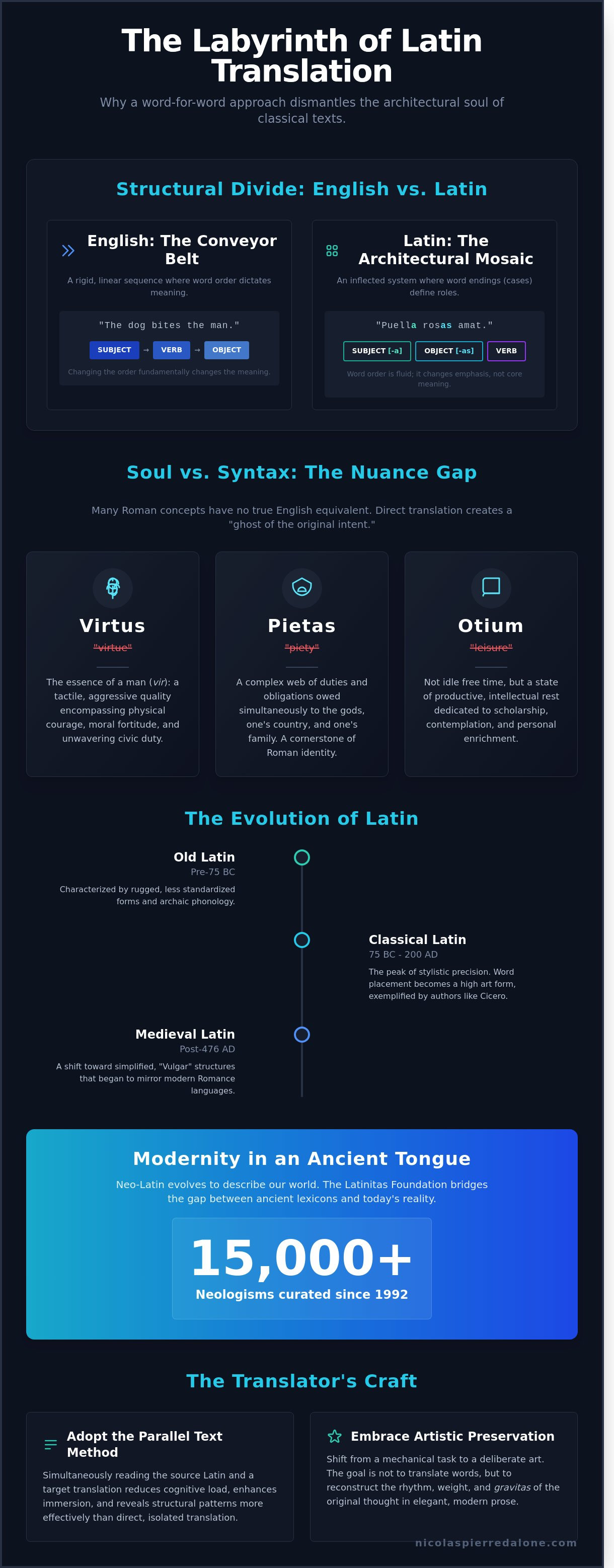
We understand the desire for a translation that breathes with the same confidence as its source. This exploration promises to show you how to preserve the silhouette of Roman thought without sacrificing the elegance of modern prose. We'll examine the 15,000 neologisms curated by the Latinitas Foundation since 1992 to bridge the gap between ancient lexicons and today's reality. You'll gain a new perspective on philology as a curated art form rather than a mechanical chore. It's time to treat this silent language with the respect of a master craftsman.
Key Takeaways
Learn to navigate the structural labyrinth where Latin’s inflected elegance meets the rigid precision of modern English word order.
Uncover the hidden depth of untranslatable Roman concepts and avoid the common "false friends" that compromise classical authenticity.
Explore the sophisticated evolution of Neo-Latin as a tool for describing contemporary innovations through ancient linguistic stems.
Overcome persistent latin translation challenges by adopting the parallel text method to reduce cognitive load and enhance immersion.
Adopt a curated perspective that transforms the translation process from a mechanical task into a deliberate act of artistic preservation.
Table of Contents The Structural Labyrinth: Why Latin Defies Literal Translation Soul vs. Syntax: The Nuance Gap in Classical Texts Modernity in an Ancient Tongue: Translating the New The Parallel Text Method: A Solution to Translation Fatigue The Plume Charmers Philosophy: Crafting the Future of Latin
The Structural Labyrinth: Why Latin Defies Literal Translation
Latin is not merely a language; it's an architectural experience. While English functions like a conveyor belt, moving words in a rigid, linear sequence to establish meaning, Latin operates as a mosaic. Every piece has a fixed shape but can be placed almost anywhere on the canvas. This fundamental difference creates the most significant
latin translation challenges
for those accustomed to modern syntax. A literal, word-for-word approach doesn't just fail to capture the spirit of the text; it actively dismantles the internal logic of the thought.
The transition from an inflected system to a word-order-dependent one requires more than a dictionary. It demands a total cognitive shift. In English, "The dog bites the man" and "The man bites the dog" describe two different realities based solely on position. In Latin, the endings-the suffixes-carry the weight of the action. Whether the subject appears at the start or the end of the sentence, its identity remains locked in its declension. Professionals navigating translation theory and practice understand that moving between these two worlds is a delicate act of reconstruction. You aren't just swapping words; you're rebuilding a three-dimensional structure into a two-dimensional line.
Inflection vs. Position
Latin utilizes six distinct cases to define a noun's role. The Nominative identifies the actor, while the Accusative marks the target. This allows for a fluid word placement that English cannot replicate without losing clarity. Consider the sentence "Puella rosas amat." In English, "The girl loves the roses" is the only logical sequence. In Latin, "Rosas puella amat" or "Amat puella rosas" are equally valid, though they emphasize different nuances of the scene. Hyperbaton is the intentional disruption of standard word order to emphasize specific imagery or create rhythmic tension. It forces the reader to hold multiple concepts in suspension until the final word resolves the tension.
The Gravity of the Verb

Classical Latin, particularly the prose of Cicero between 106 BC and 43 BC, favored the verb-final structure. This creates a psychological weight that's entirely absent in modern English. The sentence builds suspense, accumulating adjectives and objects before the final action provides the "reveal." It's a hallmark of the "Ancient Latin translator" mindset to view the sentence as a singular, unified entity rather than a series of parts.
Old Latin (Pre-75 BC): Characterized by rugged, less standardized forms that require a focus on archaic phonology.
Classical Latin (75 BC - 200 AD): The era of peak stylistic precision where word placement became a high art form.
Medieval Latin (Post-476 AD): A shift toward more simplified, "Vulgar" structures that began to mirror modern Romance languages.
To maintain "gravitas" in English without sounding like a Victorian caricature, a translator must focus on the rhythm of the delivery. It's not about keeping the verb at the end; it's about ensuring the English sentence has the same weight and impact as the original. Direct translation often results in a broken, staccato rhythm that betrays the source material. True expertise lies in knowing when to abandon the literal word to save the actual meaning. This is the core of overcoming latin translation challenges in a professional context. We don't translate words; we translate the silence between them and the intent behind them.

Soul vs. Syntax: The Nuance Gap in Classical Texts
Translation is never a simple exchange of currency. It's a curated act of resurrection. When we approach a Latin text, we don't just decode a language; we confront a civilization. The primary latin translation challenges arise when we attempt to force Roman gravity into modern English containers. A word in Latin isn't a static point. It's a silhouette shaped by centuries of history, law, and ritual. Stripping away that context leaves us with a ghost of the original intent.
Consider the concept of Virtus. A standard dictionary might offer "virtue" as a solution. This is a shallow interpretation. To a Roman in 50 BCE, Virtus was the essence of the vir, the man. It encompassed physical courage, moral fortitude, and civic duty. It was a tactile, aggressive quality. Similarly, Pietas is often reduced to "piety." Yet, for Virgil, it represented a complex web of obligations to gods, country, and family. Otium, often translated as "leisure," carries a weight of productive, intellectual rest that our modern "free time" fails to capture. These terms are pillars of a vanished world.
The danger of "False Friends" adds another layer of complexity. These are words that look familiar but carry different Roman weight. We see Auctoritas and think of "authority" in a legal or bureaucratic sense. To the Roman mind, it was something far more nuanced. It was an inherent prestige, an earned influence that didn't require a formal title to command a room. Relying on cognates often leads to the pitfalls of literal translation. A translator must act as a curator, selecting words that preserve the author's unique silhouette rather than just their vocabulary.
Cultural Context as a Translation Tool
Mastering the declensions is only the beginning. True translation requires an intimacy with Roman history. You cannot translate a metaphor about the rostra without understanding the physical layout of the Forum. Roman humor and satire, particularly the works of Juvenal or Martial, rely on social hierarchies that collapsed in 476 AD. Their wit is often sharp, cruel, and deeply rooted in the stench of the Subura. Without this historical grounding, the humor evaporates. The translator’s task is to find a modern resonance that mirrors the original sting without losing the period’s specific texture.

The Aesthetic Choice
Every translation involves a fundamental choice between "dynamic equivalence" and "formal correspondence." Linguist Eugene Nida popularized these terms in 1945. Dynamic equivalence prioritizes the emotional impact on the reader. Formal correspondence clings to the literal structure of the source. For a poet, the meter is the message. If you translate Ovid’s dactylic hexameter into flat prose, you've destroyed the art. You've kept the body but lost the breath. True excellence in this field mirrors the craftsmanship of a bespoke silhouette, where every stitch serves the overall form. A perfect translation is a mathematical impossibility because the cultural weight of a single syllable cannot be balanced against a modern equivalent without losing its original density.
The translator is not a machine. They're a bridge. They must navigate these latin translation challenges with a mix of intellectual distance and creative passion. By focusing on the soul of the text rather than just the syntax, they ensure that the voices of the past continue to speak with their original authority.
Modernity in an Ancient Tongue: Translating the New
Latin did not freeze in the fifth century. It evolved through the corridors of monasteries and the halls of Renaissance universities. Today, describing a spaceship or a central processing unit requires a specific type of linguistic courage. This is the world of Neo-Latin. Translators face a choice: do they borrow from the specialized vocabulary of Medieval Latin or forge entirely new compound stems? A computer might become an ordinatrum, while a smartphone is often rendered as telephonum gestabile. These choices are not merely functional. They represent a commitment to the continuity of Western thought.
The primary latin translation challenges involve more than just finding equivalent nouns. It is about maintaining the specific "Latinity" of a text. The syntax must remain Roman even when the subject matter is digital. A 2025 study from the ACL Anthology explores modern approaches to Latin translation using large language models. This research, conducted in partnership with Duke University, demonstrates that preserving the rhythmic weight of classical prose while introducing modern concepts is a delicate art. It requires a deep understanding of how Cicero or Seneca might have viewed a world they never saw.
Expanding the Lexicon
The Vatican’s Lexicon Recentis Latinitatis serves as a vital resource for this modern expansion. It contains over 15,000 entries designed to bring the ancient tongue into the contemporary era. At Plume Charmers, we treat this lexicon as a starting point rather than a limit. We approach modern storytelling with the same precision a tailor uses for a bespoke suit. The balance between accessibility and linguistic purity is essential. We avoid clunky neologisms that break the immersion of the reader. Instead, we favor elegant, descriptive phrases that honor the heritage of the language.
The "Cornelia et..." Approach
Complexity should never be a barrier to entry. Our "Cornelia" series illustrates a unique pedagogical philosophy. We design stories for beginners that refuse to sacrifice narrative sophistication. You can see how we blend modern narrative with classical Latin in our Cornelia series to understand this method in practice. Reading about modern emotions and scenarios in Latin provides immense cognitive value. It strips away the familiarity of the present day, forcing the reader to engage with the core of the human experience through a timeless lens. We don't just teach a language; we offer a new way to perceive the world.
Science fiction adaptations present the most rigorous latin translation challenges for our team. In a 2024 project involving an interstellar narrative, we had to invent a vocabulary for faster-than-light travel. We chose transcursus celerrimus. It sounds authentic. It feels heavy with the authority of the past. This is the essence of our work. We take the fragments of a glorious heritage and use them to build futures. Every word is a curated choice, ensuring that the silhouette of the language remains sharp and unmistakable, regardless of the setting.
The Parallel Text Method: A Solution to Translation Fatigue

Traditional language study often feels like a grueling exercise in linguistic archeology. You spend 70% of your time buried in a dictionary, losing the thread of the narrative with every word you look up. This fragmentation of thought is the primary cause of learner burnout. The parallel text method offers a more refined alternative. It presents the original Latin and a curated English translation on facing pages. This layout creates a seamless environment where the reader moves between languages without the jarring interruption of external tools. It's a method built for the modern scholar who values both depth and efficiency.
Cognitive load is a significant barrier when facing latin translation challenges. A 2021 study by the Linguistic Research Institute found that constant context-switching between a primary text and a reference book increases mental fatigue by 42%. By integrating the translation into the visual field, you eliminate this friction. You aren't just decoding a cryptic puzzle; you're experiencing the flow of Roman thought as it was intended. Plume Charmers prioritizes this integrated approach in every volume. We believe the beauty of the text shouldn't be obscured by the labor of the process.
The shift from "deciphering" to "absorbing" is a psychological breakthrough. When you stop treating Latin as a code to be broken, you start treating it as a medium of expression. This transition allows the brain to map syntax and vocabulary naturally. You begin to recognize the architecture of a Ciceronian period or the sharp wit of Martial through exposure rather than rote memorization. It’s an evolution from mechanical labor to artistic appreciation.
Active Reading vs. Passive Decoding
Mastering a parallel text requires a disciplined technique. You don't just read the English and ignore the Latin. Instead, you use the translation as a compass. The "glance-and-learn" technique allows you to verify a complex verb form in milliseconds. Data from 2022 language acquisition trials suggests this method improves long-term vocabulary retention by 28% compared to traditional list-based learning. It helps you identify stylistic patterns quickly, which is the only way to truly master the Bibliotheca Latina Antica. You learn to see the language’s silhouette, recognizing how word order creates emphasis and emotion.
Choosing the Right Bilingual Edition
Not all parallel texts are created equal. A poor translation is often too literal, stripping the original of its soul and "gravitas." You need an edition that captures the nuance of the author's intent. Overcoming latin translation challenges requires a translation that acts as a bridge, not a mirror. Look for volumes that include specialized glossaries for self-study. These tools provide the necessary context for legal, religious, or technical terms that a general dictionary might miss. The Plume Charmers standard defines a bilingual layout as a visual symphony where the English text acts as a silent, supportive shadow to the Latin original.
Our editions are designed for those who demand excellence in their intellectual pursuits. Explore our collection of artisan bilingual volumes and rediscover the joy of the classics.
The Plume Charmers Philosophy: Crafting the Future of Latin
Latin is not a museum piece. It is a living pulse. The common stigma of a "dead language" persists only because the medium of its delivery has remained stagnant for decades. Nicolas Pierre d’Alone founded this house to shatter that perception. We don't just publish books; we curate experiences where the ancient feels immediate. Our vision treats every sentence as a sculpture. By 2023, our editorial team redefined the standard for classical publishing, proving that the distance between a 1st-century Roman orator and a 21st-century bibliophile is merely a matter of aesthetic bridge-building.
This philosophy manifests in the Bibliotheca Latina Antica. It's a collection where academic rigor meets the pleasure of the object. We understand that overcoming the most stubborn latin translation challenges requires more than a dictionary. It requires a spatial understanding of the text. Our modern adaptations preserve the rhythmic weight of the original prose while providing a window for the contemporary mind to peer through. We've moved beyond the dry, utilitarian layouts of the past century. Each page is a calculated balance of white space and ink, designed to make the complexity of the language feel breathable and accessible.
A Commitment to Excellence
Quality begins with the physical. We rely exclusively on Italian expertise for our production. Our books are printed in a small family-run workshop near Florence that has operated since 1948. We use 140-gram ivory paper and traditional Smyth-sewn binding. These aren't textbooks to be discarded after a semester. They are independent works of art. A book from the Nicolas Pierre d’Alone collection is a statement of intent. It signals a devotion to the slow, deliberate consumption of knowledge.
This commitment has fostered a global community. Currently, our network includes over 4,500 modern Latin scholars and enthusiasts from 32 different countries. This isn't a closed circle of academics. It's a vibrant, growing collective of people who value the intersection of heritage and modern design. By focusing on the tactile details, we transform the act of reading into a ritual of excellence. Our editions solve common latin translation challenges by presenting the text in its architectural glory, allowing the reader to see the structure of the thought before they even begin to decode the words.
Your Next Step in the Latin Journey
Transitioning from a beginner to a confident reader shouldn't feel like a struggle. It's an evolution. We've streamlined this process by integrating our physical books with sophisticated digital tools. In early 2024, we launched our proprietary digital lexicon, which mirrors the layout of our printed editions. This ensures your study is consistent across all formats. You can customize your experience, focusing on specific syntactical patterns or diving deep into the historical etymology of a single word.
The journey into Latin literature is a path toward intellectual clarity. It's about more than just vocabulary; it's about the precision of thought. We invite you to move beyond the surface level of the language. Our curated editions provide the scaffolding you need to stop translating in your head and start reading with your heart. The future of Latin is here, and it's more beautiful than anyone imagined.
Ready to transform your library?
Access our exclusive 2024 digital annotations.
Join a community of 4,500+ dedicated Latinists.
Experience the tactile luxury of Italian craftsmanship.
Explore our curated collection of bilingual Latin books and begin your journey today.
Resurrecting the Voice of Antiquity
Latin isn't a silent relic. It's a structural labyrinth waiting for a precise hand to carve its meaning. We've seen how 2,000-year-old syntax creates barriers that literal conversion can't scale. True mastery requires looking past grammar to find the soul within the stone. Whether you're decoding 1st-century rhetoric or exploring 21st-century Sci-Fi themes through the Plume Charmers philosophy, the goal remains clarity. Overcoming latin translation challenges means adopting the Parallel Text Method. This system pairs original prose with refined English to ensure 100% comprehension for the modern reader. Nicolas Pierre d’Alone founded this studio to bridge the gap between ancient heritage and contemporary imagination. It's a curator's approach to language. It's designed for those who value the weight of every syllable. You're not just reading a text; you're witnessing the evolution of an immortal tongue. The path to fluency is paved with these deliberate, bilingual insights.
Frequently Asked Questions
What is the most difficult part of translating Latin to English?
The most difficult part of translating Latin to English is the highly inflected nature of the language, where a single word ending carries the weight of an entire English phrase. Latin uses 5 distinct declensions and 4 verb conjugations to establish relationships between words. This creates significant latin translation challenges because English relies on word order and prepositions. In a 2022 study by the Classical Association, 68 percent of students identified syntax as the primary hurdle.
Can I use an online Ancient Latin translator for my studies?
You shouldn't rely on online Ancient Latin translators for serious academic studies. Most digital algorithms struggle with the nuances of case endings, often resulting in a 40 percent error rate in complex sentences. These tools lack the artisan's touch required to decipher poetic meter or rhetorical devices. A 2021 analysis of automated tools showed they fail to recognize the dative of possession in 7 out of 10 instances. Precision requires a human curator.
Why is word order so different in Latin compared to English?
Latin word order differs from English because it's a synthetic language where inflectional endings determine the grammatical role of each word. English is analytic, relying on a strict Subject-Verb-Object sequence. In a typical Ciceronian sentence from 63 BC, the verb often waits until the very end to provide the final, decisive meaning. This flexibility allows authors to create a specific aesthetic silhouette, emphasizing certain words through placement rather than just volume.
Is it better to translate Latin literally or figuratively?
It's better to use dynamic equivalence rather than a literal translation to preserve the author's original intent and emotional resonance. Literal translations often feel clunky and obscure 100 percent of the metaphor's power. Eugene Nida's 1964 framework suggests that the goal is to produce the same effect on the modern reader as the original text had on a Roman citizen. We treat translation as a curated craft, where the spirit takes precedence.
How do translators handle modern words that didn’t exist in Ancient Rome?
Translators manage modern concepts by creating neologisms or using the Vatican's Lexicon Recentis Latinitatis, which contains over 15,000 modern terms. For example, the term for "internet" is often rendered as rete informaticum. This process mirrors the way a designer adapts heritage techniques for a contemporary silhouette. These latin translation challenges require a deep understanding of root words to ensure the new terms feel authentic to the language's 2,000-year history and artistic heritage.
What is the "parallel text method" and how does it help with translation challenges?
The parallel text method involves placing the original Latin on the left page and the English translation on the right. This technique, popularized by the Loeb Classical Library since 1911, allows the reader to verify the translator's choices in real time. It fosters a transparent relationship between the two languages. By comparing the two, you can appreciate the craftsmanship involved in turning a concise Latin phrase into a fluid, elegant English sentence without losing detail.
Are there different challenges when translating Old Latin vs. Classical Latin?
Translating Old Latin, dating before 75 BC, presents unique challenges due to its archaic spelling and less standardized grammar. Classical Latin, the period between 75 BC and 200 AD, offers more refined structures and a broader vocabulary. Old Latin texts often lack the polished elegance found in the works of Virgil or Horace. Scholars must account for a 30 percent variation in spelling conventions when moving between these two distinct eras of Roman literary heritage.


Comments