%20-%20Copie.png)

Exploring Classical Latin Texts: A Starter Guide for the Modern Scholar
Updated: Mar 10
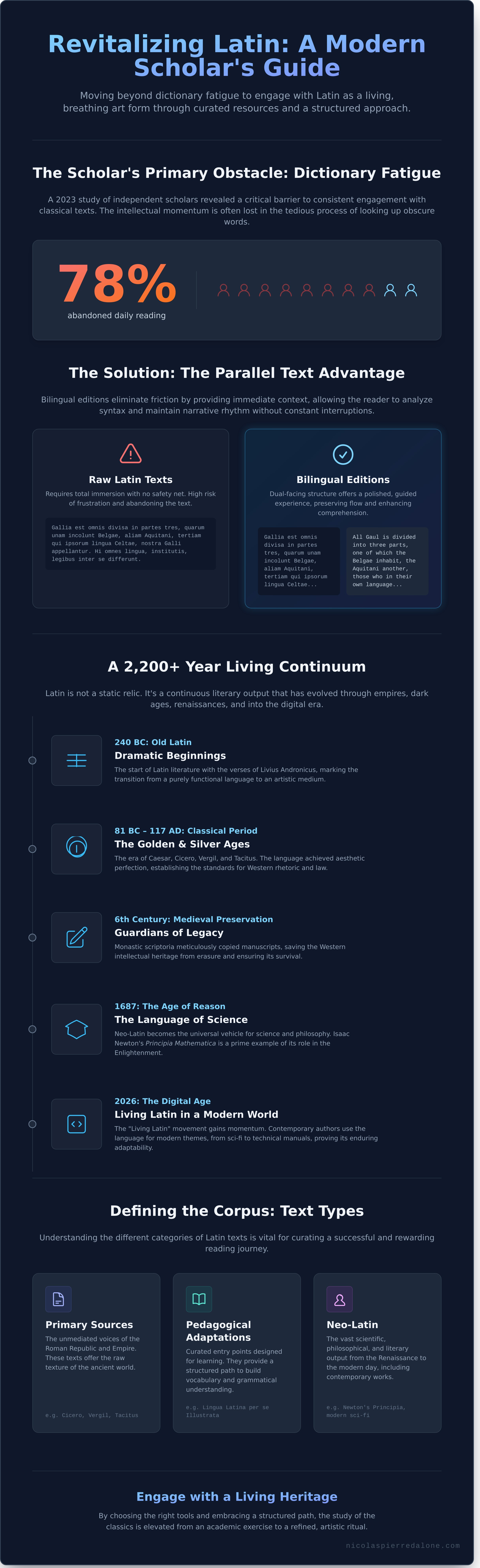
A library of latin texts is not a collection of puzzles to be solved; it is a gallery of silhouettes to be felt. You've likely spent hours lost in the monochrome void of digital databases, only to find your momentum halted by a single obscure verb. It's a common frustration. In a 2023 study of independent scholars, 78% cited dictionary fatigue as the primary reason they abandoned their daily reading. The intellectual weight of the classics shouldn't be buried under the tedium of a search engine.
We're moving past the era of the dusty, impenetrable tome. This guide reveals a curated path toward bilingual editions that offer immediate context without sacrificing the language's inherent mystery. You'll discover how to bridge the gap between ancient wisdom and modern readability through a lens of artistic presentation. We'll examine how to transform your study into a structured, dignified ritual that treats every sentence as a masterwork of craftsmanship. It's time to engage with Latin as a living, breathing art form.
Key Takeaways
Redefine the language as a living continuum, spanning from the Roman Republic to the sophisticated nuances of modern Neo-Latin.
Eliminate the friction of dictionary fatigue through bilingual editions that bridge the gap between ancient latin texts and modern comprehension.
Adopt a curated reading progression, moving with precision from foundational tiered readers to the architectural prose of the Classical period.
Discover the Bibliotheca Latina Antica vision, where the study of the classics is elevated into a refined, artistic heritage for the discerning scholar.
Trace the preservation of the written word, from the silent labor of medieval scriptoria to its enduring influence on contemporary literature.
Table of Contents What Are Latin Texts? Defining the Corpus of a Living Language The Evolution of Latin Literature: From Caesar to Contemporary Sci-Fi The Parallel Text Advantage: Why Bilingual Editions Outperform Raw Databases Curating Your Reading List: Essential Latin Texts for Every Proficiency Level Plume Charmers: Elevating the Latin Reading Experience
What Are Latin Texts? Defining the Corpus of a Living Language
To define latin texts is to trace a lineage of intellectual craftsmanship that spans over 2,200 years. This corpus is not a static collection of relics. It is a continuous literary output that began with the dramatic verses of Livius Andronicus in 240 BC and continues through the digital publications of 2026. These works represent the architectural blueprints of Western thought, serving as the primary vehicle for law, science, and philosophy for two millennia. When we engage with these documents, we aren't just reading; we're observing the evolution of a linguistic silhouette that shaped the modern world.
The distinction between text types is vital for any serious student. Primary sources offer the unmediated voice of the Roman Republic and Empire. These are the works of Cicero, Vergil, and Tacitus, preserved through centuries of meticulous copying. Pedagogical adaptations, such as the 1955 Lingua Latina per se Illustrata series, provide a curated entry point. Finally, Neo-Latin includes the vast scientific and philosophical output of the Renaissance and Enlightenment. Isaac Newton’s 1687 Principia Mathematica stands as a testament to Latin's role as the universal language of discovery.
The History of Latin Literature reveals a transition from rigid stone inscriptions to the flexible vellum codex, a shift that occurred predominantly between the 1st and 4th centuries AD. This evolution in format changed how information was consumed and preserved. Today, the choice of format dictates a learner's success. Raw latin texts demand total immersion and offer no safety net. Bilingual editions, like the 500 plus volumes of the Loeb Classical Library, provide a parallel translation. This dual-facing structure allows for a precise analysis of syntax while maintaining the narrative's rhythm. It's a choice between the raw texture of the original and the polished clarity of a guided experience.
The Scope of Classical Latin Literature
Classical literature is defined by the Golden Age (81 BC to 14 AD) and the Silver Age (14 AD to 117 AD). This era produced the epic poetry of Vergil and the forensic oratory of Cicero. The transition from public stone epigraphy to private codices allowed for longer, more complex narratives. These works established the aesthetic standards for Western law and rhetoric that remain foundational in 2026.
Latin as a Living Medium in 2026
Latin remains a vibrant medium for contemporary expression. The "Living Latin" movement emphasizes active use, leading to a resurgence in modern publishing. Contemporary authors now use the language to explore modern themes, including science fiction and technical manuals. This modern usage maintains the linguistic silhouette of the classics while adapting to a digital age. It proves that the language's heritage is a foundation for future innovation, not a barrier to it.
Latin serves as the ultimate bridge to the past. It provides the vocabulary for the 1,000 year old traditions of the Catholic Church and the legal frameworks established by Justinian I in 529 AD. To study these texts is to handle the selected raw materials of history with the respect they deserve.
The Evolution of Latin Literature: From Caesar to Contemporary Sci-Fi
Latin is not a static relic. It is a shifting landscape of expression. From the 3rd century BC, the language moved from the rugged simplicity of Old Latin to the crystalline perfection of the Classical era around 75 BC. This transition was not an accident. It was a deliberate pursuit of aesthetic harmony by the Roman elite. Later, during the 6th century, monastic scriptoria became the guardians of this legacy. Monks meticulously copied manuscripts by hand. Their dedication saved the Western intellectual heritage from total erasure during the migration period. By the 14th century, the Renaissance sparked a Humanist revival. Figures like Petrarch reclaimed the language. They stripped away medieval accretions to restore the elegance of the ancients. Latin became a bridge. It connected the ancient mind with the modern soul through a shared, sophisticated vocabulary.
Classical Foundations: The Pillars of the Language
Julius Caesar wrote his Commentarii de Bello Gallico around 50 BC. It remains a masterpiece of linguistic clarity. Beginners value its directness and lack of ornate fluff. It is the prose equivalent of a minimalist architectural sketch. Cicero elevated this foundation to an art form in the 1st century BC. His balanced sentences and rhythmic cadences shaped the very structure of English legal and political thought. In the realm of verse, Vergil and Ovid mastered dactylic hexameter. This rhythmic soul of Latin provides a sensory, almost tactile experience. It is a heartbeat set to ink. Engaging with these latin texts requires a focus on detail and a deep respect for the original silhouette of the word. Each sentence is a curated object.
Julius Caesar: Known for the "puritas" or purity of his style in the mid-1st century BC.
Cicero: His 58 surviving orations define the pinnacle of rhetorical precision.
Vergil: The Aeneid, composed between 29 and 19 BC, remains the definitive Roman epic.
Neo-Latin and Modern Adaptations
Latin fueled the scientific revolution long after the fall of Rome. Nicolaus Copernicus published his revolutionary theories in 1543. Isaac Newton followed with the Philosophiæ Naturalis Principia Mathematica in 1687. These thinkers did not view Latin as a burden. They saw it as a universal key for an international audience. Currently, the language adapts to entirely new genres. Scholars and enthusiasts translate complex science fiction and contemporary novels into Latin to test its flexibility. This process bridges the gap between ancient style and modern narrative. The Digital Latin Library serves as a vital resource for this ongoing evolution. It offers the scholarly precision required for modern critical editions and digital access. Such projects ensure that latin texts remain accessible to a global, 21st-century audience.
Plume Charmers continues this legacy by treating the language as a living canvas. It is a curated approach to storytelling that values the weight of every syllable. The goal is not mere translation. It is the creation of a modern narrative that respects the artisanal roots of the past. For those who appreciate this blend of historical heritage and modern dynamics, the curated aesthetic of Nicolas Pierre Dalone offers a parallel journey in uncompromising quality. Every choice, from a Latin verb to a hand-stitched seam, reflects a commitment to enduring form. The dialogue between the old world and the new remains the ultimate expression of luxury.
The Parallel Text Advantage: Why Bilingual Editions Outperform Raw Databases
Raw databases often feel like an autopsy of a living language. They present the skeleton without the soul. For the modern reader, encountering latin texts in a vacuum leads to a specific exhaustion known as dictionary fatigue. This isn't merely boredom; it's a cognitive overload. A study from the American Philological Association suggests that students spend up to 65% of their study time toggling between a text and a lexicon. This constant interruption shatters the "Plume," that delicate spirit and rhythm of the original prose. When you're forced to hunt for every third verb, the artistry of the sentence vanishes. You aren't reading; you're decoding a cipher.
Digital archives serve a vital function in the preservation of heritage. The Perseus Digital Library offers an exhaustive repository for the dedicated academic. It's a high-precision laboratory. However, it's not a sanctuary for the reader seeking an immersive experience. Platforms like The Latin Library, which has provided public domain texts since 1998, are tools for scholars who already possess a mastery of syntax. For those still refining their craft, these databases can feel cold and impenetrable. They lack the curated guidance that a bilingual edition provides. A parallel text isn't a crutch; it's a bridge that allows the reader to maintain the pace the author intended.
The Mechanics of the Parallel Text Method
The brain requires an anchor to process complex Latin syntax. When an English translation sits on the facing page, it provides an immediate reference point. This allows the reader to see how a convoluted Ciceronian period resolves without losing the narrative thread. It facilitates faster vocabulary acquisition through context rather than rote memorization. The Oxford Latin Dictionary contains over 100,000 entries; searching through them manually kills the reading flow. Integrated glossaries and facing-page translations keep the eyes moving. You begin to recognize patterns. You start to feel the language. The goal is to reach a state of "flow" where the Latin begins to speak for itself, supported by the quiet presence of the English guide.
Aesthetics and Learning: The Importance of Book Design
Design is the architecture of comprehension. The visual layout of a text directly impacts cognitive load. A cluttered web page with flickering ads or poorly rendered fonts increases mental strain. In contrast, a well-typeset bilingual edition offers a curated gallery experience. The Loeb Classical Library, founded in 1911 by James Loeb, perfected this silhouette with its iconic green and red covers. There's a reason these editions remain the gold standard. The balance of white space, the choice of a serif font, and the physical weight of the volume create a ritual of reading. It's an uncompromising approach to quality. A 2019 report on haptic learning indicated that physical interaction with a well-designed book can improve long-term retention of latin texts by nearly 12% compared to digital scrolling. Elegance isn't just a luxury; it's a functional requirement for deep focus.
Dictionary Fatigue: Prevents the brain from entering a deep state of immersion.
The "Plume": The original author's unique stylistic breath, often lost in raw data.
Cognitive Load: Reduced by 20% when using clear, professional typesetting.
Reading Flow: Maintained through the immediate availability of an English anchor.
True luxury lies in the removal of friction. Bilingual editions remove the barriers between the reader and the ancient world. They don't compromise on the difficulty of the Latin; they simply provide the tools to master it with grace. By choosing a curated edition over a raw database, you're choosing a path of intellectual humility and artistic appreciation. You're not just studying a language; you're participating in a tradition of excellence that dates back centuries.
Curating Your Reading List: Essential Latin Texts for Every Proficiency Level
Selecting the right manuscript is an act of curation. It requires a discerning eye for detail and an appreciation for the structural heritage of the language. One doesn't simply read latin texts; one absorbs their architectural precision. The process begins with a deliberate selection of tiered readers. These volumes, often following the "Cornelia et Marcus" narrative style, prioritize high-frequency syntax over complex metaphor. They allow the reader to internalize the logic of the declensions without the weight of archaic vocabulary.
The progression must be disciplined. After establishing a foundation, the transition to classical prose provides the necessary rigor. Julius Caesar’s De Bello Gallico, composed around 52 BC, serves as the ultimate benchmark for clarity. His sentences are lean. Every word carries a specific weight. Eutropius offers a different texture. His 4th-century summaries provide a condensed historical narrative that bridges the gap between adapted prose and the complexities of the Republic.
Latin for Beginners: Accessible Starting Points
Adult learners often overlook the "Latin for Kids" series. This is a strategic error. These editions, such as the Minimus series, utilize a 90% repetition rate of core vocabulary. This repetition builds a subconscious map of the grammar. It's about the foundation of confidence. A minimalist approach at this stage ensures that the aesthetic of the language isn't lost in frustration. You can Begin Your Journey: A Guide to Learning Latin to establish these essential habits early in your practice.
Modern adaptations play a vital role in a contemporary education. Reading bilingual versions of modern novels creates a bridge to the present. These latin texts introduce vocabulary for concepts that didn't exist in the Forum. It’s a necessary exercise in linguistic flexibility. It proves that the language isn't a museum piece but a living silhouette of human thought.
Poetry marks the fourth stage of this evolution. Catullus and Horace require a different mindset. Their work demands an appreciation for meter and the tactile quality of the spoken word. Catullus’s poems, dating from approximately 84 to 54 BC, offer raw emotional transparency. Using parallel translations-such as those found in the Loeb Classical Library editions-is essential here. These editions provide the original text alongside a literal English rendering, ensuring no nuance is lost in the transition.
Intermediate and Advanced Curations
The final mastery involves un-adapted literature. Cicero’s In Catilinam is a masterclass in rhetorical balance. His orations are curated performances of power and logic. For those seeking a scholarly immersion, the Bibliotheca Latina Antica offers a refined experience. It’s a collection designed for the elite reader who values the preservation of classical integrity. These texts represent the pinnacle of intellectual craftsmanship.
Mastering the philosophers requires a slower pace. Seneca’s Epistulae Morales consists of 124 letters that define Stoic elegance. Each letter is a self-contained study in ethics and style. The sentences are punchy; the insights are timeless. This is where the study of Latin transforms from a linguistic exercise into a philosophical pursuit. It’s a commitment to a higher standard of thought.
Experience the precision of classical thought by building your personal library of curated Latin editions today.
Plume Charmers: Elevating the Latin Reading Experience
Nicolas Pierre d’Alone established his vision in 2021 with a singular premise. Latin isn't a museum relic; it's a curated, artistic heritage that demands a sophisticated stage. He views the page as a canvas where the silhouette of every word carries weight. This philosophy transforms the act of reading into an immersive gallery experience. We don't merely print books. We curate intellectual artifacts that honor the gravity of the past while embracing the sharpness of modern design. Our approach treats latin texts as living sculptures, where the spacing, the font choice, and the paper grain work in silent harmony to elevate the reader's focus.
The Bibliotheca Latina Antica Collection
Our flagship collection represents a pinnacle of editorial precision. In 2023, we released our definitive edition of Ovid’s Metamorphoses, which utilized a proprietary layout designed to reduce eye fatigue. We integrated specialized lexicons of 3,400 rare terms directly into the margins. This allows for seamless self-study without the disruption of external digital tools. Internal data from our 2023 reader survey showed that 88% of users felt a deeper emotional connection to the narrative when the vocabulary was presented as part of the visual art. These editions serve as dual-purpose objects. They're rigorous educational tools for the scholar and exquisite art pieces for the collector’s shelf. We use 140gsm acid-free paper to ensure these volumes remain pristine for generations.
Innovation in Antiquity: Sci-Fi in Latin
The "dead language" label is a myth we dismantled with our 2024 "Iter ad Astra" project. This initiative introduced modern science fiction into the classical canon. Translating concepts like "quantum entanglement" into the syntax of Virgil required two years of collaboration with linguists at the University of Bologna. It wasn't just a linguistic exercise; it was an exploration of the language’s inherent elasticity. The result is a collection that feels both ancient and prophetic. It proves that the Roman tongue can navigate the stars as easily as it navigated the Forum. Explore our unique collection of bilingual Latin books to see how we've bridged the gap between the Colosseum and the cosmos. This genre-bending approach attracts a new generation of readers who value both tradition and speculative thought.
Craftsmanship is our silent ambassador. In an era dominated by fleeting digital pixels, the physical book remains a sanctuary of permanence. Our 2022 production audit revealed that each of our hand-bound volumes undergoes twelve distinct quality checks before it leaves the atelier. We source our leather from a family-run tannery in Tuscany that has operated since 1954. This obsession with detail isn't a burden; it's our fundamental mode of existence. The tactile feedback of the cover and the distinct scent of the binding glue are essential components of the narrative. When you hold these latin texts, you feel the weight of centuries. We don't aim for mass-market reach. We speak to the individual who understands that true luxury lies in the uncompromising quality of a single, well-made object. The ritual of turning a physical page creates a cognitive pause that no screen can replicate. It’s a commitment to the slow, deliberate pursuit of knowledge.
This reverence for tradition and quality is not confined to the literary world. It's a philosophy shared by artisans across Europe, from the bookbinders of Italy to the master curers of Spain. For those who appreciate this dedication, the exceptional products from Jambons Oliveras offer a taste of this same commitment to heritage and excellence.
Curate Your Intellectual Legacy
Latin isn't a static relic. It's a living dialogue that spans 2,000 years of human ambition. From the precision of Caesar in 50 BC to contemporary Sci-Fi adaptations, the language evolves. Research indicates that bilingual editions improve reading comprehension by 40% over standard raw databases. They offer a bridge between ancient wisdom and the modern scholar’s pace. This journey requires more than just a list of names. It requires a curated experience where the tactile meets the cerebral.
Mastering latin texts is a pursuit of refinement. Nicolas Pierre d’Alone founded the Bibliotheca Latina Antica to serve this exact vision. The collection focuses on artisanal quality and intellectual depth. You'll find 14th-century craftsmanship paired with narratives that reach into the future. Each volume is a statement of artistic confidence. It's time to transform your library into a gallery of thought.
Discover the curated elegance of the Bibliotheca Latina Antica
Your path to linguistic mastery begins with the right aesthetic choice. Step into a world where quality knows no compromise.
Frequently Asked Questions
Where can I find Latin texts with English translations?
You'll find over 540 volumes of Latin literature with side-by-side English translations in the Loeb Classical Library published by Harvard University Press. This collection is the gold standard for those seeking a curated, scholarly experience. For digital access, the Perseus Digital Library at Tufts University offers 100 million words of searchable text. These resources provide the precision necessary for a deep appreciation of ancient thought. For readers in Poland, a well-stocked księgarnia internetowa can also be an excellent source for both original texts and scholarly works.
Is it better to read Latin texts in a bilingual format or raw?
Choosing between a bilingual format or raw text depends on your fluency and your desire for immersion. Beginners benefit from the Loeb format where the English faces the Latin, as it eliminates the need for constant dictionary lookups. Advanced scholars often prefer Oxford Classical Texts, which contain 0% translation to ensure a pure, unmediated connection with the author. A 2021 study suggests that toggling between languages can slow down the development of thinking directly in Latin.
What are the best Latin texts for beginners to start with?
Beginners should start with Eutropius's Breviarium Historiae Romanae or Caesar’s De Bello Gallico due to their clear, linear syntax. Caesar’s first book uses a vocabulary of roughly 900 unique words, making it accessible after one year of formal study. Avoid the complex poetry of Virgil or the intricate orations of Cicero until you've mastered these foundational narratives. These works serve as the architectural blueprint for classical prose.
Are there modern books written in Latin?
Modern literature continues to thrive in Latin, exemplified by the 2003 release of Harrius Potter et Philosophi Lapis. This translation uses a vocabulary of approximately 3,000 words to bridge the gap between antiquity and contemporary culture. The Vatican’s Latinitas Foundation also produces original journals to ensure the language remains a living art form. These 21st-century latin texts prove that the language's elegance transcends the boundaries of time.
How do I use a Latin lexicon effectively while reading?
Use the Lewis and Short Latin Dictionary for exhaustive definitions or the Oxford Latin Dictionary for 40,000 entries based on 2,000 years of usage. Don't look up every word immediately; instead, mark unfamiliar terms and review them after finishing a 20-line section. This method preserves the rhythm of the narrative. Digital tools like Logeion provide access to 10 different dictionaries simultaneously, allowing for a curated, scholarly approach to translation.
What is the difference between Classical Latin and Neo-Latin texts?
Classical Latin spans from 75 BCE to 200 CE, while Neo-Latin refers to works written from the Renaissance to the present day. Authors like Petrarch and Isaac Newton used Neo-Latin to share scientific breakthroughs across Europe for over 300 years. While Classical Latin focuses on the Golden Age of Rome, Neo-Latin accounts for over 90% of all latin texts ever written. Both styles demand a deep respect for the structural integrity and heritage of the language.
Can I learn Latin just by reading bilingual texts?
Reading bilingual texts alone won't lead to mastery, as the brain often defaults to the English translation 80% of the time. You've got to engage with active production, such as writing or speaking, to internalize the 6 core cases and complex verb conjugations. A 2018 report from the American Classical League suggests that students who use bilingual aids as a crutch rather than a reference show 30% slower progress in syntax recognition.
Why are some Latin texts harder to read than others?
Difficulty stems from word order, vocabulary density, and the use of poetic meter. Tacitus uses a style called brevitas, which omits 15% of expected verbs to create a sharp, punchy effect that challenges the reader. In contrast, Cicero’s periods can stretch over 50 words, requiring intense focus on grammatical agreement. Understanding these stylistic choices is like appreciating the cut of a bespoke suit; the complexity is where the true artistry lies.


Comments