%20-%20Copie.png)
Biblical Hebrew vs. Modern Hebrew: A Linguistic and Artistic Comparison
Updated: Apr 3
The study of Hebrew presents a foundational choice. A decision between the ancient cadence of scripture and the dynamic rhythm of a living nation. For the discerning student, the question of biblical hebrew vs modern hebrew is not a simple academic debate; it is an inquiry into heritage, purpose, and artistic identity. The fear of an archaic grammar or the confusion over conflicting advice can paralyze this essential first step, leaving a profound connection just out of reach.
This exploration is designed to illuminate the bridge between these two worlds. We will move beyond the surface-level discussion of mutual intelligibility to dissect their profound structural forms, their phonetic nuances, and the very soul that animates their expression. We will demystify the perceived complexities of the ancient text and honor the innovative craftsmanship that shaped the reborn tongue, revealing two distinct but related masterpieces.
Here, you will find a curated understanding. A framework to inform your own linguistic journey, whether toward the sacred echoes of the past or the vibrant pulse of the present. This article will equip you with the clarity needed to choose your path with intention and to appreciate the language in its full artistic evolution.
Key Takeaways
Grasp the fundamental architectural shift in Hebrew grammar, from the verb-led syntax of the Tanakh to the subject-driven structure of today.
Uncover the curated lexicon of the Prophets and understand how ancient words have acquired entirely new meanings in the modern era.
Discern the true degree of mutual intelligibility in the biblical hebrew vs modern hebrew dialogue, moving beyond simple vocabulary to its deeper linguistic nuances.
Adopt a new aesthetic philosophy for reading the Tanakh, approaching the sacred text not merely as scripture, but as a masterpiece of world literature.
Table of Contents Defining the 2000-Year Continuum: What is Hebrew? Grammar and Syntax: From Verb-First to Subject-First Vocabulary and Nuance: The Art of Meaning Strategic Learning: Can You Read the Bible with Modern Hebrew? The Bibliotheca Hebraica: Curating a Sacred Reading Experience
Defining the 2000-Year Continuum: What is Hebrew?
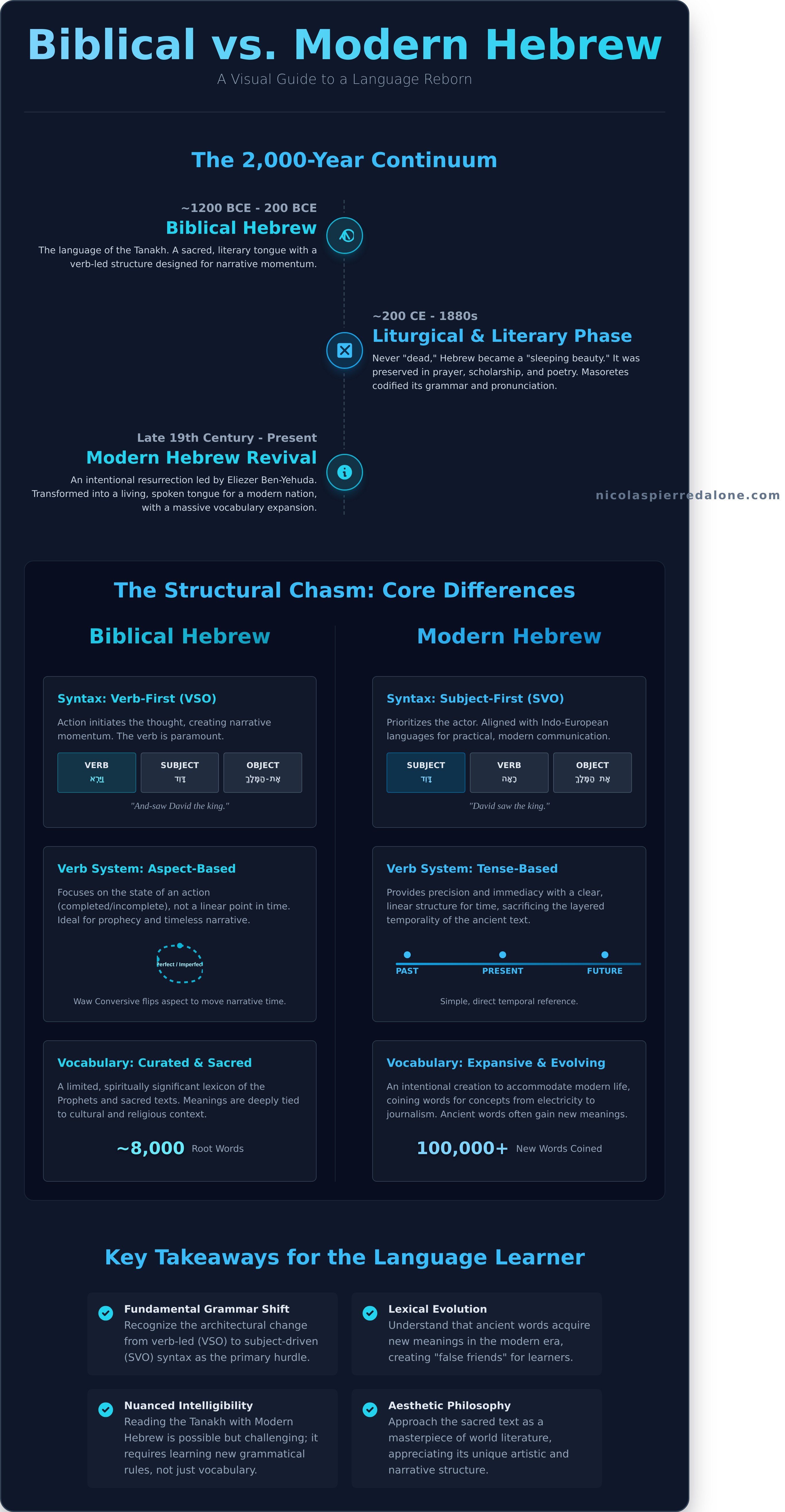
The story of the Hebrew language is a study in resilience. It is a rare, almost singular, case of linguistic revival-a journey from ancient scroll to the modern street. Understanding the distinction between Biblical Hebrew and Modern Hebrew requires appreciating this vast continuum. The former, also known as Classical Hebrew, is the language of the Tanakh, the sacred text composed between approximately 1200 BCE and 200 BCE. A comprehensive Biblical Hebrew overview reveals its ancient structure and spiritual weight. The latter is its vibrant descendant, an intentional resurrection engineered in the late 19th century. Between these two poles lie Mishnaic and Medieval Hebrew, the vital connective tissue that preserved the language’s core essence through millennia.
The Myth of "Dead" Languages
To label Biblical Hebrew "dead" is to misunderstand its legacy. It was never truly gone; it was dormant, a liturgical and literary "sleeping beauty." For centuries, it remained the language of prayer, rabbinic scholarship, and poetry. The meticulous work of the Masoretes in the Early Middle Ages preserved its ancient silhouette, codifying its pronunciation and grammar in the Masoretic Text. This act of linguistic craftsmanship ensured that the language, while not spoken in the marketplace, retained its profound artistic and cultural influence, waiting for its moment of reawakening.
Modern Hebrew: The Intentional Resurrection
The 1880s marked a deliberate turning point. Led by the visionary Eliezer Ben-Yehuda, a movement began to transform Hebrew back into a living, spoken tongue for a modern nation. This was not a simple restoration but a monumental act of creation. The core challenge in the biblical hebrew vs modern hebrew evolution was vocabulary. The revival necessitated the coining of over 100,000 new words for concepts unimaginable to ancient scribes-from electricity to journalism. The aesthetic shifted entirely: from the sacred cadence of scripture to the functional rhythm of daily commerce and conversation.
Grammar and Syntax: From Verb-First to Subject-First
The grammatical distance between Biblical and Modern Hebrew is not a subtle gap but a structural chasm. This is where the core logic of the language reveals its transformation. The ancient mind prioritized the event, while the modern mind prioritizes the actor. This fundamental shift in perspective is the most critical distinction in the biblical hebrew vs modern hebrew comparison.
The VSO vs. SVO Structural Shift
Biblical Hebrew prose is constructed with a Verb-Subject-Object (VSO) word order. The action initiates the thought, creating a sense of narrative momentum and divine causality. The verb is paramount. Modern Hebrew, revived in an era dominated by Indo-European languages, adopted the familiar Subject-Verb-Object (SVO) pattern. This structural alignment was a practical necessity, reflecting a broader pattern in the evolution of the Hebrew language as it adapted to new linguistic contexts.
Consider the simple sentence, "David saw the king":
Biblical (VSO): וַיַּרְא דָּוִד אֶת-הַמֶּלֶךְ (Vayar David et-hamelekh) - "And-saw David the king."
Modern (SVO): דָּוִד רָאָה אֶת הַמֶּלֶךְ (David ra'ah et hamelekh) - "David saw the king."
The focus shifts from the act of seeing to the one who sees.
The Evolution of the Verb System
This structural change is deeply connected to the conceptual framework of time. Biblical Hebrew's verb system operates on aspect (state of an action) rather than tense (point in time). Actions are either completed (Perfect) or incomplete (Imperfect), a system perfectly suited for prophecy and timeless narrative. To sequence these actions, the language employed a unique tool. The Waw Conversive is the grammatical "time machine" of the Bible, a unique prefix that flips the aspect of a verb to move the narrative through time.
Modern Hebrew discarded this complex system for a clear, linear tense structure: Past, Present, and Future. This provides precision and immediacy but sacrifices the nuanced, layered temporality of the ancient text. For a modern speaker, this shift makes Biblical prose feel simultaneously poetic and bewildering, profoundly impacting reading comprehension and the perceived rhythm of the text.
Vocabulary and Nuance: The Art of Meaning
Language is a living artifact, its meaning shaped by millennia of culture, conflict, and innovation. The lexicon presents one of the most textured contrasts in the biblical hebrew vs modern hebrew dialogue. While thousands of words are shared, their essence has often been transformed, creating a landscape of familiar forms with profoundly different souls.
This evolution is not merely academic; it touches the very heart of comprehension. Ancient texts are layered with words that have no modern equivalent and modern life has demanded a vocabulary the prophets could never have envisioned. This lexical journey spans from ancient loanwords absorbed from Persian and Aramaic to the modern influx from English and Arabic, painting a vivid portrait of the Jewish people's journey through history. The most elusive challenge for scholars remains the hapax legomena-words that appear only once in the entire Biblical corpus, their meanings a matter of inspired, educated conjecture.
Same Word, Different World
The most striking examples of semantic shift create a "double-exposure" effect for the modern reader. Consider chashmal (חַשְׁמַל). In the Book of Ezekiel, it is a mysterious, glowing substance from a divine vision. Today, it is the mundane word for electricity. Likewise, ruach (רוּחַ) in the Tanakh can mean God's spirit, the breath of life, or a divine will. In modern Tel Aviv, it most often just means wind.
The Architecture of the Root (Shoresh)
Beneath this lexical flux lies a core of profound stability: the shoresh (שֹׁרֶשׁ), or tri-consonantal root. This is the architectural DNA of the language. Almost every Hebrew word is built upon a three-consonant foundation that carries a core concept. Understanding this system is fundamental to grasping the entire history of the Hebrew language. For the student, the shoresh is the ultimate key. By recognizing a root in an ancient text, a modern speaker can often intuit the word's essential meaning, unlocking a direct connection to the past with an almost mathematical elegance.
Strategic Learning: Can You Read the Bible with Modern Hebrew?
The relationship between the ancient and modern forms of Hebrew is often framed by a conceptual "80/20 Rule." A speaker of Modern Hebrew might grasp 80% of the vocabulary in a simple biblical passage, yet the remaining 20%-comprising grammar, syntax, and archaic terms-creates a formidable barrier to true comprehension. The core lexicon is shared, but the architecture of the language has been rebuilt.
For a biblical scholar, listening to Modern Hebrew can feel like hearing English spoken with a thick, unfamiliar accent. The words are recognizable, but the cadence, structure, and idiomatic expressions are entirely different. This distinction is central to the biblical hebrew vs modern hebrew debate for aspiring students.
The Mutual Intelligibility Spectrum
The challenge is comparable to a modern English speaker reading the 1611 King James Bible. While the text is not entirely alien, its poetic syntax and obsolete vocabulary demand focused effort. In Hebrew, shared vocabulary provides a bridge, but the ancient verb system (the Vav-Consecutive) is a chasm. Starting with Modern Hebrew, however, offers a psychological advantage: it builds confidence with a living, breathing language before one confronts the ancient scroll.
The Parallel Text Method
For the dedicated student, a methodical approach is key. The parallel text method-using bilingual editions of the Tanakh-offers a direct path to understanding. This technique allows the text's narrative to guide your learning, bypassing years of rote grammar memorization. It reveals the structural differences in real-time. This method is most effective when paired with specialized tools, such as lexicons for biblical-only terminology.
Advantage: Immediate immersion into the source text.
Requirement: A disciplined eye for grammatical patterns.
Support: Specialized dictionaries to define archaic words.
Ultimately, the choice of where to begin is a matter of purpose. For conversational fluency, start with the modern street. For textual mastery, begin with the ancient scroll. To aid this journey, we have curated a list of premier resources. Discover our guide to the Essential Tools for Studying Biblical Hebrew.
The Bibliotheca Hebraica: Curating a Sacred Reading Experience
Understanding the distinctions between biblical hebrew vs modern hebrew is an intellectual pursuit. At Plume Charmers, we believe it is also an aesthetic one. We approach the Tanakh not as a mere textbook, but as a monumental work of world literature. Our editions are crafted to honor this legacy, transforming study into a curated, sensory experience.
Our bilingual editions are central to this philosophy. On one page, the original Hebrew text stands, its ancient "silhouette" preserved through meticulous typography. On the facing page, a modern English translation provides clarity and access. This design creates a direct dialogue between two worlds, offering a tangible connection to the evolution of the language. The physical book becomes a vessel-a tactile link to a heritage of scribes and scholars.
Beyond the Textbook
Classical language study transcends rote memorization. It demands an environment. Our minimalist layouts are designed to quiet the noise, allowing the ancient text to breathe. Glossaries are not exhaustive dictionaries; they are curated guides for the connoisseur reader, offering insight without overwhelming. This is the philosophy of our Cornelia et... Latin series, now meticulously applied to our Hebrew editions.
Your Journey into the Bibliotheca Hebraica
The path of the self-taught scholar is one of discipline and passion. It is for this reader that we have built our collection, acknowledging that the most profound learning often happens in solitude. We invite you to continue your exploration of this profound literary and spiritual tradition, where the gap between biblical hebrew vs modern hebrew becomes a bridge to deeper understanding. Discover an edition that respects both the text and its reader.
The Enduring Dialogue of a Sacred Language
The journey across Hebrew’s two-millennia evolution reveals more than linguistic divergence; it unveils a profound transformation in artistry and expression. The ancient text, with its verb-first urgency, speaks with a different rhythm than its modern descendant. Understanding the core differences between biblical hebrew vs modern hebrew is therefore not merely an academic exercise. It is an invitation to appreciate the deep, nuanced continuum of a language that has shaped history.
To truly engage with this sacred legacy, one must experience it not just intellectually, but viscerally. To feel the weight of history balanced by the clarity of modern design. This is the precise experience curated by the Bibliotheca Hebraica. Each volume is a testament to artistry and scholarship, an object designed by Nicolas Pierre d’Alone for the discerning bibliophile. These exclusively curated bilingual editions bridge the ancient and the modern, offering an unparalleled reading experience.
With global shipping available, these masterpieces of print are accessible to scholars worldwide. Discover the Bibliotheca Hebraica: Bilingual Editions for the Modern Scholar and begin your own dialogue with the sacred text.
Frequently Asked Questions
Is Biblical Hebrew harder than Modern Hebrew?
Difficulty is a matter of perspective. Modern Hebrew offers the advantage of a living context and simpler grammar for conversational use. Biblical Hebrew presents a different challenge. Its complexity lies in a nuanced verb system and a vocabulary tied to an ancient worldview. The discipline required is less about fluency and more about a precise, archaeological engagement with the text. The challenge is not in its breadth, but in its profound depth.
Can a Modern Hebrew speaker understand the Bible?
A speaker of Modern Hebrew can recognize the architecture of a biblical text. The shared alphabet and many root words provide a familiar foundation. However, in the debate of biblical hebrew vs modern hebrew, true comprehension remains partial. The chasm in grammar, syntax, and vocabulary is significant, much like an English speaker attempting to read Chaucer. The essence is perceptible, but the intricate meaning and poetic force demand dedicated, scholarly study.
Are the alphabets for Biblical and Modern Hebrew the same?
The core alphabet is a shared legacy. Both languages utilize the same 22 consonants of the Hebrew script, ensuring a fundamental visual continuity across millennia. The distinction emerges not in the letters themselves, but in their vocalization. Ancient texts were purely consonantal. The vowel points and cantillation marks seen in modern editions of the Bible are a later innovation, a meticulous system designed to preserve the ancient oral tradition with precision.
How long does it take to learn Biblical Hebrew if I know Modern Hebrew?
Knowledge of Modern Hebrew provides a distinct advantage, accelerating the initial stages of learning by removing the barrier of the alphabet. However, the unique grammar and syntax of Biblical Hebrew demand a new intellectual framework. A dedicated student can often achieve reading proficiency within one to two years of focused study. The timeline is personal-a testament to one's discipline and commitment to the craft of ancient language acquisition.
Why does the Bible have dots and dashes around the letters?
These markings are the Masoretic Vowel Points, known as niqqud. The original Hebrew scriptures were written without vowels, a purely consonantal text intended for readers who knew the oral tradition. Centuries later, scribes known as the Masoretes developed this intricate system. Their purpose was preservation: a meticulous method to ensure the precise pronunciation and recitation of the sacred text, safeguarding its heritage for all future generations.
What is the best way to start learning Biblical Hebrew as a beginner?
The path for a beginner requires structure and discipline. The ideal starting point is a foundational grammar textbook that systematically introduces the alphabet, verb conjugations, and core syntax. Enrolling in a structured academic course provides essential guidance and feedback. This methodical approach ensures a solid understanding of the language's architecture before one attempts to interpret the complex tapestry of the biblical texts themselves. It is a process built on deliberate steps.
Is Biblical Hebrew the same as Yiddish?
They are fundamentally distinct languages, each with its own unique heritage. Biblical Hebrew is a Semitic language, the ancient tongue of the Israelites. Yiddish is a Germanic language, born in Central Europe nearly a millennium ago. While Yiddish is written with the Hebrew alphabet and incorporates many Hebrew loanwords, its grammar, syntax, and core vocabulary are Germanic. To equate them is to mistake a source of cultural inspiration for the creation itself.
Can I use a Modern Hebrew dictionary for the Bible?
A Modern Hebrew dictionary offers limited utility for serious biblical study. While it can identify shared root words, the meanings have often shifted profoundly over millennia. Words acquire new nuances or lose archaic definitions entirely. For an authentic understanding, a dedicated Biblical Hebrew lexicon is indispensable. Such a tool is crafted for the ancient context, revealing the precise meaning of a word as it was used by the biblical authors.


Comments