%20-%20Copie.png)
The Word for Book in Latin: A Guide to Liber, Codex, and Volumen
- mikolajpa5
- Feb 26
- 10 min read
Updated: Feb 27
To seek a single word for book in Latin is to ask a question with more than one elegant answer. The inquiry itself reveals a material history often lost in translation, a narrative of craftsmanship and intellectual evolution. The ancient world did not conceive of the book as a singular object. Instead, there were distinct forms, each with a precise designation. Liber. Codex. Volumen.
These are not simple synonyms. They are artifacts. One speaks of the inner bark of a tree, another of a scroll to be unfurled, and the last of the bound pages we recognize today. To grasp these distinctions is to understand the very texture of classical literature, to feel the weight and form of knowledge as a Roman would have. This guide moves beyond mere definition. We will explore the heritage behind each term, offering the clarity needed to navigate classical texts with confidence. Here, you will find not just answers, but an appreciation for the physical journey of the word-and a clear pathway to begin your own engagement with the great works of antiquity.
Key Takeaways
Distinguish liber not as a physical object, but as the literary work itself—the essential concept behind the text.
Grasp the pivotal transition from the volumen scroll to the revolutionary codex, the direct ancestor of the modern book.
Discover why a single translation for the word book in latin is insufficient and explore a richer lexicon for written works.
Apply this historical understanding to select and appreciate classical Latin editions with greater confidence and insight.
Table of Contents
The Essential Latin Word for Book: `Liber` and Its Origins
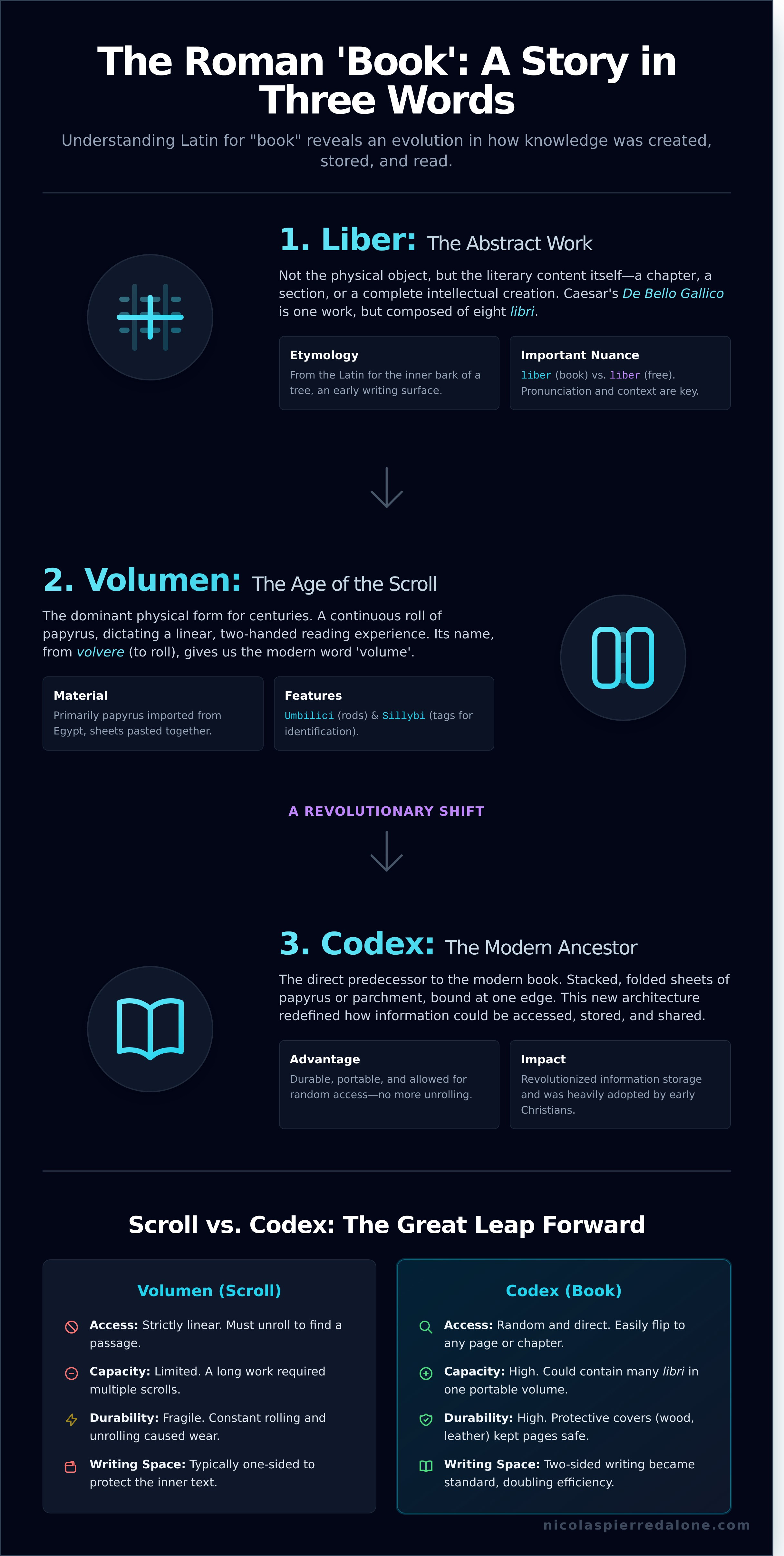
To find the perfect book in latin, one must first understand the word itself. The primary term is liber. Yet, this word carries a depth beyond a simple translation. It signifies not merely the physical object, but the literary work contained within-a division, a chapter, a complete intellectual creation.
The term’s etymology reveals its material heritage. Liber originally referred to the inner bark of a tree, a primitive surface for writing. This origin connects the abstract idea of a text to the tangible, organic world. While the physical form evolved from the scroll (volumen) to the revolutionary codex-a collection of bound pages that served as the direct ancestor of the modern book-the conceptual unit of the work remained rooted in the word liber.
Understanding `Liber` as a Literary Work
A classical work demonstrates this distinction with clarity. Julius Caesar’s commentary, De Bello Gallico, is a single literary work. It is, however, composed of eight distinct sections, each one a liber. An ancient Roman might possess one large scroll containing several libri. In this context, liber is the curated unit of thought, independent of its physical vessel.
The Double Meaning: `Liber` (Book) vs. `Līber` (Free)
A point of nuance for the student is the homograph līber, meaning ‘free’. The distinction lies in pronunciation and etymology. The word for book has a short 'i' (liber), while the adjective for free has a long 'ī' (līber). Though they appear identical in many modern texts, their meanings are entirely separate. Context is the ultimate arbiter.
Liber (book): Hic est liber meus. (This is my book.)
Līber (free): Populus Rōmānus est līber. (The Roman people are free.)
This duality demands precision. Understanding the layers of meaning within liber is the foundational step toward appreciating the curated world of Roman literature.
The Age of the Scroll: Unraveling the `Volumen`
Before the familiar bound pages, the concept of a book in Latin civilization was embodied by the volumen. This was the dominant vessel of knowledge throughout the Roman Republic and the early Empire. Its very name, derived from the verb volvere, meaning 'to roll', defines its physical essence: a scroll. This form was not merely a container for text but an artifact that dictated the rhythm of reading and the architecture of literature itself.
The Craftsmanship of the Roman Scroll
The creation of a volumen was an act of refined craftsmanship. The primary material was papyrus, a precious commodity imported from Egypt. Scribes would carefully join individual sheets (kollemata) with a flour-based paste, forming a continuous roll that could extend many meters. The finished scroll was an object of considered design, often featuring:
Umbilici: Wooden or bone rods attached to each end, providing structure and facilitating rolling.
Sillybi: Small parchment tags (tituli) that hung from the top of the scroll, identifying the author and title for easy retrieval from library shelves.
How a Roman Would Read a `Volumen`
Interacting with a volumen was a deliberate, two-handed process. A reader would unroll the scroll with their right hand to reveal the columns of text, while simultaneously rolling the read portion back up with their left. This enforced a strictly linear, sequential access to the text. One could not simply flip to a specific chapter. This physical limitation profoundly influenced literary composition and made citing a specific passage a far more challenging endeavor than in the modern book.
The Legacy of the `Volumen`
The heritage of the scroll endures. The Latin volumen is the direct ancestor of our modern English word 'volume', a testament to its foundational role. In art, the scroll remains a potent symbol of classical wisdom and authority. Yet, its practical limitations were undeniable. This elegant, yet cumbersome, form would eventually yield to a more efficient technology. The historic shift From Scroll to Codex marked a revolution in how information was stored and accessed, paving the way for the book as we know it today.
The Revolution of the `Codex`: The Ancestor of the Modern Book
Before the modern book, there was the codex. This was not a mere evolution from the scroll; it was a revolution in the architecture of knowledge. Composed of stacked and folded sheets, bound at one edge, the codex redefined how information was stored, accessed, and preserved. Its design was a statement of purpose: durability, portability, and directness.
The codex became inextricably linked with the rise of early Christianity. Its format was ideal for disseminating the Bible, allowing followers to quickly locate specific passages for study and citation-a task nearly impossible with a cumbersome scroll. This practicality made it the preferred medium for sacred texts, securing its place in history.
From Wax Tablets to Bound Pages
The codex finds its conceptual origins in Roman wax writing tablets, or tabulae. These hinged wooden blocks offered a reusable, portable surface. This structure inspired the binding of more permanent materials, marking a shift from brittle papyrus to durable parchment and vellum. The new form allowed for writing on both sides of the page, a profound efficiency that instantly doubled the capacity of the material.
Why the `Codex` Triumphed Over the Scroll
The triumph of the codex was a matter of superior function. While the scroll demanded a linear, sequential reading, the codex offered the freedom of random access. This single innovation was transformative. Its advantages were clear and decisive:
Rapid Navigation: Readers could instantly turn to any section, a crucial feature for legal, academic, and religious reference.
Superior Capacity: A single codex could contain the text of multiple scrolls, creating a more compact and comprehensive library.
Economic Efficiency: Writing on both sides of the parchment and its compact storage made it a more cost-effective format over time.
This robust and efficient design ensured the survival of countless works of classical literature through the Middle Ages, forming the foundation of the Western literary canon.
Choosing Your Word: `Codex`, `Liber`, or `Volumen`?
Precision is essential. When referring to a historic book in latin, these three terms are distinct and not interchangeable. The etymology of these words, detailed in scholarly works such as The Evolution of the Book, reveals their physical origins and clarifies their specific meanings. Understanding them is key to any serious study.
Volumen: The physical object of the scroll, derived from the Latin verb volvere, meaning "to roll."
Codex: The ancient or medieval bound book, from caudex, meaning "tree trunk" or "wooden block," referencing its early covers.
Liber: The abstract concept of the literary work itself-the text and its content-regardless of the physical format it occupies.
A Lexicon for the Literate: Other Words for Written Works
The word liber provides a strong foundation for any student. However, the Roman literary world was built upon a more nuanced and specific vocabulary. To truly appreciate a book in latin is to understand the precise terms authors and scribes used for their creations. This attention to detail reveals a culture deeply invested in the form, function, and artistic integrity of the written word.
Libellus: The 'Little Book'
The term libellus, the diminutive of liber, translates elegantly to 'little book.' It denotes a work of smaller scale and, often, greater intimacy. This was the preferred term for concise collections of poetry, personal letters, or sharp-witted epigrams. The passionate verses of Catullus and the satirical observations of Martial were presented to the world not as grand tomes, but as carefully crafted libelli, each a curated artistic statement.
Commentarii: Notebooks and Records
Commentarii were not finished literary pieces but something more direct: notebooks, journals, or field records. They represent information in its raw state, unadorned by rhetorical flourish. Julius Caesar’s Commentarii de Bello Gallico is the definitive example-a commander’s dispatch valued for its clarity and immediacy, not its polished prose. They offer an unfiltered glimpse into events, distinct from a historian's stylized narrative.
From Charta to Pagina: The Anatomy of a Text
The physical object itself had its own lexicon, reflecting the craftsmanship involved.
Charta: This referred to a single sheet of papyrus, the fundamental material for any document, letter, or literary work. It was the canvas upon which literature was born.
Pagina: Within a scroll (volumen), a pagina was not a leaf to be turned, but a single column of text. This structure dictated the rhythm and flow of ancient reading.
These terms construct the tangible reality of a Roman book, from the raw material to the structured page. Mastering this vocabulary transforms your engagement with any
book in latin
, moving beyond simple translation to a deeper appreciation for the ancient world's material culture.
From Ancient Words to Modern Reading: Choosing a Book in Latin Today
Understanding the lexicon of the past-the volumen, the codex-informs how we approach the Latin text today. The physical form has evolved, but the intellectual pursuit remains. The challenge is no longer one of preservation, but of access. Choosing your first book in latin is a significant step, an entry into a dialogue that spans millennia. The modern reader deserves a format that honors this heritage while removing unnecessary barriers to comprehension.
The Power of the Parallel Text
A bilingual edition is the modern scholar's Rosetta Stone. With the original Latin on one page and a faithful translation on the facing page, the constant interruption of dictionary lookups vanishes. This format is not a crutch; it is a catalyst. It cultivates an intuitive understanding of syntax and vocabulary, allowing the reader to build momentum and confidence. The goal is immersion, and the parallel text is the most direct path to achieving it.
Where to Begin: Classical Texts and Modern Adaptations
The classical canon offers clear entry points. Simplified editions of Caesar’s Commentarii de Bello Gallico provide a foundation in clear, historical prose. Yet, the language is not a relic. A growing collection of modern genres, from science fiction novellas to contemporary short stories, are now rendered in Latin. Engaging with these texts affirms Latin as a living, breathing medium for creative expression, connecting ancient grammar to modern narrative.
The Plume Charmers Collection: A Curated Library
Our philosophy is one of reverence and accessibility. Each edition in the Plume Charmers library is an object of thoughtful craftsmanship, designed to bridge the gap between the ancient author and the modern reader. We believe a beautiful book in latin should not be an artifact behind glass but a companion in your intellectual journey. The integrity of the text is paramount, presented in a format that invites discovery.
The Living Legacy of the Latin Book
The journey from the papyrus volumen to the revolutionary codex charts the evolution of the written word itself. We see how liber, a term rooted in the very bark of a tree, became the definitive vessel for Western literature. To understand the nuances of the word for a book in latin is to appreciate the physical and intellectual heritage that shapes our reading experience today.
This legacy is not a relic; it is a living art form. Authored and published by Nicolas Pierre d'Alone, our works honor this tradition through new creation. We present original science fiction composed in classical Latin and meticulously designed bilingual editions for the modern learner. Each volume is a testament to enduring craftsmanship and artistic vision.
We invite you to continue your journey into this world of refined literature. Discover our curated collection of bilingual Latin editions. The next chapter of your classical exploration awaits.
Frequently Asked Questions
What is the difference between the Latin words 'liber' and 'līber'?
The distinction between these words is a matter of vocalic precision, marked by the macron. The word liber, with a short 'i', signifies a 'book' (genitive librī). In contrast, līber, articulated with a long 'i', is the adjective for 'free' (genitive līberī). This subtle yet critical difference is fundamental to accurate Latin comprehension and reflects the meticulous detail inherent in the language, a quality essential for the serious student to master.
How would you say 'I am reading a book' in Latin?
The most direct and elegant translation is Librum legō. In this construction, librum is the accusative singular of liber (book), functioning as the direct object of the verb. The verb legō translates to 'I read' or 'I am reading,' as the Latin present tense encompasses both meanings. This concise structure reflects the language's inherent economy and precision, a foundational phrase for any student engaging with a text.
What were ancient Roman libraries like?
Ancient Roman libraries were curated repositories of knowledge, architecturally distinct from modern conceptions. Collections, primarily of papyrus scrolls (volumina), were housed in dedicated structures, often with separate wings for Greek and Latin works. Prominent public libraries, like those in the Forum of Trajan, were monumental statements integrated into civic life. These spaces were not merely for storage but were centers for intellectual pursuit, reflecting the cultural value placed on literary heritage.
Are there new books still being written in Latin today?
Latin persists as a living, creative medium. The language's legacy is not confined to antiquity; it continues through new compositions by contemporary authors and scholars. Furthermore, celebrated modern works, from children's stories to the Harry Potter series, have been meticulously translated. This practice affirms the language's enduring capacity for expression and its relevance in the modern cultural landscape, connecting the classical tradition with the present day.
Where can I find reliable Latin books with English translations?
For authoritative parallel-text editions, the Loeb Classical Library from Harvard University Press remains the definitive standard. Each volume presents the original Latin text on the left-hand page with a precise English translation on the right. This curated collection represents a legacy of scholarship, offering an unparalleled resource for finding the right book in latin for serious study. Series like Oxford World's Classics also provide meticulously edited volumes for the discerning reader.
What is the plural of 'liber' in Latin?
The nominative plural of liber (book) is librī. As a second-declension masculine noun, it follows a standard declensional pattern that is essential for mastering Latin grammar. The genitive singular is also librī, meaning 'of the book,' a distinction determined by its context within a sentence. Understanding this fundamental inflection is a prerequisite for accurate reading and composition, forming the bedrock of grammatical precision.


Comments