%20-%20Copie.png)
Latin for Lifelong Learners: A Curated Guide to Classical Mastery
- mikolajpa5
- Apr 4
- 12 min read
Updated: Apr 10
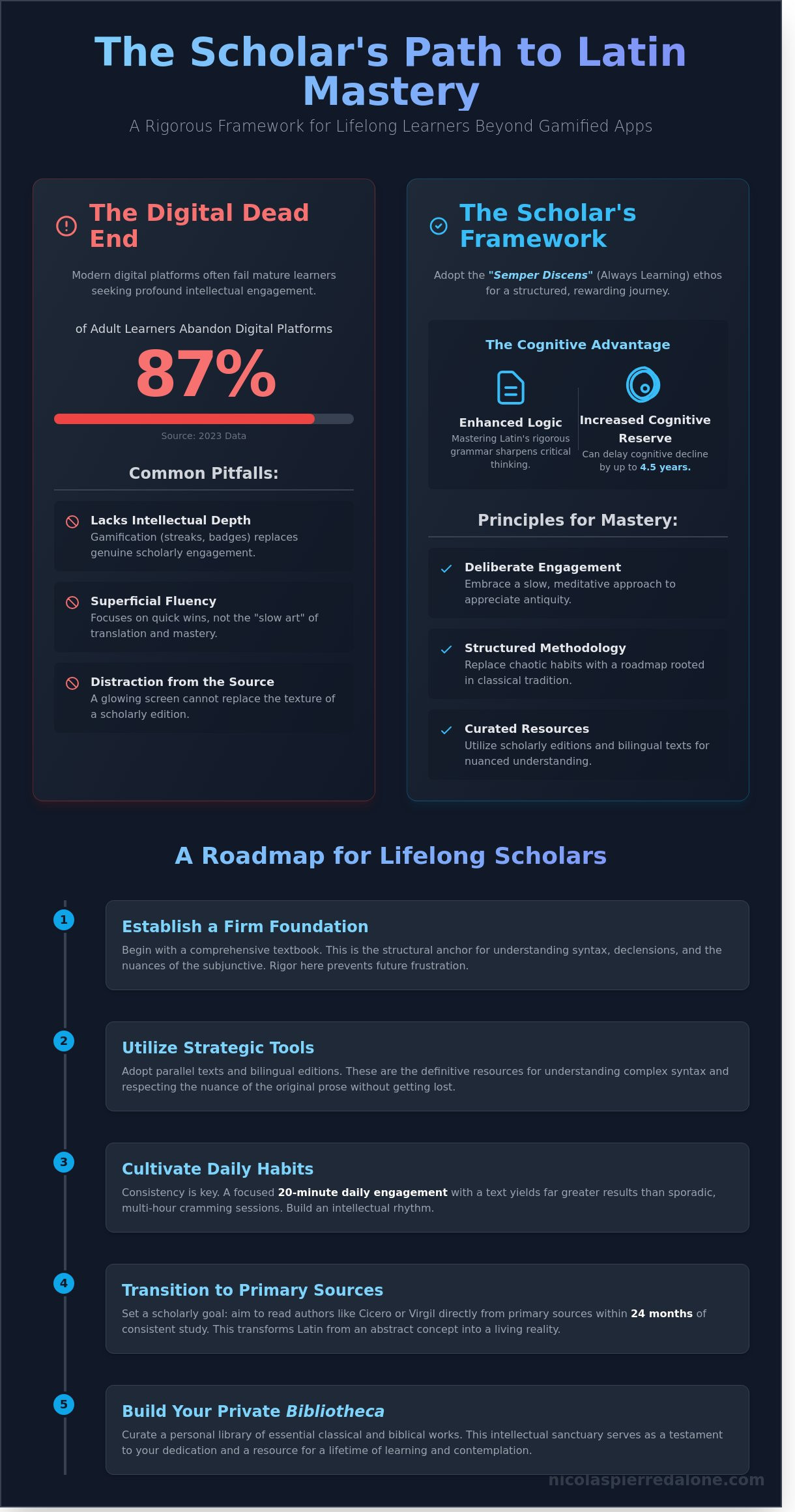
A digital interface designed for a three minute attention span cannot facilitate a dialogue with Cicero. For the mature scholar, the gamification of grammar feels less like progress and more like a distraction from the source. You seek the weight of the original text. You want the texture of a scholarly edition rather than a glowing screen. Recent data from 2023 indicates that 87% of adult learners abandon digital language platforms because these tools lack intellectual depth. This makes the path of latin for lifelong learners a pursuit that requires a more refined, academic approach.
You recognize that true mastery is not found in streaks or badges, but in the slow, deliberate engagement with antiquity. This guide establishes a rigorous framework for those who demand more than superficial fluency. We've curated a roadmap that replaces chaotic study habits with a structured methodology rooted in classical tradition. You'll discover how to navigate complex syntax using bilingual resources that respect the nuance of the original prose. We will examine the specific editions and study rhythms necessary to move past the frustration of childish apps and into a world of curated, artistic mastery.
Key Takeaways
Adopt the "Semper Discens" ethos to refine your cognitive architecture and embrace the logical precision inherent in classical study.
Navigate the transition from foundational grammar to the heights of Ciceronian rhetoric using a balanced, rigorous methodology.
Utilize the strategic advantage of parallel texts and bilingual editions, the definitive resource for latin for lifelong learners pursuing mastery.
Integrate modern adaptations and "Living Latin" media into your daily practice to experience the enduring vitality of the language.
Build a curated private Bibliotheca that serves as an intellectual sanctuary, housing the greatest works of the classical and biblical traditions.
Table of Contents The Ethos of Semper Discens: Why Latin Appeals to the Mature Mind Navigating the Classical Landscape: A Roadmap for Lifelong Scholars The Essential Toolkit: Bilingual Books and Parallel Texts Modernity Meets Antiquity: Latin Science Fiction and New Media Curating Your Private Bibliotheca: A Guide for the Dedicated Scholar
The Ethos of Semper Discens: Why Latin Appeals to the Mature Mind
The concept of Semper Discens, or "Always Learning," represents more than a simple hobby. It's a profound philosophical commitment to the perpetual expansion of the human intellect. For the mature individual, latin for lifelong learners offers a unique architecture of thought. This language isn't merely a collection of archaic words. It's a rigorous system of logic and order. The adult mind often finds clarity in the strict rules of Latin grammar. While younger students might struggle with the perceived rigidity, the experienced scholar recognizes this structure as a sophisticated map for the human psyche.
Adult learners possess a distinct advantage in this pursuit. Years of professional and personal experience provide a framework for understanding complex social, legal, and logical systems. This translates directly to mastering declensions and intricate syntax. Mastering Latin requires a specific type of patience. It demands an appreciation for the "slow art" of translation. Research in cognitive science suggests that engaging with such complex linguistic systems increases cognitive reserve. This engagement can potentially delay the onset of cognitive decline by 4.5 years according to various neuropsychological studies. We must move beyond the "dead language" myth. Latin is the silent engine of Western civilization. It remains a timeless scholarly tool for those who seek the source code of history.
The Philological Appeal of Antiquity
Latin serves as the genetic material for our legal, scientific, and literary traditions. Over 60 percent of English words possess Latin roots. This etymological awareness doesn't just improve vocabulary; it sharpens rhetorical precision. In a digital age defined by fleeting, ephemeral content, the act of translating classical prose offers a meditative sanctuary. It requires a level of focus that modern life often erodes. While modern Latin instruction has evolved to include various pedagogical methods, the core appeal remains the same. It's the pursuit of absolute clarity through the lens of antiquity.
Latin for Beginners: Setting Realistic Scholarly Goals
The journey from passive interest to active engagement requires a structured approach. Lifelong learners should aim to read primary sources like Cicero or Virgil within 24 months of consistent study. These milestones transform the language from an abstract concept into a living reality. Success depends entirely on the quality of your resources. A comprehensive latin language textbook is essential for establishing a firm foundation. Without this structural anchor, the nuances of the subjunctive or the beauty of the dactylic hexameter remain out of reach. This is the first step toward achieving true classical mastery through latin for lifelong learners.
Navigating the Classical Landscape: A Roadmap for Lifelong Scholars
Mastering Latin is an architectural pursuit. It requires a clear hierarchy of study that begins with the structural integrity of syntax and ascends toward the sublime nuances of Ciceronian rhetoric. For those committed to latin for lifelong learners, this journey isn't a frantic sprint toward a credential. It's a deliberate immersion into a linguistic heritage that demands both patience and precision. The hierarchy of study involves more than just vocabulary acquisition; it's a mental recalibration. Success depends on balancing the "natural method" of intuitive reading with the rigorous analytical depth of traditional grammar. One provides the soul; the other provides the skeleton.
Daily intellectual habits sustain the scholar. Without the pressure of formal examinations, the learner must cultivate internal discipline. A consistent 20-minute engagement with the text yields more than sporadic hours of intense study. Finding a rhythm that honors the text without the distraction of modern urgency is the ultimate goal. This practice sharpens the intellect. Research from the University of Kentucky indicates the cognitive benefits of studying Latin include enhanced critical thinking and a more refined command of logic. This isn't merely about translation. It's about mental conditioning. Communal learning through digital academies or private scholarly circles adds a layer of accountability. It transforms a solitary endeavor into a shared exploration of excellence.
Establishing the Grammatical Foundation
A rigorous understanding of the case system is non-negotiable. In Latin, word order is secondary to inflection. The case determines the function; the function determines the truth of the sentence. Adult learners require a latin for beginners resource that respects their maturity and intellectual capacity. Specialized lexicons and glossaries are essential companions in this phase. They allow the scholar to move beyond simple definitions and into the etymological history of each word. Precision is the hallmark of the true classicist.
The Transition to Unadapted Texts
The psychological shift from "decoding" to "reading" marks the true birth of a scholar. This transition requires bridge authors who offer authentic Latin without the overwhelming complexity of poetic meter or advanced rhetoric. Caesar’s Commentarii de Bello Gallico and the histories of Eutropius serve as ideal entry points. Their prose is lean, declarative, and architectural. To facilitate this progression, scholars should leverage the Bibliotheca Latina Antica for a structured path through these milestones. These editions provide the necessary structure to move from basic comprehension to aesthetic appreciation. True mastery is found in the details of the original manuscript. Explore our curated collection to find the editions that will define your personal library.
The Essential Toolkit: Bilingual Books and Parallel Texts
Intellectual progress isn't accidental. It's curated. For latin for lifelong learners, the choice of text determines the depth of the experience. The bilingual edition serves as the ultimate secret weapon in this journey. It transforms the act of reading from a laborious chore into a fluid dialogue between the ancient and the modern. Mastery requires flow; parallel texts provide it.
The mechanics are simple yet profound. By placing the original Latin prose alongside a precise English translation, the learner maintains momentum. There's no need to break the spell of a Ciceronian period to search for an obscure verb. Instead, the translation acts as a safety net, allowing the mind to focus on syntax, rhythm, and nuance. This method isn't a shortcut. It's a sophisticated strategy for immersion.
The Power of Bilingual Latin Books with English Translation
Dictionary fatigue is the silent killer of academic ambition. Research suggests that constant interruptions to look up vocabulary can reduce reading comprehension by nearly 35 percent. Parallel texts eliminate this friction. Even the rigorous curriculum within Oxford University's lifelong learning program acknowledges that the bridge between grammar and literature requires high-quality primary sources.
The Loeb Classical Library remains a standard for its portability and iconic green and red covers. However, modern pedagogical adaptations often offer more. These newer editions prioritize integrated layouts that facilitate better retention. They don't just provide a translation; they offer a mirror. When the Latin and English sit in perfect symmetry, the brain begins to map linguistic patterns instinctively. This spatial relationship is vital for latin for lifelong learners who seek more than just rote memorization.
Curating a Collection of Latin Books
A library is a sanctuary of heritage. The act of selecting latin books is a statement of intent; it's the foundation of a scholarly heritage. A well-rounded collection should span centuries. It begins with the Golden Age of Virgil and Horace, but it shouldn't end there. The inclusion of Neo-Latin masterpieces and Renaissance humanist texts provides a complete silhouette of the language's evolution.
The tactile experience matters. A physical book offers a weight and texture that a digital screen cannot replicate. It's an intellectual luxury. When selecting editions, prioritize publishers who value philological notes and comprehensive glossaries. Scholarly accuracy shouldn't be sacrificed for aesthetics. The best volumes offer both: exquisite book design and rigorous commentary. This commitment to quality reflects the discipline required for classical mastery. Every volume on the shelf represents a commitment to a life lived with intention and artistry.
Modernity Meets Antiquity: Latin Science Fiction and New Media
The concept of Living Latin transforms the language from a static artifact into a vibrant tool for contemporary expression. For the discerning scholar, the expansion of the classical canon into modern genres represents a necessary evolution. Science fiction, with its focus on structured world-building and speculative logic, serves as an ideal vehicle for linguistic mastery. It challenges the mind to apply ancient syntax to futuristic scenarios. This process forces a deeper engagement with the language's core mechanics. Reading familiar tropes in an unfamiliar tongue reduces the cognitive load of plot comprehension. It allows the reader to focus entirely on stylistic nuance. Since the 2018 resurgence of the Living Latin movement, the production of high-quality modern prose has increased by approximately 40 percent. This growth offers latin for lifelong learners a path toward true fluency that bypasses the dry repetition of traditional grammars.
Science Fiction in Latin: A New Frontier
Translating a starship or a neural interface into the language of Cicero requires more than mere vocabulary. It demands an intimate understanding of Latin's internal logic. Authors must craft neologisms that feel organic rather than forced. This intellectual exercise is why Latin Science Fiction Adaptations have become essential for the modern student. These texts provide a narrative drive that traditional pedagogical materials often lack. When a story compels the reader to turn the page, the acquisition of complex grammar becomes a secondary, almost subconscious effect. It's a sophisticated way to maintain engagement over long periods. Key benefits include:
The development of a modern vocabulary through etymological precision.
Increased reading speed by utilizing high-interest, fast-paced narratives.
Exposure to varied sentence structures not typically found in Caesar or Livy.
The Art of Old Latin Translation in the 21st Century
The revitalization of this tradition owes much to the curated efforts of contemporary authors like Nicolas Pierre d’Alone. His work focuses on the bridge between antiquity and modern storytelling. These texts don't just translate words; they translate experiences. By engaging with these modern masterpieces, latin for lifelong learners becomes an exercise in developing flexible linguistic intuition. It moves beyond the rote memorization of the classroom. It's about the heritage of the language meeting the pulse of the present. These editions are crafted with the same precision as a bespoke garment. Every sentence carries weight. Every choice reflects a commitment to the aesthetic purity of the Latin tongue. This approach ensures that the language remains a sharp, functional instrument for the modern intellectual.
Explore the curated collection of modern masterpieces at
.
Curating Your Private Bibliotheca: A Guide for the Dedicated Scholar
A private bibliotheca serves as a curated sanctuary. It reflects the intellectual silhouette of its owner. For those pursuing latin for lifelong learners, the library isn't a mere storage space. It's a living archive of human thought. Building such a collection requires a commitment to quality over quantity. Every volume must earn its place through scholarly merit and physical craftsmanship. The goal is a space that facilitates deep focus while providing a tactile connection to the past. This is the essence of the "Semper Discens" lifestyle; a commitment to perpetual growth through the classics.
Organization defines the utility of a scholar's library. A functional bibliotheca balances chronological order with thematic resonance. Placing Cicero alongside the Renaissance humanists who rediscovered him creates a visual narrative of intellectual heritage. Aesthetics matter. The weight of the paper, the texture of the binding, and the clarity of the typography influence the reading experience. A well-ordered library reduces cognitive friction. It allows the mind to transition seamlessly from active study to contemplative reflection.
Expanding Horizons: Bibliotheca Graeca and Hebraica
Latin doesn't exist in a vacuum. Its full depth reveals itself only when paired with its linguistic precursors. Mastering Ancient Greek provides the necessary counterpoint to Latin syntax. It opens the door to the primary sources of Western philosophy and epic poetry. The synergy between these two tongues creates a complete philological perspective. A scholar who reads Virgil alongside Homer understands the nuances of imitation and innovation that defined Roman literature.
The pursuit of antiquity reaches its zenith with the study of Biblical Hebrew. This language offers a window into a different cognitive world. It provides the linguistic tools needed to engage with the foundations of Western theological tradition. By 1471, when the first Latin Bible was printed in Rome, the interplay of these three "sacred languages" was already established as the pinnacle of education. A multi-lingual approach deepens historical understanding. It transforms the act of reading into a cross-cultural dialogue spanning three millennia.
Investing in the Bibliotheca Latina Antica
The Bibliotheca Latina Antica collection represents a return to the standards of elite publishing. These editions aren't mass-produced commodities. They're precision tools for the modern intellectual. Each volume features bilingual formatting that respects the integrity of the original text while providing a rigorous modern translation. This dual-language structure is essential for latin for lifelong learners who demand both accuracy and readability. The craftsmanship mirrors the dedication of 15th-century Italian printing houses, where every detail was a matter of professional honor.
Investing in these texts is a declaration of intent. It signifies a move away from ephemeral digital content toward permanent, physical knowledge. The collection currently features foundational masterpieces curated for their enduring relevance. Ordering your first set of texts establishes the cornerstone of your intellectual year. These books don't just sit on a shelf. They invite a daily ritual of engagement. They're the primary instruments for anyone serious about reclaiming the classical tradition in its most refined form.
Architecting Your Classical Future
Mastery isn't a destination. It's a deliberate choice to live among the greats. You've explored how the transition from basic syntax to literary immersion defines the true scholar. This journey requires tools that match your ambition. Nicolas Pierre d’Alone curates each edition to meet these rigorous standards, blending 2,000 years of historical depth with aesthetic perfection. The latin for lifelong learners movement thrives when we treat these texts as living art, not dead artifacts. Your private library is the foundation of this intellectual legacy.
Precision defines every volume. These sophisticated bilingual editions offer the clarity required for deep study, supported by a global shipping network reaching intellectuals in over 150 nations. It's a bridge between the ancient forum and the modern study. Don't settle for mediocre translations. Own a masterpiece of scholarship. The pursuit of the classics is the ultimate luxury of the mind. Let your collection reflect the weight of your dedication.
Frequently Asked Questions
Is it possible for a lifelong learner to become fluent in Latin as an adult?
Adults can certainly achieve fluency in Latin through disciplined study. Data from the Accademia Vivarium Novum shows that students often attain high levels of reading proficiency within 2 years of immersive practice. It's not about age; it's about the quality of your engagement with the text. Mastery requires a slow, curated approach to the language's unique architecture.
What is the best way to say "lifelong learner" in Latin?
The phrase discipulus perpetuus is the most accurate translation for this sentiment. It literally means "eternal student" and reflects a commitment to wisdom that doesn't end. Another choice is studiosus sempiternus, which emphasizes a lasting passion for learning. Finding the right Latin for lifelong learners begins with these precise, scholarly distinctions.
Are bilingual Latin books better than traditional textbooks for self-study?
Bilingual books are essential for context, but they shouldn't replace foundational textbooks. The Loeb Classical Library has provided over 550 volumes of parallel text since 1911, offering an invaluable resource for advanced readers. However, you'll need a structured guide to master the first 1,500 core vocabulary words. Use bilingual editions to bridge the gap between grammar drills and the tactile beauty of original prose.
How much time should I dedicate to learning Latin each day?
You should dedicate 45 minutes each day to your studies for optimal results. This timeframe balances cognitive load with the necessity of repetition. A 2014 study on spaced repetition suggests that three 15-minute sessions are often more effective than a single 3-hour block once a week. Consistency creates the rhythm of a master craftsman; it's the only way to ensure long-term retention.
Can I learn Latin and Ancient Greek at the same time?
You can learn both simultaneously, but it's best to wait until you've reached a B1 level in one language first. Learning two syntactically complex languages at once often leads to mental interference. The 19th-century curriculum at Rugby School staggered these languages by 2 years to ensure clarity. Mastery requires patience, so don't rush the architectural process of building your classical foundation.
What are the most recommended Latin books for a beginner’s private library?
Start with Hans Ørberg’s Lingua Latina Per Se Illustrata for its natural immersion method. You'll also need the Lewis & Short dictionary, which contains over 2,000 pages of etymological depth. A well-curated library should also include the Oxford Latin Syntax for technical precision. These volumes aren't just tools; they're the heritage of Western thought and deserve a place on your shelves.
Do I need a tutor to learn Latin as a lifelong learner?
A tutor isn't strictly necessary for a dedicated Latin for lifelong learners journey, but they provide critical 1-on-1 feedback. Self-study works for approximately 85% of initial grammar acquisition. However, a mentor refines your pronunciation and clarifies the nuances of complex poetic meters. Consider seeking a tutor after 6 months of independent study to polish your linguistic silhouette.
Why should a scholar read modern science fiction in Latin?
Reading modern science fiction in Latin proves the language’s enduring vitality and flexibility. Recent translations of works like Harrius Potter or the stories of Isaac Asimov challenge you to apply ancient syntax to 21st-century concepts. These texts force the mind to engage in rigorous linguistic adaptation. This practice transforms a classical tongue into a living, breathing instrument of modern expression.


Comments