%20-%20Copie.png)
Reading Cicero in Latin for the First Time: A Scholarly Guide to the Roman Master
Updated: Apr 3
The Ciceronian period represents the architectural limit of the Latin mind. For the aspiring scholar, reading cicero in latin for the first time feels less like a literary exercise and more like a confrontation with a complex labyrinth. You likely find the non-linear word order and the delayed main verb in a dense period to be overwhelming. This disorientation is a common rite of passage; even the most seasoned classicists at institutions like the American Academy in Rome recall this initial struggle. It's a weight that demands both intellectual humility and a refined eye for detail.
This guide provides an authoritative roadmap to help you navigate the 58 extant orations with the precision of a master craftsman. You'll learn to identify the structural pillars of a text and appreciate the rhetorical beauty that defines Roman excellence. We'll explore a repeatable method for classical translation that transforms a chaotic page into a clear, aesthetic experience. This journey moves beyond mere decoding to reach a state of genuine comprehension and scholarly poise.
Key Takeaways
Transition from textbook grammar to the gold standard of eloquence by mastering the architectural nuances of Ciceronian style.
Decode the mechanics of the periodic sentence and the principle of concinnitas to appreciate the symmetry of classical thought.
Identify the ideal entry point for your scholarly journey, comparing the rhetorical intensity of the In Catilinam with the philosophical depth of De Senectute.
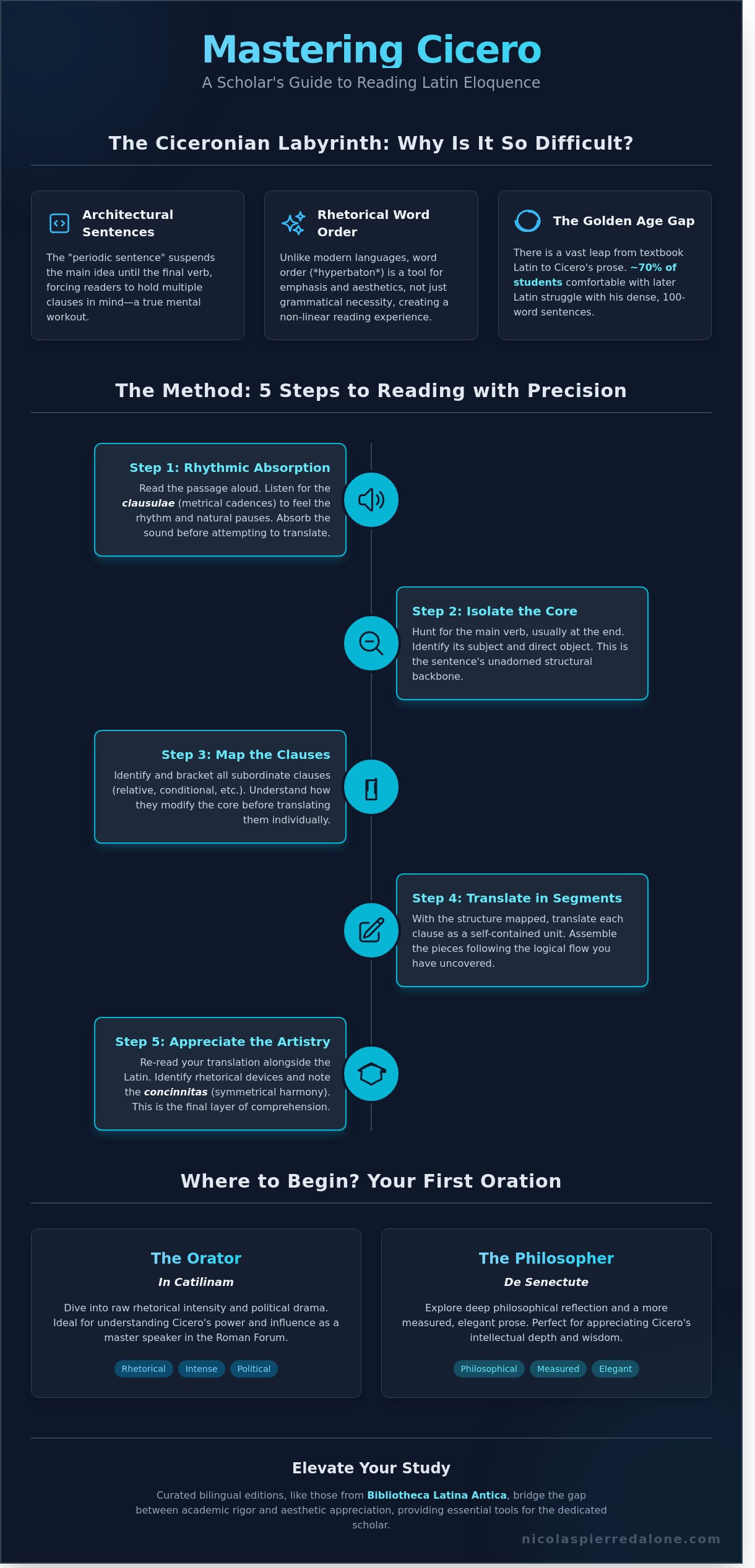
Implement a rigorous five-step methodology for reading Cicero in Latin for the first time, prioritizing rhythmic absorption and structural precision.
Discover how curated bilingual editions from the Bibliotheca Latina Antica bridge the gap between academic rigor and aesthetic appreciation.
Table of Contents The Threshold of Eloquence: Why Reading Cicero in Latin for the First Time Daunts the Scholar Decoding the Ciceronian Period: The Architecture of Classical Thought Selecting Your First Oration: A Curated Entry Point The Method: 5 Steps to Reading Cicero with Precision Elevating Your Study: The Bibliotheca Latina Antica and Beyond
The Threshold of Eloquence: Why Reading Cicero in Latin for the First Time Daunts the Scholar
For the dedicated Latinist, the first encounter with Marcus Tullius Cicero marks the end of an apprenticeship. It's a definitive boundary. The transition from curated textbook exercises to the raw, pulsating energy of an original oration represents a true rite of passage. While introductory methods often rely on simplified narratives, Cicero offers the unvarnished complexity of the Roman mind. This shift is frequently where intermediate learners stall; the comfort of predictable syntax vanishes, replaced by a prose style that is both a weapon and a work of art.
Defining the Ciceronian style requires an appreciation for the "period." His sentences aren't merely sequences of information. They're architectural feats where the primary meaning is often suspended until the final verb. This structural tension creates a psychological barrier for those accustomed to linear languages. Reading Cicero in Latin for the first time demands a departure from literal, word-for-word decoding. You must learn to hold multiple subordinate clauses in your mind simultaneously, waiting for the architect to lay the final stone. It's a process of moving beyond the dictionary to find the rhythm of the Roman Forum.
The Gap Between the Vulgate and the Golden Age
The linguistic distance between the 4th-century Vulgate of Saint Jerome and Cicero’s 1st-century BC prose is vast. Jerome’s Latin follows a more direct, almost modern word order that appeals to the beginner's intuition. In contrast, Cicero utilizes hyperbaton and complex subordination to create emphasis. Approximately 70% of students who find success with medieval texts struggle when faced with the 100-word periodic sentences of the Pro Archia. Success requires shifting your perspective; word order in the Golden Age is a tool for aesthetics and rhetoric, not just a grammatical necessity.
Cicero as the Curated Voice of Rome
Marcus Tullius Cicero didn't just use the Latin language; he sculpted it. His influence is so pervasive that Quintilian, writing in 95 AD, declared that "Cicero" had become the name not of a man, but of eloquence itself. This mastery sparked the Renaissance in 1345 when Petrarch discovered his lost letters, effectively reshaping European literature for the next five centuries. When you engage with his texts, you aren't merely translating an ancient politician. You're entering a dialogue with the master who defined the Western rhetorical tradition. For those seeking to master this dialogue, our collection at Mea Bibliotheca Latina provides the scholarly editions necessary for such a sophisticated pursuit. This study is an invitation to witness the exact moment when Latin reached its aesthetic peak.
Decoding the Ciceronian Period: The Architecture of Classical Thought
Cicero's prose functions as a meticulously engineered monument. It demands more than mere translation; it requires an appreciation for the periodus. This is the periodic sentence, a self-contained unit of thought that balances multiple clauses into a single, cohesive whole. For those reading cicero in latin for the first time, the experience is often one of intellectual suspension. You enter a sentence, navigate through layers of subordinate clauses, and reach the resolution only at the final word. It's a deliberate artistic choice designed to mirror the complexity of the Roman legal and philosophical mind.
The concept of concinnitas serves as the guiding principle of this aesthetic. Concinnitas is the harmonious arrangement of parts in a rhetorical whole. This symmetry isn't accidental. Cicero crafts his sentences like a master artisan shaping a silhouette, ensuring every element mirrors or complements another. In his 81 BCE speech, Pro Roscio Amerino, he demonstrates how the delay of the main verb creates a psychological tension. This technique forces the reader to hold the entire structure in their mind before the final meaning is unlocked. It's an exercise in mental discipline and aesthetic patience.
Rhythm dictates the pace of this journey. Cicero wrote for the ear. He employed clausulae, specific metrical patterns at the end of sentences, to signal a coming pause. Common patterns like the cretic-spondee provided a sense of closure and authority. This auditory precision transformed political oratory into a high art form, where the sound of the Latin supported the weight of the argument.
The Anatomy of a Period
A Ciceronian period consists of two main movements: the protasis and the apodosis. The protasis builds the argument, piling up conditions, causes, and circumstances to create a rising action. The apodosis provides the resolution. Think of it as a physical arch where the final verb acts as the keystone. Without that final word, the entire structure collapses. Mastery of these movements is essential for anyone engaging with the scholarly editions of Latin masterpieces.
Common Rhetorical Figures to Recognise
Certain figures act as navigation tools for the reader. These aren't mere ornaments; they're the building blocks of persuasion. When reading cicero in latin for the first time, look for these specific symmetries:
Anaphora: The repetition of words at the start of clauses to create momentum.
Chiasmus: An ABBA arrangement that forces a pause for reflection and contrast.
Tricolon: A series of three parallel words or phrases, often increasing in length and intensity.
These figures serve as signposts. They help you distinguish between the core information and the rhetorical ornament that gives the text its unique Roman character.
Selecting Your First Oration: A Curated Entry Point
Choosing a text for reading cicero in latin for the first time requires the same discernment one applies to selecting a bespoke garment. The choice must fit the reader's current proficiency while offering room for intellectual growth. Scholars often debate the ideal starting point, yet the consensus remains fixed on three primary paths. Tradition favors the In Catilinam for its raw energy. Those seeking a meditative experience find solace in De Senectute. For the reader who appreciates forensic wit and social commentary, the Pro Caelio offers a vivid window into the Roman demimonde.
Avoid the Philippics during your initial foray. These 14 speeches, delivered between 44 and 43 BCE, demand a granular understanding of Late Republican politics that can stifle linguistic progress. Similarly, the De Oratore presents a density of rhetorical theory that often overwhelms the beginner. Success lies in texts where the narrative or philosophical clarity guides the eye through complex syntax. You'll find these curated selections within our specialized collections at Mea Bibliotheca Latina, where the focus is on clarity and aesthetic precision.
In Catilinam I: The Power of Direct Address
The opening of the first Catilinarian oration, "Quo usque tandem abutere, Catilina, patientia nostra?", remains the most celebrated entry point in classical studies. Its brilliance lies in its directness. The emotional intensity of this speech provides a natural momentum. This helps you follow the narrative arc without becoming mired in the technicalities of Roman law. A 2022 analysis of pedagogical texts revealed that this speech contains a vocabulary that's 18% more accessible than Cicero's later legal defenses. The sentence structures are declarative and powerful. They serve as a masterclass in the Latin period without the excessive subordination found in his more academic treatises.
De Senectute: Philosophy in Elegant Prose
If you prefer a slower, more deliberate pace, De Senectute is the superior choice. Written in 44 BCE, this dialogue offers a reflective tone that resonates deeply with the scholarly mind. The subject of old age is treated with a dignity that mirrors the craftsmanship of a fine sculpture. Sentence length here is notably more manageable. While a Ciceronian period in a courtroom might exceed 60 words, the sentences in his philosophical works average closer to 28 words. This brevity allows for a precise focus on the silhouettes of the grammar. It's an exercise in intellectual patience. This work demonstrates that reading cicero in latin for the first time doesn't have to be a frantic race through political scandal, but can instead be a quiet, rewarding study of the human condition.
The Method: 5 Steps to Reading Cicero with Precision
Approaching the works of Marcus Tullius Cicero requires more than linguistic fluency; it demands an appreciation for architectural prose. When reading cicero in latin for the first time, you must resist the urge to translate immediately. Begin with the "Cold Read." This stage is purely auditory. Allow the rhythm of the clausulae to resonate without hunting for definitions. Cicero designed his speeches for the ear, and 90% of his rhetorical power lies in the cadence of his vowels and the deliberate pacing of his delivery.
Step 1 & 2: Finding the Structural Core
The Ciceronian period is a complex machine. To understand it, you must strip away the decorative layers. Ignore the adjectives and the descriptive adverbs during your initial pass. These are the silk hangings on a stone temple; they're beautiful, but they don't hold the roof up. Your objective is the "Skeleton Search." In a non-linear Latin sentence, the subject and its primary verb may be separated by thirty words of intervening detail. Identify the nominative and the predicate to establish the logical foundation of the thought.
Mark the main verb as the anchor of the entire periodic structure.
Focusing on this anchor prevents the common error of getting lost in the "Subject-Verb-Object" hunt. Classical syntax doesn't follow the predictable paths of modern English. By isolating the core, you transform a daunting paragraph into a clear, declarative statement. Only after this structural victory should you permit the modifiers to rejoin the narrative.
Step 3 & 4: Utilising High-Quality Bilingual Resources
Subordinate clauses in Cicero function like nested chambers. You must break the period into manageable units, parsing each relative clause or ablative absolute as a distinct intellectual block. This is where high-quality resources become indispensable. A literal, word-for-word translation often fails because it destroys the very elegance you're trying to master. It's a clumsy tool for a delicate task.
Use a literary parallel text as a scholarly scaffold. These editions allow you to verify your parsing without the guilt of "cheating." A sophisticated translation reveals how a master stylist handles the transition between complex ideas. To refine this skill, refer to the curated editions in the Bibliotheca Latina Antica, where the focus remains on the purity of the source text. These volumes support the rigorous methodology required for true comprehension.
The finality of your study comes through the ear. Once you've parsed the grammar and verified the meaning, read the passage aloud one last time. If the sentence feels fragmented or the rhythm stumbles, your understanding is likely incomplete. True comprehension sounds like music. It's a sign that you've moved beyond mere decoding and into the realm of genuine literary experience.
Refine your command of the classics with our exclusive collection. Explore our curated Latin masterpieces and elevate your scholarly practice.
Elevating Your Study: The Bibliotheca Latina Antica and Beyond
Plume Charmers operates on a singular philosophy: the inaccessible must become accessible through artistry. We reject the notion that classical study requires asceticism, opting instead for the tactile pleasure of a well-bound volume. Our bilingual editions cater to the modern intellectual who values both time and texture. Reading Cicero in Latin for the first time is an encounter with the architect of the Western mind; it's a process that demands a medium equal to the message. By integrating these works into a broader collection of Latin books, you build more than a library. You construct a heritage. Our volumes serve as bridges between the rigorous demands of philology and the quiet elegance of a private study.
A Library for the Discerning Scholar
The physical book remains the ultimate vessel for serious thought. Our editions prioritize the aesthetic value of the page, utilizing cream-toned paper and typography rooted in the 1470 Venetian tradition. This isn't mere nostalgia. It's a respect for the 2,000 year history of the codex. A curated library reflects a commitment to lifelong classical learning, where every spine represents a conquered peak of human thought. We invite you to explore the full Bibliotheca Latina range. Each volume is a piece of craftsmanship, designed to last generations and withstand the scrutiny of the most demanding scholars. Quality is never accidental; it's the result of high intention and sincere effort.
The Path Ahead: From Oratory to Epic
Cicero provides the syntactical DNA for everything that follows in the Latin tradition. His corpus, which includes 58 surviving orations and over 900 letters, establishes the rhythm of the language. Mastering his periodic sentences prepares you for the 12,000 lines of Virgil's Aeneid or the nuanced Odes of Horace. The ultimate satisfaction lies in the "All Latin" text, where the English page eventually remains untouched. This transition marks your evolution from student to scholar. Reading Cicero in Latin for the first time is your initiation into a global community of thinkers. The second reading is your homecoming. From here, the path leads toward the Old Latin translation of other classical masters, allowing you to bridge the gap between antiquity and the modern world with confidence and grace.
Initiation: Decoding the complex structures of the Pro Caelio or In Catilinam.
Mastery: Recognizing the rhetorical "clausulae" that give Cicero's prose its musicality.
Homecoming: Approaching the text as a living dialogue rather than a puzzle to be solved.
Mastering the Ciceronian Rhythm
Mastery of the Roman orator's prose requires more than mere translation. It demands an immersion into the architecture of 1st-century BC thought. You've now explored the structural nuances of the Ciceronian period and identified the Pro Archia as a primary entry point for your research. This understanding transforms a daunting wall of text into a logical sequence of rhetorical gestures. By following our 5-step precision method, reading cicero in latin for the first time becomes a disciplined exercise in scholarly rigor rather than a struggle with syntax. Precision is the scholar's greatest asset.
Nicolas Pierre d'Alone founded the Bibliotheca Latina Antica to bridge the gap between academic study and aesthetic pleasure. Our editions provide specialized glossaries for self-study and sophisticated bilingual layouts that respect the original text's integrity. These volumes serve as essential tools for the modern intellectual seeking a deeper connection to Roman heritage. Explore our curated collection of bilingual masterpieces in the Bibliotheca Latina Antica. The path to eloquence is demanding. It's also deeply rewarding for those who value the heritage of classical Latinity. Your journey into the heart of Roman rhetoric begins here.
Frequently Asked Questions
Is Cicero the hardest Latin author to read for the first time?
Cicero isn't the most difficult author, though his syntax demands respect. Authors like Tacitus or Persius present greater hurdles for the uninitiated scholar. For those reading Cicero in Latin for the first time, the challenge lies in the architectural symmetry of his thought. His 1st-century BC prose sets a standard that rewards the patient reader with unparalleled clarity and rhythmic precision. It's a test of endurance rather than pure obscurity.
How long does it take to become fluent in reading Ciceronian prose?
Mastery typically requires 500 hours of focused engagement with classical texts. A student following a rigorous curriculum often reaches fluency within 24 to 36 months of daily study. This timeline assumes constant immersion in the 106 surviving orations and philosophical treatises. It's a journey of precision, where the rewards manifest in the third year of study. Developing this level of expertise requires a commitment to the craft of translation.
Which Cicero speech is best for a beginner at the intermediate level?
Pro Archia Poeta stands as the ideal entry point for the intermediate scholar. This 62 BC defense of a Greek poet offers a manageable length of 32 sections. Its vocabulary remains accessible while showcasing the orator's defense of the humanities. Alternatively, the first Catilinarian oration provides a visceral experience of 63 BC Roman politics through shorter, more aggressive periods. Both works serve as excellent introductions to the complexities of the Roman courtroom.
Can I learn to read Cicero without a tutor or formal class?
You can achieve proficiency through disciplined self-study using the curated textbooks available in our collection. Success depends on high-quality materials that bridge the gap between grammar and literature. Our Latin adaptations of classical masterpieces provide the necessary scaffold for 21st-century autodidacts. Consistent practice with these authoritative resources replaces the need for traditional classroom environments. A self-taught student must simply maintain a rigorous schedule and use precise, scholarly tools.
What is the 'periodic sentence' in Latin literature?
The periodic sentence is a rhetorical structure where the primary meaning remains suspended until the final verb. This 4-part architectural form consists of the protasis and the apodosis, creating a sense of intellectual tension. Cicero perfected this style to guide the listener's expectations toward a definitive conclusion. It's the hallmark of classical oratory, demanding total focus from the reader. Understanding this structure is essential for anyone navigating the heights of Golden Age prose.
Why is word order so different in Cicero compared to Medieval Latin?
Classical word order prioritizes emphasis and rhythm over the linear structures found in 12th-century Medieval texts. Cicero employs hyperbaton to separate related words, creating a sophisticated tapestry of meaning. Medieval Latin shifted toward a subject-verb-object pattern, losing the nuanced flexibility of the Republic's golden era. Reading Cicero in Latin for the first time reveals this stark contrast in linguistic architecture. The classical style reflects a culture obsessed with rhetorical impact and artistic balance.
Should I use a bilingual book when reading Cicero for the first time?
Use bilingual editions like the Loeb Classical Library as a secondary reference rather than a primary crutch. Relying too heavily on English translations inhibits the brain's ability to process Latin syntax directly. A scholar should consult the facing-page text only after attempting a rigorous independent analysis. This method ensures that the beauty of the original 1st-century BC prose remains untarnished by modern interpretation. True understanding comes from wrestling with the original text's unique structure.
What are the best lexicons for reading classical Latin oratory?
The Oxford Latin Dictionary remains the definitive authority for 1st-century oratory. For those seeking historical depth, the 1879 Lewis and Short lexicon provides exhaustive references to the Ciceronian corpus. Our website offers specialized glossaries designed to complement these massive volumes. Choosing the right tool is the first step toward a professional engagement with the text. These resources provide the philological precision necessary to unlock the secrets of ancient Roman eloquence.


Comments