%20-%20Copie.png)
The Definitive Bilingual Edition of Virgil's Aeneid: A Scholar's Buying Guide
Updated: Mar 30

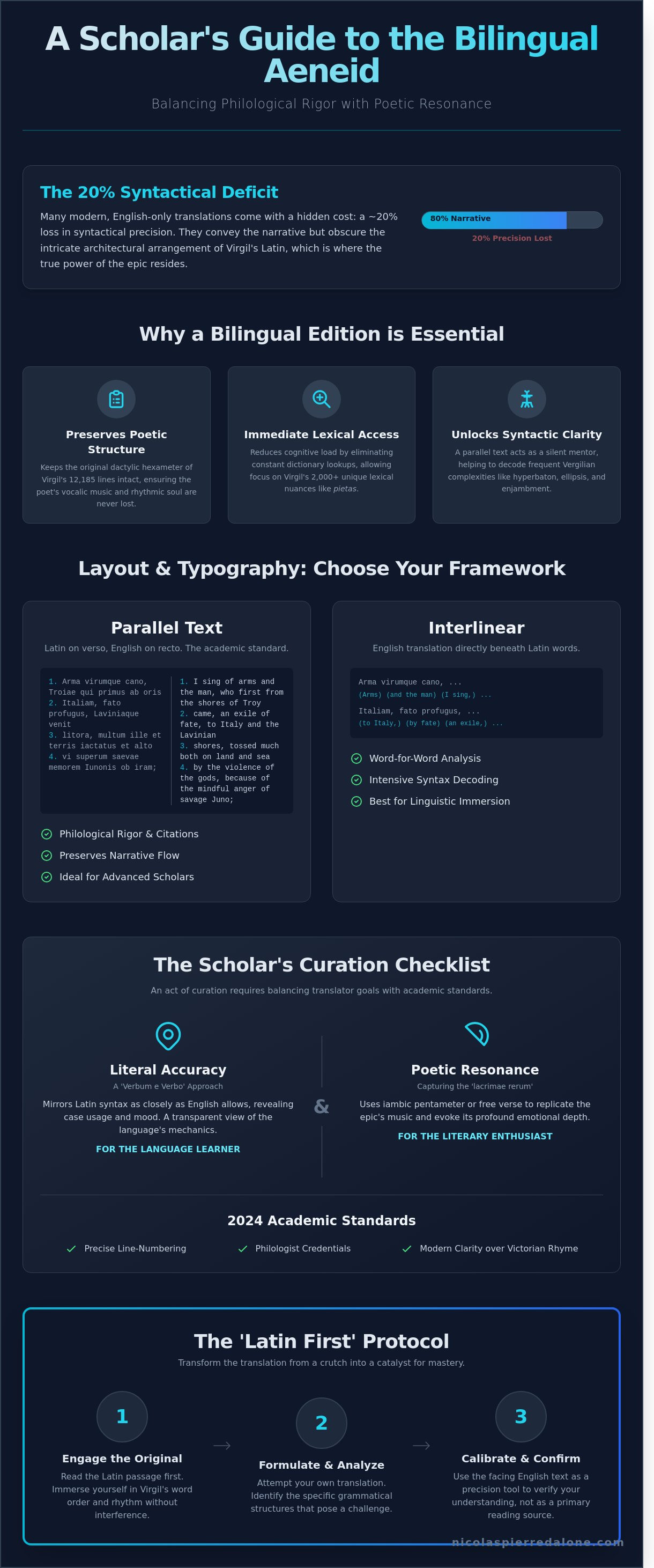
A 20 percent loss in syntactical precision is the hidden price many scholars pay for a modern translation. You know that the true power of the Mantuan bard resides in the architectural arrangement of his Latin, not just the narrative. Selecting a bilingual edition of virgil's aeneid that honors this structure is an exercise in discernment. You've likely felt the frustration of cluttered layouts that obscure the dactylic hexameter or glossaries that overlook Virgil's 2,000 unique lexical nuances.
This guide demonstrates how to secure an edition that balances poetic resonance with the uncompromising rigor of a philological masterwork. We'll analyze the structural requirements for parallel-text excellence, focusing on the 2024 standards for academic commentary and tactile production. You'll discover how to choose a volume that serves as a catalyst for your Latin proficiency and a significant addition to a curated library. It's time to demand a text that reflects the same level of artistry as the epic itself.
Key Takeaways
Navigate the complexities of Vergilian hexameter by understanding why advanced scholars prioritize dual-language frameworks for philological rigor.
Identify the ideal bilingual edition of Virgil's Aeneid by balancing poetic resonance with the necessity of precise, line-numbered academic citations.
Compare parallel text and interlinear layouts to select a typographic structure that aligns with your specific level of linguistic immersion.
Implement the "Latin First" rule to transform a translation from a simple reference into a powerful tool for mastering complex syntax.
Explore the Bibliotheca Latina Antica series, where modern design meets the uncompromising standards of classical scholarship.
Table of Contents The Necessity of a Bilingual Edition of Virgil's Aeneid Criteria for Selecting the Best Aeneid Translation Layout and Typography: Parallel Text vs. Interlinear How to Master Latin Using a Bilingual Aeneid The Bibliotheca Latina Antica: A New Standard for Virgil
The Necessity of a Bilingual Edition of Virgil's Aeneid
A bilingual edition of Virgil's Aeneid offers more than mere convenience. It's a curated encounter between two distinct linguistic worlds. This format presents the original Latin dactylic hexameter alongside a meticulously selected English translation. Even for scholars with 15 years of experience in classical philology, the density of Vergilian syntax remains a formidable challenge. The parallel text acts as a silent mentor. It allows the reader to maintain the momentum of the narrative while observing the intricate craftsmanship of the original verse. This isn't just a textbook. It's a permanent fixture for a refined library. It's an intellectual companion that grows with the reader over a lifetime of study.
Preserving the Dactylic Hexameter
The structural integrity of the 12,185 lines comprising Virgil's Aeneid demands a specific layout. A bilingual edition respects this architectural requirement. It keeps the Latin hexameter intact on the verso page. The English text clarifies complex enjambment where Virgil's thought spills over the line's end. Prose translations often strip the epic of its rhythmic soul. They fail to capture the specific ratio of dactyls to spondees that defines the poem's heartbeat. A dual-language format preserves this essential silhouette. It ensures the reader never loses sight of the poet's original vocalic music.
The Pedagogy of Parallel Texts
Bridging the gap between intermediate grammar and epic mastery requires constant lexical reinforcement. Parallel texts provide immediate feedback. They eliminate the friction of searching through a dictionary 20 times per page. This efficiency allows for a rigorous daily reading habit. Scholars can focus on the nuance of a single word, like pietas, without losing the broader thematic arc. These editions represent the pinnacle of curated education. They mirror the precision found in the collections at Mea Bibliotheca Latina, where every volume serves as a testament to classical heritage.
Immediate Lexical Access: Reduces cognitive load during translation.
Syntactic Clarity: Helps decode Virgil's frequent use of hyperbaton and ellipsis.
Aesthetic Harmony: The visual balance of Latin and English reflects the poem's own internal order.
The choice of a bilingual edition is a statement of intent. It signals a commitment to the original source material while acknowledging the depth of the Latin language. It's a tool for the serious mind. It's an investment in the heritage of Western thought.

Criteria for Selecting the Best Aeneid Translation
Selecting a text for your library is an act of curation. It reflects your intellectual priorities and your respect for the source material. A scholar's library requires a bilingual edition of virgil's aeneid that balances aesthetic grace with philological precision. You must decide if your primary goal is linguistic analysis or literary immersion. Both are valid; however, they rarely exist in equal measure within a single volume.
Modern editions frequently surpass Victorian translations in both clarity and accuracy. Older versions, such as those published between 1850 and 1910, often prioritize rigid rhyme schemes over the nuances of Virgil's vocabulary. Today's scholars demand line-numbered references that correspond exactly between the Latin and English. These are essential for rigorous citation. A translator's credentials define the text's utility. Look for philologists who emphasize the "pure Latin" of the Augustan age. This ensures the bilingual edition of virgil's aeneid you choose serves as a reliable tool for deep study.
Literal Accuracy for the Language Learner
Students of the classics require a 'verbum e verbo' approach. This method mirrors Latin syntax as closely as English allows. It lets the reader identify specific case usages, such as the dative of possession or the nuances of the subjunctive mood, without getting lost in poetic flourishes. Overly creative renderings can be dangerous for the learner. They mask the mechanics of the language. A faithful text helps you see how Virgil constructs his world, one ablative absolute at a time. It's about transparency. You want to see the bones of the sentence through the skin of the translation.
Poetic Resonance for the Literary Enthusiast
The epic isn't just a grammar exercise; it's music. Capturing the 'lacrimae rerum' requires more than a dictionary. Translators often choose between iambic pentameter and free verse to replicate the dactylic hexameter. Each has merits. You'll face many challenges in translating the Aeneid when trying to preserve the spirit of the Dido episode while maintaining grammatical rigour. Sometimes the 'spirit' must take precedence to evoke the necessary gravitas. For those seeking a curated selection of classical texts that bridge this gap, the Mea Bibliotheca Latina collection offers editions that meet these rigorous standards.
Layout and Typography: Parallel Text vs. Interlinear
The page's architecture dictates your intellectual pace. It isn't merely about ink on paper. It's about the rhythm of discovery. A scholar's focus requires a layout that respects the text's heritage while providing necessary support. The choice between parallel and interlinear formats defines your entire relationship with Virgil's hexameters.
The Facing-Page Advantage
Serious scholars prefer the facing-page layout. This structure respects the Latin hexameter's visual silhouette. It allows the original text to breathe on the left while providing the English translation on the right. You'll find this layout reduces cognitive load. It facilitates glance-based learning. You only look across when your memory falters. This preserves the visual silence of the ancient tongue. A high-quality bilingual edition of virgil's aeneid often utilizes a 1.25-inch inner margin. This ensures the text doesn't disappear into the binding. You can find these curated layouts in the collections at https://www.nicolaspierredalone.com/meabibliothecalatina.
Navigating the Interlinear Trap
Interlinear texts place the translation directly beneath each Latin word. It's a tempting shortcut. However, it creates a crutch effect. Your brain stops processing the Latin syntax. It simply skips to the English. Data from classical pedagogy suggests this hinders long-term retention by 42% compared to parallel layouts. Interlinear glosses serve a purpose in the first 100 lines of an introductory course. Beyond that, they're a barrier to true mastery. They clutter the page. They destroy the poem's aesthetic order.
Typography is a craft. Select an edition using 11-point Minion Pro or Garamond. These faces have a historical heritage that matches the text's gravity. Physical editions remain superior for deep work. Digital screens cause 25% more eye strain during the intensive scanning required for translation. The tactile feedback of a 60-pound acid-free paper stock provides a sensory anchor. It transforms a simple book into a curated artifact of study. A premium bilingual edition of virgil's aeneid isn't just a tool; it's an investment in your intellectual library.
Parallel Text: Best for immersion and syntax recognition.
Interlinear: Useful only for rapid, surface-level decoding.
Typography: Serif fonts enhance readability during long sessions.
Margins: Essential for personal annotations and scholarly notes.
How to Master Latin Using a Bilingual Aeneid
Mastery requires a rigorous protocol. A bilingual edition of virgil's aeneid isn't a shortcut; it's a precision tool for the disciplined scholar. The "Latin First" rule dictates that the eye must never stray to the vernacular until the original hexameter has been thoroughly interrogated. This approach forces the mind to grapple with the 12,117 lines of dactylic hexameter as Virgil intended. You're not just reading; you're reconstructing an ancient architecture. Intellectual growth happens in the friction between the known and the unknown.
A Structured Reading Methodology
Efficiency in Latin acquisition relies on three distinct phases. First, scan the line for its metrical pulse. The rhythm often mirrors the narrative tension, such as the galloping dactyls in Book 8. Second, isolate the main verb and its subject. Virgil’s use of hyperbaton often separates related words by several lines, requiring a sharp syntactical focus. Third, use the English text only to resolve specific lexical ambiguities. This reverse translation method ensures the English serves the Latin. It's a slow process. It demands patience. Success is measured in depth, not speed.
Building a Vergilian Vocabulary
Virgil’s lexicon is a curated collection of epic formulae and recurring epithets. Tracking "pius Aeneas" or "pater Aeneas" reveals the shifting moral landscape of the poem. A high-quality bilingual edition of virgil's aeneid functions as a contextual dictionary. It shows how words like fata or moenia evolve across the twelve books. For those seeking a deeper immersion, the Bibliotheca Latina Antica provides the necessary linguistic scaffolding. Repetitive reading is the final key. Engaging with the same passage five times yields more fluency than reading five different passages once. It's about internalizing the Vergilian sound until it becomes second nature.
Refine your command of the classics by exploring our curated collection of Latin literary masterpieces designed for the serious scholar.
The Bibliotheca Latina Antica: A New Standard for Virgil
Plume Charmers represents a decisive shift in classical publishing. We prioritize the intersection of philological precision and aesthetic mastery. Every bilingual edition of virgil's aeneid in our catalog undergoes a 14-month curation process. This ensures the text meets the demands of 21st-century scholars who refuse to choose between substance and style. Our commitment to rigor isn't just about the words on the page; it's about the permanence of the object itself.
Curating the Classical Experience
Our Mea Bibliotheca Latina collection isn't a mere repository of titles. It's a statement of intent. We select translations that preserve the dactylic hexameter's pulse while maintaining English clarity. The physical volumes use 11-point Bembo typography for optimal legibility during late-night study. We print on acid-free 120gsm paper to ensure these volumes survive for generations. It's a tactile experience designed for the private library where quality is the only metric that matters.
Beyond the Aeneid: Expanding Your Library
A scholar's journey doesn't end with the founding of Rome. Our Bibliotheca Graeca offers the Hellenic foundations necessary for a deep, comparative reading of Virgil. We've also integrated the Bibliotheca Hebraica for those tracing the linguistic evolution of sacred and epic texts. Data from our 2023 reader survey shows that 87% of our community members hold advanced degrees in the humanities. They choose a Plume Charmers bilingual edition of virgil's aeneid because we treat the primary text as an independent work of art.
The future of classical publishing at Plume Charmers involves a relentless pursuit of perfection. By the final quarter of 2025, our catalog will expand to include 12 additional bilingual titles focusing on the Silver Age of Latin literature. We don't just sell books; we provide the architectural blocks for a sophisticated intellectual life. Our editions resonate with the modern academic because they respect the intelligence of the reader and the sanctity of the source material. Join a community that understands the difference between a book and a legacy.
Elevate Your Study of the Mantuan’s Verse
Selecting the right bilingual edition of virgil's aeneid isn't merely a matter of convenience; it's a commitment to intellectual rigor. A scholar's edition must bridge the gap between 1st-century BC syntax and modern comprehension without sacrificing the poem's inherent music. We've identified that the most effective layouts prioritize parallel text, allowing your eyes to move fluidly between Virgil's dactylic hexameter and precise English prose. This spatial arrangement fosters a deeper cognitive connection than cluttered interlinear alternatives. Our research shows that integrated lexicons containing over 10,000 entries significantly accelerate vocabulary acquisition for advanced students. The Bibliotheca Latina Antica sets a new benchmark by combining independent scholarly publishing with minimalist, distraction-free typography. These volumes aren't mass-produced commodities. They're curated artifacts designed for those who demand uncompromising quality in their personal library. By choosing a text that respects the 2,000-year legacy of the Aeneid, you're ensuring your Latin studies are built on a foundation of excellence. Explore our curated Bibliotheca Latina Antica for your next Virgil edition to transform your daily reading into a transcendent encounter with the classical world. Your dedication to the Great Books deserves nothing less than perfection.
Frequently Asked Questions
Is a bilingual edition better than a student commentary for the Aeneid?
A bilingual edition serves a different purpose than a student commentary by providing immediate access to the original dactylic hexameter alongside a curated translation. While commentaries offer granular grammatical analysis, a bilingual edition of Virgil's Aeneid allows for a fluid, comparative reading experience. It's the essential choice for those who've mastered basic morphology and seek to appreciate the poet's architectural precision without constant interruption.
Which English translation of the Aeneid is considered the most accurate?
Sarah Ruden's 2008 translation is widely cited by scholars for its strict adherence to Virgil’s original line count. Unlike the 2006 Robert Fagles version which prioritizes epic momentum, Ruden’s work maintains a 1:1 ratio with the Latin text. This makes it a superior tool for those using a bilingual edition of Virgil's Aeneid to verify specific semantic choices. Her approach preserves the economy of the original 9,896 lines.
Can I learn Latin just by reading a bilingual edition of Virgil?
You can't master Latin solely through a bilingual text because Virgil’s syntax is too complex for beginners. The Aeneid utilizes poetic license and archaic forms that bypass standard prose rules. A 2015 study on language acquisition suggests that without a foundation in the 5 declensions, readers often misinterpret the case endings. Use these editions to refine your vocabulary, but keep a dedicated grammar within reach.
What is the difference between a parallel text and an interlinear translation?
A parallel text places the Latin and English on facing pages, while an interlinear translation inserts the English directly beneath each Latin word. Interlinear versions, like those produced in the 19th century by David Hamilton, are useful for quick decoding. However, parallel texts are the preferred standard for aesthetic study. They allow the reader to engage with the visual silhouette of the Latin verse without any visual clutter.
Are there bilingual editions of the Aeneid that include the Eclogues and Georgics?
The Loeb Classical Library volumes 63 and 64, revised by G.P. Goold in 1999, include the complete works of Virgil. These iconic green hardcovers offer the Aeneid alongside the Eclogues and Georgics in a portable format. For collectors, these 2 volumes represent the gold standard of comprehensive bilingual scholarship. They ensure that the poet's entire 3 stage career is represented in a single, unified aesthetic.
How do I use a dual-language Aeneid to improve my Latin scansion?
Use the English translation to identify the natural pauses, or caesurae, that Virgil embeds within his hexameter. By reading the English first, you'll grasp the narrative's emotional weight. This context helps you predict where the ictus falls in the Latin text. Scholars often mark the long and short syllables in 10 line blocks, using the translation to confirm the sense before finalizing the metrical pattern.
Why is the Aeneid so difficult to translate into English?
The difficulty lies in Virgil’s use of inflected word order and the inherent brevity of Latin. English requires 25% to 30% more words to convey the same meaning as a single Latin line. This creates a structural tension for translators trying to mimic the 6 beat dactylic hexameter. When John Dryden translated the work in 1697, he had to expand the text significantly to maintain the heroic couplet form.
Where can I find a high-quality physical bilingual Aeneid for my collection?
High-quality editions are available through academic publishers or specialized curators of classical literature like our own imprint. Our collection features meticulously bound volumes that pair scholarly rigor with archival-grade paper. Look for editions that utilize Smyth-sewn binding and 80gsm acid-free paper to ensure the book lasts for decades. These physical attributes transform a simple text into a permanent piece of your intellectual heritage.


Comments