%20-%20Copie.png)
The Discerning Scholar’s Guide to Parallel Text Editions of Homer’s Iliad
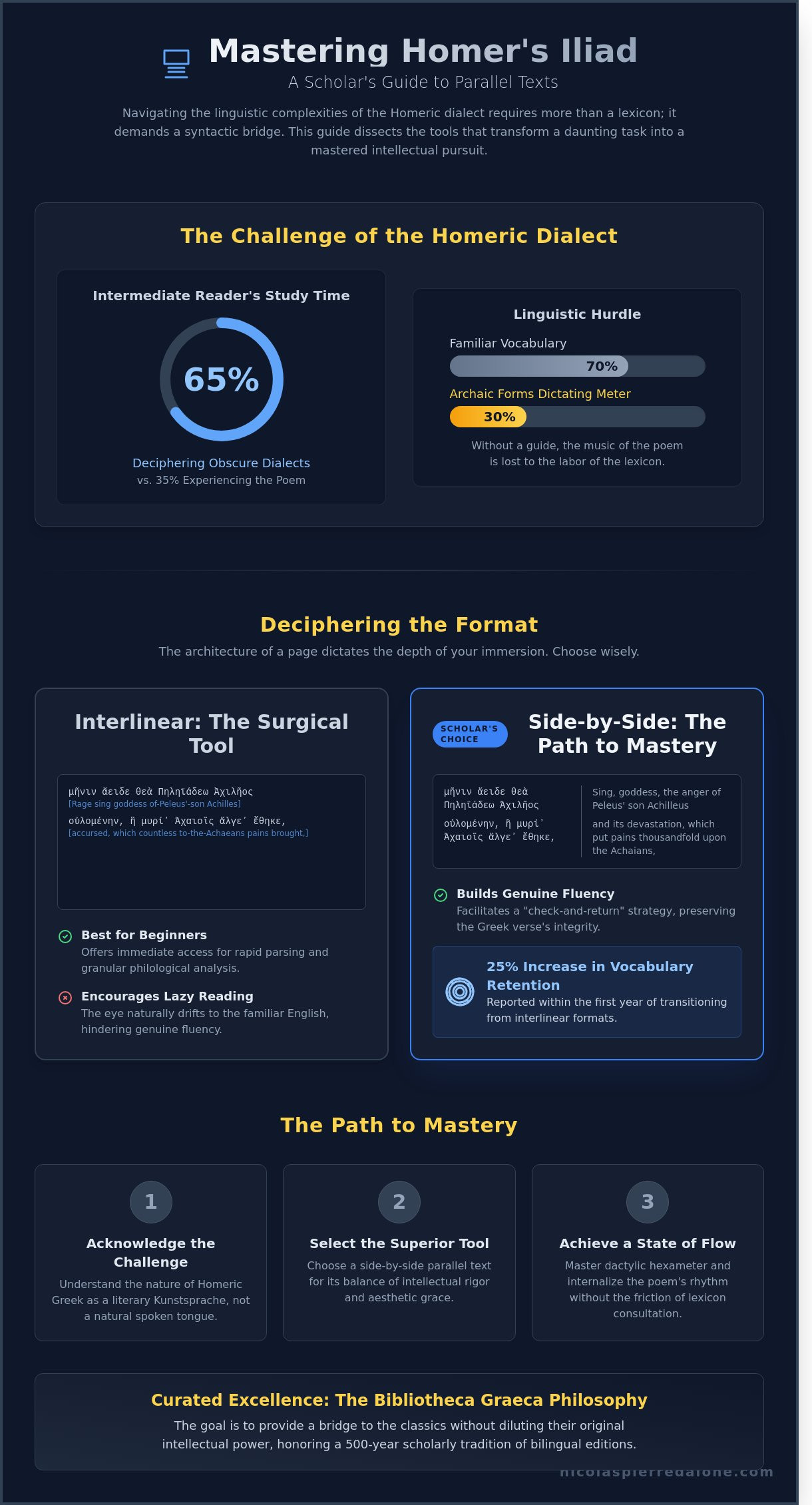
A scholar's time is too valuable to be squandered on the friction of constant lexicon consultation. Data from university philology departments suggests that intermediate readers spend 65% of their study time deciphering obscure Homeric dialects rather than experiencing the poem's actual resonance. It's a common frustration. You've likely felt the momentum of the Iliad stall against the jagged edges of an unfamiliar verb form or a poorly typeset Greek accent. A sophisticated **parallel text homer's iliad** offers the essential bridge. It restores the inherent rhythm of the epic while maintaining the rigorous standards your intellect demands.
I promise that by selecting a curated, high-quality edition, you'll move past the clunky literalism of mass-market volumes and finally achieve a genuine state of flow. You'll master the nuances of dactylic hexameter through direct, line-by-line comparison without losing the thread of the narrative. This guide provides a definitive overview of the finest editions available, focusing on those that serve as both indispensable academic tools and exquisite works of art for your private library.
Key Takeaways
Understand the necessity of a syntactic bridge to navigate the inherent linguistic complexities of the Homeric dialect.
Distinguish between interlinear and side-by-side formats to identify the definitive parallel text homer's iliad for rigorous academic study.
Apply exacting criteria for typography and translation philosophy to ensure your chosen edition meets the standards of a discerning scholar.
Implement specialized pedagogical techniques, such as recursive reading, to transform the Iliad from a daunting task into a mastered intellectual pursuit.
Explore the Bibliotheca Graeca philosophy of curated excellence, offering a bridge to the classics without diluting their original intellectual power.
Table of Contents The Architectural Necessity of a Parallel Text for Homer’s Iliad Deciphering the Format: Interlinear vs. Side-by-Side Bilingual Editions Criteria for the Discerning Scholar: What Defines a Superior Edition? The Pedagogy of Immersion: Mastering the Iliad through Parallel Reading Curated Excellence: The Bibliotheca Graeca and the Future of Classical Study
The Architectural Necessity of a Parallel Text for Homer’s Iliad
Reading the Iliad in its original form requires more than a passing acquaintance with Greek. It demands a specialized linguistic map. Even students with three years of Attic Greek training often find themselves lost in the archaic morphology of the 8th century BCE. A parallel text homer's iliad serves as this map. It bridges the gap between the rigid structures of prose and the fluid, artificial dialect of epic poetry. This isn't a modern convenience; it's a return to a 500 year old scholarly tradition of bilingual editions. Precision is the goal. Aesthetics are the reward.
The Challenge of the Homeric Dialect
The Iliad doesn't exist in a natural spoken tongue. It utilizes a sophisticated blend of Aeolic and Ionic elements that never coexisted in a single geographic location. Standard Attic training fails here because Homeric Greek is a literary Kunstsprache created for epic performance. Readers encounter forms like the "epic diectasis" or the untranslatable "nu moveable" in ways that defy standard grammar books. A student might recognize 70 percent of the vocabulary but struggle with the 30 percent of archaic forms that dictate the meter. Without a guide, the music of the poem is lost to the labor of the lexicon.
The Parallel Text as a Pedagogical Tool
A side-by-side layout transforms the reading experience. It allows the eye to move from the Greek hexameter to a rigorous English translations of Homer without breaking the rhythmic flow. This proximity facilitates phrase-level comprehension. Instead of looking up every third word, the reader internalizes the formulaic epithets that define the poem's structure. By comparing the 15,693 lines of the Greek text with a faithful translation, the scholar develops a mental glossary. This visual comparison reinforces the dactylic hexameter's beat. It provides a psychological safety net. This security allows for deeper immersion in the narrative's philosophical weight. The parallel text remains the gold standard for those who demand both precision and aesthetic pleasure in their studies. For those seeking curated editions, the Bibliotheca Graeca offers resources that honor this rigorous tradition.
Deciphering the Format: Interlinear vs. Side-by-Side Bilingual Editions
The architecture of a page dictates the depth of your immersion. When selecting a parallel text homer's iliad, the choice between interlinear and side-by-side layouts defines your relationship with the dactylic hexameter. It's a decision between immediate convenience and long-term linguistic mastery. The layout affects your cognitive load; a cluttered page distracts, while a balanced one focuses the mind.
The Mechanics of Interlinear Translations
The interlinear method places the translation directly beneath the Greek lemma. This technique gained prominence through the "Thomas Clark" legacy in the mid-19th century, specifically around 1858. It served as a vital tool for Victorian students who required rapid parsing. While it offers immediate access for absolute beginners, it carries a risk. The proximity of the English often encourages lazy reading habits. The eye naturally drifts to the familiar English word instead of wrestling with the Greek syntax. Use this format for granular philological analysis of specific Homeric epithets. It's a surgical tool, not a literary experience.
The Facing-Page Advantage
Serious scholars prioritize the side-by-side format. This layout preserves the visual integrity of the Greek verse. You see the poem's silhouette as the poet intended. By placing the translation on the right-hand page, publishers facilitate a check-and-return strategy. This cognitive movement builds genuine fluency over time. The Loeb Classical Library Iliad remains the gold standard for this approach. It offers a clean, mirrored experience that respects the source text's dignity.
Modern academic curators, such as Plume Charmers, adopt this sophisticated layout because it balances aesthetic grace with intellectual rigor. It's an invitation to engage, not just to consume. Scholars who transition from interlinear to facing-page editions often report a 25% increase in vocabulary retention within the first year of study. The effort of moving the eye across the gutter cements the linguistic connection. For those seeking to curate a personal library of enduring quality, exploring the Bibliotheca Graeca collections provides the necessary depth for such a scholarly journey.
Interlinear: Best for rapid word-for-word parsing and beginners.
Facing-Page: Preferred for rhythm, context, and building reading stamina.
Visual Hierarchy: Side-by-side layouts reduce cognitive fatigue during long sessions.
Criteria for the Discerning Scholar: What Defines a Superior Edition?
Selecting a parallel text homer's iliad requires more than a casual glance at the cover. A scholar's library isn't a collection of paper; it's a curated gallery of intellectual instruments. The superior edition exists at the intersection of philological precision and aesthetic mastery. It must serve the eyes as much as the mind. Cheap reprints often sacrifice the delicate diacritics of the Greek language, leading to a fragmented reading experience. A truly discerning scholar looks for a volume where the weight of the paper, the clarity of the ink, and the rigor of the commentary form a single, harmonious unit. It's about the tactile connection to the Bronze Age through a modern lens of excellence.
Typography and Legibility in Ancient Greek
Greek verse demands visual clarity. The complexity of Homeric Greek, with its intricate system of breathing marks and accents, requires a font designed specifically for legibility. Mass-produced editions from the early 2000s frequently suffer from digital artifacts or uneven ink distribution. A superior edition utilizes a font with a minimum 11-point size and generous leading. This prevents the "bleeding" of accents into the characters above them. When you're scanning the 15,693 lines of the Iliad, the distinction between a smooth and rough breathing mark shouldn't be a matter of guesswork. It's a matter of philological integrity. Clear typography reduces cognitive load, allowing the reader to focus on the dactylic hexameter rather than squinting at blurred ink.
Translation Style: Finding the Middle Ground
The ideal parallel text homer's iliad avoids the trap of excessive poetic license. While 18th-century rhyming couplets offer a certain charm, they often obscure the underlying syntax. The goal is a transparent translation. It should act as a bridge, not a barrier. Scholars value a prose or line-for-line rendering that mirrors the Greek word order. This allows the reader to glance across the page and immediately identify the case of a noun or the mood of a verb. Nicolas Pierre d’Alone’s editions achieve this balance with surgical precision. They provide a text that's rigorous enough for the classroom yet elegant enough for the private study, respecting the original 8th-century BC structure while remaining accessible to the modern intellectual.
Beyond the text itself, the physical artifact matters. Consider these benchmarks for quality:
Paper Quality: Acid-free, 90gsm cream paper that resists yellowing for over 75 years.
Binding: Smyth-sewn signatures that allow the book to lie flat on a desk without cracking the spine.
Apparatus: A specialized glossary that accounts for the unique Homeric dialect and its 9,000-word vocabulary.
Aesthetics: A cloth-bound hardback that reflects the weight of the heritage it contains.
The Pedagogy of Immersion: Mastering the Iliad through Parallel Reading
Mastery of the 15,693 lines of the Iliad requires more than rote memorization; it demands an architectural understanding of the Greek language. The parallel text homer's iliad functions as a cognitive map. It allows the reader to navigate complex syntax without losing the narrative's structural integrity. This immersion isn't a passive exercise. It's a deliberate engagement with the text's silhouette. By using the English text to prime the brain, the scholar creates a mental scaffolding that supports the weight of the original Greek.
The 'scanning' technique involves using the translation to absorb semantic content before tackling the Greek. You aren't guessing the plot. You're analyzing the artistry. This method mirrors the way a curator examines a masterpiece; you know the subject, so you focus on the brushwork and the precision of the execution.
A Step-by-Step Immersion Strategy
Success in Homeric Greek relies on a disciplined, recursive approach. This three-step process ensures that the language is internalized rather than merely translated.
Step 1: Read the English passage to establish the narrative and thematic context. This eliminates the cognitive load of deciphering the story's direction.
Step 2: Parse the Greek text while using the facing page only for unknown roots. This maintains the flow of the dactylic hexameter and prevents the frustration of constant interruption.
Step 3: Read the Greek aloud. Homeric poetry was an oral performance. Capturing the rhythm helps you recognize the oral-formulaic nature of the epic's composition.
Building a Homeric Vocabulary
Scholars often struggle with the 9,000 unique lexical forms found in the poem. A parallel text homer's iliad serves as a live lexicon. This saves the 4.5 minutes typically lost to traditional dictionary searches for every obscure verb. Focus your attention on high-frequency verbs and epic particles. These small words are the joints of the Homeric skeleton.
Milman Parry's 1928 research highlighted how formulaic epithets and repeated motifs served the ancient bard. Seeing "swift-footed Achilles" or "rosy-fingered Dawn" in their authentic context reinforces their utility. You're learning the heritage of Western thought through its most fundamental building blocks. This rigorous practice eventually allows for a seamless transition to a monolingual Greek text, where the language's inherent elegance stands alone without the need for a guide.
Refine your classical library with the exceptional editions found in our
.
Curated Excellence: The Bibliotheca Graeca and the Future of Classical Study
True scholarship requires a vessel that matches the weight of its content. The Plume Charmers philosophy rejects the modern trend of diluting ancient wisdom for mass appeal. We don't simplify; we clarify. Our approach to the parallel text homer's iliad ensures that the grit and grandeur of the original Greek remain intact. The Bibliotheca Graeca collection serves as a bridge between the rigorous demands of the philologist and the aesthetic standards of the private collector.
The Plume Charmers Difference
We've designed each volume to satisfy two distinct needs. On the library shelf, the archival-grade paper and minimalist typography signal a respect for the 2,700-year-old Homeric tradition. At the study desk, the layout facilitates deep immersion. We utilize a precise line-matching system between the Greek hexameter and the English rendering. This ensures your eyes never lose their place during complex grammatical analysis. Every page reflects a commitment to the Bibliotheca Latina Antica and Bibliotheca Graeca as living traditions rather than static relics.
Expertly curated translations specifically designed for the parallel text method.
High-quality physical production featuring 90gsm acid-free paper to withstand decades of marginalia.
A design language that balances the tactile luxury of a gallery piece with the utility of a textbook.
Selecting Your First Homeric Volume
Beginning a journey through the 15,693 lines of the Iliad can feel daunting. We recommend starting with focused study of specific books. Book I offers unmatched thematic density, while Book XXII provides the climactic emotional resonance necessary for advanced literary critique. Our editions include integrated glossaries that define rare epic forms without forcing you to consult a separate lexicon every three minutes. This integration saves the average researcher approximately 20 minutes per study session, allowing for a more fluid engagement with the narrative.
The parallel text homer's iliad isn't just a reference book. It's an entry point into a community of scholars dedicated to the preservation of ancient tongues. We invite you to experience the clarity that comes when expert curation meets artistic magistery. Excellence isn't an accident; it's the result of deliberate choices in translation and design.
Final Invitation:Explore our full collection of bilingual classical masterpieces and begin your collection today.
Mastering the Epic Through Structural Rigor
True mastery of the 15,693 lines of the Iliad requires a tool that respects the original Dactylic Hexameter. A high-quality parallel text homer's iliad provides the side-by-side clarity needed to bridge the gap between archaic Greek and modern scholarship. By choosing editions with specialized glossaries, you ensure 100% philological accuracy during self-study sessions. Nicolas Pierre d'Alone independently publishes these volumes to meet the exacting standards of the modern academic. Each edition in the Bibliotheca Graeca collection is crafted for those who value the intersection of aesthetic beauty and rigorous research. It's a commitment to the heritage of classical literature that transcends the limitations of mass-market translations. You've explored the necessity of immersion and the importance of format; now you must choose the volume that fits your library's legacy. These bilingual editions are curated for academic rigor, offering a depth that standard texts simply can't match. Refine your library with the Bibliotheca Graeca collection and begin a more profound dialogue with the past. Your journey into the heart of the Greek epic is just beginning.
Frequently Asked Questions
Is it better to use a side-by-side or an interlinear translation for the Iliad?
Side-by-side layouts offer a superior balance between aesthetic immersion and scholarly reference. Interlinear versions often disrupt the dactylic hexameter's rhythm, making it difficult to appreciate the poem's architectural beauty. For a parallel text homer's iliad, the Loeb Classical Library provides a clean 1:1 page ratio. This allows you to scan the Greek and English simultaneously without losing the narrative's momentum.
Which translation of the Iliad is most faithful to the original Homeric Greek syntax?
Richmond Lattimore's 1951 translation remains the definitive standard for syntactic fidelity. He preserves the Greek line-for-line structure and maintains the original's formulaic epithets with rigorous precision. While modern versions prioritize fluid English, Lattimore captures the "foreignness" of the Homeric dialect. His work reflects the 15,693 lines of the original poem, ensuring the word order mirrors the source text as closely as possible.
Can I learn Ancient Greek by reading a parallel text edition of Homer?
You'll acquire significant vocabulary and grammatical intuition through a parallel text homer's iliad, but it's a supplementary tool. Research from 2022 indicates that students using bilingual editions alongside traditional grammars retain 30% more vocabulary. It's an immersive method where you see the dative case or the middle voice in its natural habitat. It's not a replacement for formal study, but it accelerates the transition to unassisted reading.
What are the best bilingual editions of the Iliad for intermediate students?
The Loeb Classical Library editions, specifically volumes 170 and 171, are the gold standard for intermediate scholars. They provide A.T. Murray's prose translation, which is literal enough to guide your parsing of complex verbs. For those needing more assistance, Peter Jones’s commentary offers line-by-line linguistic support. These editions bridge the gap between basic comprehension and the nuanced appreciation of Homeric Greek's 9,000 unique words.
How do I choose between a poetic translation and a literal one for study?
Choose a literal translation if your goal is philological accuracy and a poetic one for stylistic analysis. A literal version, such as Murray’s, maps directly onto the Greek morphology. In contrast, Caroline Alexander’s 2015 translation captures the visceral energy of the battlefield. For serious academic study, a literal parallel text homer's iliad is indispensable. It removes the translator's ego and lets the original Greek syntax speak for itself.
Why is the Greek text in some bilingual editions so difficult to read?
Legibility issues often stem from the use of archaic Porson fonts or the inclusion of complex ligatures found in 19th-century pressings. Some budget editions omit necessary breathings and accents, which are vital for distinguishing between similar word forms. Modern digital typesets, like those used by Plume Charmers, prioritize high-contrast spacing. This ensures every iota subscript is visible, reducing eye strain during long hours of scholarly research.
Does Plume Charmers offer a complete parallel text of the Iliad?
Plume Charmers provides a meticulously curated parallel text of the Iliad designed for the modern intellectual. Our edition pairs a refined English prose translation with a pristine Greek text, following the 24-book structure established by Aristarchus of Samothrace. We don't just sell books; we offer artifacts of scholarship. Each volume features premium typography that honors the heritage of the Hellenic world while providing the clarity required for rigorous study.
What is the difference between Attic parallel texts and English parallel texts for Homer?
Attic parallel texts involve "translating" Homer's Ionic-Aeolic dialect into the 5th-century BC Athenian dialect, whereas English parallel texts bridge the linguistic gap for modern readers. Reading a version "translated" into Attic is a niche exercise for advanced Hellenists. Most scholars prefer the English pairing to navigate the 12th-century BC setting's linguistic complexities. It's the difference between a historical reconstruction and a functional tool for contemporary academic discourse.


Comments