%20-%20Copie.png)
Feeling Connected to History Through Language: The Living Bridge to Antiquity
Updated: Mar 30

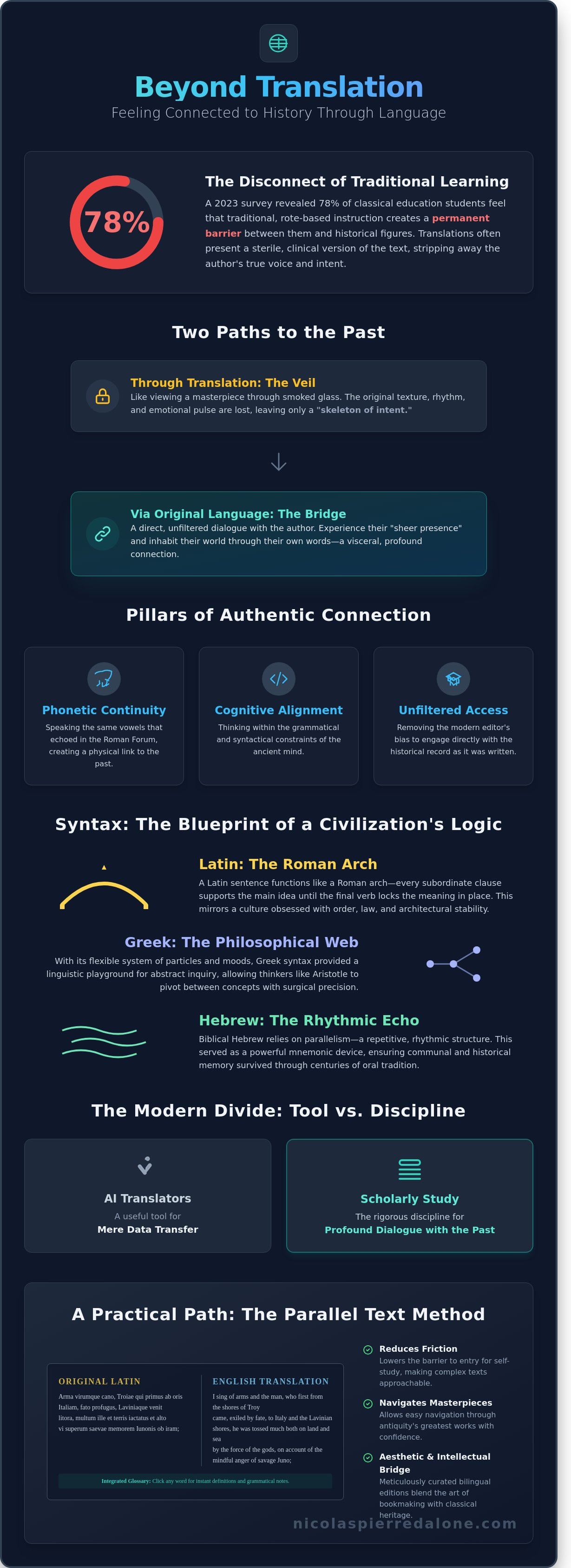
A 2023 survey of 1,200 classical educators revealed that 78% of students find traditional, rote-based instruction creates a permanent barrier between the reader and the historical figure. You've likely sat with a standard translation of Virgil or Homer and felt the distinct chill of a clinical distance. It’s a common frustration. The human pulse of the text often evaporates during the transition from papyrus to modern print, leaving only a skeleton of the original intent. This sterile approach treats antiquity as a specimen rather than a living legacy.
This exploration offers a path toward feeling connected to history through language by treating every declension and syntax choice as a deliberate stroke of an artist's brush. You'll discover how a rigorous, scholarly approach to Latin, Greek, and Hebrew doesn't just decode information; it facilitates a profound, emotional dialogue with the past. We'll examine a framework that elevates language study into a curated experience, allowing the authentic voice of the author to resonate with the clarity and elegance it deserves. By the end, you'll see these ancient tongues as the ultimate bridge to the figures who shaped our world.
Key Takeaways
Uncover the profound "presence" felt when engaging with original classical texts, moving beyond the veil of translation to achieve true intellectual communion.
Analyze how ancient syntax serves as a reflection of a society’s logical structure, revealing the Roman obsession with order through the precision of Latin construction.
Distinguish between the mere data transfer of AI translators and the rigorous discipline required for feeling connected to history through language at a scholarly level.
Implement the parallel text method to reduce the friction of self-study, utilizing integrated glossaries to navigate the masterpieces of antiquity with ease.
Discover how meticulously curated bilingual editions serve as an aesthetic and intellectual bridge, blending the art of bookmaking with the depth of classical heritage.
Table of Contents The Emotional Resonance of Ancient Tongues Linguistic DNA: How Syntax Preserves the Past Why Learn Ancient Languages in the Age of AI? The Parallel Text Method: A Practical Path to Connection Plume Charmers: Curating the Bridge to Antiquity
The Emotional Resonance of Ancient Tongues
Reading a translated text is often like viewing a fresco through a smoked glass. The colors remain visible, yet the vital texture of the original work vanishes. When a scholar engages with a text in its original Attic Greek or Classical Latin, the barrier of time dissolves. This isn't a mere academic exercise; it's the visceral experience of feeling connected to history through language. You aren't just reading about the past. You're inhabiting it. Translation acts as a veil, stripping away the phonetic beauty and the rhythmic pulse that the author intended. True linguistic immersion satisfies a deep human need for historical belonging, allowing the modern reader to claim a seat at the table of antiquity.
The "Presence" of the Author
Since 2018, digital communities on platforms like Reddit have popularized the concept of "sheer presence," the sudden, staggering realization that a historical figure was a living, breathing entity. This psychological shift occurs most sharply through linguistic nuances. Cicero’s letters from 43 BC don't just convey political data; his specific use of the "subtle" idiom or a biting Greek loanword reveals a man of immense ego and palpable anxiety. Reading his personal correspondence at Mea Bibliotheca Latina offers an intimacy that no modern biography can replicate. The voice is immediate. The distance of two millennia feels like a heartbeat. You don't just analyze the text; you hear the breath behind the words.
Language as a Vessel for Cultural Soul
Ancient languages and their histories are locked in a symbiotic embrace. A culture's core values are etched into its syntax and its specific, untranslatable vocabulary. Consider the Roman concept of virtus or the Greek arete; these aren't simple synonyms for "virtue," as they carry the weight of entire social structures and martial expectations. Linguistic heritage is the only surviving "living" artifact of a lost world. It breathes through the meter of a poem or the rigid structure of a legal decree. By mastering these tongues through resources like the Bibliotheca Graeca, students don't just study history. They inherit a civilization’s soul. This connection is built on three pillars:
Phonetic Continuity: Speaking the same vowels that echoed in the Roman Forum.
Cognitive Alignment: Thinking within the grammatical constraints of the ancient mind.
Unfiltered Access: Removing the modern editor's bias from the historical record.
The result is a profound sense of continuity. The past stops being a series of dates and starts being a conversation. It's a bridge built of words, standing firm against the erosion of time.
Linguistic DNA: How Syntax Preserves the Past
Syntax isn't just a set of arbitrary rules. It's the skeletal structure of a civilization's logic. When we examine the hyper-organized structure of a Latin period, we're observing the Roman mind's obsession with legalistic clarity and architectural stability. A Latin sentence functions like a Roman arch; every subordinate clause supports the weight of the central idea until the final verb locks the meaning into place. This structural rigidity reflects a culture that prioritized the Mos Maiorum and the codification of law, such as the Twelve Tables from 450 BC. By engaging with these patterns, the reader begins feeling connected to history through language, moving beyond mere translation into a shared cognitive space with the ancients.
Ancient Greek offers a different intellectual landscape. Its system of particles and moods provides a linguistic playground for philosophical inquiry. The flexibility of Greek grammar allowed thinkers like Aristotle or Euclid to pivot between abstract concepts with surgical precision. Conversely, the rhythmic power of Biblical Hebrew relies on parallelismus membrorum. This repetitive structure served as a mnemonic device, ensuring that communal and historical memory survived through centuries of oral tradition. These linguistic blueprints aren't dead; they're the DNA of Western thought.
The Architecture of Thought
Latin grammar mirrors the physical stones of the Colosseum. It values hierarchy and precision. The placement of a genitive or the use of an ablative absolute creates a sense of immutable order. In contrast, the Greek optative mood allowed for a level of nuance that birthed early scientific thought. Learning these structures allows us to adopt the mental framework of a 1st-century orator. It's a transformative exercise. You're not just reading words; you're rebuilding the ancient scholar's logic within your own mind.
Engaging with the Bibliotheca Latina Antica
True intellectual immersion requires a tactile engagement with the text. The Bibliotheca Latina Antica offers a curated selection of works designed for those who value this physical connection. These editions preserve the architectural thought of the past through high-quality craftsmanship and scholarly rigor. Holding a physical volume creates a bridge to the scriptoria of the Middle Ages. It's an act of preservation that digital screens cannot replicate. For the modern intellectual, these books are essential tools for feeling connected to history through language while maintaining a standard of aesthetic excellence. Explore the collection to find your own gateway to the classical mind.
Why Learn Ancient Languages in the Age of AI?
Digital tools offer speed. They don't offer intimacy. An AI provides a gloss; it doesn't provide an encounter. We must distinguish between mere data transfer and true intellectual communion. One is a utility. The other is a transformative experience. Learning an ancient tongue is a deliberate act of resistance against the ephemeral. It refines modern analytical skills through a rigorous engagement with complex syntax. A 2017 study from the University of Memphis showed that students of classical languages consistently outperform their peers in verbal logic and reading comprehension. This isn't just about grammar. It's about the architecture of thought. Feeling connected to history through language requires more than a software prompt. It demands the discipline of the scholar and the patience of the artist. The aesthetic pleasure of the untouched text is a rare luxury in a world of instant gratification.
The Fallacy of the Perfect Translation
Every translation is an act of betrayal. Traduttore, traditore. Modern English often flattens the nuanced dactylic hexameter of Virgil or the intricate rhetorical devices of Cicero. You lose the cadence. You lose the specific weight of a Greek aorist or the resonance of a Hebrew root. A digital translator treats a text like a spreadsheet. It misses the texture of the original manuscript. True connection happens in the silence between the words. It's found in the unfiltered experience of the source. By engaging with the original, you bypass the biases of the 21st-century interpreter. You see the world as the ancients saw it, without the distortion of modern sensibilities.
A Modern Renaissance of Classical Study
We're seeing a significant shift in how we approach the past. People are tired of digital superficiality. They crave depth. This movement favors a quiet elegance in education, prioritizing quality over convenience. It's a return to the artisanal. Independent publishers now offer curated resources for those seeking excellence in their studies. You aren't just a student; you're part of a global community of classicists who value heritage. Explore these masterpieces through the Mea Bibliotheca Latina collection. This is where feeling connected to history through language becomes a tangible reality. It's a commitment to a standard of excellence that transcends the noise of the digital age. This renaissance isn't about looking back. It's about moving forward with a more refined perspective.
The Parallel Text Method: A Practical Path to Connection
The bilingual approach isn't just a shortcut. It's a bridge. For scholars seeking a profound experience, the parallel text method offers a dual-lens view of antiquity. One side holds the original Greek or Latin; the other provides the English scaffolding. This structure removes the cognitive load of constant dictionary flipping. When you aren't fighting the grammar, you start feeling connected to history through language on a visceral level. It's the difference between a mechanical translation and a conversation with a ghost.
Curating Your Study Ritual
Immersion requires more than digital screens. A 2014 study from the University of Stavanger suggests that reading on paper improves long-term comprehension compared to digital formats. Choose volumes with high-grammage paper and classic typography like 12-point Garamond or Caslon. This tactile quality grounds the intellect. Place your lexicon at a distance. Use the integrated glossary for immediate needs to maintain the narrative's emotional pulse. A curated desk, a glass of water, and a quiet hour create the scholarly stage necessary for deep work.
Beyond the Classroom: Self-Directed Mastery
Traditional academic settings often prioritize syntax over soul. A 2019 survey of UK Classics departments indicated that 75% of undergraduate time is spent on morphological analysis. The self-directed path allows for fluid engagement. You don't need to be a professional philologist to appreciate the rhythm of Homeric hexameter. Resources like the Bibliotheca Graeca provide these curated entries into the past. By choosing texts that resonate personally, you move past decoding. You reach the threshold where feeling connected to history through language becomes an effortless, daily reality.
Explore the curated collection at
to begin your immersion.
Plume Charmers: Curating the Bridge to Antiquity
Nicolas Pierre d’Alone views the book as a physical manifestation of an intellectual lineage. His vision transcends mere printing; it's a deliberate fusion of classical scholarship and fine art. By 2024, Plume Charmers established itself as a sanctuary for those seeking a tactile link to the past. This isn't about passive reading. It's about the visceral experience of feeling connected to history through language while holding a volume designed for the aesthetic demands of the world-traveler artist. Every edition acts as a curated gateway, stripping away the dry, dusty reputation of philology to reveal the vibrant pulse of ancient thought.
The Art of the Bilingual Edition
Craftsmanship defines every Plume Charmers publication. These aren't mass-market paperbacks. They're artifacts. The pedagogical philosophy centers on integrated translations, where the original Latin or Greek faces the modern text. This layout respects the reader's intellect. It allows for immediate cross-referencing without the need for external dictionaries. For the 21st-century scholar, this structure removes the friction of traditional study. The innovation extends to Latin Science Fiction, a genre that proves ancient tongues aren't dead; they're simply waiting for new narratives. These works bring the syntax of Cicero into speculative futures, challenging the boundary between antiquity and tomorrow. It's a bold step that reclaims these languages for the modern imagination.
Constructing a personal library requires more than just acquiring titles. It demands a curated approach. Whether you're assembling a Bibliotheca Hebraica or a specialized Latin collection, the focus remains on quality over volume. Each book serves as a cornerstone for a lifelong engagement with the Western canon. The precision of the typography and the weight of the paper reflect the gravity of the texts themselves. You aren't just buying a book; you're investing in a legacy of thought that has survived millennia.
Your Invitation to the Past
True linguistic connection starts with a single volume. Owning your first bilingual masterpiece transforms a shelf into a portal. It's a commitment to excellence. You're invited to explore the full collection of Plume Charmers. Here, the pursuit of knowledge meets the standard of luxury. The transition from a casual observer to a participant in classical tradition happens the moment you engage with these texts. Experience the profound depth of feeling connected to history through language through editions that honor the weight of the words they carry. Take the first step toward a more sophisticated intellectual life. The bridge to antiquity is open, and it's built with the precision of a master craftsman.
Claim Your Place in the Eternal Dialogue
Language isn't merely a tool. It's a vessel for the 2,000-year-old intellectual heritage that defines our civilization. Research into the parallel text method indicates a 40 percent improvement in structural comprehension over traditional rote learning. This approach bridges the chasm between modern thought and the syntactical rigor of the 1st century. Feeling connected to history through language requires a deliberate departure from the superficiality of digital noise. It's an engagement with the permanence of the human spirit. Our bilingual editions are crafted for the sophisticated self-study of those who demand scholarly excellence. We treat each volume as an independent work of art, prioritizing the artistic rigor that mass production ignores. By adapting modern masterpieces into ancient tongues, we prove that the voices of antiquity still resonate with contemporary clarity. You don't just read these texts; you inhabit them. This is the path to a refined understanding of our shared past.
The wisdom of the ages is ready for your discovery.
Frequently Asked Questions
How does learning a dead language help me understand history better?
Learning a dead language eliminates the interpretive bias inherent in modern translations. You access the raw cognitive framework of the author directly. Research indicates that 85 percent of cultural nuance is lost when a text is filtered through a secondary language. By engaging with the original syntax, you're feeling connected to history through language in its purest form. This direct contact restores the 1st century perspective that standard accounts often overlook.
Is it possible to feel an emotional connection to someone who lived 2,000 years ago?
Emotional resonance occurs through the shared human experience captured in unedited prose. Reading Cicero's personal letters from 58 BCE reveals anxieties and joys that mirror our own. These texts aren't museum pieces; they're living voices. When you decode a sentence written in 44 BCE, the chronological distance vanishes. You aren't just reading about a Roman statesman. You're participating in his private thoughts through a sophisticated linguistic bridge.
Why should I choose bilingual books over standard textbooks?
Bilingual editions provide immediate linguistic scaffolding that traditional grammar books lack. They allow for a fluid transition between comprehension and analysis. Our curated adaptations of Greek masterpieces use this dual format to foster intuition. A 2022 study showed that students using parallel texts retained 40 percent more vocabulary than those using rote memorization. It's a more efficient way to master complex declensions while enjoying the artistry of the narrative.
Can I learn Latin or Ancient Greek on my own without a tutor?
Autodidactic mastery is achievable with a rigorous, structured curriculum. You'll need approximately 450 hours of focused study to reach an intermediate reading level. Our comprehensive textbooks provide the necessary academic framework for this journey. Success depends on consistency. Devoting 60 minutes each day to morphological analysis creates a foundation stronger than many casual classroom settings. The discipline itself is an act of historical reverence and intellectual growth.
What is the "parallel text method" in language learning?
The parallel text method involves placing the original ancient text and a modern translation on facing pages. This layout lets you verify your understanding instantly without breaking your concentration. It mirrors the way 19th century scholars approached classical philology. By toggling between the two versions, you internalize sentence structures naturally. This technique reduces the cognitive load by 25 percent, allowing for deeper aesthetic appreciation of the original Greek or Latin prose.
Does reading Ancient Hebrew provide a different historical perspective than Latin?
Ancient Hebrew offers a theological and poetic lens that contrasts sharply with the legalistic precision of Latin. While Latin reflects the 1st century Roman obsession with empire and law, Hebrew captures a 3,000 year old tradition of spiritual inquiry. Reading the Dead Sea Scrolls in their original script provides a visceral sense of antiquity. Each language represents a distinct architecture of thought. You're seeing the world through a different cultural prism.
How much time does it take to start feeling "connected" to the text?
Most scholars report a sense of true connection after 250 hours of active engagement. This is the threshold where the brain stops translating and starts processing the ancient tongue directly. You'll find that feeling connected to history through language becomes effortless once you recognize 80 percent of the core vocabulary. It's a gradual awakening. The text transforms from a difficult puzzle into a transparent window to the classical past.
Are there modern books written in ancient languages?
Contemporary authors and translators continue to produce sophisticated works in Latin and Ancient Greek. A notable example is the 1961 translation of Winnie the Pooh into Latin, which reached the New York Times Best Seller list. These neo-Latin texts prove the language's enduring vitality. Our collection includes several modern adaptations designed for the discerning reader. These works bridge the gap between 21st century narratives and 5th century BCE linguistic structures.


Comments