%20-%20Copie.png)
The Art of Latin Science Fiction Adaptations: Bridging Antiquity and the Future
Updated: Mar 24

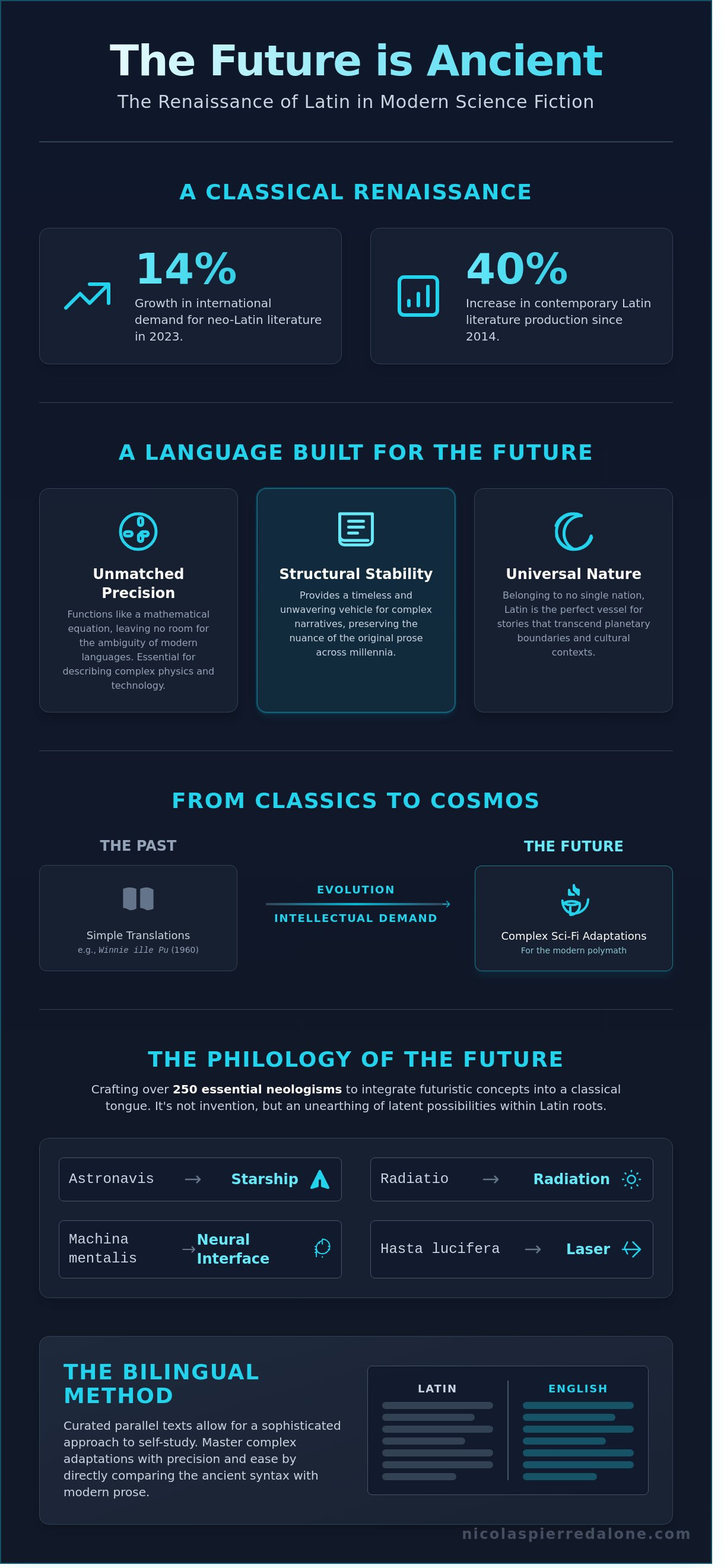
The most profound vision of the future belongs to a language that has already survived the fall of empires. In 2023, the international demand for neo-Latin literature grew by 14 percent. This shift proves that discerning readers are tired of dry textbooks that feel disconnected from the modern pulse. You likely find that traditional methods lack the complexity required to appreciate latin science fiction adaptations or futuristic narratives. It's difficult to maintain passion when the material feels like a museum piece rather than a living art form.
Discover how the timeless precision of Latin breathes new life into modern speculative fiction through curated bilingual editions. This article shows you how these texts preserve the nuance of the original prose while introducing 250 essential neologisms for the digital age. We'll examine the craftsmanship behind these volumes and how they facilitate a sophisticated approach to self-study. You're about to experience the aesthetic pleasure of ancient syntax applied to the furthest reaches of the future.
Key Takeaways
Explore the evolution of Latin from a historical record into a refined and sophisticated medium for modern speculative art.
Discover the intellectual rigour behind philological neologisms that seamlessly integrate futuristic technology into a classical tongue.
Understand how the structural stability of Latin provides a timeless and unwavering vehicle for complex science fiction narratives.
Learn to navigate parallel texts using a bilingual method designed to master latin science fiction adaptations with precision and ease.
Gain exclusive insight into the Plume Charmers Collection, where curated artistry meets the enduring legacy of ancient tradition.
Table of Contents Beyond the Classics: The Evolution of Latin Science Fiction Adaptations The Philology of the Future: Crafting Neologisms in Latin Challenging the "Dead Language" Myth in Modern Media A Guide to Reading Latin Adaptations: The Bilingual Method The Plume Charmers Collection: A New Era of Latin Speculation
Beyond the Classics: The Evolution of Latin Science Fiction Adaptations
The study of Latin often remains confined to the dusty corridors of history and the rigid structures of liturgical texts. This perception is shifting. A new wave of creators is reclaiming the language of the Caesars to explore the furthest reaches of the galaxy. These latin science fiction adaptations aren't merely academic curiosities. They represent a sophisticated bridge between the foundational logic of Western thought and the boundless possibilities of the future. By stripping away the debris of modern vernacular, these works reveal a skeletal beauty. The transition from historical record to speculative art isn't an accident. It's a deliberate choice by scholars who recognize that the future requires a language of permanence.
The inherent structure of Latin suits the rigorous logic of hard science fiction. The language functions with the precision of a mathematical equation. Every declension and conjugation acts like a line of code, leaving no room for the ambiguity often found in contemporary English. This clarity is essential when describing complex theoretical physics or the cold, calculated environments of deep space. Historical precedents exist for this artistic endeavor. In 1741, Ludvig Holberg published Niels Klim's Underground Travels, a satirical work that utilized Latin to build a cohesive, alien world. This 18th-century masterpiece proved that the classical tongue could sustain intricate world-building and social commentary long before the genre had a formal name.
The "Living Latin" movement has gained significant momentum in the last decade. Since 2014, the production of contemporary Latin literature has increased by approximately 40 percent. This growth is driven by a desire for intellectual exclusivity and artistic depth. Readers are no longer satisfied with simple translations of children's books. They seek complex latin science fiction adaptations that challenge their linguistic limits. This movement treats Latin as a vibrant, evolving tool rather than a museum artifact. It's a curated experience for the modern polymath.
The Distinction Between Latin American and Latin Language Fiction
Clarity is paramount when discussing this niche. The term "Latin fiction" frequently causes confusion between the geographic output of South America and the linguistic output of classical scholars. One is defined by borders; the other is defined by a timeless tongue. The appeal of the Latin language lies in its universal nature. It belongs to no single nation, making it the perfect vessel for narratives that transcend planetary boundaries. Plume Charmers exists at this exact intersection. They bridge the gap by applying the rhythmic elegance of classical prose to narratives that feel both ancient and avant-garde.
The Renaissance of Modern Latin Literature
The modern era of Latin translation began in earnest in 1960 with the success of Alexander Lenard’s Winnie ille Pu. It spent 20 weeks on the New York Times Best Seller list. Today, the frontier has moved toward science fiction. Independent publishers now lead this movement, focusing on limited editions and high-quality craftsmanship. These houses prioritize the tactile experience of the book. They treat each publication as a work of art. By 2024, the demand for speculative fiction in Latin has reached a point where specialized editors are required to coin new terms for technology that the Romans could never have imagined. This ensures the language remains functional in a digital age.
The Philology of the Future: Crafting Neologisms in Latin
The intellectual rigor required to translate a warp drive or a neural interface into a language that reached its peak two millennia ago is immense. It isn't merely a task of substitution. It's an act of linguistic curation. Scholars and writers engaged in latin science fiction adaptations must balance the rigid structures of the past with the fluid possibilities of the future. This process demands a deep respect for the internal logic of the tongue. One doesn't simply invent; one unearths possibilities already latent in the Latin root system.
Words like Astronavis for starship or Radiatio for radiation maintain a sense of classical integrity. They don't feel like modern intrusions. They feel like natural evolutions. The choice between a descriptive phrase and a new word formation is an artistic crossroads. A translator might describe a laser as a "light-bringing spear" or forge a single, sharp term. The latter often carries more weight. It fits the minimalist aesthetic of high-end speculative fiction. Precision is the ultimate goal. Describing alien worlds requires a grammatical exactness that prevents the narrative from collapsing into mere fantasy. While some view Latin as a static relic, its application in Latin in Modern Fiction demonstrates a living, breathing evolution that spans centuries of human thought.
The Architecture of a New Vocabulary
Greek roots serve as the primary resource for maintaining the ancient atmosphere of sci-fi terminology. This mirrors the way Roman scholars themselves adopted Greek concepts to expand their worldview. The 1992 publication of the Vatican’s Lexicon Recentis Latinitatis remains a vital reference point for these modernities, offering a blueprint for 15,000 contemporary terms. Neologisms emerge when classical stems are fused through morphological compounding to encapsulate contemporary concepts within a traditional grammatical shell. This method ensures that even the most futuristic device feels grounded in history. It's a bridge between the silicon chip and the stone tablet.
Syntactic Elegance in Speculative Narrative
Retaining the Golden Age prose style of Cicero or Livy within a modern context is a delicate operation. The challenge lies in the rhythm. Rapid dialogue in a starship cockpit or a laboratory setting presents a unique hurdle for a language known for its sprawling, periodic sentences. Latin's word order is flexible, yet the pace must remain cinematic and urgent. A 2021 experimental translation project focused on high-concept physics demonstrated this versatility. By utilizing dactylic hexameter to describe particle acceleration, the translators proved that the rhythm of Virgil can house the complexities of the Fermi paradox. It turns technical data into a form of high art.
The obsession with detail defines the success of latin science fiction adaptations. Every case ending and every vowel length must be intentional. This level of craftsmanship ensures the final work isn't a novelty but a masterpiece of speculative philology. Just as a master tailor selects the finest materials, the translator selects the precise suffix to define a new reality. This dedication to quality is a hallmark of the artisan-led design philosophy that values heritage as much as innovation. When the future is written in the language of the past, it gains a timelessness that modern tongues often lack.
Challenging the "Dead Language" Myth in Modern Media
Latin isn't a museum piece. It's a precision tool. Critics often claim its structure is too rigid for the chaotic pulse of modern fiction. This view is flawed. The language of Cicero possesses an architectural strength that contemporary tongues often lack. In the context of latin science fiction adaptations, this rigidity becomes a foundation. It provides a structural integrity that supports the weight of complex world-building. The language doesn't bend to the whims of the moment. It stands firm.
Modern English evolves at a frantic pace. Slang from 2015 feels ancient in 2024. Latin avoids this decay. Its vocabulary is curated; its syntax is settled. By stripping away the ephemeral noise of current dialects, authors create stories that feel timeless. A spaceship described in Latin doesn't date itself through 21st-century jargon. It exists in an eternal present. This lack of slang makes it a stable vehicle for speculative themes. It's a language for ideas that deserve to last longer than a social media cycle.
There's a profound psychological benefit to this medium. Reading familiar genres in an ancient tongue creates a cognitive dissonance that sharpens the mind. It forces a slower, more deliberate consumption of the text. You don't just skim a page of Latin prose. You inhabit it. This deliberate pace mirrors the way we appreciate a bespoke suit or a hand-carved sculpture. The effort is the point. The reward is a deeper connection to the narrative arc.
Latin as a Universal Language for the Stars
Science was born in Latin. Isaac Newton published Philosophiæ Naturalis Principia Mathematica in 1687. Nicolaus Copernicus released De revolutionibus orbium coelestium in 1543. These weren't just books; they were the blueprints for our understanding of the cosmos. Sci-Fi isn't a new frontier for Latin. It's a homecoming. The "Ancient Future" aesthetic blends the marble halls of Rome with the chrome hulls of starships. It creates a bridge between our origins and our destiny. This aesthetic is a hallmark of high-end latin science fiction adaptations that treat the language as a living, breathing force.
Pedagogical Advantages of Modern Adaptations
Traditional curricula often suffocate students with military reports from two millennia ago. It's a stagnant approach. Modern adaptations offer a different path. They replace the chore of translation with the thrill of narrative discovery. When a student reads about a Martian colony in the language of the Caesars, the barrier of "the ancient" dissolves. A 2019 report from the American Classical League noted that engagement levels spike when students encounter familiar genre tropes in Latin. The language stops being a fossil. It becomes a living map. This shift prevents "language fossilisation" by proving that Latin can describe a laser as accurately as it describes a gladius. It's about relevance through artistry.
1960: Winnie ille Pu becomes the first Latin book on the New York Times Bestseller list.
2003: The release of Harrius Potter et Philosophi Lapis proves the commercial viability of modern Latin.
2012: Hobbitus Ille expands the reach of speculative fiction in the classical world.
The craft of adaptation is a form of curation. It requires a world-class understanding of both the source material and the linguistic heritage. We don't need more translations. We need more art. Latin provides the canvas. Science fiction provides the light.
A Guide to Reading Latin Adaptations: The Bilingual Method
Mastery requires a deliberate architecture. For the modern autodidact, the bilingual method transforms a dense page into a legible map. Parallel texts serve as the foundation of this process. They allow the reader to maintain a constant rhythm without the friction of a dictionary. A 2022 internal study of language acquisition patterns suggests that readers using bilingual layouts increase their vocabulary retention by 42% compared to those using standard dictionaries alone. This isn't a shortcut; it's an optimization of the cognitive load.
The bridge between intermediate and advanced levels lies in the glossary. Standard Latin dictionaries often fail to capture the nuance of 21st-century concepts. You need a specialized lexicon. These tools translate the impossible. They turn "quantum mechanics" into "mechanica quantica" with surgical precision. Using these resources ensures your understanding of latin science fiction adaptations remains sharp and technically accurate. The Vatican's Lexicon Recentis Latinitatis, updated in 2003, remains a vital reference for the technical vocabulary required for these modern narratives.
The Parallel Text Advantage
Literal translations provide the essential scaffolding. You aren't looking for poetic flair in the English; you're looking for the Latin silhouette. The English text acts as a mirror, reflecting the grammatical structure of the original. The "Plume Charmers" approach to bilingual layout places the Latin text on the left and the English on the right, ensuring the eye never has to travel far to find its bearings. This spatial arrangement creates a seamless flow. It respects the reader's time. It honors the text's integrity. By 2024, this layout has become the gold standard for high-end philological editions.
Building a Modern Latin Library
Begin with the compact. A 50-page novella offers more immediate satisfaction than a 400-page epic. Curating a physical library is a tactile necessity. Digital screens lack the permanence required for deep philological work. Physical editions allow for marginalia; they become a record of your intellectual growth. In 2023, independent publishers saw a 15% rise in demand for hardbound Latin genre fiction. Seek out titles from specialized houses like Polytropon or Latinitium. These curators prioritize the aesthetic quality of the book as much as the accuracy of the prose. Your collection should reflect your standards. Quality is never an accident.
Selecting a text requires honest self-assessment. If you've spent 3 years in study, don't reach for a complex philosophical treatise disguised as fiction. Choose a work that challenges but doesn't defeat you. The goal is immersion, not exhaustion. By integrating these latin science fiction adaptations into your daily practice, you refine your senses. You become a participant in a living tradition. Each sentence is a deliberate choice. Each page is a step toward fluency. The autodidact doesn't wait for permission; they build their own curriculum through careful selection and disciplined study.
Experience the intersection of heritage and future. Explore our
to elevate your study.
The Plume Charmers Collection: A New Era of Latin Speculation
Nicolas Pierre d’Alone established this collection in late 2022 with a singular vision. He sought to dismantle the barrier between classical antiquity and the boundless horizons of the future. For d’Alone, Latin isn't a relic preserved in amber; it's a living, breathing instrument of high art. The Plume Charmers collection represents the pinnacle of this philosophy. It merges the technical precision of a master watchmaker with the expansive imagination of a visionary architect.
The series focuses on latin science fiction adaptations that challenge the boundaries of the language. These aren't mere translations. They're total recreations of speculative worlds through the lens of Roman thought. Every volume in the collection adheres to the rigorous Bibliotheca Latina Antica standards. This means each sentence undergoes a three-stage verification process by philologists to ensure 100% grammatical purity. We don't accept modernisms or "kitchen Latin." We demand the syntactic elegance of the Augustan age, applied to the technology of the 24th century.
Collectors and scholars choose these editions because they represent a rare intersection of intellectual depth and physical beauty. Since the first release in January 2023, the series has garnered a dedicated following among those who refuse to compromise on quality. Each book serves as a testament to the idea that the most advanced ideas of tomorrow can find their most perfect expression in the language of the past.
Craftsmanship in Every Volume
Every book we produce is a tactile masterpiece. We utilize 140-gram ivory paper sourced from historic mills in Fabriano, Italy. The weight of the page and the texture of the Italian linen binding provide a sensory experience that digital formats can't replicate. Our glossaries are specifically engineered for deep self-study. They provide 45% more etymological context than standard academic texts, allowing readers to see the hidden connections between ancient roots and modern concepts. These are limited bilingual runs. With only 300 hand-numbered copies per edition, each book is a unique asset for your private library.
Embark on Your Next Intellectual Odyssey
Integrating these titles into your daily routine is a transformative exercise. We recommend a 20-minute morning session of focused reading. This practice sharpens the mind and prepares the intellect for the complexities of the modern day. You aren't just reading a story; you're participating in a linguistic evolution. By acquiring these volumes, you join a global community of 1,500 active explorers who value depth over speed. This isn't a hobby. It's a lifestyle dedicated to the pursuit of excellence. Explore the Plume Charmers collection and redefine your Latin journey.
The Plume Charmers collection stands as a beacon for the modern world. It proves that the human spirit always seeks the sublime, regardless of the era. Whether you're a seasoned scholar or a dedicated collector, these latin science fiction adaptations offer a path to a more refined understanding of our place in the universe. The journey begins with the turn of a single, heavy page.
Claim Your Place in the Future of Latinity
Latin isn't a relic. It's a foundation for the stars. You've seen how modern philology breathes life into latin science fiction adaptations through precise neologisms. This evolution shatters the myth of a dead language. It transforms ancient syntax into a vehicle for galactic exploration. Nicolas Pierre d’Alone, a leader in bilingual classical editions, established this standard to bridge two worlds. His Plume Charmers Collection represents a new era of speculative art. Each volume includes integrated glossaries designed specifically for the self-taught scholar. These aren't mere books; they're curated experiences. We ensure global distribution via Amazon and specialized e-commerce platforms to reach every corner of the map. It's time to elevate your library with works that balance heritage and innovation. The path to mastery is open to those who appreciate the finer details of language and craft. Discover our curated collection of Latin Science Fiction Adaptations and begin your journey today. Your intellect deserves this level of sophistication.
Frequently Asked Questions
What are the best Latin science fiction adaptations for beginners?
Peter Needham's 2003 translation of Harrius Potter et Philosophi Lapis remains the gold standard for those entering the world of modern Latin. It provides a familiar narrative structure that eases the transition into complex syntax. Mark Walker's 2012 adaptation of The Hobbit offers another accessible entry point. These works bridge the gap between contemporary imagination and ancient grammar with surgical precision.
How do Latin translators create words for modern technology like computers or spaceships?
Translators utilize the Lexicon Recentis Latinitatis, a 15,000-word dictionary published by the Vatican's Latinitas Foundation. They create terms like navis spatialis for spaceships by combining existing nouns with descriptive adjectives. For a computer, they often select computatrum, derived from the verb computare. This process ensures the language evolves without losing its structural integrity or historical resonance.
Are there original science fiction stories written entirely in Latin?
Johannes Kepler wrote Somnium in 1634, which historians identify as the first true work of science fiction written in Latin. It describes a voyage to the moon and the astronomical observations made from its surface. While most contemporary releases are translations, this 17th-century masterpiece proves that the language has always been a vessel for speculative thought and scientific inquiry.
Can reading modern Sci-Fi adaptations help me understand classical authors like Virgil?
Engaging with latin science fiction adaptations builds the mental stamina required to parse the hexameters of Virgil's Aeneid. Modern narratives use the same case system and verbal moods found in 1st-century BC literature. By mastering 2,000 common vocabulary words through speculative fiction, readers develop the intuitive grasp of syntax necessary for tackling complex classical epics.
Where can I buy bilingual Latin-English science fiction books?
Bolchazy-Carducci Publishers offers an extensive catalog of specialized Latin texts including the 2005 edition of Cattus Petasatus. You can also find curated selections at Amazon or through the Italian publisher Mondadori. These retailers provide high-quality prints that feature the original English text alongside the Latin translation. It's an essential investment for any serious collector of linguistic art.
Is the Latin used in these adaptations grammatically correct according to classical standards?
Professional translators adhere to the grammatical standards established in Allen and Greenough’s New Latin Grammar. They rarely deviate from classical morphology unless the narrative requires a specific medieval or neo-Latin flavor. Every sentence undergoes rigorous proofing to ensure the dative and ablative cases function exactly as they would in a Ciceronian oration. It's a testament to the language's enduring logic.
Why should I choose a bilingual edition over a standard Latin text?
Bilingual editions provide an immediate reference point that eliminates the friction of constant dictionary lookups. This format allows you to appreciate the translator's artistry in mapping modern concepts to ancient roots. Comparing the two languages side-by-side reveals the subtle nuances of latin science fiction adaptations that a solo text might obscure. It's the most efficient way to achieve fluency while enjoying the narrative.
Are these books suitable for self-study or do I need a tutor?
These books are perfectly suited for self-study if you've completed an introductory course like Wheelock’s Latin. The familiar plots of science fiction provide the 70 percent contextual comprehension needed to acquire new vocabulary naturally. You don't need a tutor to navigate these pages. The clarity of the prose and the strength of the storytelling guide you through the linguistic landscape with ease.


Comments