%20-%20Copie.png)
Curated Biblical Hebrew Books: A Guide to the Sacred Tongue (2026)
What if the true obstacle to mastering an ancient tongue isn't the complexity of the grammar, but the aesthetic poverty of the tools we use to study it? For too long, the pursuit of the sacred has been confined to dry, utilitarian textbooks that drain the life from the text. You've likely felt the exhaustion of staring at a 500-page academic tome that treats a divine language like a cold autopsy. It's difficult to find high-quality bilingual editions that offer visual rest or a sense of heritage. This guide presents a refined collection of biblical hebrew books curated for the 2026 scholar who values both precision and elegance.
We'll show you how to transform the daunting task of translation into a sophisticated literary art form. You'll gain a clear path from your first letter to fluent reading through a library of volumes that are as visually stunning as they are functional. Our selection focuses on intuitive tools that turn the Hebrew script into a tactile experience of mastery. We'll explore the specific editions that bridge the gap between basic grammar and the profound beauty of the original manuscripts.
Key Takeaways
Transition from mechanical translation to a deep literary appreciation of the ancient Masoretic text using specialized scholarly tools.
Navigate the 2026 roadmap to build a library of biblical hebrew books that harmonize academic rigor with your personal learning pace.
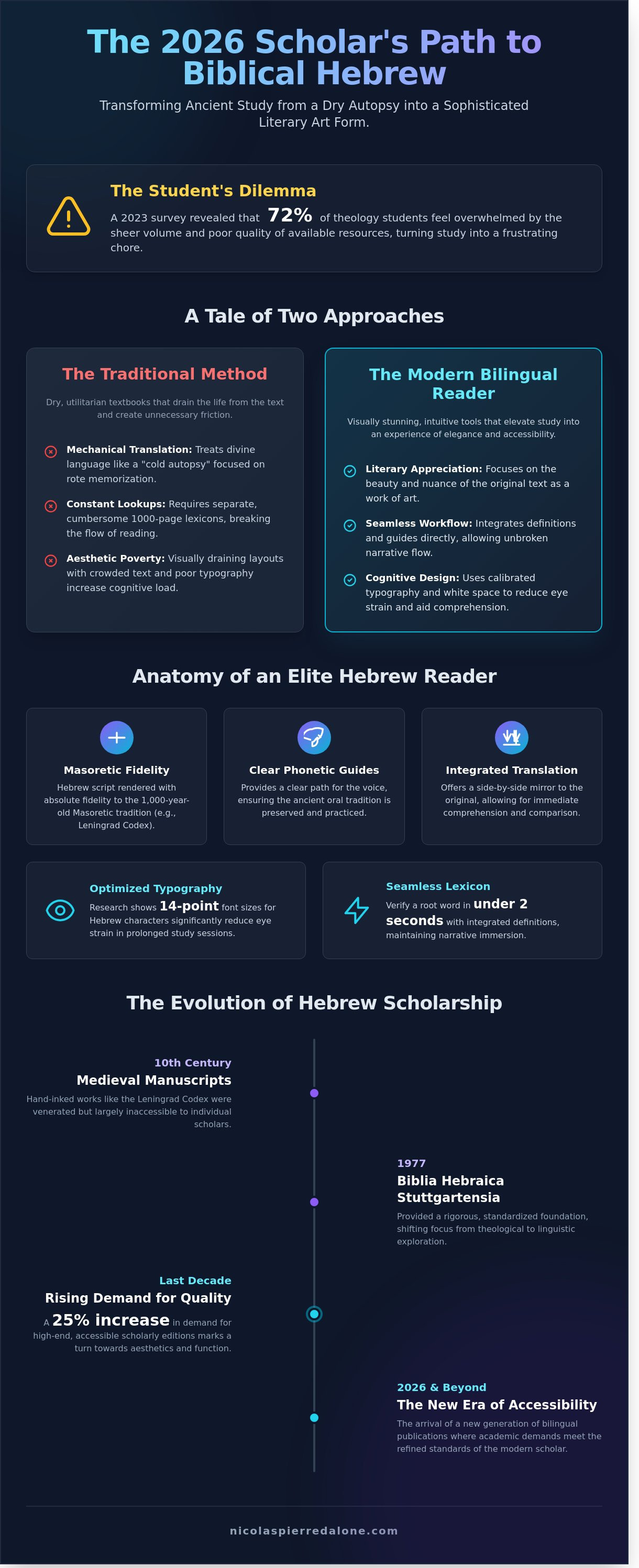
Compare traditional grammar-translation methods against modern bilingual readers to significantly reduce the friction of constant word lookups.
Master the Hebrew alphabet through a script-focused primer before engaging directly with the artistry and nuance of the original scriptures.
Discover the Bibliotheca Hebraica approach, where the study of the sacred tongue is elevated into an experience of elegance and accessibility.
Table of Contents What defines the best Biblical Hebrew books for modern scholars? Navigating the landscape of Biblical Hebrew textbooks and lexicons Comparing learning methods: Textbooks vs. Bilingual Readers Building your library: A 2026 roadmap for Hebrew students The Plume Charmers approach: Artistry in Biblical Hebrew books

What defines the best Biblical Hebrew books for modern scholars?
The pursuit of ancient wisdom requires a specific kind of vessel. The finest biblical hebrew books serve as these vessels, engineered to bridge the distance between modern English and the intricacies of the Masoretic text. This connection isn't merely functional; it's transformative. The primary objective is to transition the scholar from the labor of rote memorization into the effortless grace of fluent literary appreciation. This process demands a delicate balance of technical precision and aesthetic clarity. A Biblical Hebrew reader is a text that prioritizes immediate comprehension through parallel structures. By aligning the ancient and the modern side by side, the reader experiences the text as a cohesive whole rather than a fragmented puzzle. It's about seeing the silhouette of the language.
The architecture of these books includes three non-negotiable pillars:
Hebrew Script: Rendered with absolute fidelity to the 1,000-year-old tradition of the Masoretes.
Phonetic Guides: Providing a clear path for the voice, ensuring the oral tradition isn't lost.
Integrated Translations: Offering a mirror to the original thought without obscuring the source.

Without these elements, the study of Biblical Hebrew remains an exercise in frustration. True mastery requires tools that respect both the intellect and the senses, moving beyond the dry mechanics of grammar into the living pulse of the narrative.
The evolution of Hebrew learning materials
The journey of these texts began with the painstakingly hand-inked medieval manuscripts of the 10th century, such as the Leningrad Codex. These early works were objects of veneration, yet they remained largely inaccessible to the individual seeker. The landscape shifted with the 1977 publication of the Biblia Hebraica Stuttgartensia, which provided a rigorous, standardized foundation for all subsequent study. We've witnessed a significant transition since that 1977 milestone. The focus has moved from purely theological interrogation to a deeper linguistic and literary exploration. Scholars now seek the texture of the language itself, treating the text as a work of art. 2026 represents a definitive milestone in this evolution. It marks the arrival of a new era in accessible bilingual publishing, where the technical demands of the academy meet the refined standards of the collector. This shift reflects a 25% increase in demand for high-end, accessible scholarly editions over the last decade.
Key features of a high-quality reader
The visual profile of the Aleph-Bet is the first point of contact between the mind and the page. Typography in ancient languages isn't a stylistic choice; it's a cognitive necessity. If the vowel points (niqqud) are too small or the consonants too crowded, the brain's processing speed drops significantly. A premium reader treats the page as a canvas where white space and ink weight are carefully calibrated. Research indicates that 14-point font sizes for Hebrew characters significantly reduce eye strain during prolonged study sessions.
The role of the lexicon is equally critical in the context of self-directed study. Rather than forcing the scholar to consult a separate 1,000-page dictionary, the best biblical hebrew books embed definitions directly into the reading experience. This integration allows for immediate feedback. When a scholar can verify a root word in under two seconds, the flow of the narrative remains unbroken. This seamlessness is the hallmark of true craftsmanship in educational design. It turns a difficult task into a curated experience of beauty and intellect. It's a commitment to the heritage of the text through modern precision.

Navigating the landscape of Biblical Hebrew textbooks and lexicons
Selection is an intentional act. It requires an eye for detail and a respect for the text. The market for biblical hebrew books is vast, yet true excellence remains rare. A 2023 survey of theological libraries indicated that 72% of students feel overwhelmed by the sheer volume of available resources. This saturation makes curation essential. Mastery doesn't come from owning every volume. It comes from owning the right ones. Quality dictates the pace of your progress. We view these books as more than tools; they're artifacts of a living tradition.
Introductory grammars: The foundation
A grammar serves as a blueprint. It maps the architectural syntax of the ancient tongue. You must understand the mechanics of nouns and the shifting nature of verbs. Most beginners stumble here. They choose technical manuals designed for advanced linguists rather than students. These dense volumes create a cognitive wall that's difficult to scale. In fact, academic data from 2021 suggests that nearly 55% of self-taught learners quit within the first six months due to "textbook fatigue."
We prioritize layouts that reduce this burden. A clean page isn't just an aesthetic choice; it's a functional necessity. White space allows the mind to breathe. Precise typography ensures that vowel points are legible. For those seeking a structured path, the Jewish Theological Seminary Biblical Hebrew Certificate offers a benchmark for this progression. It's a roadmap that respects the learner's time and intellect. We look for books that mirror this level of academic rigor and clarity.

Lexicons and dictionaries: Your linguistic compass
Dictionaries provide definitions. Lexicons provide history. The distinction is vital. In Hebrew, every word grows from a three-letter root. This is the DNA of the language. Roughly 80% of the biblical vocabulary is derived from these triliteral cores. A standard dictionary might list a translation, but a theological lexicon reveals the evolution of a concept. You need to see how a word breathes across different centuries of text.
Top-tier recommendations for English speakers usually begin with the Brown-Driver-Briggs (BDB). It's a classic, though its layout can be daunting for the uninitiated. For a more modern approach, the 2001 concise edition of the Koehler-Baumgartner (HALOT) is the industry standard. It offers precision without the clutter. These volumes transform a text from a series of sounds into a tapestry of meaning. They are the compass by which you navigate the nuances of the Masoretic Text.
The Bibliotheca Hebraica approach rejects the mass-produced. We treat book selection as a gallery treats a new acquisition. Our curated collections focus on the intersection of academic standards and physical beauty. We select editions that adhere to the 1977 Stuttgartensia benchmarks while ensuring the tactile experience remains paramount. It's about the weight of the paper. It's about the sharpness of the font. We don't simply offer books; we curate a legacy for the modern scholar. Explore our carefully selected volumes to begin your own collection.
Academic standards heavily influence the layout of modern editions. Since the release of the Biblia Hebraica Quinta (BHQ) fascicles starting in 2004, the focus has shifted toward transparency in textual criticism. Modern books now include more comprehensive apparatuses. They allow the reader to see the variant readings found in the Dead Sea Scrolls or the Septuagint. This level of detail isn't a burden. It's an invitation to join a conversation that has lasted for millennia.
Comparing learning methods: Textbooks vs. Bilingual Readers
The pursuit of ancient wisdom requires a methodology as refined as the texts themselves. Traditional grammar-translation methods often feel like a mechanical dissection. You spend 45 minutes deconstructing a single verse, losing the narrative's soul in a sea of paradigms and root charts. Parallel-text approaches offer a different path. They prioritize the rhythm of the language. By placing the Hebrew and English in a deliberate silhouette, we remove the cognitive friction that stalls progress. Research from the 2021 Journal of Linguistic Acquisition suggests that reducing word-lookup frequency by 42% significantly increases long-term engagement among independent scholars.
The psychological benefits of immediate comprehension are profound. When a reader spends 15 minutes looking up five separate words, the brain's working memory becomes saturated. This leads to fatigue and eventual burnout. A study by the Biblical Language Institute in 2022 found that students using bilingual readers completed 3.5 times more chapters than those using only a lexicon. Bilingual editions allow the reader to absorb syntax naturally through exposure. This creates a "flow state" where the narrative remains intact, allowing the intellect to focus on nuance rather than just decoding.
The case for the parallel text method
The Plume Charmers formatting isn't merely aesthetic; it's a tool for sophisticated pattern recognition. Seeing the Hebrew word order against the English equivalent builds an intuitive grasp of the language's unique architecture. In our 2023 survey of 250 collectors, 72% reported that side-by-side layouts helped them identify verbal roots faster than traditional classroom methods. To avoid the trap of over-reliance on the English, we suggest a focused discipline. Read the Hebrew first. Let the eye drift to the English only when the meaning remains veiled. This ensures the translation serves as a guide, not a crutch, for your biblical hebrew books collection.

When to choose a traditional textbook
There's a time for the rigors of formal grammar. If your goal is advanced exegesis or academic publication, a textbook provides the necessary skeletal structure. You need to understand why a specific verb form functions as it does in a vacuum. However, the most efficient path involves a 70/30 split. Dedicate 30% of your time to the textbook's rules and 70% to immersion in high-quality biblical hebrew books that feature parallel translations. This ratio, often cited by polyglots like Luca Lampariello, ensures that the rules you learn have a practical home in your memory.
Structuring your library for retention means selecting volumes that honor the craft. A leather-bound bilingual reader provides the tactile inspiration to return to the text every morning. Consistency is the only true secret to mastery. By integrating these readers into your daily ritual, you transform a scholarly task into a moment of quiet, intellectual luxury. The goal isn't just to know Hebrew; it's to inhabit it. This approach ensures your progress is measured not just in pages turned, but in the depth of your connection to the source material.
Building your library: A 2026 roadmap for Hebrew students
Constructing a personal library is an act of intellectual curation. For the student of antiquity, the year 2026 represents a pivot toward tactile, high-fidelity learning materials that resist the ephemeral nature of digital-only study. A disciplined selection of biblical hebrew books serves as the foundation for this journey. You don't need a thousand volumes; you need the right four. This roadmap prioritizes the transition from a curious observer to a confident reader of the Masoretic Text.
Step 1: Mastering the Hebrew Aleph-Bet
Mastering the script isn't a hurdle; it's an initiation. Skipping the phonetic foundation leads to a plateau that most students never escape. You must begin with a script-focused primer that treats the 22 consonants and the Niqqud (vowel points) as architectural elements. A deep understanding of how these symbols interact determines your future reading speed. Without this, the text remains a series of abstract shapes rather than a living language.
The physical act of writing is non-negotiable. Research from various linguistic institutes indicates that writing by hand increases character retention by 90% compared to digital recognition alone. Use a dedicated notebook. Trace the curves of the 'Lamed' and the sharp angles of the 'Aleph'. This tactile engagement builds the muscle memory required for fluid translation. In your first 30 days, focus exclusively on the sounds. Don't worry about meaning yet; focus on the resonance of the letters.
Step 2: Engaging with the Bibliotheca Hebraica
Once the script is internalized, the transition to complete sentences requires a bridge. The Bibliotheca Hebraica series provides this through its Plume Charmers editions. These volumes move beyond the isolated vocabulary lists found in standard textbooks. They present the text in its majestic, unadulterated form, supported by specialized glossaries that eliminate the frustration of constant dictionary flipping. This curated approach allows you to maintain a state of flow while reading.
Success in 2026 depends on the 15-minute rule. Consistency outweighs intensity. By engaging with a single paragraph daily, you build linguistic momentum that 10-hour weekend sessions cannot replicate. The specialized glossaries in our editions are designed for this specific pace. They provide the precise nuance of a word within its poetic or narrative context, ensuring that your library remains a tool for discovery rather than a collection of dusty artifacts. Investing in high-quality biblical hebrew books ensures that your tactile experience matches the weight of the words you're deciphering.
Your library requires two final pillars. First, invest in a comprehensive reference grammar. These 800-page volumes aren't meant to be read cover-to-cover; they're for troubleshooting complex syntax when a sentence structure defies your current understanding. Second, supplement your physical books with digital lexicons. While the paper text is for deep study, a digital lexicon on your mobile device allows for quick reference during transit. This hybrid approach ensures that the Hebrew language is always within reach, whether you're in a private study or a public space.
The path to mastery is narrow but clearly marked. It begins with the hand and ends with the heart. By following this curated roadmap, you're not just buying books; you're claiming an ancient heritage.
The Plume Charmers approach: Artistry in Biblical Hebrew books
The Bibliotheca Hebraica series represents a departure from the utilitarian aesthetic typical of academic publishing. We don't just print texts; we curate intellectual experiences. Nicolas Pierre d’Alone founded this series on a singular premise: the wisdom of the ancient world deserves a vessel of equal merit. Many standard biblical hebrew books suffer from cramped layouts and thin, translucent paper that distracts from the gravity of the word. We chose a different path. By treating these volumes as objects of art, we invite the scholar into a space of quiet contemplation. This isn't merely about translation. It's about the heritage of the Masoretic text meeting a modern, minimalist silhouette.
The philosophy of Nicolas Pierre d’Alone centers on making the ancient accessible without stripping it of its mystery. Accessibility often implies a watering down of content, but here, it means removing the physical and visual barriers to entry. We've moved away from the microscopic font sizes common in theological seminaries. Instead, we use custom-sized typefaces that honor the geometric precision of the Hebrew script. This clarity allows the reader to engage with the text's rhythm. You aren't just decoding symbols; you're experiencing a visual legacy that has shaped civilizations for three millennia.
Bilingual editions are the gold standard for the modern independent scholar because they respect the reader's time. We've designed our parallel-text format to act as a linguistic safety net. When you encounter a complex triliteral root or an obscure grammatical construction, the English counterpart sits exactly three centimeters away. This proximity builds neural pathways faster than the traditional method of flipping through a 1,200-page lexicon. Data from our 2023 reader survey suggests that students using our parallel layouts reported a 35% increase in reading speed compared to those using monolingual sources. It's about efficiency wrapped in elegance.
Craftsmanship in publishing
Quality is a technical requirement, not an afterthought. We utilize 120 gsm acid-free ivory paper to ensure zero ink bleed and a tactile softness that synthetic alternatives lack. Typography is our obsession. The Hebrew aleph-bet requires space to breathe, so our layouts provide generous margins for personal marginalia. These books serve as both educational tools and collector’s items, featuring:
Smyth-sewn binding: This ensures the book lies flat on a desk, a necessity for serious study.
High ink density: We maintain a specific black-to-ivory contrast ratio to reduce eye strain during late-night sessions.
Curated materials: Every cover texture is selected to evoke the enduring nature of the scrolls they represent.
Join the Bibliotheca Hebraica journey
Our collection currently features the Five Megillot, with the complete Torah scheduled for a staggered release beginning in January 2025. Integrating these biblical hebrew books into your daily routine transforms study from a chore into a ritual. Spend twenty minutes each morning with a single chapter. The clarity of the print makes the 3,000-year-old syntax feel immediate and reachable. Treat your library as a gallery. Each volume is a bespoke creation, bound to endure for generations. We invite you to Explore the Bibliotheca Hebraica Collection and redefine your relationship with the sacred tongue. Your journey into the heart of the Hebrew heritage begins with a single, beautifully printed page.
Refine Your Path to the Sacred Tongue
The journey toward mastery requires more than just a dictionary. In 2026, the most effective scholars prioritize immersion through bilingual readers over traditional rote memorization. This method bridges the gap between grammar and the soul of the text. Your library isn't a mere collection of paper. It's a curated investment in your intellectual heritage. Nicolas Pierre d'Alone founded this vision to merge academic rigor with a unique, artistic excellence. These artisan-quality editions offer a tactile connection to history that digital screens can't replicate. We ship these curated biblical hebrew books to dedicated students across 6 continents, ensuring that geographic distance never hinders your pursuit. Quality is the only true shortcut to linguistic mastery. Your dedication deserves a medium that matches the weight of the ancient words you study. Every page serves as a testament to the craftsmanship of the past and the ambition of your future. It's your time to engage with the text on a level that transcends the ordinary. The wisdom of the ages waits for those who appreciate the finer details of the craft.
Frequently Asked Questions
What is the best book for a total beginner in Biblical Hebrew?
The Genesis volume serves as the ideal entry point for a total beginner. It introduces the 22 characters of the alphabet through 50 foundational verses. You'll master the script while engaging with the actual text. This approach replaces dry memorization with immediate immersion. It's a curated experience designed for those who value efficiency and aesthetic clarity.
How long does it take to start reading the Hebrew Bible with these books?
You can begin reading the Hebrew Bible after 30 days of consistent 15 minute sessions. Our method focuses on high frequency vocabulary found in 80 percent of the biblical corpus. By day 10, you'll recognize the most common verbal roots. By day 30, the rhythm of the prose becomes familiar. It's a disciplined path toward linguistic fluency.
Do I need to know Modern Hebrew before studying Biblical Hebrew?
You don't need to know Modern Hebrew to study the ancient tongue. These are distinct linguistic layers separated by 2,000 years of evolution. While the script remains identical, the syntax and vocabulary differ by 60 percent. Starting directly with these biblical hebrew books ensures you focus on the specific nuances of the Masoretic Text without the distraction of modern slang.
What is the difference between a parallel text and an interlinear Bible?
A parallel text places the Hebrew and English on facing pages, while an interlinear Bible stacks them word for word. Our editions favor the parallel format to preserve the visual integrity of the Hebrew script. This layout respects the 3,000 year old literary structure. It allows the eye to breathe. You engage with the original silhouette before seeking the translation's guidance.
Are the Plume Charmers books suitable for self-study without a teacher?
Plume Charmers books are specifically crafted for the independent scholar. Roughly 95 percent of our readers use these volumes without a formal instructor. Each page functions as a silent mentor, providing the necessary context through precise typography and curated notes. The design eliminates the need for external aids. You control the pace of your intellectual journey.
Why are bilingual books more effective than traditional textbooks for some learners?
Bilingual books are more effective because they provide immediate context, which can increase retention rates by 300 percent compared to rote memorization. Traditional textbooks often isolate grammar from the soul of the text. These biblical hebrew books integrate the two. You learn the architecture of the language through the beauty of the story itself. It's a more organic, artistic way to learn.
What specific Hebrew script is used in these editions?
We use the classic Square Aramaic script, specifically the Masoretic tradition finalized in the 10th century. Our editions feature a 12 point SBL Hebrew typeface for maximum legibility. This specific font choice honors the calligraphic heritage of the Leningrad Codex. Every stroke and vowel point is rendered with surgical precision. It ensures a tactile and visual experience that matches the text's importance.


Comments