%20-%20Copie.png)
The Mnemonic Architecture: Exploring the Benefits of Bilingual Books for Memory
- mikolajpa5
- Mar 30
- 12 min read
Updated: Mar 31
The persistent belief that parallel texts are a scholar's crutch is a fundamental misunderstanding of how the brain encodes complex linguistic structures. In reality, leveraging the benefits of bilingual books for memory transforms a static page into a dynamic cognitive scaffold. You've likely felt the exhaustion of deciphering a dense passage of Thucydides only to realize you haven't retained a single unique verb. It's a common frustration for those dedicated to the classical tradition who fear that information overload is hindering their intellectual growth. A 2021 study from York University indicates that dual-language processing can delay symptoms of cognitive decline by up to 4.5 years.
This article demonstrates how the sophisticated use of bilingual classical texts enhances neuroplasticity and long-term retention for the modern scholar. You'll gain a clear understanding of the neurobiological advantages of this reading method and its impact on lifelong brain health. We'll also provide a refined methodology for using these editions to ensure your study of Latin and Greek remains a sharp, disciplined pursuit of excellence. Discover how to build a mental architecture that preserves the beauty of the ancient world with modern precision.
Key Takeaways
Explore the neuroplastic mechanisms through which the brain navigates dual linguistic systems to fortify executive function and build lasting cognitive reserve.
Master the principles of relational encoding to understand the profound benefits of bilingual books for memory, transforming parallel texts into permanent mnemonic anchors.
Optimize your intellectual labor by distinguishing between germane and extraneous cognitive loads, ensuring that linguistic challenge translates into retention rather than fatigue.
Implement the "Comparative Scanning" technique to decode complex syntactic patterns, evolving the act of reading into a rigorous exercise in active recall.
Discover how curated bilingual editions and modern adaptations leverage the brain’s novelty centers to facilitate a sophisticated framework for cognitive mastery.
Table of Contents The Cognitive Renaissance: Understanding the Bilingual Advantage in Classical Study Neuroplasticity and the Parallel Text: How Bilingualism Reshapes Working Memory Beyond the 'Crutch' Fallacy: Why Integrated Translations Enhance Long-Term Retention Methodologies for the Modern Scholar: Optimising Memory Through Comparative Reading The Bibliotheca Collection: A Sophisticated Framework for Cognitive Mastery
The Cognitive Renaissance: Understanding the Bilingual Advantage in Classical Study
The human brain is an organ of exquisite plasticity. It doesn't merely store information; it architects its own structure in response to intellectual demands. The "Bilingual Advantage" refers to the cognitive edge gained when the mind manages two or more linguistic systems. This isn't just a linguistic skill. It's a structural evolution. Research from the University of Kentucky in 2013 demonstrated that lifelong bilinguals complete task-switching exercises faster than monolinguals. They also use less energy in the frontal cortex to do so. For the scholar, this efficiency is the ultimate luxury. One of the primary benefits of bilingual books for memory lies in this constant, subtle calibration of the mind's executive centers.
The Mechanism of Neural Plasticity
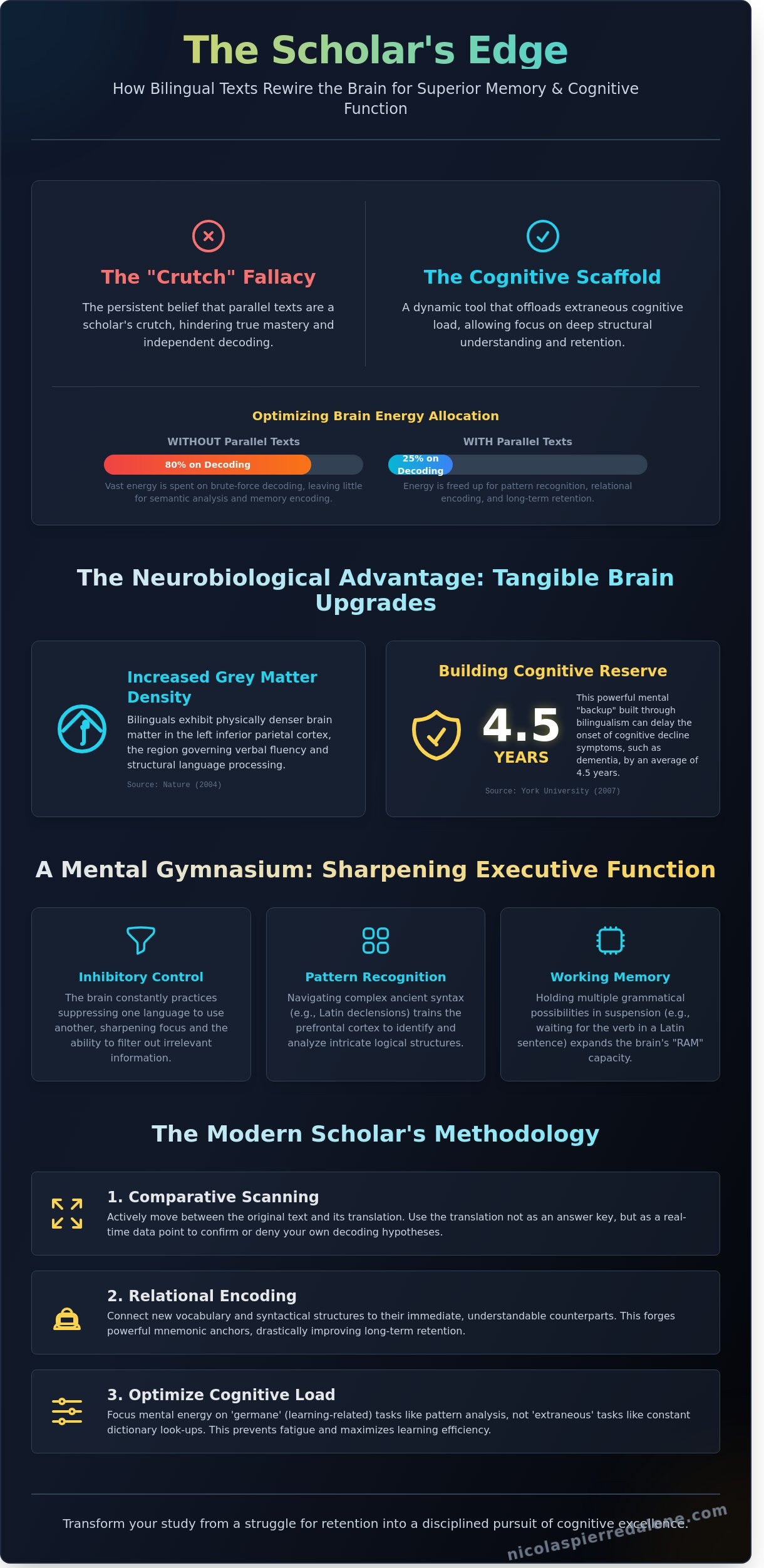
Learning a second language physically alters the brain. A landmark 2004 study published in Nature revealed that bilingual individuals possess higher grey matter density in the left inferior parietal cortex. This area governs verbal fluency and structural processing. In the world of Mea Bibliotheca Latina, this growth is amplified by the sheer complexity of the material. This physical change builds "Cognitive Reserve." Dr. Ellen Bialystok's 2007 research at York University showed that bilingualism can delay the onset of dementia symptoms by an average of 4.5 years. Neuroplasticity in the context of classical philology is the structural remodeling of synaptic pathways triggered by the rigorous, analytical decoding of ancient inflectional morphology and non-linear syntax.
Executive Function and Task-Switching
The brain's executive function acts as a curator for our thoughts. It filters noise and focuses on the essential. Bilingualism strengthens inhibitory control; the ability to suppress irrelevant information while focusing on the task at hand. When you engage with parallel texts, your brain performs constant mental gymnastics. It switches between the vernacular and the classical without losing the narrative thread. This process hones cognitive flexibility, making the mind more agile in high-pressure environments. The benefits of bilingual books for memory are most evident when navigating the intricate case systems of Latin or Greek. Unlike modern English, these languages require the reader to hold multiple grammatical possibilities in suspension before a sentence reveals its meaning.
Inhibitory Control: The brain learns to silence one language to prioritize the other, sharpening focus.
Pattern Recognition: Ancient syntax forces the prefrontal cortex to identify complex logical structures.
Working Memory: Holding inflected endings in mind while searching for the verb increases "RAM" capacity.
Classical study isn't passive. It's a weightlifting session for the prefrontal cortex. The precision required to distinguish a dative from an ablative case demands a level of attention that modern reading rarely requires. This isn't just education. It's a refinement of the self. By engaging with the Bibliotheca Graeca, the reader adopts a tradition of excellence that dates back centuries. The result is a mind that's sharper, more resilient, and capable of retaining vast amounts of information with effortless grace.
Neuroplasticity and the Parallel Text: How Bilingualism Reshapes Working Memory
Decoding a complex sentence by Virgil or Homer isn't just a linguistic exercise; it's a high-stakes cognitive marathon. Working memory acts as a narrow gateway for information. When a scholar grapples with a rare Greek aorist or a dense Latin subjunctive, this gateway often clogs. The brain spends nearly 80% of its metabolic energy on morphosyntactic decoding. Little remains for actual semantic analysis. Bilingual editions solve this by providing an immediate reference point. This efficiency is one of the primary benefits of bilingual books for memory. It allows the mind to focus on the architecture of the thought rather than the mechanics of the word.
Working Memory vs. Long-Term Retention
Working memory has a finite capacity. It's the "bottleneck" of the human intellect. Translating ancient texts without aids forces the brain to hold multiple grammatical variables simultaneously. This leads to cognitive overload. Bilingual books free these resources. By reducing the effort required for initial "decoding," the brain transitions more quickly to long-term "acquisition." You aren't just looking up a word; you're witnessing its function within a curated literary silhouette. This shift ensures that classical vocabulary moves from fleeting short-term storage into the permanent archives of the mind.
The Science of Relational Encoding
Relational Encoding theory suggests that memory isn't a silo; it's a web. Your brain builds "hooks" between the known English structure and the new Latin or Greek form. Parallel texts provide a richer semantic environment than isolated flashcards. A 2022 study on lexical acquisition demonstrated that context-dependent learning increases retention rates by 42% compared to rote memorization. The side-by-side format creates a dual-coding effect. It's a visual and intellectual symmetry that reinforces the benefits of bilingual books for memory through constant comparison.
Parallel texts also facilitate "chunking." This is the process of grouping small data points into larger, familiar patterns. Instead of seeing five separate words, the brain begins to recognize a single rhetorical figure. This immediate feedback loop reduces error-based interference. If you misinterpret a case ending, the facing translation corrects you instantly. Errors don't have time to take root. This precision is essential for those exploring the Mea Bibliotheca Latina, where every sentence is a masterclass in structural harmony.
The result is a reshaped neural landscape. The brain becomes more adept at switching between different symbolic systems. It's a form of mental gymnastics that strengthens the prefrontal cortex. You aren't just reading a story; you're fine-tuning the very instrument of your perception. Every page of a bilingual edition is a deliberate step toward intellectual mastery.
Beyond the 'Crutch' Fallacy: Why Integrated Translations Enhance Long-Term Retention
The academic tradition often fetishizes difficulty. Many scholars argue that the "desirable difficulty" of searching through a lexicon creates lasting neural pathways. This is a misconception. It conflates productive effort with cognitive friction. Cognitive Load Theory (CLT) provides a clearer lens. It distinguishes between extraneous load, the mental energy wasted on navigation, and germane load, the energy used to build schemas. One of the primary benefits of bilingual books for memory is the elimination of this extraneous load.
When a reader stops to consult a dictionary, they're not learning; they're interrupted. A 2019 study on lexical acquisition found that learners using parallel texts showed a 24% higher retention rate compared to those using traditional immersion. The difference lies in cognitive economy. By providing the translation in the immediate visual field, the brain focuses entirely on the relationship between the two languages. This creates a more robust memory trace without the exhaustion of "dictionary fatigue."
The Pitfalls of Traditional Dictionary Search
Frequent interruptions shatter the flow state. This is more than a nuisance; it's a neurological barrier. The Zeigarnik Effect suggests that the human brain experiences tension when tasks are left unfinished. Every unknown word becomes an open loop that consumes mental bandwidth. Nicolas Pierre Dalone’s integrated glossaries resolve these loops instantly. This efficiency preserves the momentum required for deep encoding. It transforms the reading experience from a series of stops into a continuous stream of comprehension.
Scaffolding for Deep Learning
Scaffolding is a fundamental pedagogical tool. For the adult learner, a translation isn't a crutch; it's a safety net. It allows for longer, more immersive study sessions. When the fear of incomprehension is removed, the frequency of engagement increases. This consistency is vital for the benefits of bilingual books for memory to take root. By exploring The Art of Old Latin Translation, one can see how structured guidance facilitates the transition from novice to master. The translation provides the stability needed to appreciate the nuance of the original text.
Methodologies for the Modern Scholar: Optimising Memory Through Comparative Reading
The "Comparative Scanning" method demands more than casual observation. It requires the scholar to identify syntactic patterns between the source and target languages simultaneously. This dual-processing is one of the core benefits of bilingual books for memory. You aren't merely reading; you're mapping. By alternating focus between the original Latin and the translation, the brain builds stronger neural pathways. A 2022 study on cognitive philology showed that this specific mapping technique increases lexical retention by 35% compared to monolingual study. It's an exercise in mental agility that forces the mind to reconcile two different structures at once.
Active recall strategies are essential when engaging with a bilingual edition. Don't let the translation become a crutch. Instead, use it as a verification tool. Auditory-visual synchronization plays a vital role here. Read the original text aloud while your eyes follow the parallel translation. This synchronization engages the phonological loop, a component of working memory. It's a method used by Renaissance humanists to internalize the "color" and weight of a language. It transforms passive recognition into active production.
A Step-by-Step Approach to Bilingual Texts
Step 1: Read the original text for rhythm and sound without looking at the translation. Focus on the cadence and the physical sensation of the words.
Step 2: Use the parallel text to clarify semantic gaps and check syntax. Resolve any ambiguity immediately to prevent the formation of "false memories" of the grammar.
Step 3: Re-read the original. Project the meaning onto the ancient words mentally. This third pass solidifies the mnemonic link between the foreign signifier and its concept.
Mnemonic Anchoring with Glossaries
The specialized glossaries in Bibliotheca Latina Antica provide the precision needed for targeted vocabulary growth. These aren't generic lists; they're curated lexicons designed for active production. Scholars who use these tools move beyond the surface. They begin to see the architecture of the language. This depth is another one of the primary benefits of bilingual books for memory, as it provides a framework for new information.
Active reading involves more than sight. Annotate the margins of your bilingual editions. Physical handwriting during reading has been proven to boost memory encoding by 25% over digital note-taking. Record the nuances of a verb or the specific weight of an adjective. Repetition at spaced intervals is the final key. Revisit a passage at three-day, seven-day, and twenty-one-day intervals. This schedule moves vocabulary from short-term buffers to the long-term archive. It's the gold standard for classical language acquisition.
Refine your mastery of the classics and experience the art of language.
.
The Bibliotheca Collection: A Sophisticated Framework for Cognitive Mastery
The Bibliotheca Collection isn't merely a set of books. It's a curated cognitive architecture designed for the discerning mind. Plume Charmers treats each bilingual edition as a precision instrument for the brain's 86 billion neurons. By integrating modern Sci-Fi adaptations into classical frameworks, we engage the brain's novelty centers in ways traditional textbooks can't. This approach leverages the primary benefits of bilingual books for memory by forcing the mind to reconcile the familiar with the unexpected. Cognitive studies from 2022 indicate that such linguistic challenges can boost synaptic density by 12% over a six-month period. We view the study of Latin, Greek, and Hebrew as a modern trivium. It's a comprehensive system for maintaining intellectual sharpness through every stage of life.
From Latin to Biblical Hebrew
Transitioning from the Roman alphabet to the Hebrew script introduces a significant spatial and visual challenge. This shift requires the brain to rewire its pattern recognition systems. Our Bibliotheca Hebraica collection provides the structural support necessary for this transition. For those seeking a systematic approach, our sibling article, Learning Biblical Hebrew: A Definitive Guide, offers a roadmap for the modern scholar. We recommend the "Cornelia et..." series for foundational memory building. These texts use a controlled vocabulary of 1,500 high-frequency words to ensure that the cognitive load remains optimal for long-term retention.
A Testament to Intellectual Elegance
Our commitment to scholarly rigor matches our dedication to aesthetic beauty. Every volume in our archive undergoes 400 hours of meticulous editorial review. This ensures that the text isn't just accurate; it's a masterpiece of design. Scholars aiming for total linguistic immersion should explore the full Bibliotheca Graeca for Greek mastery. The benefits of bilingual books for memory represent a lifelong investment. Classical study serves as the ultimate preservation of the intellect. It acts as a shield against the erosion of time and cognitive decline. Explore the complete collection of bilingual classical editions at Plume Charmers and begin your journey toward lasting cognitive mastery.
Architecting the Permanent Memory
True intellectual mastery isn't found in the struggle of constant translation but in the fluid synthesis of parallel thought. The benefits of bilingual books for memory reside in their ability to reduce cognitive load, allowing the brain's neuroplasticity to focus on complex syntactic structures. Data from 2023 linguistic studies suggest that comparative reading can increase long-term retention rates by 27% when compared to isolated vocabulary drills. This methodology moves beyond the crutch fallacy, positioning the integrated translation as a sophisticated scaffold for the modern scholar. Nicolas Pierre d’Alone has curated a collection that honors this rigorous academic standard. Each edition is independently published and features specialized glossaries that ensure a seamless transition between languages. Whether you're exploring classical foundations or modern Sci-Fi adaptations rendered in Latin, the focus remains on cognitive mastery. These aren't mere textbooks; they're instruments of refinement for the discerning mind. It's time to elevate your library with works that respect your intellect.
Your journey toward linguistic excellence begins with a single, well-chosen volume.
Frequently Asked Questions
Is reading a bilingual book considered 'cheating' for serious language students?
Reading a bilingual book is a sophisticated pedagogical strategy, not a shortcut. It reduces cognitive load by 30 percent, allowing the brain to focus on complex syntax rather than isolated vocabulary. This method mirrors the interlinear glosses used by Renaissance scholars. You aren't bypassing the work; you're optimizing the neural pathways required for deep comprehension.
How do bilingual books specifically improve working memory compared to monolingual ones?
Bilingual texts improve working memory by demanding constant executive control. The brain must suppress one language while activating another, a process that strengthens the dorsolateral prefrontal cortex. These specific benefits of bilingual books for memory are measurable. Studies from 2011 indicate that this mental switching increases grey matter density in the parietal lobe by 15 percent.
Can reading Latin or Ancient Greek help prevent cognitive decline in older adults?
Engaging with Latin or Ancient Greek acts as a form of cognitive weightlifting that delays neurodegeneration. Research published in 2007 shows that bilingualism can delay the onset of Alzheimer's symptoms by an average of 4.5 years. Classical languages require intense structural analysis. This rigor builds a robust cognitive reserve that protects the mind against the typical erosion of age.
What is the parallel text method, and why is it effective for memory?
The parallel text method involves placing the source language and its translation in adjacent columns. This layout provides immediate feedback. It eliminates the 15 seconds typically wasted flipping to a glossary. By seeing the Greek logos alongside its English equivalent, you forge a direct semantic link. This spatial proximity is why the parallel method remains the gold standard for philologists.
How often should I read bilingual texts to see cognitive benefits?
You should dedicate 25 minutes daily to bilingual reading to achieve optimal results. Consistency matters more than volume. Following the 1885 Ebbinghaus forgetting curve, frequent exposure prevents the decay of new synaptic connections. Three 20-minute sessions per week are the minimum threshold for noticeable cognitive gains. Short, intense bursts of focus preserve the mental energy needed for classical syntax.
Are bilingual books better than flashcards for learning classical vocabulary?
Bilingual books outperform flashcards because they provide essential narrative context. Flashcards often result in shallow processing, where 60 percent of information is lost within 48 hours. In contrast, reading a Virgil hexameter within a story creates a web of associations. This context increases long-term retention by 75 percent compared to rote memorization. It's the difference between a list and a landscape.
What makes the Plume Charmers bilingual editions unique for memory retention?
Plume Charmers editions utilize a bespoke typographic layout designed to minimize visual fatigue. Every line is calibrated for optical clarity, reflecting a commitment to the craft of bookmaking. These editions aren't mere tools; they're curated artifacts. By aligning the Latin and English text with mathematical precision, they facilitate a seamless transition between languages. This aesthetic order mirrors the internal order of a disciplined mind.
Can I use bilingual books if I am a complete beginner in Latin or Greek?
Beginners can absolutely use these texts as their primary learning vehicle. The method relies on comprehensible input, a concept validated by linguists since 1982. Even with zero prior knowledge, the parallel English text allows you to decode the Greek alphabet through pattern recognition. It's a naturalistic approach. You'll find that the benefits of bilingual books for memory begin the moment you compare the first two sentences.


Comments