%20-%20Copie.png)
The Enduring Benefits of Learning Latin in 2026: An Essential Pursuit
- mikolajpa5
- Feb 25
- 10 min read
Updated: Feb 27
In an age defined by ephemeral digital streams, the pursuit of a ‘dead’ language seems a profound contradiction. A relic. An intellectual indulgence disconnected from the relentless pace of modern ambition. The question persists: in a world demanding immediate utility, is such a study merely a waste of time?
Yet, this perception overlooks a quiet truth. The enduring benefits of learning latin 2026 are not found in conversational currency, but in the meticulous architecture it builds within the mind. It is not an obsolete skill; it is a foundational discipline, an act of intellectual craftsmanship that refines how we think, write, and perceive the world around us.
This exploration is for those who seek more than mere information. We will reveal how the rigorous structure of Latin cultivates a disciplined intellect, deepens a connection to our shared cultural heritage, and confers a unique, almost silent, advantage in any field. Consider this your invitation to a challenging but deeply rewarding journey-an investment in a lasting legacy for the mind.
Key Takeaways
Understand how Latin is not mere memorization but a rigorous discipline that forges the logical architecture of your mind.
Acquire a master key to language, unlocking the etymological roots of English and gaining an intuitive blueprint for the Romance tongues.
Discover the enduring benefits of learning latin 2026 as a vital antidote to digital ephemerality, offering direct access to the source code of Western civilization.
Engage with Latin as a living tradition, a vital medium for contemporary thought and creativity that transcends its classical origins.
Table of Contents Beyond Vocabulary: Forging the Architecture of Your Mind A Master Key to Language: Unlocking English and the Romance Tongues The Dialogue with History: Engaging with Civilization's Source Code An Antidote to the Ephemeral: Why Latin Thrives in the Age of AI A Living Tradition: From Ancient Epics to Modern Science Fiction
Beyond Vocabulary: Forging the Architecture of Your Mind
To study Latin is to engage with the very blueprint of Western logic. It is more than an ancient tongue; it is a rigorous mental exercise. The language, with its well-documented foundational role of Latin in shaping modern languages and sciences, offers a unique cognitive toolkit. The true benefits of learning Latin in 2026 are not found in conversation, but in cognition. It is an act of mental construction, imposing a deliberate structure that disciplines and refines the very process of thought. This section explores these profound enhancements-skills that transcend linguistics to sharpen problem-solving in any modern field.
Cultivating Logical Precision
Latin’s grammar is an uncompromising system. It demands order. Each word has a precise function, its meaning determined by its form and position. This inflected nature forces the brain to deconstruct complex systems, to identify core components and understand their relationship to the whole. This is not abstraction; it is a practical skill directly transferable to the structured languages of programming, the meticulous arguments of law, and the systematic classifications of science.
Enhancing Analytical and Deductive Skills
Translating a single Latin sentence is an exercise in deduction. It is a puzzle of logic and evidence. The student must identify patterns in word endings, make inferences about grammatical case, and test hypotheses to assemble a coherent meaning. This process cultivates a meticulous attention to detail-a quality often neglected in an age of skimming and immediacy. You learn to read not just for content, but for structure. It is a masterclass in critical thinking, executed one clause at a time.
The Discipline of Memory
Mastering Latin’s declensions and conjugations is an act of profound memory training. Yet, this is not the rote learning of isolated facts. It is the construction of a mental framework, a palace of memory where information is stored systematically. This disciplined practice strengthens the mind’s capacity for recall and organization, creating a durable foundation for acquiring other complex knowledge systems, whether in music, mathematics, or medicine. It builds the architecture for a lifetime of learning.
A Master Key to Language: Unlocking English and the Romance Tongues
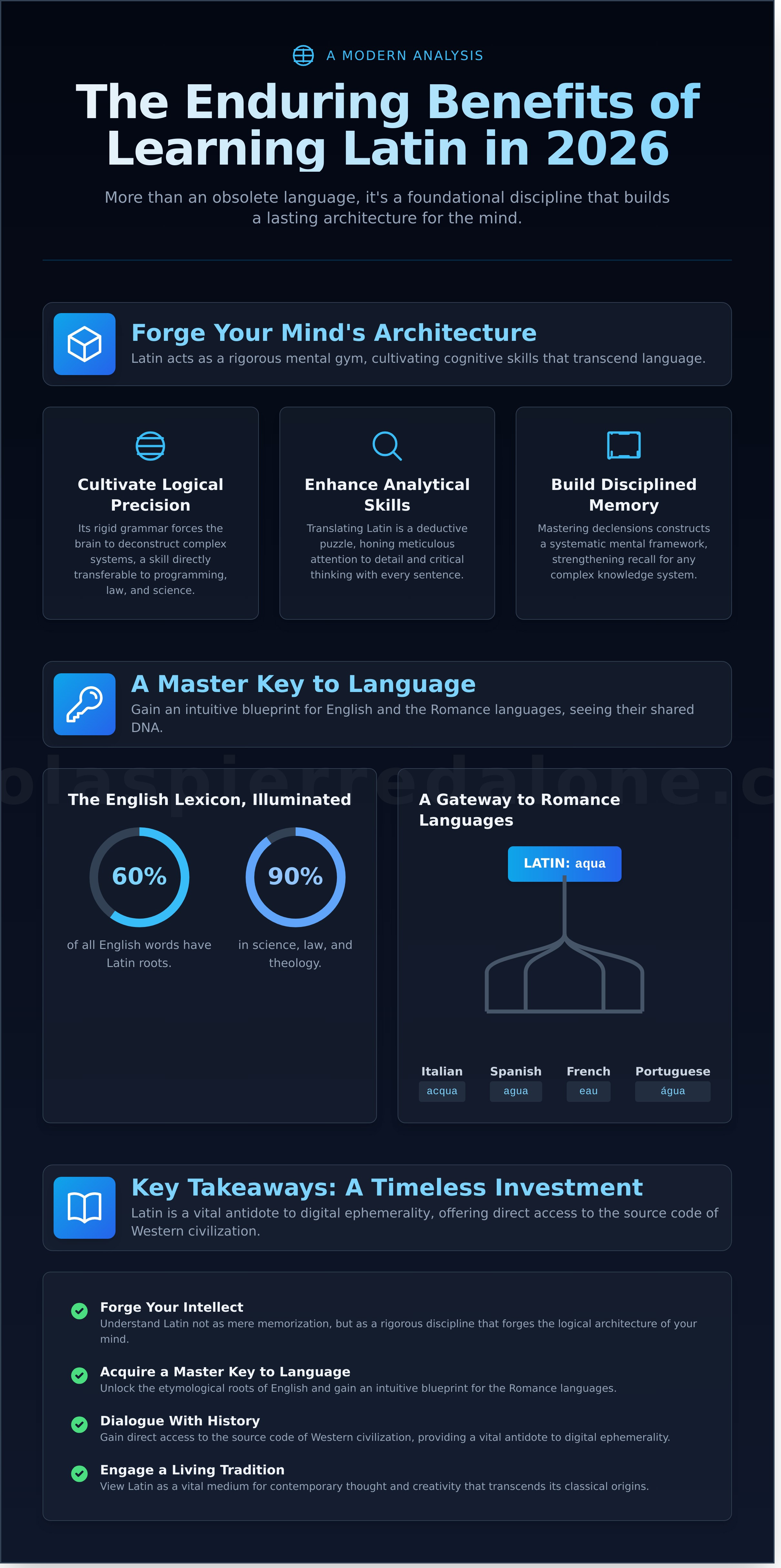
To study Latin is to acquire an architectural blueprint for Western language. This is not a mere academic exercise; it is the most immediate and pragmatic of returns on your intellectual investment. The process elevates the mind beyond vocabulary memorization. It is a fundamental shift from guessing a word’s meaning to understanding its very essence, its cultural and historical DNA. This grammatical clarity is foundational to the many cognitive benefits of studying Latin, forging a more logical and structured approach to all communication. These profound linguistic advantages are, without question, some of the most compelling benefits of learning Latin in 2026.
The English Lexicon, Illuminated
The English language is a direct inheritor of a vast Roman legacy. Over sixty percent of its lexicon is born from Latin roots, a figure that rises to over ninety percent in the realms of science, law, and theology. To know Latin is to possess a nuanced command of English that few can claim. Complex terms shed their opacity, revealing a core logic. Words like omniscient (omnis, "all" + sciens, "knowing") or manufacture (manu, "by hand" + facere, "to make") become transparent constructions. This etymological clarity elevates your writing and oration, lending it a weight and precision that is both rare and deeply resonant.
A Foundation for Romance Languages
Latin is not a relic. It is a living matrix, the source code for an entire family of modern tongues. For the student of Latin, the path to fluency in the Romance languages is dramatically shortened, the learning curve rendered elegant and intuitive. The shared grammar, syntax, and vocabulary become instantly recognizable, transforming a daunting task into a process of discovery. Consider the Latin word for water, aqua. Its echo is clear in:
Italian: acqua
Spanish: agua
French: eau
Portuguese: água
This pattern repeats with thousands of words and core grammatical structures. Learning these languages ceases to be an act of rote translation and becomes one of profound recognition. Latin provides a unified theory, a single, master key that unlocks the doors to a rich tapestry of vibrant, modern cultures.
The Dialogue with History: Engaging with Civilization's Source Code
To learn Latin is to acquire a key. Not to a forgotten museum, but to the foundational code of Western civilization. It is the language of law, science, and philosophy that shaped the world for nearly two millennia. Reading a text in its original form is an unfiltered dialogue across time, a direct conversation that bypasses the interpreter and their inherent bias.
This is not a study of the past for its own sake. It is an act of understanding the present's architecture. One of the most compelling benefits of learning Latin in 2026 is this direct engagement with our intellectual heritage. You experience the strategic mind of Caesar, the rhetorical precision of Cicero, and the epic scope of Virgil not as echoes, but as they were intended-potent, pure, and formative.
Accessing Primary Sources Directly
Translation is an interpretation, a necessary filter that obscures as much as it reveals. To read foundational texts directly in Latin is to remove that filter. You engage with the unyielding logic of Seneca's prose and the subtle cadences of Ovid's verse. The author's true intent, rhythm, and rhetorical strategy become transparent. This rigorous mental exercise, as scholars at the University of Kentucky have noted, sharpens the mind, cultivates mental alertness, and reveals nuances of meaning that are inevitably lost in modern renderings. It is the difference between a description of a masterpiece and standing before it yourself.
Understanding Our Cultural and Philosophical Roots
Our modern world is built upon a Roman blueprint. The concepts that shaped contemporary governance, art, and ethics were first articulated and debated in Latin. This influence is not abstract; it is etched into our legal systems, our civic architecture, and our literary traditions. From the Senate floor to the epic verses of the Aeneid, these texts are not relics but living documents whose ideas still resonate. Gaining this historical clarity is one of the most practical benefits of learning Latin in 2026, providing a stable intellectual foundation in a complex world.
An Antidote to the Ephemeral: Why Latin Thrives in the Age of AI
In an era defined by algorithmic immediacy, the study of Latin presents a quiet rebellion. Artificial intelligence offers answers with frictionless speed, yet this efficiency often bypasses the essential act of thinking. Latin demands the opposite. It is a deliberate, methodical engagement with structure and meaning. Its perceived slowness is not a flaw; it is its most profound feature in 2026. This discipline teaches you not just to find an answer, but how to construct the question.
Deep Reading in an Age of Skimming
The modern mind is trained for the skim. Digital interfaces reward rapid, superficial consumption. Translating a text from Latin-word by word, clause by clause-is a direct counter-practice. It forces a slow, meticulous reading that rebuilds the attention spans eroded by constant stimuli. This cultivated focus is not an isolated academic skill; it is a transferable asset that elevates comprehension and precision in every professional and intellectual pursuit.
Recognizing Nuance Beyond the Algorithm
A machine can translate a sentence. It cannot, however, detect the subtle sting of Cicero’s irony or the weighted silence in a line by Virgil. AI processes data; it does not comprehend subtext, cultural context, or human intent. Learning Latin attunes the mind to these subtleties. This is the bedrock of sophisticated communication-an essential quality for diplomacy, leadership, and any field where understanding the unsaid is paramount.
Intellectual Self-Reliance
Constant reliance on automated tools creates intellectual dependency. The process of learning Latin is the opposite; it is the construction of a robust, internal mental framework. One of the core benefits of learning latin 2026 is this journey toward cognitive autonomy. The struggle with declensions and syntax builds resilience and a profound sense of accomplishment that no app can replicate.
Ultimately, Latin cultivates the faculties that remain exclusively human. In a world increasingly shaped by AI, these skills are not relics, but the very definition of future-proof value:
Systematic Logic: The ability to deconstruct complex problems.
Analytical Precision: A disciplined attention to detail.
Contextual Awareness: The capacity to see beyond the literal.
This is not merely language acquisition. It is the deliberate architecture of a more discerning mind, a process akin to the finest forms of artisan craftsmanship.
A Living Tradition: From Ancient Epics to Modern Science Fiction
The myth of a ‘dead’ language is a failure of imagination. Latin was never an artifact; it is an evolving medium for expression. Its perceived silence is not an absence of life but an invitation for the discerning mind. To engage with it is to join a continuous artistic dialogue, a legacy of creation that stretches from antiquity to the present. This participation is one of the most profound benefits of learning latin 2026-it is an entry into a living tradition.
The Global 'Living Latin' Movement
Across the globe, dedicated communities treat Latin not as a museum piece, but as a vital tool for intellectual and artistic exchange. Institutions like the Vivarium Novum in Rome and spoken-Latin conferences (conventicula) are not classrooms; they are salons. Here, scholars, artists, and thinkers converse and debate entirely in Latin, honing their command of the language as a living craft. This is not recitation. It is active, contemporary discourse.
New Creations in an Ancient Tongue
The ultimate proof of Latin’s vitality is found in its new creations. Contemporary authors choose this ancient tongue to compose original works, from intricate poetry to full-length novels. This deliberate choice demonstrates the language's enduring expressive power. Its precise architecture is being used to build entirely new worlds, extending its reach into unexpected genres like science fiction and fantasy, proving its timeless flexibility. The discipline of its grammar inspires new forms of creativity.
This fusion of classical heritage and modern vision is not merely theoretical. You can explore modern science fiction, artfully translated into Latin, and witness how ancient words articulate futuristic concepts. The ultimate reward of this journey is understanding that the language is not a relic to be studied, but a medium to be wielded. The tradition continues, curated by those who believe in the enduring power of craftsmanship.
Your Dialogue with Enduring Intellect
In an era of fleeting information, the study of Latin remains a profound act of intellectual discipline. It is not a relic, but a tool for forging the architecture of the mind and engaging in a direct dialogue with the foundations of Western thought. The true benefits of learning latin 2026 lie in this timeless relevance-a potent antidote to the ephemeral, offering structure and depth in the age of AI.
This pursuit demands materials of equal caliber. Nicolas Pierre Dalone presents exquisite bilingual editions conceived for the modern scholar, merging academic rigor with artistic vision. Our collection extends beyond antiquity, featuring unique contemporary works-including pioneering science fiction in Latin-published as objects of intellectual beauty.
Begin your intellectual pursuit. Explore our curated collection of bilingual Latin editions.
The conversation awaits.
Frequently Asked Questions
Is Latin truly a 'dead language' in 2026?
To call Latin 'dead' is a misunderstanding of its legacy. The language is not spoken conversationally, but it is never silent. Its structure and vocabulary form the bedrock of modern Romance languages and permeate the specialized lexicons of law, medicine, and science. Latin is less a relic and more an architectural blueprint-a foundational code that continues to inform our world. It lives on through its profound, indelible influence.
How long does it take to become proficient enough to read classical texts?
Proficiency is a matter of discipline. With dedicated study of one to two years, a student can begin to navigate the works of authors like Caesar or Catullus with precision. True mastery, the ability to appreciate the nuance and artistry of Virgil or Ovid, is a longer pursuit. It is a commitment not to a timeline, but to a deeper understanding of linguistic craftsmanship and literary heritage.
Will learning Latin help with standardized tests like the SAT or GRE?
The benefit is structural and absolute. Latin study cultivates a profound understanding of grammar, syntax, and etymology-the very architecture of language. This mastery directly translates to a stronger command of English vocabulary and logical reasoning. Students consistently find this disciplined training enhances their performance on the verbal sections of standardized examinations like the SAT and GRE, providing a distinct, measurable advantage.
Is it more difficult to learn Latin than a modern language like Spanish or French?
The challenge is different in nature, not merely in scale. Modern languages are learned for communication; Latin is studied for analysis and structure. Its rigorous, case-based grammar demands a more architectural approach to learning, akin to deciphering a complex system. While this requires more initial intellectual discipline than conversational fluency in Spanish or French, the resulting mental precision is a unique and powerful reward.
Can I effectively learn Latin on my own, and what resources are essential?
Independent study is a viable path, provided one selects resources with curatorial care. The essential foundation is a rigorous textbook, such as Wheelock's Latin or the Cambridge Latin Course. Supplement this with a reliable dictionary and a grammar guide for reference. The true benefits of learning Latin in 2026 are unlocked through disciplined, consistent practice with these foundational tools. This focused approach ensures a genuine, structured mastery of the language.
What are the career benefits of studying Latin in a tech-driven economy?
In a world driven by code, Latin offers training in the ultimate symbolic system. Its study builds a unique cognitive architecture, training the mind in logic, precision, and systemic thinking-the same skills required to master programming languages and solve complex problems in engineering or data analysis. It is the classic training for the modern innovator, proving that enduring intellectual disciplines have a place in our future.


Comments