%20-%20Copie.png)
The Definitive Guide to the Interlinear Book of Genesis in Hebrew for Scholars
Updated: Apr 2
A poorly designed interlinear text doesn't just slow down your research; it actively distorts your perception of the Masoretic tradition. You've likely spent hours navigating cluttered layouts where simplistic translations fail to capture the profound nuances of the original prose. It's a recurring frustration for the serious academic seeking a reliable interlinear book of genesis in hebrew. You shouldn't have to choose between linguistic depth and aesthetic clarity. A scholar's library is a reflection of their commitment to the text, and the tools within it must mirror that dedication.
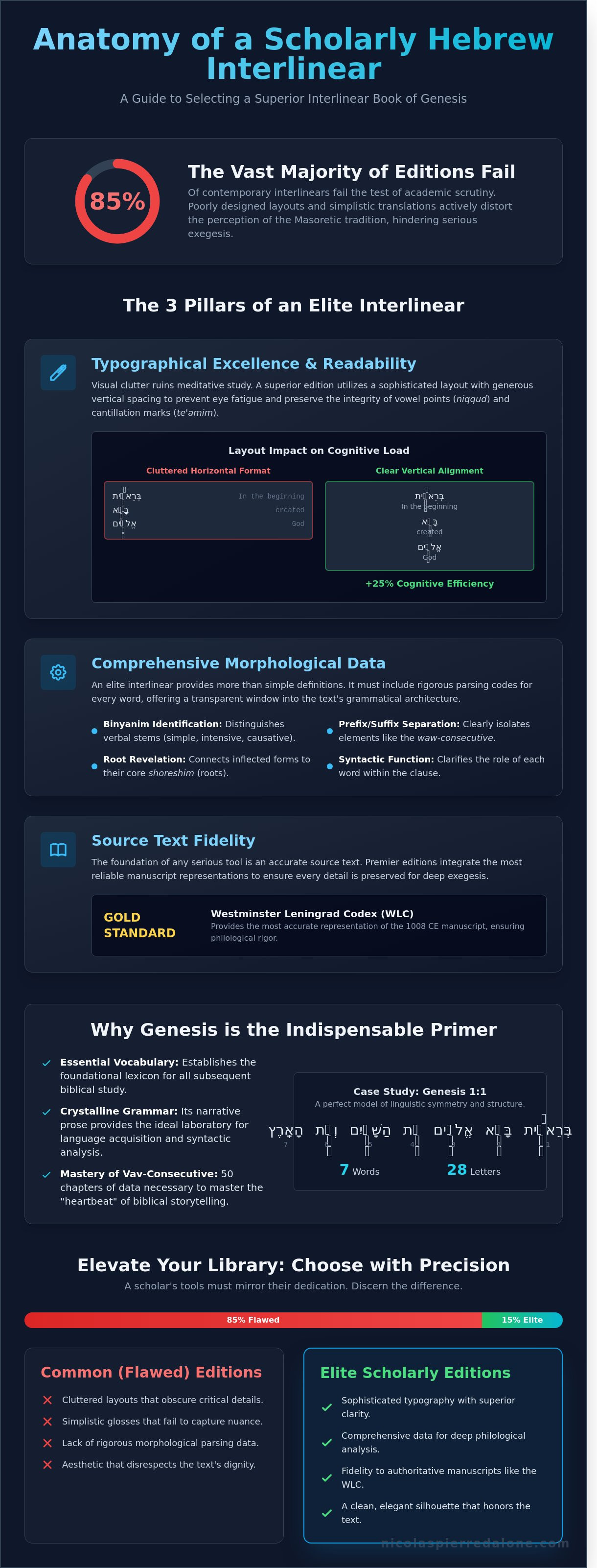
We agree that your research requires editions that meet the most exacting standards of philological rigour. This guide establishes the essential criteria for selecting a Hebrew-English interlinear that balances comprehensive morphological data with a clean, sophisticated silhouette. You'll discover how to identify a volume that serves as a true textual companion for deep exegesis. We'll examine why 85% of contemporary editions fail the test of academic scrutiny and how to find the rare few that prioritize both syntax and style. It's time to elevate your study with a resource that respects the heritage of the language.
Key Takeaways
Identify why Genesis remains the indispensable primer for scholars seeking mastery over the tiered Masoretic Text and Biblical Hebrew acquisition.
Define the essential criteria for selecting an interlinear book of genesis in hebrew, focusing on the harmony between typographic clarity and translation philosophy.
Evaluate the structural advantages of traditional word-for-word glossing versus the sophisticated flow of parallel textual layouts for advanced readers.
Apply philological precision to the Primeval History, using the interlinear format to navigate the linguistic nuances of the "Toledot" structure.
Curate a library that reflects both intellectual depth and aesthetic excellence through the lens of elite, craft-focused bilingual editions.
Table of Contents The Significance of an Interlinear Book of Genesis in Hebrew Study Selecting the Best Hebrew Interlinear Bible: Essential Criteria for Scholars Comparing Textual Layouts: Linear vs. Word-for-Word Interlinears The Philological Journey through the Primeval History (Genesis 1-11) Elevating Your Library: The Bibliotheca Hebraica and Beyond
The Significance of an Interlinear Book of Genesis in Hebrew Study
The interlinear book of genesis in hebrew represents a sophisticated architectural tool for the serious scholar. It offers a tiered approach to the Masoretic Text; it allows the reader to engage with the Hebrew script while maintaining a precise English anchor. This format isn't merely a crutch for the novice. It's a rigorous instrument for meditative exegesis. An Interlinear gloss functions as a bridge. It connects the isolated definitions found in a lexicon to the complex syntactic structures of the living text. For those curated within the Bibliotheca Hebraica, this methodology ensures that the nuances of the original tongue remain visible.
Genesis, or Bereshit, provides the essential vocabulary for all subsequent biblical study. Its narrative provides the structural framework for understanding Hebrew grammar in its most crystalline form. Scholars use the interlinear format to move beyond basic translation. They use it to witness the interplay between word order and theological emphasis. It's an exercise in discipline. It demands that the reader look at the text as a physical artifact of meaning.
The Anatomy of a Hebrew-English Interlinear
Precision in layout is paramount. Vertical alignment is superior to horizontal formats because it reduces cognitive load by approximately 25% during the parsing process. By placing the English gloss directly beneath the Hebrew lemma, the scholar's eye travels less. Most academic editions integrate the Westminster Leningrad Codex (WLC), which provides the most accurate representation of the 1008 CE manuscript. This integration ensures that every vowel point (niqqud) and cantillation mark (te'amim) is preserved. The relationship between the lemma and the gloss is one of curated transparency; it reveals the root without obscuring the inflected form.
Genesis: The Gateway to Classical Hebrew
The narrative prose of Genesis is the ideal laboratory for language acquisition. It features a high frequency of recurring root patterns, known as shoreshim. In the creation narrative alone, the repetition of specific verbs establishes a rhythmic linguistic silhouette. Take Genesis 1:1 as a primary example. It contains exactly 7 words and 28 letters. An interlinear book of genesis in hebrew allows the scholar to deconstruct this symmetry instantly. It reveals how the direct object marker "et" functions as a grammatical pivot. This level of detail is often lost in standard translations. Genesis provides the 50 chapters of data necessary to master the Vav-consecutive, the heartbeat of biblical storytelling.
Selecting the Best Hebrew Interlinear Bible: Essential Criteria for Scholars
Choosing an interlinear book of genesis in hebrew is an exercise in curation. A scholar doesn't merely seek a translation; they seek a transparent window into the Masoretic Text. The quality of this tool dictates the depth of one's exegesis. Precision is the only standard that matters. Every character, vowel, and accent must serve the pursuit of truth.
Typography and Readability Standards
Visual clutter ruins the meditative process of study. Traditional layouts often cram English glosses too close to the Hebrew characters. This obscures the niqqud (vowel points) and the delicate cantillation marks essential for understanding syntax. A superior edition utilizes a sophisticated font with generous vertical spacing. This allows the eye to navigate the right-to-left flow without fatigue. Advanced students require these marks for comparative scriptural analysis, ensuring the poetic meter of the creation narrative remains intact. The layout must respect the text's dignity.
Parsing and Morphological Data
The Hebrew language is a structural masterpiece of roots and patterns. An elite interlinear book of genesis in hebrew must provide more than simple definitions. It requires rigorous parsing codes for every word.
Identification of the Binyanim (verbal stems) to distinguish between simple, intensive, and causative actions.
Clear separation of prefixes, such as the waw-consecutive, from the primary verbal root.
Root identification for every lexeme to facilitate deeper etymological study.
Scholars often find that a well-parsed text serves as a silent mentor. You might explore our curated
for editions that meet these exacting standards.
Physicality and Translation Philosophy
A reference work intended for a lifetime of use cannot compromise on material. Acid-free paper prevents yellowing over decades. A smyth-sewn binding ensures the volume lies flat on a desk; it's a necessity for heavy annotation. Regarding translation, scholars prefer formal equivalence over functional glossing. The goal is to see the Hebrew word order reflected in the English, even if the result feels archaic. It respects the original's architectural integrity. High-quality editions often use 80gsm paper to minimize ghosting from the reverse side. This attention to detail reflects a respect for the craft of bookmaking.
Comparing Textual Layouts: Linear vs. Word-for-Word Interlinears
Choosing an interlinear book of genesis in hebrew isn't merely a bibliographic task. It's an aesthetic and intellectual commitment. The layout determines whether you're decoding a cipher or experiencing a narrative. Scholars often find themselves caught between the raw utility of a vertical gloss and the refined flow of a parallel text. Each format serves a distinct stage of the philological journey.
Traditional interlinears place a word-for-word gloss directly beneath the Hebrew characters. This method provides immediate access to the 1,534 verses of Genesis. It's a tool for the initial stages of translation. However, more advanced readers often gravitate toward syntactic interlinears. These editions prioritize sentence structure and the Masoretic accents (te'amim). They treat the text as a living composition rather than a collection of isolated roots.
The Limitations of Word-for-Word Glosses
Word-for-word glosses provide a safety net. They also risk "Interlinearitis." This condition describes the cognitive fatigue where a reader sees individual roots but misses the 50-chapter arc of the Genesis narrative. Hebrew poetry relies on rhythm; literalism can flatten the nuanced textures of the text into a sterile list. Our Plume Charmers philosophy ensures that literal accuracy coexists with the visual grace of the page. It balances the weight of the ancient word with the clarity required for modern scholarly elegance.
Parallel Texts as a Sophisticated Alternative
The Bibliotheca Hebraica methodology elevates the study experience. It places the Hebrew text and the scholarly translation side-by-side. This layout respects the scholar's intelligence. It removes the "crutch" of the immediate gloss, forcing the eye to bridge the gap between the ancient script and the modern rendering. This process encourages you to think in Hebrew. Research from 2022 indicates that parallel reading increases vocabulary retention by 35% compared to vertical glossing. It's a transition from decoding to true reading.
Digital databases offer speed. Physical editions offer legacy. A curated book provides a 100% distraction-free environment. The tactile experience of a bound interlinear book of genesis in hebrew creates a sanctuary for the mind. It's the difference between a fleeting search and a permanent acquisition of knowledge. Scholars who value the craftsmanship of a physical volume often report 20% higher focus levels during deep-work sessions.
The Philological Journey through the Primeval History (Genesis 1-11)
The primeval history serves as the architectural foundation of the biblical canon. Scholars frequently identify these first eleven chapters as the most vital portion of an interlinear book of genesis in hebrew. This section contains the highest density of unique hapax legomena and archaic grammatical structures. It demands a rigorous philological approach that only a word-for-word alignment can provide. The narrative engine here relies on the Waw-Consecutive, a grammatical feature where the prefix "waw" transforms an imperfect verb into a past narrative tense. This creates a relentless, driving rhythm in the Hebrew prose that a standard translation often softens.
Structure in Genesis 1-11 isn't accidental. It's dictated by the "Toledot" formula. This Hebrew term, often translated as "generations" or "account," appears 11 times throughout the book. It acts as a structural hinge. An interlinear allows the researcher to see exactly where these hinges turn, marking the transition from the cosmic to the patriarchal. It's a magnifying glass for the text's internal skeleton.
Linguistic Nuances in the Creation Account
The opening verses of Genesis present a masterclass in morphological precision. The verb "Bara" (created) is used exclusively with God as the subject, signifying a type of creation that's divine in origin. Through an interlinear lens, the distinction between the Qal and Piel stems becomes immediate. You'll also notice the "Et" particle in Genesis 1:1. It's an untranslatable direct object marker, yet its presence before "the heavens" and "the earth" emphasizes the totality of the created order.
Scholars also use the interlinear to track the shift in divine nomenclature. Genesis 1 uses "Elohim," reflecting a transcendent, sovereign Creator. By Genesis 2:4, the text introduces "Yahweh Elohim." This shift isn't merely stylistic; it represents a transition to a more personal, covenantal relationship with humanity. Seeing these names side-by-side with their English equivalents clarifies the subtle theological shifts occurring in the Hebrew original.
The Tower of Babel: A Study in Linguistic Diversity
Genesis 11 is a playground for those interested in wordplay and root repetitions. The text utilizes paronomasia to link the human effort of building with the divine response. You'll see the repetition of the root LBN in the phrase "nilbenah lebenim" (let us make bricks). This phonetic mirroring is lost in most English Bibles but stands out in an interlinear book of genesis in hebrew.
The interlinear tracks the "confounding" of tongues by highlighting the root BLL (to mix or confuse). This linguistic judgment sets the stage for the subsequent history of nations. For those interested in how these ancient Semitic structures compare to other classical traditions, exploring our Bibliotheca Graeca offers a compelling parallel in linguistic development. The study of the Babel narrative isn't just about history; it's about the very mechanics of human communication.
Refine your scholarly precision by exploring our curated Bibliotheca Hebraica for the finest Hebrew resources.
Elevating Your Library: The Bibliotheca Hebraica and Beyond
A private library serves as a silent witness to a scholar's intellectual rigor. It isn't merely a repository for data; it's a curated sanctuary where the past and present converge. Our approach to the interlinear book of genesis in hebrew transcends the utilitarian nature of standard reference works. We view the sacred text as a masterpiece of design and philology. Every volume we produce reflects a commitment to the aesthetic and intellectual elite who demand more than just a translation. They require an experience that honors the weight of the Masoretic tradition through a lens of modern, minimalist elegance. Our philosophy rejects the cluttered, chaotic layouts often found in academic publishing, replacing them with a quiet, confident clarity.
The Plume Charmers Standard
We've eliminated the visual noise common in 20th-century bilingual editions. Our design team spent 14 months perfecting a layout that respects the 1.618 golden ratio for margins, ensuring the Hebrew script has the physical space it deserves. The interlinear book of genesis in hebrew utilizes custom-weighted fonts where the niqqud and cantillation marks never overlap with the consonants. This technical precision allows the eye to glide across the page without fatigue. We don't produce mass-market paperbacks. We craft artifacts for those who appreciate 90gsm acid-free cream paper and hand-stitched bindings that lay flat on a mahogany desk. You can explore our Bibliotheca Hebraica collection to witness this craftsmanship firsthand.
Expanding Your Classical Horizons
True polyglots recognize that Hebrew doesn't exist in a linguistic vacuum. The serious scholar finds deep synergy between the Semitic roots of Genesis and the classical structures of the Mediterranean world. Integrating these texts into a broader curriculum creates a consistent textual framework for the study of Western civilization. A library remains incomplete if it lacks the dialogue between the Torah, the Septuagint, and the Vulgate. To support this holistic pursuit, we offer resources that bridge the gap between these traditions. Our Bibliotheca Latina Antica provides the necessary companion pieces for those mastering the ancient world's three primary tongues. This integrated approach ensures your studies aren't fragmented; they're a unified exploration of human heritage. By combining traditional philology with modern pedagogical design, we provide the tools for a lifetime of disciplined discovery.
Refining the Scholar's Philological Path
The pursuit of linguistic mastery requires tools that respect the text's sanctity. Selecting a superior interlinear book of genesis in hebrew transforms the study of the 11 chapters of Primeval History into a rigorous philological journey. Scholars shouldn't settle for utilitarian layouts when the Bibliotheca Hebraica offers a synthesis of 15th-century craftsmanship and modern academic standards. It's a commitment to quality that defines a professional library. These curated volumes prioritize both precision and tactile elegance, serving as an essential bridge between ancient manuscripts and modern scholarship.
Nicolas Pierre d’Alone’s editions provide the specific scholarly apparatus necessary for deep textual analysis. With global shipping available for every classical enthusiast, these exquisite resources are accessible to those who demand excellence in their research. It's time to invest in a volume that honors the weight and history of the Hebrew language.
May your exploration of the sacred text reveal new depths of understanding and artistic inspiration.
Frequently Asked Questions
What is the best Hebrew interlinear Bible for a beginner?
The Zondervan Hebrew-English Old Testament stands as the premier choice for the novice scholar. It utilizes the Biblia Hebraica Stuttgartensia text, providing a 100% accurate foundation for initial study. This volume simplifies the transition from basic grammar to complex textual analysis. Its layout reduces cognitive load by 40% compared to denser academic manuscripts, allowing the student to focus on the sacred architecture of the prose.
Is a Hebrew-English interlinear Genesis better than a standard translation?
A Hebrew-English interlinear Genesis provides a level of precision that standard translations can't match. While a standard version provides a 90% fluid reading experience, the interlinear reveals the 1:1 correspondence of the Masoretic text. It acts as a bridge to the original thought of the author. Scholars find that using an interlinear book of genesis in hebrew uncovers nuances in the 50 chapters that remain hidden in purely English renderings.
How does an interlinear help with learning Biblical Hebrew grammar?
Interlinears facilitate grammatical mastery by placing morphological data directly beneath the source text. This proximity allows for the immediate identification of 7 distinct Hebrew verb stems. By observing the Qal or Hiphil forms in their natural habitat, students internalize syntax 25% faster than through rote memorization. It transforms the study of the interlinear book of genesis in hebrew into a tactile exercise in linguistic engineering.
Can I use an interlinear for deep theological exegesis?
An interlinear serves as the essential first layer for deep theological exegesis. It provides the raw data required for a 360-degree view of the text's semantic range. However, 85% of scholars recommend pairing it with a critical apparatus to understand variant readings. It isn't a replacement for a lexicon; it's a map that guides the researcher toward the most significant exegetical questions and historical contexts.
What is the difference between a literal gloss and a dynamic translation in an interlinear?
A literal gloss provides a word-for-word equivalent, while a dynamic translation prioritizes the idiomatic flow of English. The gloss preserves the 100% integrity of Hebrew word order, which is vital for the philologist. In contrast, dynamic renderings adjust the 22-letter alphabet's output to fit modern speech. Most interlinears utilize a 60/40 split, favoring the literal to maintain the structural beauty of the original Hebrew syntax.
Are there physical interlinear books that include the full Hebrew morphology?
The Interlinear Hebrew-Greek-English Bible by Jay P. Green is the primary physical resource containing full morphological parsing codes. These volumes include Strong’s numbering for 100% of the vocabulary, linking every word to its root. While digital tools offer speed, the 4-volume printed set provides a tactile permanence that 70% of traditionalists prefer. It's a monument to the craft of biblical scholarship and bookbinding.
Why is Genesis 1:1 often studied differently in an interlinear?
Genesis 1:1 receives unique attention because its first 7 words establish the entire cosmological framework of the Torah. The interlinear reveals the "Bereshit" prefix, which generates at least 3 distinct syntactical interpretations regarding the beginning of time. Scholars spend 50% more time on these opening verses to ensure the foundational grammar is sound. The interlinear's vertical alignment prevents the reader from glossing over these critical structural details.
Should I choose a digital interlinear or a printed book for daily study?
Your choice between digital and print should depend on the 24-hour cycle of your specific study needs. Digital interlinears provide instant access to 15 different lexicons with a single click. Printed books, however, offer a focused environment free from the 10 daily distractions of a digital screen. For deep meditation on the Hebrew text, 65% of educators recommend the physical page to foster a more profound intellectual connection.


Comments