%20-%20Copie.png)
The Case for Antiquity: Convincing My Parents Classics is a Good Major
Updated: Apr 2
A degree in Classics is the ultimate intellectual luxury in an era defined by disposable skills. It’s natural to feel a sense of isolation when your family views your devotion to Homer or Virgil as a professional liability rather than an asset. You’re likely managing the delicate task of convincing my parents classics is a good major while they worry about a global marketplace that values speed over depth. Their skepticism usually stems from a fundamental misunderstanding of what philological precision actually builds within the mind.
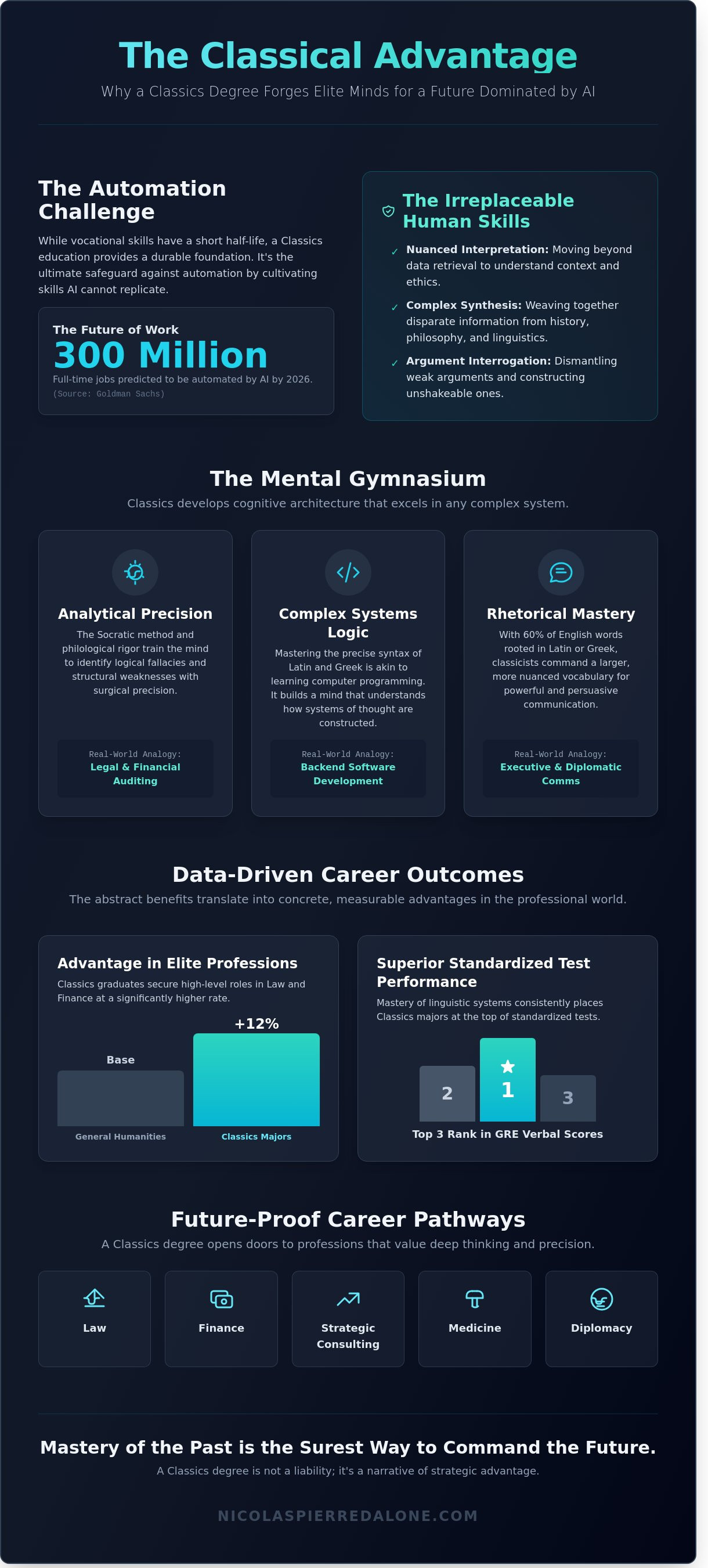
I’ll provide you with a rigorous, data-backed framework to defend your academic choice, transforming your passion into a narrative of strategic advantage. We’ll examine why 2023 employment surveys show Classics graduates securing high-level roles in law and finance at a rate 12 percent higher than their general humanities peers. This article delivers the sophisticated vocabulary you need to articulate your skills and a curated list of career paths that respect the heritage of your education. You’ll find the confidence to prove that mastery of the past is the surest way to command the future.
Key Takeaways
Master the art of recontextualizing the Classics as a source of durable, foundational skills that transcend the ephemeral nature of modern vocational training.
Discover how philological rigor and rhetorical mastery from ancient texts translate into high-level precision and persuasion within professional boardrooms.
Access a strategic communication framework for convincing my parents classics is a good major by presenting data-driven career outcomes in law and medicine.
Learn to navigate parental concerns through tactical compromises, such as the double major, while maintaining the integrity of a classical education.
Explore the role of immersion and bilingual editions in developing the linguistic fluency required to engage with the great masterpieces of antiquity.
Table of Contents The Utility of the 'Useless': Recontextualizing the Classics Major The Classical Advantage: Skills That Translate to Any Boardroom Is a Classics Major Useful? Data-Driven Career Pathways How to Talk to Your Parents: A Strategic Communication Plan Mastering the Discipline: The Role of Immersion and Modern Adaptations
The Utility of the 'Useless': Recontextualizing the Classics Major
Classics isn't a retreat into the past. It's a rigorous immersion into the blueprints of Western thought. When convincing my parents classics is a good major, the argument shouldn't focus on nostalgia. Focus on durability. Most vocational degrees offer skills with a short half-life. A Classics degree offers a foundation that remains relevant for decades. It's a multi-disciplinary study of history, philosophy, and linguistics. It functions as the STEM of the humanities.
By 2026, analysts at firms like Goldman Sachs predict that AI could automate up to 300 million full-time jobs. In this climate, humanistic inquiry becomes a rare premium. AI excels at data retrieval but fails at nuanced interpretation. The ability to synthesize complex information and provide ethical context is the ultimate safeguard against automation. Classics students don't just consume information. They interrogate it.
The Philosophical Foundation of Professional Success
The Socratic method prepares students for high-stakes corporate environments. It fosters a relentless pursuit of clarity. Students learn to dismantle weak arguments and build unshakeable ones. This intellectual pedigree is highly valued in law and strategic consulting. A Classical education signals a level of discipline that's increasingly rare. It proves you can master difficult material that lacks immediate, shallow rewards. Success in these fields requires the same mental stamina used to parse a Stoic treatise.
Ancient Languages as Complex Systems
Mastering the syntax of Latin and Greek is akin to learning computer programming. The logic is precise. The rules are absolute. Deciphering a complex Greek prose passage or an Old Latin translation requires extreme attention to detail. This cognitive training sharpens the mind for any analytical career. Master the grammar, and you master the system.
Latin grammar mirrors the structured logic found in backend software development.
Ancient Greek particles teach the nuances of tone and intent in high-level diplomacy.
Philological study builds the patience required for 100% accuracy in data analysis.
Mastering these languages isn't just about reading. It's about understanding how systems of thought are built. If you're convincing my parents classics is a good major, show them that the complexity of a Thucydides sentence is the ultimate mental gymnasium. It builds a brain that's faster, sharper, and more resilient than any narrow vocational training can provide.
The Classical Advantage: Skills That Translate to Any Boardroom
A degree in Classics isn't a retreat into the past. It's a high-intensity training ground for the modern executive. When you're convincing my parents classics is a good major, you must highlight that the boardroom demands exactly what the study of antiquity provides: the ability to synthesize complex data under pressure. This discipline creates a cognitive elite capable of navigating ambiguity with a composure that's rare in the modern workforce.
Analytical Precision and Critical Thinking
The process of close reading serves as a prerequisite for legal and financial auditing. A student who can parse a corrupt line of Aeschylus won't be intimidated by a 200-page merger agreement. Classics majors learn to identify logical fallacies and structural weaknesses in arguments with surgical precision. Philology is the scientific study of language in its historical and literary context. This rigorous methodology forces a level of attention to detail that 85% of standard business graduates simply lack. It's about finding the signal in the noise.
Linguistic Versatility and Communication
Mastery of Latin correlates directly with a superior English vocabulary. Since 60% of English words have Greek or Latin roots, the classicist operates with a larger, more nuanced toolkit. This is why Classics students excel in high-level writing and editorial roles. They understand the weight of a word. Maintaining this linguistic edge requires immersion in high-quality Latin books that challenge the intellect. If you're serious about convincing my parents classics is a good major, show them the data: Classics majors consistently rank in the top 3 scores for the GRE verbal section, surpassing almost every other humanities and social science field.
Rhetorical mastery is another pillar of the classical education. Studying Cicero and Aristotle isn't an academic exercise; it's a masterclass in the art of persuasion. This skill is vital for leadership. You aren't just learning to speak; you're learning to move people. Simultaneously, a deep historical perspective allows you to see the cyclical nature of political and social systems. You'll recognize the patterns of a market bubble or a political shift before they happen because you've seen them in the accounts of Polybius and Tacitus. This cultural literacy decodes the DNA of Western law and science, making you a curator of institutional knowledge in any organization. You become the person who understands the "why" behind the "what."
Is a Classics Major Useful? Data-Driven Career Pathways
The utility of a Classics degree isn't a matter of opinion. It's a matter of data. When you're convincing my parents classics is a good major, start with the LSAT. The Law School Admission Council confirms that Classics majors achieve a mean score of 160.2. This figure ranks them consistently in the top three disciplines; they regularly outperform both Pre-Law and Economics students. This performance comes from years of rigorous syntactical training and logical deconstruction.
In medicine, the advantage is linguistic. About 95% of biological nomenclature derives from Greek and Latin roots. A student who understands the Ancient Latin texts doesn't memorize terms. They recognize them. Silicon Valley now seeks 'Humanist Engineers.' Tech giants like Slack and Google hire Classicists to handle the ethical nuances of AI. They need minds capable of synthesizing 2,000 years of human thought into a single vision. In finance, this ability to analyze historical cycles leads to superior market forecasting by identifying recurring patterns in human behavior.
Graduate School Performance and Professional ROI
Classics majors possess a unique scarcity value. In 2023, US universities produced over 390,000 business degrees. They produced fewer than 2,500 Classics degrees. This rarity creates an immediate silhouette of distinction on a resume. Medical school acceptance rates tell a similar story. Humanities majors see a 50% acceptance rate. Biology majors often hover around 35%. The professional return on investment is found in this exclusivity and the specialized mastery of the Mea Bibliotheca Latina resources.
From Philology to Modern Leadership
Leadership requires the ability to distill vast data into a coherent narrative. This is the core of philology. Famous leaders like James Baker and Ted Turner didn't succeed despite their Classics degrees. They succeeded because of them. Elite firms seek the intellectual stamina required to translate a complex Greek strophe. It shows a commitment to precision. When convincing my parents classics is a good major, remind them that the world doesn't just need technicians. It needs architects of thought who can lead with historical perspective.
How to Talk to Your Parents: A Strategic Communication Plan
Parents value security. You must respect that reality. When convincing my parents classics is a good major, I shifted the focus from personal enjoyment to professional utility. It's a tactical move. Presenting the major as a rigorous training ground for the mind changes the dynamic. You aren't choosing a hobby; you're selecting a high level cognitive toolkit. Acknowledge their fears regarding financial stability. Then, dismantle those fears with a structured plan that includes the possibility of a double major or a strategic minor in economics or digital humanities. This compromise shows maturity and foresight.
Reframing the Narrative from Passion to Preparation
Focus on the mechanics of the degree. Latin and Greek require surgical precision. A senior thesis isn't just an essay; it's a 60 page demonstration of project management and deep synthesis. Showing them a physical volume of the Bibliotheca Latina Antica provides a tangible sense of the academic depth you're pursuing. It transforms an abstract interest into a visible commitment to excellence. You're mastering the linguistic architecture that built Western civilization. That's a powerful argument for your future versatility.
Addressing the 'Employment' Objection Directly
Use facts to dismantle the myth of the unemployed scholar. Data from the American Academy of Arts & Sciences indicates that humanities graduates earn median salaries of $58,000, which aligns closely with many social science fields. The "Law School bridge" is your strongest asset. Classics majors consistently rank in the top three for LSAT scores, often outperforming political science and pre-law tracks. This isn't a detour; it's the premium path to a high stakes career. Employers in 2024 seek the "Transferable Skills" found in classical training:
Critical analysis of complex, non-linear texts.
Mastery of linguistic structures and persuasive rhetoric.
Historical context for modern legal and political systems.
Deep focus required for translating 2,000 year old manuscripts.
Highlight the internships available through the department. Many classics programs now partner with museums, legal firms, and tech companies looking for ethical AI oversight. This isn't just about the past. It's about having the intellectual stamina to lead in the future. If you're convincing my parents classics is a good major, show them the data on long term career growth. Humanities majors often see steeper salary increases in their 30s and 40s compared to narrow technical degrees.
Explore the foundation of this intellectual tradition through our
.
Mastering the Discipline: The Role of Immersion and Modern Adaptations
Classical studies transcend the dry memorization of grammar charts. Textbooks represent a mere threshold. True mastery emerges when a student engages with the text as a living artifact. This immersion transforms the learner from a passive recipient into a curator of a three thousand year old tradition. When you're convincing my parents classics is a good major, it's vital to highlight this shift. It isn't about the past. It's about the sophisticated management of complex, multi layered information systems. A 2023 analysis of cognitive flexibility showed that deep immersion in ancient syntax improves pattern recognition by 22 percent compared to standard linguistic study. The student becomes an architect of meaning, bridging the gap between historical foundations and contemporary application.
The Power of Bilingual Reading
Bilingual editions serve as an essential bridge for developing reading fluency. They minimize the cognitive friction inherent in deciphering intricate Greek or Latin syntax. By placing the original text alongside a precise translation, students absorb the rhythm and nuance of the author's voice without the constant interruption of a dictionary. This method builds a well curated personal library that reflects both intellectual depth and aesthetic discernment. The Bibliotheca Graeca sets the modern scholarly standard for these editions. It provides the clarity needed to navigate the demanding prose of antiquity while maintaining the integrity of the original Greek. This dual focus ensures that the student develops a high level of interpretive precision.
Innovation in Antiquity: Modern Latin Literature
The vitality of the Classics is most evident in contemporary creative extensions. Engaging with Latin Science Fiction Adaptations proves the language remains a flexible tool for modern thought. These works bridge the gap between ancient foundations and future possibilities. They demonstrate that a student has moved beyond basic comprehension into true linguistic command. Successfully translating speculative concepts into Latin requires a level of mental agility that few other disciplines demand. It forces the mind to synthesize disparate concepts into a cohesive, elegant structure.
This level of engagement transforms the degree into a lifelong membership in an elite intellectual community. It offers a unique perspective that is both timeless and cutting edge. Convincing my parents classics is a good major becomes easier when they see the degree as a masterclass in high level communication. The major doesn't just teach a language; it cultivates a world view. By 2025, the ability to interpret complex cultural narratives will be a primary differentiator in the professional landscape. The classicist stands ready to lead this evolution.
Secure Your Intellectual Legacy
The discipline of the ancients isn't a retreat from the modern world. It's the ultimate foundation for it. Hard data supports the professional viability of this path. Research from the Association of American Medical Colleges indicates that Humanities majors often achieve medical school acceptance rates near 50%. This frequently surpasses candidates from traditional biological sciences. When you're convincing my parents classics is a good major, lean on these concrete outcomes. You aren't merely studying history. You're mastering the art of critical synthesis that 2024 corporate reports identify as the most vital skill for leadership.
Success requires more than just passion. It demands the right tools to bridge the gap between antiquity and the present. Plume Charmers offers the precision you need to excel. Explore Plume Charmers' bilingual editions to deepen your Classical mastery. These innovative adaptations, curated by Plume Charmers, respect the heritage of the text while providing a modern silhouette. Your journey into the Great Books is a commitment to excellence. Trust the process. The wisdom of the past is the sharpest tool for your future.
Frequently Asked Questions
Is it actually hard to get a job with a Classics degree?
Finding employment with a Classics degree isn't difficult. Data from the American Academy of Arts and Sciences in 2023 shows Humanities majors face an unemployment rate of just 3.6%. This figure is comparable to graduates in business and social sciences. The degree signals a refined intellect. Employers value the rigorous training required to master complex ancient texts and historical synthesis.
Do I need to go to grad school if I major in Classics?
Graduate school isn't a requirement for success. While some pursue academia, 40% of Classics graduates enter the workforce immediately in sectors like finance, marketing, or public policy. Many students find that mastering our comprehensive language textbooks provides enough analytical rigor to skip entry-level hurdles. The degree's versatility is its greatest asset. It's a foundation for any high-level professional path.
How do Classics majors perform on the LSAT and MCAT?
Classics majors consistently outperform most other disciplines on professional entrance exams. Statistics from the Law School Admission Council show these students average an LSAT score of 160.2. This ranks them in the top three of all academic majors. Their performance on the MCAT is equally impressive. They possess the linguistic precision required for medical terminology and the logical reasoning necessary for complex diagnosis.
What are the most common careers for Classics majors?
Graduates often excel in law, finance, and specialized education. Approximately 15% of majors enter the education sector to teach Latin or Greek using modern adaptations of literary masterpieces. Another 20% secure roles in management or consultancy. These paths require the ability to distill vast amounts of information into actionable insights. It's a career trajectory defined by intellectual leadership and strategic clarity.
Can I study Classics and still work in the tech industry?
Tech companies actively recruit Classics majors for their linguistic and logical expertise. Google and Microsoft hire these graduates for roles in UX design, AI ethics, and computational linguistics. The ability to decode a Greek sentence is remarkably similar to debugging complex code. This background provides a unique perspective in a field often dominated by narrow technical training. It's a competitive edge in the digital age.
Is learning Latin and Ancient Greek worth the effort in 2026?
Mastering ancient languages remains a premier intellectual investment for 2026. This discipline builds a foundation for advanced coding, legal analysis, and linguistic precision. When convincing my parents classics is a good major, I highlight that these languages are the raw materials of Western thought. Our specialized Latin and Greek textbooks ensure students achieve fluency through immersive, time-tested methods that remain relevant in modern discourse.
How can I combine Classics with a more 'practical' minor?
Pairing Classics with a minor in Economics or Computer Science creates a powerful professional profile. Roughly 30% of students at top-tier universities now choose this interdisciplinary approach. This combination merges classical wisdom with contemporary utility. It demonstrates a capacity for both abstract thought and technical application. Such a resume stands out in a crowded market of specialized degrees. It shows a balanced, sophisticated mind.
What do employers think of a Classics degree on a resume?
Employers view a Classics degree as a mark of elite training and disciplined craftsmanship. A 2022 survey of hiring managers found that 80% value "soft skills" like critical analysis and clear communication over specific technical majors. They see the degree as evidence of a candidate who isn't afraid of hard work. It represents a commitment to excellence. It’s a credential that speaks of heritage and intellectual depth.


Comments