%20-%20Copie.png)
The Best Bilingual Latin Books: A Curated Guide for Learners
Updated: Feb 27
The experience of reading classical Latin should be one of immersion, not interruption. Yet, the constant reach for a dictionary can fracture the narrative, turning a masterpiece into a lexical puzzle. The frustration of tedious lookups, the fear of misinterpreting complex syntax, and the search for engaging material beyond the textbook can diminish the pursuit. This is where the artistry of a parallel text reveals its profound value, creating a bridge between the student and the ancient author.
This guide is a curated collection, a definitive resource for discovering the best bilingual latin books available. We have assembled these editions with meticulous care, organizing them by level and genre to provide a clear, confident path toward fluency. Here, you will find the tools to build your vocabulary intuitively, internalize grammar with grace, and finally, engage with classical literature not as a challenge to be overcome, but as a world to be explored.
Key Takeaways
Understand how parallel-text editions provide an essential bridge from structured exercises to the nuance of authentic classical literature.
Selecting the best bilingual latin books requires matching the text's complexity to your proficiency, from graded readers to unabridged prose.
Master the unique challenges of Latin poetry, such as meter and inverted word order, by leveraging a facing-page translation as your guide.
Expand your reading practice beyond the classical canon by exploring modern and adapted Latin works for a dynamic learning experience.
Table of Contents The Power of Parallel Texts: Why Read Bilingual Latin Books? For the Beginner: Foundational Texts and Graded Readers The Intermediate Step: Approaching Classical Prose and History The Beauty of Verse: Navigating Latin Poetry with a Guide Beyond the Classics: Modern Latin and Unique Adaptations
The Power of Parallel Texts: Why Read Bilingual Latin Books?
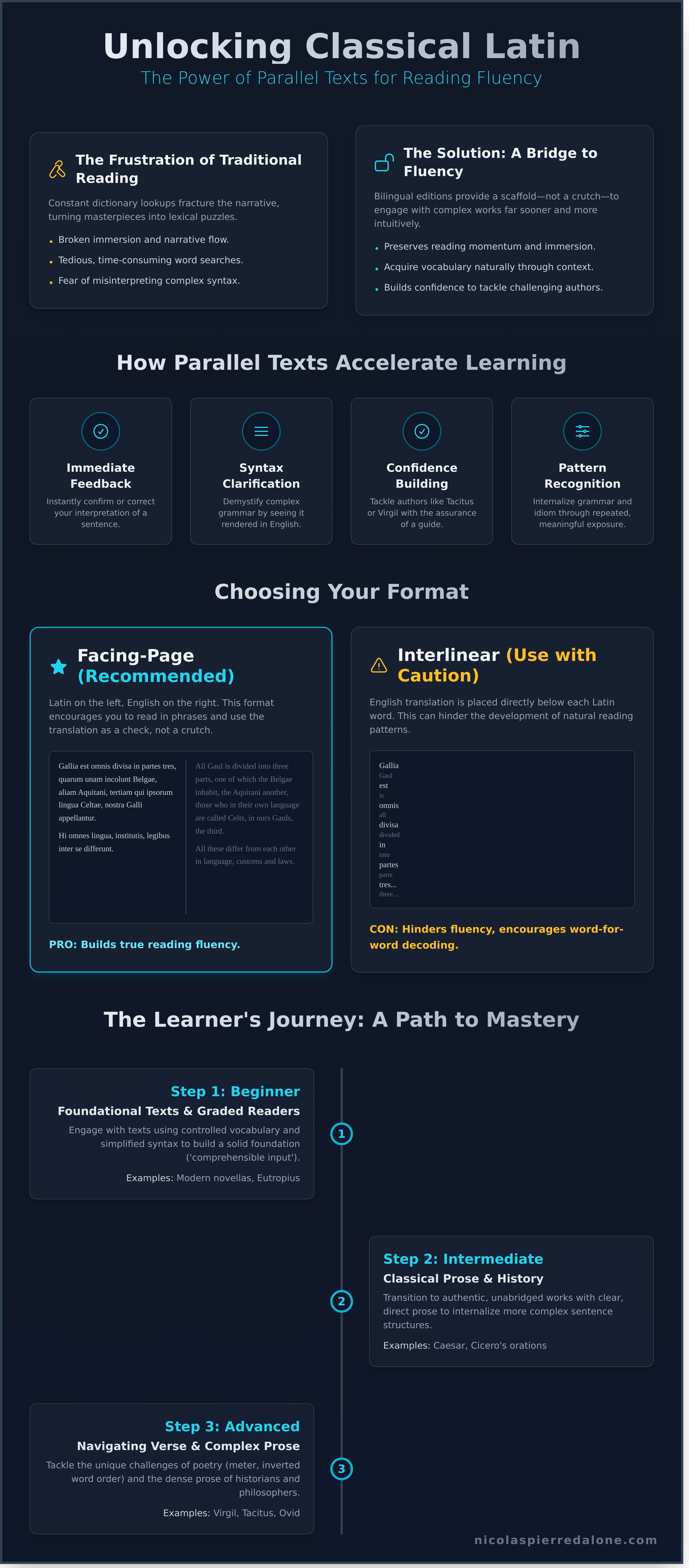
The transition from textbook exercises to authentic Latin literature is a formidable leap. Bilingual editions offer the most elegant bridge across this divide. Often dismissed as a 'crutch', they are more accurately understood as a scaffold-a temporary, essential structure that enables the reader to engage with complex works far sooner. This is the foundational principle behind the best bilingual latin books: they grant access without sacrificing rigor. Their structure is one of disciplined simplicity, and it is this design that unlocks The Power of Parallel Texts for the modern student.
The primary virtue of this format is the preservation of momentum. Constant dictionary consultation fragments the reading experience, turning a flowing narrative into a disjointed series of lexical puzzles. A parallel text eliminates this friction. When you encounter an unfamiliar word or a complex subordinate clause, a quick glance to the right provides immediate clarity, allowing you to remain immersed in the world of the text. This is learning in its most organic form-vocabulary acquired through context, not rote memorization.
How Parallel Texts Accelerate Learning
By providing an immediate reference, these editions cultivate a more fluid and intuitive learning process. They are not merely translations; they are curated tools for mastery.
Immediate Feedback: Instantly confirm or correct your interpretation of a sentence.
Syntax Clarification: Demystify complex grammatical structures by seeing them rendered in English.
Confidence Building: Tackle challenging authors like Tacitus or Virgil with the assurance of a reliable guide.
Pattern Recognition: Internalize Latin grammar and idiom through repeated, meaningful exposure.
Choosing Your Format: Interlinear vs. Facing-Page
The architecture of a bilingual book is paramount. An interlinear text places the English translation directly beneath each Latin word, a method that can hinder the development of true reading fluency. In contrast, the facing-page format-Latin on the left, English on the right-encourages your eye to grapple with the original first. It trains you to read in phrases and clauses, using the translation as a check, not a direct substitute. It is no surprise that the most respected series, and the foundation for any list of the best bilingual latin books, exclusively employ this superior facing-page design.
For the Beginner: Foundational Texts and Graded Readers
The journey into Latin begins not with Cicero, but with clarity. True mastery is built upon a foundation of understanding. This principle, known as 'comprehensible input', dictates that real progress comes from engaging with texts just beyond one's current ability. Attempting authentic Roman prose prematurely leads to frustration, not fluency. A curated approach is essential.
The solution is the graded reader. These texts are meticulously crafted for the learner, featuring controlled vocabulary and simplified syntax. They allow the student to read extensively, internalize patterns, and build genuine confidence. This is the indispensable first step toward reading authentic literature.
The best bilingual latin books for a novice are not merely translations; they are complete learning systems. An ideal edition provides:
The original Latin text presented cleanly on one page.
A facing-page English translation for immediate reference.
Comprehensive glossaries or vocabulary notes to minimize dictionary work.
An engaging narrative that encourages continuous reading.
For an exemplary start, explore the curated graded reader series available from Plume Charmers. Their modern novellas, offering compelling stories within a carefully controlled grammatical framework, are a perfect entry point for students finishing their first year of study. They represent a new standard in accessible Latin learning.
Once this foundation is secure, the transition to classical authors can begin. Start not with complex poetry, but with clear, historical prose. The historian Eutropius, with his Breviarium ab Urbe Condita, offers an ideal bridge. His Latin is direct, unadorned, and serves as a gateway to more intricate works. When selecting from the many available editions, seek those that continue the supported model. Plume Charmers offers exemplary editions of authors like Eutropius and Caesar, providing the full text, a facing-page translation, and extensive commentary. This format guides the reader with precision and care, making it one of the most effective ways to find the best bilingual latin books for transitioning learners.
The Intermediate Step: Approaching Classical Prose and History
Upon mastering foundational grammar, the Latin student enters a new landscape: the world of unabridged classical prose. This is the core of a traditional classical education, a direct engagement with the minds that shaped Western thought. The challenge is no longer merely translation, but interpretation.
The curriculum at this level is defined by monumental figures of history and rhetoric. The typical progression includes authors such as:
Gaius Iulius Caesar
Marcus Tullius Cicero
Gaius Sallustius Crispus
Titus Livius
Their prose is intricate, layered with complex syntax and dense historical allusion. Here, a parallel text becomes an indispensable tool. It serves not as a shortcut, but as a scholarly companion, clarifying nuanced arguments and sophisticated sentence structures. The best bilingual latin books for this stage bridge the gap between student and master, making authentic, profound texts accessible without simplification.
The Loeb Classical Library: A Scholar's Staple
For over a century, the iconic red-bound Latin volumes of the Loeb Classical Library have been the standard. Its comprehensive scope is its greatest virtue, offering an unparalleled collection of classical literature. However, its design is utilitarian. The small font and occasionally dated English translations prioritize completeness over a refined reading experience. It remains an essential reference, a foundational pillar for any serious classical library.
Modern Alternatives for Clarity and Design
A new sensibility has emerged, one that values both scholarly integrity and aesthetic form. These modern editions recognize that a book is an object of art, and that design profoundly impacts comprehension and pleasure. The focus shifts to clean typography, generous layouts, and fresh, lucid translations. This philosophy is the very essence of our work. Discover the elegance of the Bibliotheca latina antica collection.
The Beauty of Verse: Navigating Latin Poetry with a Guide
Latin poetry is an architecture of sound and meaning. Unlike prose, its structure is not dictated by conventional syntax but by meter and artistic emphasis. Word order becomes a deliberate choice, placing key concepts at the fore or aft of a line for dramatic effect. This intricate design, woven with dense figurative language, presents a unique challenge. Here, a parallel text is not a convenience; it is an essential guide.
A facing-page translation acts as a blueprint, revealing the poem's inner structure. It deciphers the hyperbaton and illuminates the metaphors, allowing the original Latin to resonate with its intended power. Through this lens, we can appreciate the monumental craft of Rome's greatest poets: the epic grandeur of Virgil, the transformative wit of Ovid, the lyrical precision of Horace, and the raw passion of Catullus.
Essential Bilingual Editions of the Great Poets
For Virgil’s Aeneid, seek the Allen Mandelbaum translation (University of California Press). It captures the epic's gravitas with poetic fidelity. Ovid’s fluid Metamorphoses finds an accessible and elegant partner in the A.S. Kline version, often available online and in print. For Horace’s Odes or the intimate verses of Catullus, the editions from Oxford World's Classics offer scholarly yet readable translations, making them some of the best bilingual latin books for lyrical works.
Tips for Reading Latin Verse Bilingually
To truly engage with the text, adopt a deliberate method. This practice transforms reading from a task of translation into an act of appreciation. A great translation requires a level of artistry that respects the original's form.
Engage the Original First. Read a section of the Latin aloud. Attempt your own interpretation, focusing on the rhythm and the images the words evoke, before consulting the English.
Use the Translation as a Control. The English text should confirm or clarify your understanding, not replace the primary experience. It is a reference, not the main event.
Observe the Translator’s Craft. Note how the translator handles untranslatable wordplay or complex metrical effects. This reveals the art inherent in both languages.
Beyond the Classics: Modern Latin and Unique Adaptations
The study of Latin is often confined to the ancient world. Caesar, Cicero, Virgil. Yet, the language did not perish with the fall of Rome. It evolved, serving for centuries as the lingua franca of European science, philosophy, and diplomacy. Today, a vibrant 'Living Latin' movement continues this legacy, with contemporary authors creating new works entirely in Latin.
Engaging with these modern compositions offers a distinct advantage. The narratives, though rendered in classical prose, explore sensibilities and plots familiar to the 21st-century reader. This modern context removes a layer of historical distance, allowing you to focus purely on the language. It is a direct and dynamic path to fluency.
The Rise of Neo-Latin Literature
From Isaac Newton's Principia Mathematica to the present day, a continuous thread of Neo-Latin literature exists. This tradition is upheld by a dedicated community of writers who prove the language's enduring capacity for artistic expression. Reading their work provides an invaluable bridge, connecting ancient grammar with modern storytelling. For learners seeking practical mastery, these contemporary works are often among the best bilingual latin books available, offering clarity without sacrificing authenticity.
Engaging with Latin Through Science Fiction
Innovation in this field requires a bold vision. It demands a fusion of deep classical knowledge with a modern artistic sensibility. This is precisely the territory explored through a unique collection of Latin science fiction adaptations. Imagine familiar archetypes-the intrepid space explorer, the sentient machine-recast in the language of the Caesars. This juxtaposition is not merely a novelty; it is a revolutionary pedagogical tool.
The familiar narrative structures of science fiction provide a framework that accelerates comprehension, allowing the intricate beauty of Latin to unfold against a backdrop of interstellar discovery. It is an invitation to see the language not as a relic, but as a living medium capable of expressing the furthest reaches of human imagination. Experience a new frontier of the language with our Latin Science Fiction creations, curated for the discerning modern classicist.
Your Curated Path to the Classics
The parallel text is more than a tool; it is a bridge to antiquity. Your journey through Latin, from foundational readers to the masterful prose of historians and the intricate verse of poets, is a deeply personal one. Finding the best bilingual latin books is not about accumulating volumes, but about selecting the right companions for this intellectual pilgrimage.
This philosophy of deliberate selection is the heart of our work. We present expertly crafted editions for the modern reader, where elegant design, readability, and absolute clarity are paramount. Through unique adaptations that bring ancient languages to life, each volume becomes an artifact of study and beauty. We invite you to explore our curated collection of bilingual editions and discover a new standard in classical learning.
Begin your dialogue with the past. The classics await your attention.
Frequently Asked Questions
Are the Loeb Classical Library books suitable for a beginner?
The Loeb Classical Library presents authentic, unaltered Latin. It is not the ideal instrument for a true novice. These volumes are crafted for learners who have already established a grammatical foundation. A beginner should view them as an aspiration-a curated collection to be appreciated once the essential rudiments of the language have been mastered. They are a tool for refinement, not for initial instruction.
What is the difference between a 'reader' and an authentic classical text?
A 'reader' is a pedagogical tool. Its text is intentionally simplified or adapted to guide the learner through graduated levels of difficulty, often including vocabulary and grammatical notes. An authentic text, by contrast, is the work as the original author composed it. It offers no concessions to the modern student, presenting the language in its pure, unmediated form. The former builds skill; the latter tests mastery.
When using a parallel text, should I read the Latin or the English side first?
The Latin text demands first priority. Engage with the original language to assess your comprehension and challenge your abilities. The facing English translation serves as a precise reference, a way to verify your interpretation or illuminate a complex construction. To consult the English first is to surrender the exercise. True progress is forged by grappling with the original text, using the translation only as a carefully employed guide.
Can reading bilingual books completely replace using a textbook or grammar?
No. A textbook provides the indispensable architecture of the language-the systematic study of grammar and syntax. Bilingual editions are designed for application, not foundational learning. They are the space where theoretical knowledge becomes practical fluency. While the best bilingual latin books are powerful supplements, they cannot substitute for the structured discipline of a formal grammar. Each serves a distinct, essential purpose in the journey toward mastery.
How much Latin should I know before starting to read Caesar or Cicero with a parallel text?
Before approaching authors like Caesar or Cicero, a student must command the core mechanics of Latin grammar. This includes a firm grasp of all noun declensions, verb conjugations, and the function of participles and subjunctives. Mastery of complex syntax, such as the ablative absolute and indirect statement, is also essential. This proficiency is typically achieved after completing a comprehensive introductory textbook, providing the necessary foundation for these challenging works.
Besides books, are there any digital resources for parallel-text reading?
The digital landscape offers several curated resources for the discerning student. The Dickinson College Commentaries and the Perseus Digital Library are preeminent examples. These platforms present classical texts alongside vocabulary aids, grammatical analysis, and scholarly notes. They offer a dynamic, layered experience that complements the tangible quality of a printed book, providing a modern pathway to engage with ancient literature with precision and depth.


Comments