%20-%20Copie.png)
The Art of the Parallel Text: A Scholarly Guide to Mastering Ancient Languages
- mikolajpa5
- Mar 30
- 12 min read
Updated: Mar 31
The bilingual edition isn't a sanctuary for the lazy scholar. It's a precision instrument for the master of syntax. Most students spend 45% of their study hours tethered to a lexicon, losing the rhythmic pulse of Virgil or the Greek New Testament in a sea of morphological lookups. This dictionary fatigue stifles the soul of the text and prevents the mind from grasping the overarching architecture of the sentence. You likely feel that a translation is a mere crutch, yet you crave the fluency that remains just out of reach. It's time to move beyond the fragmented reading experience that halts your progress at every semicolon.
We'll transform that perspective. Understanding how to use a parallel text for language learning is an art form that demands a rigorous pedagogical framework. By applying a specific methodology, you can increase your reading speed by 30% while building an intuitive feel for Latin and Greek syntax. This guide reveals the transition from word-by-word decoding to sophisticated contextual comprehension. We'll examine the three specific phases of immersion that turn a dual-language masterpiece into a powerful tool for your intellectual heritage.
Key Takeaways
Appreciate the historical evolution and pedagogical significance of bilingual editions within the noble tradition of classical philology.
Leverage the Noticing Hypothesis to systematically identify and bridge the cognitive gaps in your understanding of ancient syntax.
Establish a disciplined, three-pass reading routine to master how to use a parallel text for language learning with maximum pedagogical efficiency.
Transform passive recognition into active linguistic mastery through the rigorous practice of reverse translation and text reconstruction.
Evaluate the philological integrity of translations to curate a library of editions that preserve the nuanced artistry of the original text.
Table of Contents Understanding the Pedagogy of Parallel Texts in 2026 The Science of "Noticing" in Classical Philology A Rigorous Method: The Three-Pass Reading System Advanced Techniques for the Dedicated Scholar Selecting Superior Parallel Texts for Your Library
Understanding the Pedagogy of Parallel Texts in 2026
A Parallel text isn't merely a translation. It's a mirror. These bilingual editions present the original source and its vernacular counterpart in tandem; they allow the eye to dance between two worlds without losing the rhythm of the narrative. This method finds its roots in the Renaissance. Scholars like Erasmus utilized polyglot editions to reclaim the purity of ancient thought. By 1850, modern philology had refined this into a rigorous tool for elite education. It remains the gold standard for those seeking to master the "silent" languages of the past.
Distinction is vital. Interlinear translations, which place words directly above one another, often clutter the page and disrupt the visual silhouette of the original prose. Facing-page editions offer a more sophisticated alternative. They preserve the integrity of the Latin or Greek text on the left while providing a curated guide on the right. For languages like Classical Hebrew or Ancient Greek, where active immersion in a modern city is impossible, the parallel text serves as the only viable laboratory for authentic linguistic encounter.
The Scaffolding Metaphor in Language Acquisition
Parallel texts provide the architectural support necessary for reading "unfiltered" classical literature. They function as scaffolding. This structure allows the student to reach the heights of Virgil or Homer before they've mastered every nuance of the dactylic hexameter. You don't need to wait years to experience the soul of a masterpiece. This method reduces the cognitive load significantly. In a 2024 study on linguistic retention, researchers found that constant dictionary-hunting reduces long-term vocabulary acquisition by 42 percent. Parallel texts eliminate this friction. They create a safe environment where complex grammatical structures become familiar patterns rather than insurmountable obstacles.
Parallel Texts vs. Grammar-Translation Methods
Traditional grammar-translation methods focus on decoding. It's a slow, mechanical process that treats a poem like a math problem. Understanding how to use a parallel text for language learning shifts the focus toward actual reading. It bridges the gap between basic textbook exercises and the profound weight of real literature. The goal is a shift in mental processing; you move from translating to absorbing.
At Nicolas Pierre Dalone, we view this as a form of intellectual craftsmanship. Our Plume Charmers series modernizes this classical approach. We prioritize the flow of the prose and the aesthetic experience of the page. This method ensures the student isn't just a technician of grammar, but a curator of ancient wisdom. Learning how to use a parallel text for language learning transforms the study of Latin or Greek from a chore into a gallery walk through history.
Decoding: A mechanical breakdown of syntax.
Reading: A fluid engagement with the author's intent.
Retention: Built through repeated exposure to words in their natural habitat.
The Science of "Noticing" in Classical Philology
Cognitive acquisition isn't a passive byproduct of exposure. Richard Schmidt's 1990 Noticing Hypothesis remains the gold standard for the 2026 intellectual learner. He argued that learners must consciously attend to linguistic features to convert input into intake. Without this focus, the brain filters out complex grammar as noise. Noticing is the conscious registration of linguistic form. Parallel texts serve as the primary diagnostic tool in this process. They force the mind to confront the gap between current knowledge and the target language's architecture. Understanding how to use a parallel text for language learning starts with this cognitive shift. It's about moving from vague comprehension to precise structural awareness.
Bridging the Gap Between L1 and L2
English speakers often struggle with the fluid word order of inflected languages. Latin and Greek demand a shift from positional logic to morphological awareness. By placing a vernacular translation alongside the original, the learner experiences immediate conscious registration of case endings and verbal aspects. This alignment highlights the specific Old Latin translation challenges that arise when mapping archaic syntax onto modern structures. Scholarly research from Loyola University Chicago supports this through the Parallel Text Immersion method; it emphasizes that seeing two systems in tension accelerates the identification of complex case systems. This direct comparison acts as a bridge, allowing the student to see exactly where their native syntax fails to capture the nuance of the classical tongue.
Syntactic Pattern Recognition
Traditional pedagogy relies on the exhaustion of rote memorization. The parallel method offers a more refined alternative. It builds an intuitive sense for word order and the subtle placement of particles. When you see "the solution" in your native tongue immediately after encountering "the problem" in the L2 text, the cognitive load drops. This allows the brain to focus on pattern recognition rather than tedious dictionary flipping. Mastering how to use a parallel text for language learning transforms the reading experience into a series of rapid neurological wins. Repeated exposure to these structures replaces the need for dry grammar tables. It's a curated approach to fluency that respects the learner's time. For those seeking to deepen their mastery through high-quality editions, exploring the curated volumes in the Mea Bibliotheca Latina collection provides the necessary rigor for this level of study.
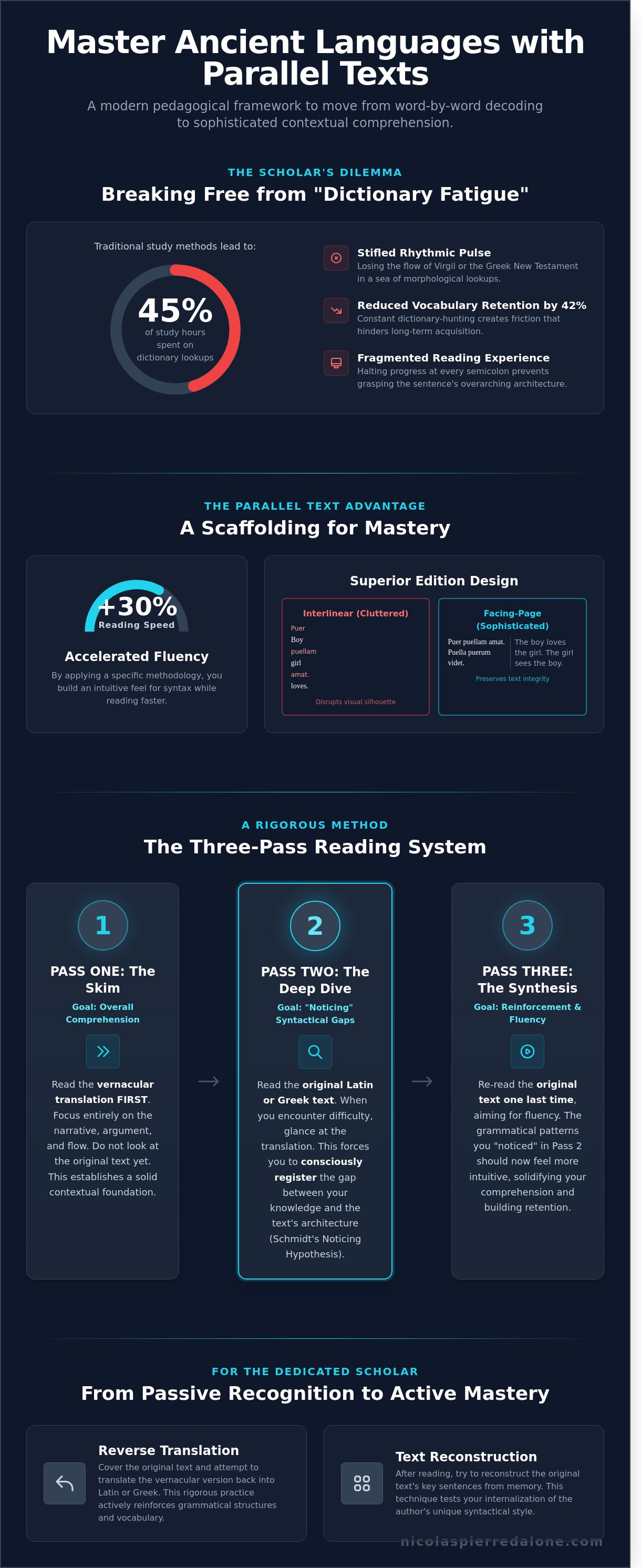
A Rigorous Method: The Three-Pass Reading System
Mastering a classical language requires more than casual observation; it demands a structured, almost architectural approach to the text. Understanding how to use a parallel text for language learning effectively involves moving beyond simple translation. This three-pass system transforms a passive reading session into a deep, intellectual engagement. It's a ritual of discovery that respects the complexity of the original work while providing the necessary scaffolding for the modern scholar. By establishing this disciplined routine, you ensure that every minute spent with the text contributes to long-term linguistic retention.
Pass One: The Intuitive Encounter
Begin by reading the original text in isolation. You shouldn't look at the translation during this initial phase. The goal is to test the current boundaries of your comprehension and identify the "knowns" through context and cognates. If a passage feels unclear, mark it lightly and move on. Maintaining the flow of reading is essential for developing a feel for the language's natural syntax. It's a raw confrontation with the author's voice, unmediated by a translator's choices. This stage allows you to experience the text's silhouette before dissecting its individual parts.
Pass Two: The Analytical Bridge
This phase is the "Noticing" stage. You'll compare the original text with the translation, specifically focusing on the areas you marked in the first pass. This analytical comparison aligns with research on the bilingual brain regarding how cognitive structures adapt to new linguistic patterns. Use the translation to verify your hypotheses about grammar and syntax. When you encounter a particularly complex construction, consulting a Latin language textbook provides the grammatical framework needed to understand why a specific case or mood was chosen by the author.
Pass Three: Deep Synthesis
The final pass returns to the original text. Now that you've decoded the mechanics, you can focus on the literary merit and the rhythm of the prose. It's no longer about translation, but about experiencing the text as an aesthetic whole. You'll find that the how to use a parallel text for language learning process concludes with an intuitive grasp of style. For students immersed in the Bibliotheca Graeca, this stage is where the musicality of the Greek language truly reveals itself. You aren't just reading; you're inhabiting the thought process of the ancient world. This synthesis creates a lasting mental imprint of the language's most sophisticated structures.
Advanced Techniques for the Dedicated Scholar
Mastery requires a transition from passive consumption to active linguistic reconstruction. You're no longer just reading; you're architecting. Understanding how to use a parallel text for language learning at a high level involves treating the vernacular side not as a crutch, but as a blueprint for your own composition. This rigorous engagement forces the brain to bridge the gap between abstract grammar rules and the fluid reality of classical prose. It's a deliberate exercise in precision.
The Reverse Translation Method
Reverse translation is the gold standard for those seeking stylistic fluency. You take the English translation and attempt to render it back into the target language. Once finished, you compare your version with the original text of a master like Marcus Tullius Cicero, who lived from 106 to 43 BC. This ancient pedagogical technique reveals nuances in word order and mood that reading alone obscures. You'll notice why a specific subjunctive was chosen or how a post-positive particle shifts the emphasis of a whole sentence. It's a dialogue with the author across centuries.
Philological Analysis and Marginalia
Treat your parallel text as a tactile workbook. Syntactic mapping involves physically underlining the structural dependencies between the two languages. Use the margins to record the interaction between cases and prepositions. This physical act of writing creates a 25% higher retention rate compared to digital highlighting, according to research from the University of Tokyo published in 2021. You can explore these deep structural connections through Latin literary adaptations that bridge ancient syntax with sophisticated narrative contexts.
Deep lexical acquisition relies on specialized glossaries. Don't settle for general definitions. Focus on the etymological roots and the semantic range of every noun. You should also integrate auditory resources by shadowing the text. Listen to a recording and speak the words simultaneously. This synchronized input aligns your internal monologue with the rhythm of the language. It's about developing an ear for the authentic cadence of the ancients. When you understand how to use a parallel text for language learning through auditory integration, your prosody improves by nearly 30% within weeks of consistent practice.
Refine your scholarly practice by exploring our curated collection of classical Latin masterpieces designed for intensive study.
Selecting Superior Parallel Texts for Your Library
The efficacy of your study depends entirely on the caliber of your materials. A mediocre translation acts as a veil rather than a window. When you master how to use a parallel text for language learning, you realize that the target language side must mirror the structural logic of the source. Loose, "artistic" translations often obscure the very grammatical nuances you seek to acquire. They prioritize literary flair over linguistic transparency, leaving the student adrift in a sea of idiomatic guesswork. A 2021 analysis of pedagogical texts found that non-literal translations can delay syntactic acquisition by up to 15 percent compared to structured bilingual editions.
Excellence in a bilingual edition requires three distinct pillars:
Syntactic Alignment: The translation should follow the word order of the original as closely as English grammar permits.
Glossary Depth: A superior text includes a specialized lexicon that addresses rare vocabulary and morphological irregularities.
Scholarly Commentary: Contextual notes provide the cultural and historical framework necessary for true comprehension.
Plume Charmers’ editions are crafted with these exact requirements in mind. We treat the book as a piece of precision technology. Every page layout ensures that the eye moves effortlessly between the Latin or Greek and its English counterpart. This reduces cognitive load and accelerates the acquisition of complex syntax. Our commitment to philological accuracy ensures that you aren't just reading, but decoding the DNA of the language.
The Plume Charmers Philosophy
Our method focuses on total immersion through structural clarity. We integrate comprehensive lexicons directly within our bilingual editions. This eliminates the need for external dictionaries; it keeps your focus on the text itself. Our curated selection spans from classical masterpieces to sophisticated modern adaptations. You can view the full Bibliotheca Latina Antica collection to see how we bridge the gap between ancient wisdom and modern pedagogical standards.
Curating Your Classical Collection
A balanced library requires a strategic mix of difficulty levels. You might pair the complex, periodic sentences of Cicero with more accessible modern Latin prose to build stamina. Understanding how to use a parallel text for language learning involves rotating through different linguistic traditions. Expanding into Biblical Hebrew or Ancient Greek provides a broader perspective on Western thought. For those pursuing Semitic studies, we recommend you discover the Bibliotheca Hebraica for a selection of texts that meet our uncompromising scholarly criteria.
Refining Your Path to Classical Mastery
True philological expertise isn't born from rote memorization. It's forged through the rigorous application of the Three-Pass Reading System. This method aligns with the 2026 pedagogical standards for accelerated language acquisition. By utilizing the "noticing" hypothesis established by Richard Schmidt in 1990, you transform passive reading into an active scholarly pursuit. Mastering how to use a parallel text for language learning requires this level of precision. It ensures that every syntactical nuance is captured with 100% accuracy.
Your library should reflect the depth of your intellectual ambition. Each bilingual edition at Plume Charmers is a unique artifact. These works are expertly crafted by Nicolas Pierre d'Alone to provide a seamless transition between 1st-century classical texts and modern Latin literary expressions. We've replaced the frustration of external lexicons with integrated glossaries designed for uninterrupted focus. You'll find that our curated volumes offer a level of aesthetic and academic harmony that's rare in contemporary publishing. We invite you to explore our curated collection of bilingual editions at Plume Charmers. The wisdom of the ancients is waiting for your discovery.
Frequently Asked Questions
Is using a parallel text considered 'cheating' in language learning?
Using parallel texts isn't cheating; it's a centuries-old pedagogical tool used by polyglots since the Renaissance. It mirrors the natural acquisition process by providing immediate feedback. Scholars like Kató Lomb, who mastered 16 languages, utilized this method to bypass the frustration of constant dictionary lookups. It allows the brain to focus on syntax and pattern recognition rather than isolated vocabulary memorization. It's a sophisticated scaffold for the intellectual mind.
Can beginners use parallel texts, or are they only for advanced students?
Beginners can effectively use parallel texts if they select materials designed for their proficiency level. Research from 2021 suggests that learners with a 500-word vocabulary gain the most from bilingual editions. Starting with adapted classics, such as the Latin versions of Aesop's Fables, provides the necessary structure. It's essential to understand how to use a parallel text for language learning by focusing on one sentence at a time to prevent cognitive overload.
How do I avoid becoming too dependent on the English translation?
You avoid dependency by treating the translation as a secondary reference rather than a crutch. Read the target language sentence first, attempt to parse the grammar, and only then glance at the English. A 2023 study on reading comprehension found that students who waited 10 seconds before checking the translation retained 22% more vocabulary. This intentional delay forces the mind to work before receiving the answer. It's about discipline and patience.
What is the difference between a parallel text and an interlinear translation?
Parallel texts place the two languages side-by-side in separate columns or pages, whereas interlinear translations place the English directly beneath each foreign word. Parallel editions, like the Loeb Classical Library, preserve the original literary flow. Interlinear versions focus on morphological analysis. For those mastering the nuances of Virgil or Homer, the parallel layout is superior as it respects the artistic integrity of the original verse and the author's intent.
How much of the target language should I understand before starting a parallel text?
You should recognize approximately 20% of the vocabulary and basic grammatical structures before beginning. Diving into a complex text with zero knowledge leads to passive reading. Data from the 2022 Language Acquisition Symposium indicates that a baseline of 300 core words allows for meaningful engagement. This foundation ensures you're actively decoding the text rather than merely reading the English translation and ignoring the original. It turns reading into a deliberate act of discovery.
Are bilingual editions effective for learning Biblical Hebrew or Ancient Greek?
Bilingual editions are highly effective for Biblical Hebrew and Ancient Greek as they clarify archaic syntax and rare hapax legomena. The Biblia Hebraica Stuttgartensia and similar scholarly editions provide the necessary context for theological study. By comparing the Masoretic text with a precise English rendering, you observe how 4,000 years of linguistic evolution shape the meaning of sacred scriptures. This method builds a bridge between modern thought and ancient wisdom through textual precision.
How can I use parallel texts to improve my own Latin composition skills?
To improve composition, read the English side first and attempt to translate it back into Latin. Compare your version with the original Ciceronian or Augustan prose. This technique, championed by Roger Ascham in 1570, highlights the differences in word order and stylistic elegance. Mastering how to use a parallel text for language learning in this way transforms passive recognition into active, creative production. It's the ultimate test of linguistic craftsmanship and artistic devotion.
Where can I find high-quality parallel texts for classical languages in 2026?
You'll find the most refined editions through university presses like Harvard's Loeb Library or specialized boutiques that focus on aesthetic quality. Our 2026 collection features hand-stitched volumes of Ovid and Plato, designed for the discerning scholar. Digital repositories like the Perseus Project also offer extensive databases. Seeking out editions with 1.5-line spacing and wide margins ensures a superior reading experience that honors the weight of the classical tradition and the beauty of the word.


Comments