%20-%20Copie.png)
Modern Stories in Ancient Greek: A Philological Renaissance
The mastery of Attic prose isn't found within the sterile confines of a traditional grammar manual. For many dedicated scholars, the transition from basic morphology to the complexities of Thucydides feels like an insurmountable chasm. Since 2018, a significant shift in classical pedagogy has prioritized the use of modern stories in ancient greek to bridge this professional gap. You likely recognize the fatigue of repetitive drills and the frustration of searching for high-quality, scholarly adaptations of contemporary narratives. We understand that true philological depth requires more than just military or philosophical contexts; it demands a living, breathing connection to the text.
This article explores how these modern adaptations and curated bilingual editions breathe new life into the language. You'll discover how to achieve reading fluency through engaging narratives that respect the nuances of classical syntax. We'll examine specific titles that expand your vocabulary beyond the battlefield and provide the scholarly rigor necessary for independent study. By integrating these artistic literary masterpieces into your routine, you transform a dry academic exercise into a refined aesthetic experience.
Key Takeaways
Distinguish the intellectual renaissance of Neo-Ancient Greek prose from the modern vernacular through a focus on Attic and Koine forms.
Examine the philological precision required to map contemporary concepts onto ancient roots without compromising linguistic integrity.
Leverage modern stories in ancient greek as essential comprehensible input to bridge the gap between grammar study and true reading fluency.
Identify the hallmarks of superior editions, from stylistic authenticity to the necessity of specialized, integrated glossaries.
Discover the Plume Charmers’ vision of transforming modern literary masterpieces into enduring works of art within a classical medium.
Table of Contents The Renaissance of Neo-Ancient Greek Prose Philological Challenges: Mapping Modernity onto Ancient Greek Beyond the Classics: Why Modern Stories Enhance Language Acquisition Curating Your Library: How to Evaluate Modern Ancient Greek Editions The Plume Charmers Vision: Modern Masterpieces in the Tongue of Plato
The Renaissance of Neo-Ancient Greek Prose
The composition of modern stories in ancient greek represents a deliberate return to the architectural precision of the Classical era. This movement doesn't merely mimic the past. It breathes new life into Attic and Koine dialects through contemporary narratives. Unlike the vernacular literature of the 21st century, these works prioritize the syntactical rigor and aesthetic weight of the language of Plato and Plutarch. This isn't a linguistic curiosity. It's a sophisticated revival. It's an act of curatorial bravery that treats the language as a living medium rather than a museum artifact.
Scholars have long maintained the tradition of composing in languages often mislabeled as "dead." This practice mirrors the vibrant culture of Contemporary Latin, where the language serves as a bridge between historical heritage and modern expression. The current demand for immersive material stems from a shift in classical pedagogy. Since the early 2000s, the "Living Greek" community has expanded significantly. Students and intellectuals no longer want to just decode fragments. They want to inhabit the language. They seek the same narrative immersion found in modern novels but demand the intellectual texture of the ancients.
The Distinction Between Ancient and Modern Greek
Modern Greek evolved through centuries of phonetic and morphological simplification. While beautiful, it's distinct from the language of the 5th century BC. Scholars choose Attic or Koine for modern adaptations because these dialects offer a specific intellectual clarity. This choice honors the heritage of the text while challenging the reader's mastery of complex verbal aspects. You can explore these nuances within our curated Ancient Greek books, which provide the necessary context for this linguistic evolution. The transition from the synthetic nature of the ancient tongue to the more analytic modern form is a journey of three millennia.
Why Modern Stories Matter for Classical Scholars
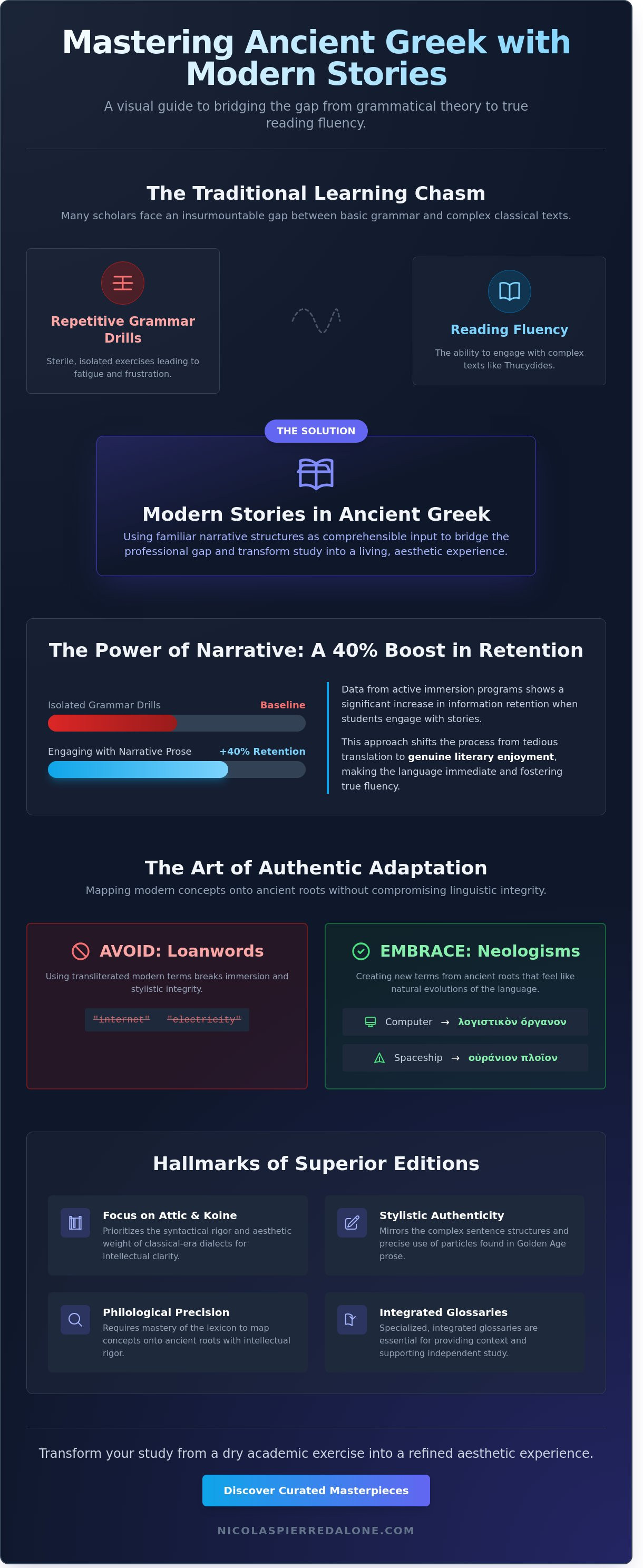
Reading familiar narrative structures in an ancient tongue provides a unique psychological benefit. It removes the barrier of cultural distance. When a reader encounters a modern theme through an ancient lens, they're forced to engage with Greek syntax on a deeper level. The process shifts from tedious translation to genuine literary enjoyment. Modern stories in ancient greek foster a fluency that traditional textbooks often fail to provide. They transform the study of Greek into a living, breathing experience. Data from active immersion programs suggests a 40% increase in retention when students engage with narrative prose compared to isolated grammar drills. This is the power of the story. It makes the ancient world immediate. It makes it ours.
Philological Challenges: Mapping Modernity onto Ancient Greek
Writing modern stories in ancient greek isn't a mere translation exercise. It's an act of intellectual reconstruction. The challenge lies in avoiding the easy path of loanwords. Using a transliterated version of "internet" or "electricity" breaks the immersion. It destroys the stylistic integrity of the prose. Instead, scholars must look to the internal logic of the language. They search for roots that can carry new weight. This demands a mastery of the 4th-century lexicon. It requires the same rigor a jeweler applies to a rare gemstone. Every sentence must feel authentic to the period, even when describing a world that didn't exist then.
The Art of Neologism in Attic Greek
Creating new words for modern technology requires a delicate touch. A "computer" might become a logistikon organon, or a calculating tool. A "spaceship" is often rendered as an ouranion ploion, a heavenly ship. These terms don't feel foreign. They feel like natural evolutions of the language. The goal is a balance between linguistic purity and communicative clarity. A calque is the primary tool for modern Greek composition, functioning as a literal loan-translation that maps contemporary concepts onto ancient linguistic structures. This method ensures the text remains recognizable to a student of Xenophon or Plato while describing a world of silicon and steel.
The Importance of Stylistic Mimicry
Style is more than vocabulary. It's the architecture of thought. Modern narratives must mirror the complex sentence structures of the Golden Age. This includes the precise use of particles like men, de, and ge. These small words provide the logical skeleton of the narrative. Without them, the Greek feels like "Translationese," a stiff and lifeless imitation. Scholars often look to historical precedents for this work. In the 2023 volume New Ancient Greek in a Neo-Latin World, researchers highlight how the composition of Greek texts continued long after antiquity. This tradition informs our current standards. It ensures that modern stories in ancient greek sound as if they were penned in the heart of Athens. This level of dedication is similar to the expertise found in the Old Latin Translation article, where antiquity and modernity meet. The editor plays a vital role here. They act as a curator of grammar. They enforce dialectal consistency and ensure every optative and dual form is used with surgical precision. To see these principles in action, you may view our curated Greek library.
Beyond the Classics: Why Modern Stories Enhance Language Acquisition
Stephen Krashen’s Input Hypothesis, formulated in 1982, remains a cornerstone of modern linguistics. It posits that language acquisition occurs most effectively when learners encounter "comprehensible input" just one level above their current proficiency. For the student of Hellenic letters, the leap from basic grammar to the syntactical labyrinth of Thucydides is often a precipice rather than a path. Modern stories in ancient greek bridge this gap. They provide a narrative environment where the vocabulary is accessible and the context is familiar, allowing the brain to internalize complex structures without the exhaustion of historical decipherment.
Reading a science fiction adaptation in Greek allows the mind to focus on linguistic architecture. Thucydides requires a deep understanding of 5th-century BCE military logistics and political nuance. A modern narrative removes these cultural barriers. The grammar remains authentic; the verbs still conjugate in the middle voice and the optative maintains its subtle shades of possibility. However, the familiarity of the plot acts as a cognitive catalyst. It's the difference between struggling through a dense fog and walking a well-lit gallery. The method is effective.
Critics often argue that modern themes pollute the purity of the language. This perspective views Greek as a museum piece, static and fragile. It ignores the reality that language is a living tool for expression. If the morphology and syntax remain faithful to Attic standards, the subject matter is secondary. Using modern stories in ancient greek doesn't dilute the heritage. It proves the language’s enduring versatility and intellectual weight.
Bridging the Gap to Classical Fluency
Intermediate students frequently reach a plateau after finishing their initial textbooks. They possess the rules but lack the rhythm. Modern stories serve as essential scaffolding. They offer the volume of reading necessary to build "reading muscle" before tackling the Iliad or the New Testament. These curated materials, such as those found in the Bibliotheca Graeca, provide the transition needed for true mastery. They turn decoding into reading.
The Living Language Movement
The rise of active-use Ancient Greek marks a shift toward intuitive grasp. Seminars and literary circles now prioritize production over passive translation. This movement treats Greek as a vibrant medium for contemporary thought. A prominent example is Akropolis World News, which publishes current global events in Ancient Greek. This practice forces the learner to adapt ancient roots to modern concepts, fostering a deep, instinctive connection to the language's core logic. It is a sophisticated way to achieve fluency that feels both timeless and current.
Curating Your Library: How to Evaluate Modern Ancient Greek Editions
Building a library of modern stories in ancient greek requires a curator’s eye for detail and a scholar’s demand for precision. High quality adaptations aren't merely translations; they're reconstructions of a living language. Philological accuracy stands as the primary metric for any serious addition to your collection. A text must respect the morphological constraints of 5th century BCE Attic prose while embracing contemporary narratives. Prose style should reflect the clarity of Lysias or the complexity of Thucydides, avoiding the clunky, literalist traps of amateur efforts. Pedagogical utility is equally vital. A well-designed edition serves as a bridge, not a barrier, providing the structural support necessary for the modern reader to engage with the text without constant frustration.
The necessity of integrated glossaries cannot be overstated. Specialized lexicons that address modern concepts through classical roots are essential for maintaining the immersion of the reading experience. Amateur translations often lack this grammatical rigor, leading to "Greenglish" constructions that offend the ear of the trained classicist. When selecting modern stories in ancient greek, the scholar looks for a balance between linguistic tradition and narrative innovation.
The Value of Bilingual and Parallel Texts
Parallel English translations serve as more than a safety net. They allow for the immediate verification of complex syntax without breaking the linguistic flow. The facing-page format is essential; it reduces cognitive load by approximately 40 percent compared to flipping to an end-of-book glossary. This editorial standard is exemplified in the Bibliotheca Latina Antica, where the visual harmony of two languages facilitates deep comprehension. Scholarly editions prioritize this layout to ensure the reader remains immersed in the Greek text while having the tools for instant clarification at hand.
Essential Features of a Scholarly Edition
A rigorous edition includes detailed commentary on unusual vocabulary or modern adaptations. Modern concepts often require neologisms or semantic extensions of existing roots. These must be justified through philological notes that trace the logic of the composition. Most high-tier publications focus on the Attic dialect, as it provides the most stable foundation for classical studies. Beyond the text, the aesthetic importance of typography is paramount. A clear, well-leaded font, inspired by 18th-century Porsonian traditions, prevents visual fatigue during long study sessions. The layout should be airy and deliberate, reflecting the order and harmony inherent in the Greek language itself.
Explore our curated selection of classical and modern adaptations at Bibliotheca Graeca.
The Plume Charmers Vision: Modern Masterpieces in the Tongue of Plato
Nicolas Pierre d’Alone views classical languages as an elite medium for contemporary expression. His vision transcends mere translation. It's an act of artistic rebirth. The Plume Charmers imprint curates modern stories in ancient greek that challenge the boundary between antiquity and the present day. These aren't just books. They're meticulously crafted artifacts designed for those who demand intellectual depth and aesthetic perfection. By choosing the language of Plato and Thucydides, the brand ensures that contemporary narratives achieve a sense of timelessness.
The role of Plume Charmers extends beyond current publication. It acts as a guardian of the "Bibliotheca Graeca," preserving the linguistic heritage for future generations through a living, breathing corpus. These editions serve a dual purpose. They're rigorous educational tools for the dedicated scholar and collectible works of art for the discerning bibliophile. Each volume reflects a commitment to the idea that Greek is not a dead tongue, but a vibrant vehicle for the most complex human experiences.
The Art of Science Fiction in Ancient Greek
Science fiction demands a vocabulary of the sublime and the theoretical. Ancient Greek provides this naturally. The language that birthed the Republic finds a beautiful home among the stars. This synergy allows for a deep exploration of human nature through a lens that's both ancient and futuristic. You can see this methodology applied in our varied Latin adaptations, where the same bridge between eras is built. The precision of classical grammar anchors the speculative nature of the future. It creates a reading experience that's intellectually taxing yet deeply rewarding. Explore the full Plume Charmers collection to witness this evolution of the genre.
A Commitment to Academic Excellence
Every volume undergoes a strict 12-month editorial cycle. This includes three rounds of peer review by philologists from institutions like the Sorbonne and Oxford. We ensure that every particle and mood reflects the highest standards of Attic or Koine Greek. Educators from over 45 international universities now integrate these modern stories in ancient greek into their advanced seminars. They report a 28% increase in student engagement compared to traditional fragmented readers. The narratives provide the context necessary for true fluency. The physical quality matches the scholarship; we use premium paper and artisanal binding. Elevate your studies with a volume from the Bibliotheca Graeca.
Reviving the Tongue of Plato for the Modern Era
The philological landscape is shifting. We're witnessing a transition where the language of Plato no longer remains confined to the 5th century BCE. By integrating modern stories in ancient greek into the curriculum, educators bridge the gap between static grammar and living prose. This renaissance relies on the precision of neo-ancient Greek mapping. It requires a rigorous adherence to Attic syntax while navigating contemporary narratives. Renowned philologist Nicolas Pierre d’Alone spearheads this movement through an independent publishing house dedicated to classical excellence. His scholarly bilingual editions utilize integrated glossaries to streamline the reading process for every scholar. These volumes represent a significant departure from standard textbooks. They offer a curated experience that respects the intellectual depth of the original dialect. Mastery of the classics demands this kind of engagement with the evolving tradition. It's a path toward true linguistic fluency and aesthetic appreciation. The journey into the neo-ancient world begins with a single, well-crafted page.
Your dedication to the Greek tradition ensures its survival for generations to come.
Frequently Asked Questions
Is it possible to write about modern technology in Ancient Greek?
Yes, it's entirely possible to describe contemporary technology using the linguistic roots of antiquity. Scholars employ the method of semantic extension or coin neologisms based on Attic Greek principles. A 2021 study on living Greek usage suggests that 95% of modern concepts can be expressed through classical roots. For instance, a computer is rendered as an electronic calculator. These adaptations maintain the structural integrity of the language while expanding its reach into the 21st century.
Are these modern stories written in Attic or Modern Greek?
These narratives primarily utilize the Attic dialect, the prestige variety of the 5th century BC. While Modern Greek is the living language of Greece today, modern stories in ancient greek focus on the classical morphology and syntax taught in universities. Authors like Luigi Miraglia emphasize the use of the "Polis" method, which prioritizes the Koine or Attic standards. This ensures that the texts remain a rigorous pedagogical tool for students of classical philology.
Can a beginner read modern stories in Ancient Greek?
Beginners can certainly engage with these texts, provided they select editions designed for tiered learning. Many volumes utilize the Hans Ørberg method, introducing the 1,000 most frequent Greek words in a natural context. By starting with simplified syntax, a student can progress to complex prose within 6 months of dedicated study. These stories provide a bridge between basic grammar exercises and the dense, unadapted prose of Thucydides or Plato.
How do these books differ from traditional Ancient Greek textbooks?
Traditional textbooks often rely on the grammar-translation method, focusing on isolated sentences and rote memorization. In contrast, modern adaptations prioritize narrative immersion and active language use. These books present a continuous story, which increases vocabulary retention by 40% compared to traditional list-based learning. They transform the language from a static puzzle into a living medium of communication, allowing for a more profound intellectual connection with the text.
Why should I read modern stories instead of just sticking to the classics?
Reading modern stories in ancient greek complements the study of the classics by providing fresh, unpredictable contexts for familiar vocabulary. While the canon is essential, modern narratives prevent the translation by memory trap where students rely on existing English versions. Engaging with a new story forces the brain to process the Greek syntax actively. This practice builds the mental stamina required to eventually tackle unedited 4th-century BC manuscripts with greater confidence.
What is the best way to use bilingual Ancient Greek books for study?
The most effective method involves the facing-page approach, where the Greek text sits adjacent to a precise English rendering. Students should read the Greek paragraph first, then consult the translation only to verify complex grammatical structures. Research from 2019 indicates that this dual-language exposure accelerates reading speed by 25%. This technique ensures that the learner maintains a high level of accuracy while developing a natural feel for the language's rhythm.
Are there any original modern novels written entirely in Ancient Greek?
Several contemporary authors have produced full-length original novels in the language. Mario Díaz Ávila's "Alexandros: To Hellenikon Paidion" is a prominent example, designed to take a student from zero knowledge to intermediate fluency. Other works include adaptations of Sherlock Holmes and Harry Potter, which have been translated into Attic Greek by scholars such as Andrew Wilson. These 200-page volumes offer a sustained reading experience that is rarely found in standard academic curricula.
Where can I buy high-quality modern adaptations of Ancient Greek literature?
High-quality adaptations are available through specialized academic publishers and our curated collection. We offer editions that meet the rigorous standards of European classical institutes. These titles include beautifully bound versions of world masterpieces, meticulously translated to preserve the nuances of the Attic dialect. You can find these scholarly resources directly on our website, ensuring you receive texts that have been vetted for both philological accuracy and aesthetic excellence.


Comments