%20-%20Copie.png)
Learning Biblical Hebrew: A Definitive Guide for Beginners
- mikolajpa5
- Feb 27
- 10 min read
The desire to read the Old Testament in its original form is a pursuit of profound depth, an engagement with an ancient text in its purest state. Yet, for many, the journey begins not with clarity, but with hesitation – a foreign alphabet, a disorienting array of resources, and the fundamental question of where to begin. At Plume Charmers, we crafted this guide to bring order to that uncertainty. We firmly believe that learning biblical hebrew for beginners should not be an exercise in frustration, but a deliberate, intellectual process; a craft to be honed with precision and the right tools.
Here, you will find a curated path designed for the dedicated self-learner. We move beyond rote memorization, focusing instead on the elegant structure of the language itself. From the foundational aleph-bet to the quiet satisfaction of deciphering your first verse, this guide provides a definitive map. The objective is not merely comprehension, but a deeper, more nuanced appreciation for the sacred text – an understanding built, step by step, with confidence and clarity.
Key Takeaways
Discover the intellectual foundation for studying Biblical Hebrew, moving beyond translation to grasp the original text's profound artistry and cultural nuance.
Master the aleph-bet as the essential first step, then approach grammar not as rules to memorize, but as the language's inherent logic.
Our curated toolkit outlines the three essential book types, creating a complete curriculum for those serious about learning biblical hebrew for beginners.
Adopt a structured, six-month study plan designed to deconstruct the learning process into clear, manageable phases from your first day.
Table of Contents The Intellectual Foundation: Why Learn Biblical Hebrew? First Steps: Mastering the Hebrew Aleph-Bet Core Concepts of Biblical Hebrew Grammar A Curated Toolkit: Essential Resources for the Self-Learner Your Study Plan: A Structured Approach for the First Six Months
The Intellectual Foundation: Why Learn Biblical Hebrew?
To read the Old Testament in translation is to see a masterpiece through a veil. The narrative remains, but the texture, the intricate wordcraft, and the profound cultural resonance are muted. The discipline of learning Biblical Hebrew is an invitation to lift that veil. It is a direct engagement with one of humanity’s most foundational literary and spiritual traditions, offering an unparalleled clarity that translation alone cannot provide.
The journey of learning biblical hebrew for beginners is not merely academic; it is an immersion into the ancient mind. This process is a commitment to understanding the Scriptures on their own terms, moving beyond interpretation to experience the original revelation.
Uncovering Textual Nuance
Translation is an approximation. The genius of Hebrew lies in its poetic density and multi-layered meaning, qualities often lost in the transition to English. The language is built upon a system of three-consonant roots, where a single root can generate a constellation of related concepts. For example, the same root can inform words for "word," "desert," and "pestilence," creating a theological tapestry woven directly into the vocabulary. Even grammar conveys meaning; verb forms can express a nuance of action and reality that English requires entire phrases to suggest.
Biblical vs. Modern Hebrew: A Critical Distinction
A common question is whether knowledge of Modern Hebrew is a prerequisite. The answer is a definitive no. While related, the two are distinct linguistic systems separated by millennia. They differ significantly in vocabulary, syntax, and pronunciation. Our focus is exclusively on Biblical Hebrew, the language preserved in the scriptures-a linguistic artifact of immense historical and theological importance. Your study begins here, with no prior knowledge assumed or required.
Embarking on this path is to choose depth over convenience. It is an intellectual and spiritual discipline that rewards the student with a more authentic, textured, and profound understanding of the Old Testament. The text ceases to be a static document and becomes a living, breathing work of literary art.
First Steps: Mastering the Hebrew Aleph-Bet
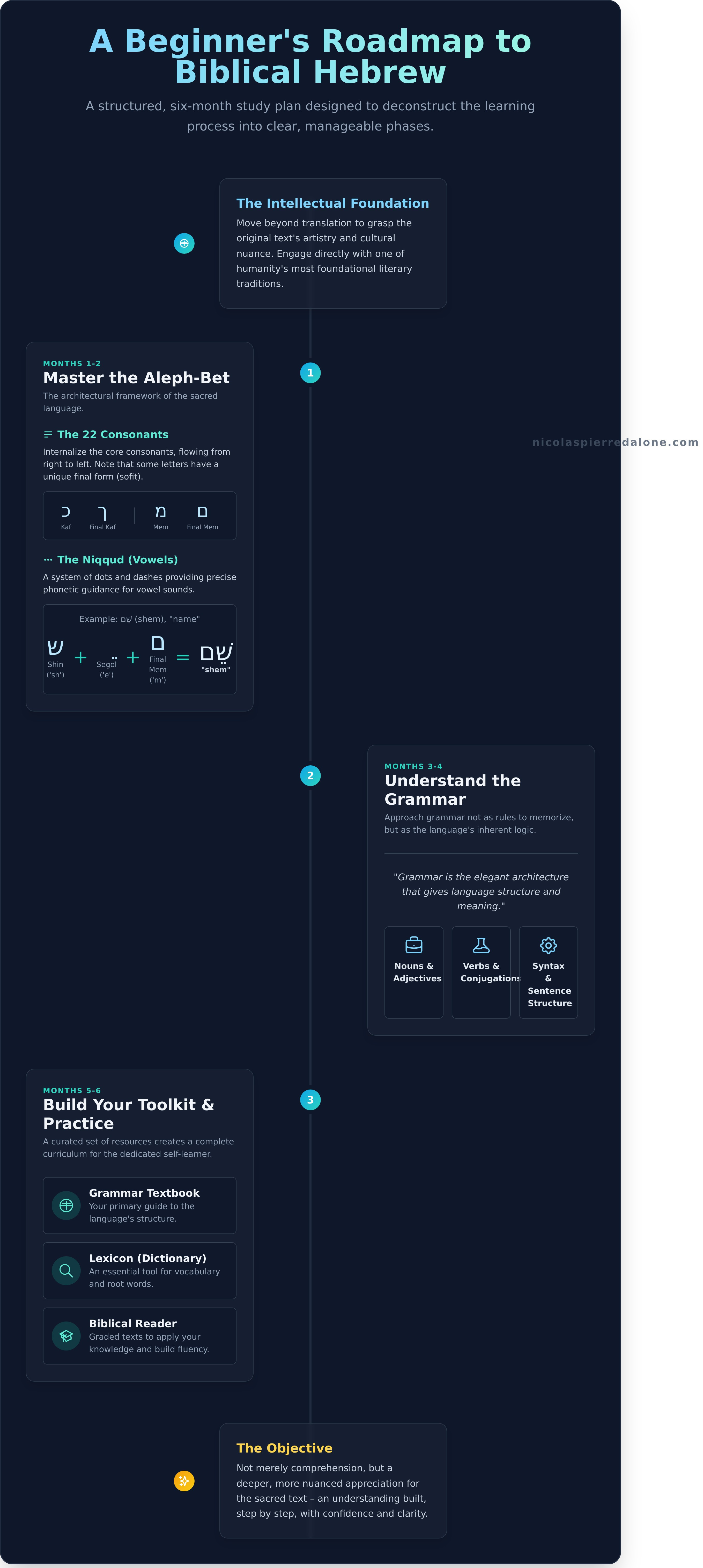
The journey into Biblical Hebrew begins with a single, foundational act: mastering the aleph-bet. This is not merely an alphabet; it is the architectural framework of a sacred language. The script flows from right to left, a simple reorientation of perspective that quickly becomes intuitive. Your first task is to internalize the 22 core consonants. This discipline is the cornerstone of learning biblical hebrew for beginners and the essential first step toward textual fluency.
The 22 Consonants
Each of the 22 consonants possesses a distinct form and sound. Certain letters-Kaf (כ/ך), Mem (מ/ם), Nun (נ/ן), Peh (פ/ף), and Tzadi (צ/ץ)-adopt a unique final form (sofit) at a word's end, a subtle, structural elegance. To aid memorization, group letters by their visual silhouette: distinguish the rounded corner of Bet (ב) from the sharp angle of Kaf (כ). Daily engagement with curated flashcards or minimalist applications is essential for building recognition.
The Niqqud: Understanding Hebrew Vowels
Vowels in Hebrew are not letters, but a delicate system of markings known as the niqqud. These dots and dashes, placed above, below, or within the consonants, provide precise phonetic guidance for the major vowel sounds (a, e, i, o, u). While ancient manuscripts were purely consonantal, the Masoretic scribes later introduced this system with scholarly precision, preserving the oral heritage of the text for generations.
From Letters to Words: Your First Reading Practice
True understanding begins when letters coalesce into words. Consider the word שֵׁם (shem), meaning "name." It is composed of two consonants and one vowel:
ש (Shin) - provides the 'sh' sound
ֵ (Segol) - the 'e' vowel sound, placed below the consonant
ם (Final Mem) - provides the final 'm' sound
Voicing the word aloud-shem-transforms abstract symbols into meaningful sound. This practice is fundamental. Consistent, deliberate effort is the only path to connecting with the text in its original form.
Core Concepts of Biblical Hebrew Grammar
Grammar is not a collection of arbitrary rules to be memorized. It is the internal logic of a language-the elegant architecture that gives it structure and meaning. For those committed to learning biblical hebrew for beginners, understanding this system is the foundational step toward true comprehension. Instead of focusing on exceptions, we begin with the three pillars that support the entire linguistic edifice.
This approach prioritizes insight over rote learning, allowing you to discern patterns and appreciate the sophisticated design of the sacred tongue. We will explore the root system, the verb, and the noun in their most essential forms.
The Power of the Three-Letter Root
At the heart of Biblical Hebrew lies a principle of profound elegance: the tri-consonantal root (shoresh). Most words in the language are not independent creations but are derived from a core, three-letter foundation that carries a specific semantic concept. By adding vowels and affixes, this single root blossoms into a family of related words.
Consider the root K-T-V (כ-ת-ב), which embodies the concept of 'writing'.
From this, we derive katav (כָּתַב), meaning 'he wrote'.
We also find kotev (כּוֹתֵב), the participle for 'writing' or 'a writer'.
And miktav (מִכְתָּב), meaning 'a letter' or 'a written document'.
Mastering this concept transforms vocabulary acquisition from a task of memorization into an art of recognition.
Understanding the Hebrew Verb
The Biblical Hebrew verb operates on a system of aspect rather than tense. It is less concerned with when an action occurred and more with whether the action is complete or incomplete. The two primary states you must understand are:
The Perfect (Qatal): This form typically denotes a completed action, viewed as a whole. It is often, but not always, translated as a past tense.
The Imperfect (Yiqtol): This form signifies an incomplete, ongoing, or future action.
More advanced verb stems (binyanim) build upon this foundation to express nuances like passive, intensive, or causative action, but a firm grasp of the Perfect and Imperfect is the essential starting point.
Nouns, Gender, and the Construct State
Three features define the Hebrew noun. First, every noun has a grammatical gender-either masculine or feminine-which affects agreement with adjectives and verbs. Second, nouns exist in singular, plural, and occasionally dual forms (for things that come in pairs, like eyes or hands). Finally, Hebrew uses a unique and powerful formation to show possession: the construct state (smichut). Instead of saying 'the word of God', Hebrew joins the words directly. For example:
davar (word) + Elohim (God) becomes d'var Elohim (דְּבַר אֱלֹהִים) - 'word of God'. This direct, minimalist connection is a hallmark of Hebrew prose and a vital concept for every student.
A Curated Toolkit: Essential Resources for the Self-Learner
The path of the self-learner is one of discipline and discernment. Mastery is not achieved through an accumulation of resources, but through the deliberate selection of a few essential tools. The process of learning biblical hebrew for beginners is an achievable art, provided your toolkit is curated with precision and an eye for pedagogical quality.
Your foundational library needs only three volumes, each with a distinct and critical function:
A foundational grammar textbook.
An essential lexicon.
A bilingual reader.
Together, they form a complete curriculum for the dedicated student, transitioning your study from how to learn to with what.
The Foundational Grammar Textbook
Your grammar is the architectural blueprint of the language. It provides the structured lessons, logical progression, and critical exercises that form the bedrock of your knowledge. Look for a text with lucid explanations, a comprehensive answer key for self-correction, and a pace that respects the learning process. Renowned choices like Pratico & Van Pelt's Basics of Biblical Hebrew offer a deductive approach, guiding you through the language's elegant structure.
The Essential Lexicon (Dictionary)
A lexicon transcends a simple dictionary. It is a curated archive of a word's life, revealing not just its definition but its root, semantic range, and contextual nuance. This is where you develop a feel for the language's texture. For the beginner, a lexicon like Holladay's Concise Hebrew and Aramaic Lexicon is an indispensable companion, offering clarity without overwhelming detail as you begin to translate authentic passages.
The Bilingual Reader: Bridging Theory and Practice
Here, knowledge becomes skill. A bilingual reader places the authentic Hebrew text alongside a faithful translation, transforming abstract rules into living language. This parallel structure is the most elegant method for building reading fluency, reinforcing vocabulary intuitively, and gaining confidence. It is the essential bridge from academic exercise to genuine textual engagement.
For those who appreciate the intersection of scholarship and artistry, we have crafted editions for this very purpose. Discover the Bibliotheca Hebraica for curated bilingual volumes that honor the text and elevate the reader's journey.
Your Study Plan: A Structured Approach for the First Six Months
Success in this pursuit is not accidental. It is the result of structure and intention. This six-month plan provides a curated path, transforming the complex challenge of learning Biblical Hebrew for beginners into a series of manageable, deliberate steps. It is a framework for building a sustainable habit, a discipline that yields profound rewards. Approach this journey not as a task, but as the development of a craft.
The First Month: Foundational Marks
Your initial focus is absolute precision. The goal is to master the aleph-bet-its shapes, sounds, and names-and a core lexicon of 50-100 common nouns. Dedicate 30-45 minutes each day to a ritual of focused study. Use physical or digital flashcards for recall and practice writing each character by hand. This is an exercise in muscle memory and visual imprinting, the essential groundwork upon which all future understanding is built.
Months 2-4: The Architecture of Grammar
Here, you begin to understand the language's internal logic. The objective is to progress methodically through the first half of a standard grammar textbook. Commit to one chapter per week, diligently completing every exercise to internalize the patterns. This systematic work reveals the structural principles of verbs, nouns, and syntax. Begin to apply this knowledge by reading simple, constructed sentences from a bilingual reader, connecting abstract rules to concrete meaning. You are learning the art of composition.
Months 5-6: Your First Encounter with Text
The final phase is the transition from theory to artifact. The goal is to translate your first authentic verses from simple narrative passages, such as those found in Genesis or Jonah. This is a slow, meditative process. With your lexicon and grammar as your tools, you will parse each word, deconstructing sentences to uncover their intended meaning. The focus must be on deep comprehension, not speed. It is in this careful, deliberate engagement that the text begins to reveal itself. Our bilingual edition of Jonah serves as an impeccable entry point for this profound journey.
The Art of Reading Scripture
Your expedition into the heart of the Hebrew Bible has been charted. From the foundational elegance of the Aleph-Bet to the intricate logic of its grammar, you now possess a clear framework for a direct encounter with the sacred texts. This structured approach transforms the challenge of learning biblical hebrew for beginners into a deeply rewarding intellectual pursuit.
True mastery, however, demands more than a map; it requires impeccably crafted tools. We invite you to explore the Bibliotheca Hebraica collection for your self-study journey. Each volume is an artifact of scholarship and design. Our expertly curated bilingual editions are conceived for the modern, independent learner, featuring integrated glossaries and meticulous notes that facilitate a seamless understanding. This is not just reading; it is a curated, immersive experience.
The path is clear. Your authentic engagement with the original text awaits. Begin the work.
Frequently Asked Questions
How long does it take to learn Biblical Hebrew?
The timeline for proficiency is a testament to discipline. Foundational grammar and a core vocabulary can be acquired within one to two years of consistent study. True mastery, however, is a more nuanced, lifelong pursuit. The goal is not speed but a deep, structural understanding of the text. This journey demands patience and a commitment to the craft of language acquisition.
Is Biblical Hebrew harder to learn than Latin or Ancient Greek?
The challenge is unique, not necessarily greater. Biblical Hebrew presents an unfamiliar script and Semitic grammar, a departure from Indo-European structures. While its verb system is more streamlined than that of Greek, and its case system less complex than Latin's, the initial barrier of the alphabet and right-to-left orientation requires a focused and deliberate approach from the start.
Do I need a tutor, or is it possible to learn Biblical Hebrew by myself?
Independent study is possible with curated resources. However, the guidance of a skilled tutor is invaluable for an authentic education. An instructor provides essential structure, corrects pronunciation, and clarifies the nuanced logic of the language. This mentorship accelerates progress and builds a correct foundation, a critical element in learning biblical hebrew for beginners.
What is the best first book of the Bible to read in Hebrew?
Begin with narrative prose. The books of Jonah or Ruth offer a contained vocabulary and a clear, direct narrative structure. These texts provide an ideal foundation before approaching the more complex poetry of the Psalms or the dense prophecies of Isaiah. A deliberate, sequential approach ensures a solid base for future reading and a more profound appreciation of the text.
Should I focus on learning to write the script, or just to read it?
The primary objective is reading comprehension. Mastery of the text is paramount. However, the physical act of writing the Hebrew script should not be dismissed. This tactile practice reinforces letter recognition and deepens your connection to the alphabet's form. Treat writing as a refined tool to enhance your reading ability, not as an end in itself.
What are the most common mistakes beginners make when learning Biblical Hebrew?
A common error is impatience. Beginners often rush to complex texts before mastering foundational grammar. Another pitfall is neglecting consistent vocabulary review, the bedrock of comprehension. Finally, avoid imposing English syntax onto Hebrew sentence structures. One must learn to think within the language's own elegant and distinct logic to truly understand its meaning.


Comments