%20-%20Copie.png)
Intellectual Hobbies for Adults: Cultivating the Art of Cerebral Leisure
- mikolajpa5
- Mar 25
- 11 min read
Updated: Mar 26

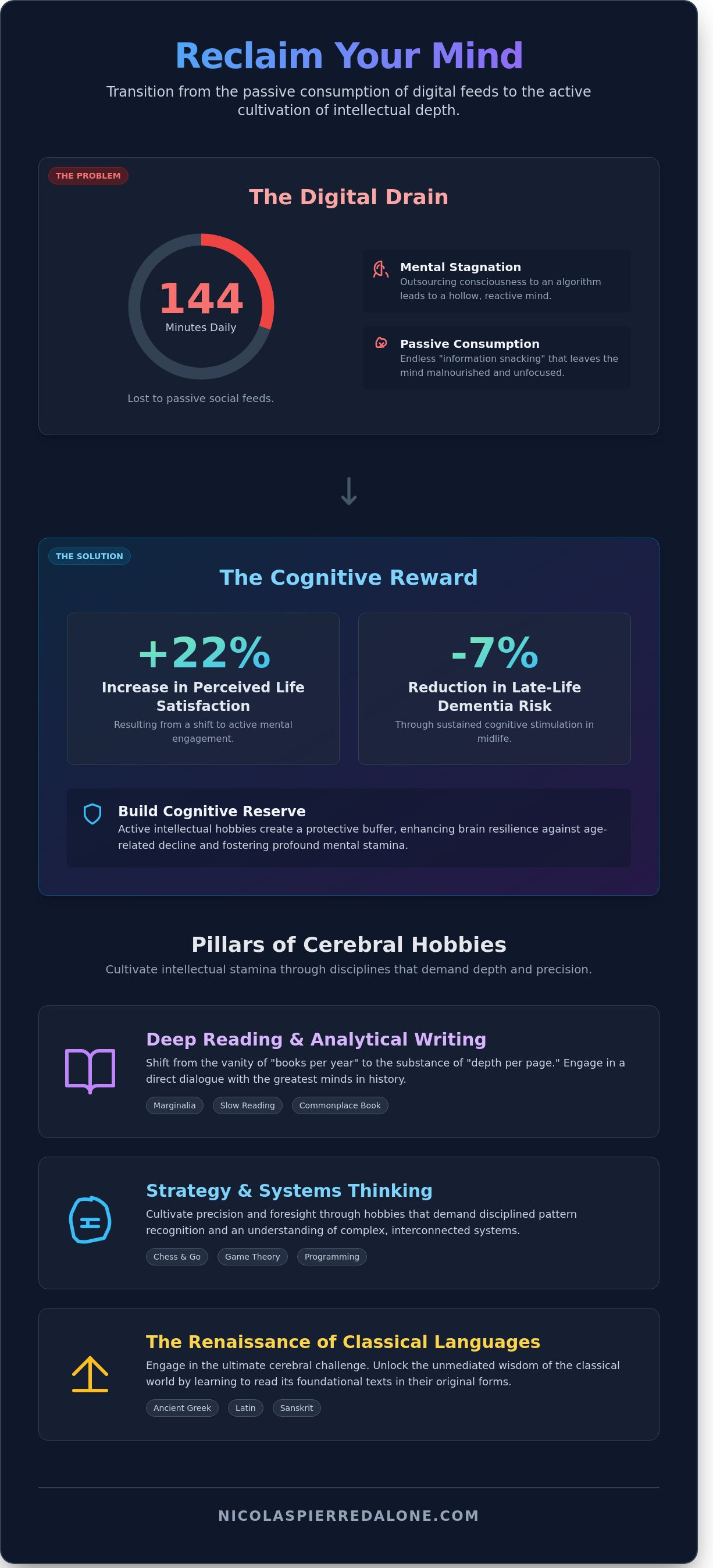
The average adult spends 144 minutes every day lost in the digital vacuum of social feeds, a habit that effectively outsources human consciousness to an algorithm. You've likely felt the resulting mental stagnation. It's that specific, hollow exhaustion following an hour of scrolling when you realize your most valuable asset, time, was traded for trivialities. Cultivating intellectual hobbies for adults is no longer a luxury; it's a vital strategy for reclaiming your focus and your dignity. You deserve a leisure life that reflects the same precision and quality as your professional pursuits.
A 2023 report on cognitive health suggests that shifting to active mental engagement can increase perceived life satisfaction by 22 percent. This article promises to guide you through that transition. You'll learn how to move from passive consumption to a state of cerebral flow, finding hobbies that function as a personal art form. We'll explore a curated selection of disciplines that build intellectual stamina and connect you with the profound history of human genius. It's time to transform your downtime into a deliberate act of self-cultivation.
Key Takeaways
Transition from passive information snacking to active cognitive engagement, trading fleeting digital consumption for lasting intellectual depth.
Elevate your reading practice by shifting focus from sheer volume to analytical dialogue and the refined art of marginalia.
Cultivate strategic precision through intellectual hobbies for adults that demand systemic thinking and disciplined pattern recognition.
Design a bespoke leisure framework that replaces hollow habits with curiosity-driven pursuits and sustained mental stamina.
Experience the ultimate cerebral challenge by unlocking the unmediated wisdom of the classical world through its original, ancient languages.
Table of Contents Beyond Passive Leisure: Why Intellectual Hobbies for Adults Matter in 2026 The Pillars of Cerebral Hobbies: Deep Reading and Analytical Writing Strategy and Systems: Hobbies That Make You Smarter Through Patterns Cultivating Intellectual Stamina: A Framework for Implementation The Renaissance of Classical Languages: The Ultimate Intellectual Pursuit
Beyond Passive Leisure: Why Intellectual Hobbies for Adults Matter in 2026
True luxury is the reclamation of one's attention. In 2026, the digital environment offers endless "information snacking," a shallow consumption that leaves the mind malnourished. Intellectual hobbies for adults represent a radical departure from this passivity. These are activities requiring sustained cognitive effort and critical reflection. They aren't merely pastimes; they are architectural projects for the human brain. While a standard what is a hobby definition might include any regular non-work activity, the intellectual variant demands a higher entry price: your presence.
This shift toward deep engagement serves as a counter-movement to ubiquitous automation. When machines can summarize a text in three seconds, the act of analyzing a complex philosophy for thirty hours becomes a status symbol of the intellect. It's the difference between owning a mass-produced print and commissioning an original oil painting. This "intellectual play" is a form of luxury that transcends material wealth. It separates productive labor from the pure, unadulterated joy of learning for its own sake.
The Psychology of Cerebral Engagement
Cerebral hobbies trigger the "Flow State," a psychological phenomenon where high-challenge tasks meet high-skill execution. This isn't just about entertainment. According to a 2024 report from the Lancet Commission, cognitive stimulation throughout midlife reduces the risk of late-life dementia by 7 percent. Intellectual curiosity acts as a vital buffer, building "cognitive reserve" that protects the brain against age-related decline. Intellectual stamina is the ability to sit with complex ideas without distraction. Cultivating this stamina through intellectual hobbies for adults builds an emotional resilience that short-form content cannot provide.
Leisure as an Art Form
We must transition from "killing time" to "cultivating the self." Modern leisure should be treated with the same precision as a bespoke garment. The most rewarding pursuits are those with the steepest learning curves. They offer an exclusivity born of effort rather than price. Depth is the new frontier of the elite. Choosing a hobby that requires months of foundational study creates a unique internal heritage. It's a commitment to quality over quantity. The difficulty isn't a barrier; it's the point of the exercise. Only through rigorous engagement do we find the clarity and harmony that define a sophisticated life.
The Pillars of Cerebral Hobbies: Deep Reading and Analytical Writing
True intellectualism rejects the vanity of the "books per year" metric. It's a race to nowhere. Instead, we measure depth per page. A single paragraph of Spinoza or a page of Stephen Hawking’s 1988 insights offers more cognitive friction than a dozen disposable novels. This friction builds hobbies for mental resilience, as highlighted in a January 2025 psychological study on cognitive longevity. Intellectual hobbies for adults should challenge the status quo of your own mind.
Marginalia is the key. Treat the white space of a page as a canvas for dialogue. When you underline a passage or argue with a premise in the margins, you're no longer a passive consumer. You're a collaborator. This practice transforms reading into a two-way conversation with history’s greatest thinkers. It requires a sharp pencil and an even sharper focus.
The Slow Reading Movement
Select texts that fight back. Choose "hard" non-fiction like theoretical physics or classical history. These subjects demand a second pass. To master this, commit to a 30-minute deep reading session. Turn off every digital intrusion. If you're exploring Petrarch or Dante, use a parallel-text edition. Seeing the original Italian alongside the English preserves the rhythmic intent and linguistic nuance that a standard translation loses. It's about the texture of the language, not just the plot.
Epistolary and Reflective Writing
Writing is the act of thinking on paper. It's the ultimate tool for internal order. Use a Commonplace Book to curate a personal library of human thought. This isn't a diary. It's a curated archive where you transcribe quotes and distill complex systems into your own words. Research suggests that 82% of information is better retained when synthesized through handwriting rather than digital typing.
Letter Writing: Revive the art of the long-form letter. It forces a deliberate pace and a structured argument.
Analytical Journaling: Use writing to clarify internal beliefs. If you can't write it down, you don't fully understand it.
Curated Thought: Treat your notebook like a gallery. Every entry should be a deliberate piece of your intellectual silhouette.
Refining your intellect is a meticulous craft. Much like selecting hand-finished Italian essentials, it requires an eye for the subtle details that others overlook. Focus on the quality of the thought, and the expansion of the mind will follow naturally.
Strategy and Systems: Hobbies That Make You Smarter Through Patterns
Intelligence thrives on structure. The ability to recognize, decode, and manipulate patterns is the hallmark of a refined mind. These pursuits aren't mere distractions; they're exercises in cognitive architecture. Engaging in intellectual hobbies for adults allows for a deliberate sharpening of the senses against the noise of modern life. It's about finding the hidden logic in the chaos.
The Mastery of Strategic Games
Chess is the gymnasium of the mind. With 10^120 possible move sequences, known as the Shannon number, it offers an infinite landscape for calculation. It's a game of perfect information. Nothing is hidden; your only opponent is your own lack of foresight. Mastery requires more than logic; it demands an appreciation for the aesthetic of a "clean" game where every piece serves a singular, curated purpose.
Delayed Gratification: A single match can last five hours. Success requires the discipline to forgo immediate captures for long-term positional dominance.
Pattern Recognition: Grandmasters don't see individual pieces. They see "chunks" of information and historical archetypes.
Abstract Logic: Games like Go, with its 10^170 possible board positions, elevate strategy to a form of territorial art.
Systems-Based Pursuits
Gardening isn't a simple chore. It's the management of a complex biological system. A successful curator of a garden understands the nitrogen cycle and the delicate balance of soil pH, ideally kept between 6.0 and 7.0 for most cultivars. It's a lesson in patience and systemic health. You don't just grow plants; you manage an ecosystem where every variable affects the final silhouette of the landscape.
Coding offers a similar intellectual rigor for the non-technical adult. With over 700 programming languages in existence, learning Python or Swift is a linguistic and logical puzzle. It's pure intent translated into syntax. There's no room for ambiguity. A single misplaced semicolon breaks the system, demanding a level of precision that few other intellectual hobbies for adults can match.
Amateur astronomy connects the local observer to cosmic systems. Navigating the 88 recognized constellations or identifying the 110 objects in the Messier catalog requires a map-maker's mind. It's a pursuit of order. You're not just looking at stars; you're witnessing the mechanics of gravity and time on a scale that humbles the ego while expanding the intellect.
Cultivating Intellectual Stamina: A Framework for Implementation
Time is the ultimate raw material. According to a 2024 Statista report, the average adult spends 144 minutes daily on passive social media consumption. This is digital "junk" leisure. It offers no ROI for the soul. To master intellectual hobbies for adults, you must first audit your calendar. Replace mindless scrolling with nourishing activities that demand cognitive presence. True intellectual growth isn't a byproduct of luck; it's a result of curated intent.
Shift your perspective from productivity to curiosity. Don't treat a new hobby like a corporate KPI. There are no quarterly targets in philosophy or private pilot training. Mastery is a slow burn. It requires a "Sanctuary of Thought," a physical space dedicated to your craft. This environment should be free from digital noise. A solid oak desk, 2700K warm lighting, and the absence of a smartphone create the necessary vacuum for deep work.
Expect resistance. Every new pursuit begins with the "Struggle Phase." This is the period where your taste exceeds your current skill level. Research from the University of California suggests that cognitive friction is the exact moment neural pathways begin to strengthen. Don't retreat from the discomfort. Embrace it as the price of entry for a refined mind.
The 30-Day Intellectual Reset
Commit to a structured trial. Dedicate 30 minutes every morning to one "hard" topic, such as quantum mechanics or architectural history. Remove digital friction. Use physical books or Moleskine journals. Analog tools ground the experience in the tactile world. Document every moment of frustration in a log. This record transforms your "uncomfortable" learning phases into a map of personal evolution.
Finding Your Intellectual Community
Solitary study eventually hits a ceiling. Move toward curated, salon-style discussions. Seek "high-signal" forums where the signal-to-noise ratio favors depth over volume. Niche reading groups or private societies offer the friction necessary for growth. Mentoring others is the final stage of mastery. A study by the National Training Laboratories found that teaching others results in a 90% retention rate of the subject matter.
True sophistication is found in the pursuit of excellence. Explore our curated collections of artisanal inspiration to complement your intellectual journey.
The Renaissance of Classical Languages: The Ultimate Intellectual Pursuit
Learning Latin or Ancient Greek represents the marathon of intellectual hobbies for adults. It is a pursuit defined by depth rather than speed. While modern languages offer utility, classical tongues provide a direct connection to the foundations of logic. Reading Cicero’s In Catilinam (63 BC) or the 8th-century BC verses of Homer in their original script removes the filters of modern interpretation. You hear the unmediated voice of the author. This is the essence of philology. It acts as a bridge to the DNA of Western thought. A 2023 report on educational trends noted a 15% increase in adult enrollment for classical language courses, signaling a return to "slow" intellectualism. Bilingual editions make this "Great Conversation" accessible to the modern reader. They provide the original text alongside a precise translation, allowing you to absorb the syntax without losing the narrative flow.
Latin: More Than a Dead Language
Latin is not a relic. It is an architecture. Its highly inflected, logical structure acts as a software upgrade for the brain, demanding a level of precision that sharpens cognitive processing. You gain access to 2,000 years of science, law, and literature through a single linguistic framework. From the legal codes of Justinian in 529 AD to the 18th-century classifications of Linnaeus, Latin remains the silent structure of our world. Bilingual books eliminate the dictionary fatigue of learning Latin by placing the translation directly alongside the original text for instant clarity.
The Plume Charmers Approach
The Bibliotheca Latina Antica at Plume Charmers serves as a curated gateway to these classics. It is an invitation to aesthetic and intellectual harmony. We don't offer dusty textbooks; we offer art. Modern adaptations, including Latin Sci-Fi, blend 21st-century imagination with the weight of ancient tradition. This approach transforms a historical study into a living, breathing experience for those seeking intellectual hobbies for adults that transcend the ordinary. It is a choice for the discerning mind that values heritage and innovation alike.
Mastering the 2026 Cognitive Landscape
Passive consumption offers no lasting value. The year 2026 demands a return to cognitive rigor. You've explored how deep reading and strategic systems build lasting mental stamina. These intellectual hobbies for adults function as an investment in your own clarity. It's about the precision of thought and the elegance of a well-trained mind. High-level analytical writing and pattern recognition aren't just skills; they're the pillars of a sophisticated lifestyle.
True mastery requires a return to the foundations of Western thought. Nicolas Pierre d'Alone established his collection to meet this specific need for the modern scholar. The Bibliotheca Latina Antica offers unique bilingual Latin science fiction adaptations. Each volume contains specialized glossaries created for rigorous self-study. It's where 21st-century imagination meets the timeless structure of classical language. This isn't mere study. It's a curation of your own intellectual heritage.
Your journey toward cerebral excellence begins with a single page. Embrace the challenge of a more refined leisure today.
Frequently Asked Questions
What are the best intellectual hobbies for beginners?
Strategic board games like Chess and reading non-fiction are the most effective starting points for beginners. A 2023 study by the University of Edinburgh found that consistent reading improves cognitive aging scores by 15 percent. Start with curated essays or a single game of strategy to build mental discipline. These activities provide a structured entry into deeper thought without requiring expensive equipment or prior expertise.
Can intellectual hobbies really make you smarter as an adult?
Engaging in intellectual hobbies for adults enhances neuroplasticity by creating new neural pathways. Research from the Mayo Clinic in 2021 indicates that cognitively stimulating activities reduce the risk of cognitive impairment by 30 to 50 percent. This isn't about raw IQ; it's about refining the mind's ability to process complex patterns. It's a deliberate exercise in mental craftsmanship that keeps the intellect sharp and resilient over decades.
How do I find time for cerebral hobbies with a busy schedule?
Dedicate exactly 20 minutes each morning to your chosen pursuit to maintain progress. The "Power of 20" rule suggests that these small, consistent windows yield 120 hours of practice annually. Treat this time as an unmovable appointment in your calendar, similar to a private consultation. Precision in scheduling ensures that even the busiest professionals can cultivate a rich inner life without sacrificing their professional obligations.
Is learning a dead language like Latin a useful intellectual hobby?
Latin serves as the architectural foundation for 60 percent of English vocabulary and remains a highly useful pursuit. Mastering its structure provides a logical framework that sharpens analytical thinking and linguistic precision. It's a pursuit for the curator of history, offering direct access to 2,000 years of Western philosophy. Learning a dead language is an exercise in decoding the very DNA of modern thought and communication.
What is the difference between an intellectual hobby and just learning a new skill?
An intellectual hobby focuses on the theory and the "why," while a skill prioritizes the physical output and the "how." Learning to code is a skill; studying the history of algorithmic logic is an intellectual pursuit. Intellectual hobbies for adults seek a deeper understanding of the world's underlying structures. They're about the appreciation of the process and the heritage of ideas rather than just achieving a specific result.
What are some inexpensive intellectual hobbies for adults?
Philosophy and bird watching require minimal financial investment but offer profound mental rewards. A library card provides access to over $50,000 worth of curated knowledge for zero cost. Nature observation, specifically identifying 50 local species, fosters a meticulous eye for detail and patience. These pursuits prove that the most refined mental experiences don't always carry a high price tag, requiring only time and focus.
How can I stay motivated when an intellectual hobby gets difficult?
Connect the challenge to a larger sense of personal heritage and growth to maintain your drive. Data from a 2022 Harvard Business Review report shows that individuals who view struggle as a "refinement process" stay committed 40 percent longer. Accept the difficulty as a sign of quality. True excellence is never found in the effortless path; it's forged through the persistence of a focused and disciplined mind.
Are there social intellectual hobbies for extroverts?
Philosophy salons and competitive bridge clubs offer the perfect blend of social energy and mental rigor for extroverts. The American Contract Bridge League reports that 1.5 million people find connection through this complex game of logic. These gatherings function like an exclusive gallery opening where the exchange of ideas is the primary attraction. They allow for the public expression of private intellectual growth in a sophisticated, communal setting.


Comments