%20-%20Copie.png)
How to Learn Latin Effectively: A Strategic Guide for the Modern Scholar
- mikolajpa5
- Feb 24
- 9 min read
Updated: Feb 27
The pursuit of Latin is an act of intellectual craftsmanship. Yet, the path is often obscured, a labyrinth of conflicting methods that can leave the modern scholar adrift. The fear of endless declensions, the chasm separating diligent study from the authentic voice of Cicero-these are common points of friction. The essential question is not simply how to approach the language, but how to learn Latin effectively, with precision and purpose.
This guide offers a curated strategy. It is a roadmap designed for clarity and momentum, moving beyond the debate between grammar and immersion to forge a more integrated path. Here, you will discover how to select a core methodology that aligns with your intellectual architecture. We will illuminate the transition from foundational exercises to the sublime cadence of authentic literature, ensuring your journey is one of sustained progress, not perpetual preparation. The ambition is not mere translation, but a genuine connection to a profound cultural heritage.
Key Takeaways
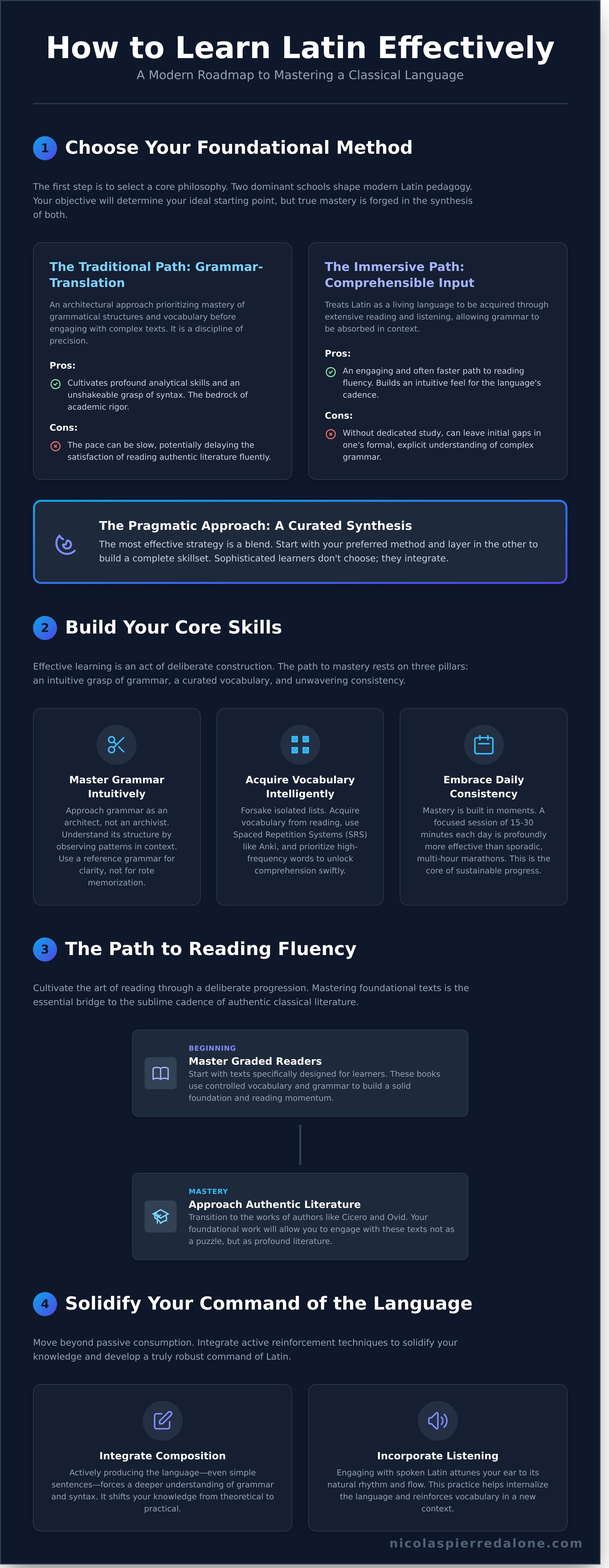
Your journey begins with a foundational choice: understand the critical differences between the Grammar-Translation and Comprehensible Input methods.
Cultivate the art of reading through a deliberate progression, mastering graded texts before approaching authentic classical literature.
Solidify your command of the language through active reinforcement, integrating composition and listening to move beyond passive consumption.
The answer to how to learn Latin effectively is a disciplined, daily practice that integrates core skills with consistent engagement.
Table of Contents The Two Philosophies: Choosing Your Foundational Method Building Your Core Skills: A Structured Practice The Power of Reading: From Graded Readers to Authentic Texts Active Reinforcement: Techniques to Solidify Your Knowledge
The Two Philosophies: Choosing Your Foundational Method
Beginning the study of Latin is not a monolithic endeavor. The path you choose defines the journey and its destination. The first step in understanding how to learn Latin effectively is to select a core philosophy, a foundational method that aligns with your ultimate goals. Two dominant schools of thought shape modern Latin pedagogy: the meticulous Grammar-Translation method and the fluid approach of Comprehensible Input.
Your objective-be it academic research, classical translation, or the simple pleasure of reading Ovid-will determine your ideal starting point. A truly masterful command of the language, however, is rarely achieved through dogmatic adherence to a single method. It is forged in the synthesis of both.
The Traditional Path: Grammar-Translation
This is the architectural approach to Latin. It prioritizes the mastery of grammatical structures and vocabulary before engaging with complex texts. Learning is a process of systematic deconstruction and translation, word by word. It is a discipline of precision.
Pros: Cultivates profound analytical skills and an unshakeable grasp of syntax. It is the bedrock of academic rigor.
Cons: The pace can be methodical to the point of slow, potentially delaying the satisfaction of reading authentic literature fluently.
The Immersive Path: Comprehensible Input (CI)
This philosophy treats Latin not as a relic, but as a living language to be acquired. It prioritizes extensive reading and listening to material that is immediately understandable, allowing grammar to be absorbed through context. This modern evolution in the Instruction in Latin champions intuition over rote memorization.
Pros: An engaging and often faster path to reading fluency. It builds an intuitive feel for the language's natural cadence.
Cons: Without dedicated study, it can leave initial gaps in one's formal, explicit understanding of complex grammar.
Making Your Choice: A Pragmatic Approach
The most effective strategy is a curated one. For the scholar demanding absolute precision, begin with Grammar-Translation and layer in Comprehensible Input to build fluency. For the reader seeking literary enjoyment, begin with CI and consult grammar resources to clarify patterns as they emerge. Ultimately, the most sophisticated learners do not choose; they blend. They understand that a hybrid methodology, tailored to their own progress, is the most direct route to mastery.
Building Your Core Skills: A Structured Practice
Effective learning is an act of deliberate construction. It demands a fundamental shift from passive reception to active engagement-a daily dialogue with the language itself. The path to how to learn Latin effectively rests on three pillars: an intuitive grasp of grammar, a curated vocabulary, and unwavering consistency. This is not a race, but a refined craft, built with focused, sustainable effort.
Mastering Grammar Without Memorization
Approach Latin grammar as an architect, not an archivist. The goal is to understand its elegant structure, not to merely catalogue endless declension charts. Observe patterns as they appear in context. When a rule is seen in action within a sentence, it ceases to be an abstract decree and becomes a living component of communication. A reliable reference, such as Allen and Greenough's New Latin Grammar, should serve as your blueprint-consulted for clarity, not committed to memory. Small, regular exercises will internalize these concepts, cultivating intuition over rote learning.
Acquiring Vocabulary Intelligently
Build your lexicon with intention. Forsake isolated word lists in favor of vocabulary acquired directly from your reading, which anchors each new word in meaning. For reinforcement, employ the precision of a Spaced Repetition System (SRS) and a focus on high-yield words.
Use tools like Anki: This digital method presents information just before you are about to forget it, making your effort maximally productive.
Focus on frequency: Prioritize the most common words to unlock comprehension swiftly and build a practical foundation.
Connect to English: Observe the echoes of Latin in English derivatives to forge deeper, more memorable connections.
The Principle of Consistency
Mastery is built in moments. A focused session of 15 to 30 minutes each day is profoundly more effective than sporadic, multi-hour marathons. This daily ritual is the essence of how to study Latin with purpose, as the brain requires regular exposure to construct and solidify new neural pathways. This approach is sustainable; it integrates into your life rather than disrupting it. The goal is not exhaustion, but elegant, incremental progress. This structured, consistent practice is the core of learning Latin effectively.
The Power of Reading: From Graded Readers to Authentic Texts
The ultimate purpose of learning Latin is not mere translation, but direct engagement with the masterpieces of Western literature. To read Virgil or Cicero in their original language is to experience their artistry unfiltered. This journey from novice to connoisseur requires a deliberate, curated progression. Understanding this path is fundamental to knowing how to learn Latin effectively.
Starting with Graded Readers
Begin with texts designed for immersion. Works like Hans Ørberg’s Lingua Latina Per Se Illustrata (LLPSI) are not textbooks; they are meticulously structured environments. They introduce grammar and vocabulary intuitively, within the context of a narrative. This method builds confidence and reading velocity on a solid, accessible foundation. Completing such a series is an essential rite of passage before approaching the classical masters.
The Bilingual Bridge: Why Parallel Texts Accelerate Fluency
Transitioning to authentic literature presents a formidable challenge. Here, bilingual editions serve as an elegant scaffold, not a crutch. By providing immediate feedback, they eliminate the disruptive process of constant dictionary-checking and preserve the narrative flow. This tool allows you to engage with complex, authentic works far earlier, accelerating your path to genuine fluency. Explore our Bibliotheca Latina Antica for a curated collection of bilingual editions.
Engaging with Modern Latin for Practice
Fluency is also refined through consistent practice in a low-stakes environment. Modern narratives written in Latin-from simple stories to speculative fiction-offer this opportunity. They leverage familiar story structures, allowing you to focus purely on the language. This practice is not a diversion but a vital part of a comprehensive strategy, making the process both effective and profoundly enjoyable. Discover unique genres in our Latin Science Fiction collection.
Active Reinforcement: Techniques to Solidify Your Knowledge
Reading Latin is an act of reception. To truly possess the language, you must move from reception to creation. Active use cements grammar and vocabulary into your mind, transforming passive understanding into an active, usable skill. This transition from observer to participant is fundamental to learning Latin effectively. Even minimal, consistent practice yields profound results in retention and fluency.
Composition: The Art of Thinking in Latin
Composition is the discipline of thinking directly in Latin. It forces an active engagement with the architecture of the language-its grammar, syntax, and idiom. This practice exposes the gaps in your knowledge with clinical precision, revealing exactly where to focus your review.
Begin with simple translations. Start with foundational English sentences and render them into Latin. Focus on core structures: "The poet tells a story." "Rome is a great city."
Progress to summaries. After reading a passage, compose a short summary of it in your own Latin. This bridges reading comprehension with active production.
Listening and Pronunciation
Language possesses a unique cadence. To internalize this, you must listen. Audio recordings of classical texts attune your ear to the flow of Latin, making sentence structures feel intuitive rather than academic. Complement listening by reading aloud. This physical act of pronunciation reinforces memory and builds confidence. Your choice between Classical or Ecclesiastical pronunciation is secondary to the discipline of consistency. Select one and adhere to it.
Leveraging Digital Tools and Communities
The modern classicist has access to a curated set of digital tools. Use them with intention and purpose.
Digital Lexicons: Employ online dictionaries and parsers for immediate clarification, but do not rely on them as a crutch. Precision is the goal.
Online Forums: Engage with dedicated communities like Reddit's r/latin to pose nuanced questions and observe the work of others.
Study Groups: Find a partner or a small reading group. Accountability is a powerful catalyst for progress.
These active techniques are not mere exercises. They are the deliberate acts of a craftsman honing a skill. This is the final, essential stage for anyone asking how to learn Latin effectively. It is a process of refinement and dedication-a commitment to mastery that echoes in all great endeavors, from classical scholarship to modern artisan craftsmanship.
From Method to Mastery: Your Latin Journey Begins
The path to mastering Latin is one of disciplined artistry. It begins not with rote memorization, but with a deliberate choice of method and the structured cultivation of core skills. As we have explored, true fluency is forged beyond the grammar tables-it is found in the immersive, consistent act of reading. Ultimately, the answer to how to learn Latin effectively lies in transforming study from a mere academic exercise into a living engagement with its profound and timeless literature.
This is where theory becomes practice, and study becomes art. The Bibliotheca Latina Antica was conceived from a singular passion: to make classical languages accessible to the discerning modern scholar. Our library is a testament to this vision, presenting meticulously curated bilingual editions and unique modern adaptations-including science fiction in Latin. Each volume is crafted to bridge the ancient world with contemporary thought.
The great works of antiquity await your discovery. Your dialogue with history begins now.
Frequently Asked Questions
How long does it take to learn Latin effectively?
Mastery is a function of disciplined, consistent effort. A dedicated student, committing to an hour of daily study, can expect to read authentic texts with reasonable comfort within two to three years. This timeline is not a race but a process of intellectual craftsmanship. The focus remains on depth and precision, ensuring a solid foundation is built before advancing to more complex structures and literature. True progress is measured in comprehension, not speed.
Do I need to learn how to speak Latin to read it well?
Speaking Latin is not a prerequisite for reading proficiency, but it is a powerful tool for internalization. Engaging with the language actively-through recitation or composition-transforms abstract grammar into a living structure. This practice deepens your connection to the text and accelerates comprehension. It is less about conversation and more about embedding the language's rhythm and logic into your mind, a technique essential for anyone asking how to learn Latin effectively.
What is the difference between Classical and Ecclesiastical Latin?
The primary distinction lies in pronunciation and historical context. Classical Latin reflects the Golden Age of Rome-the language of Cicero and Virgil-with a reconstructed pronunciation (e.g., 'V' as 'W'). Ecclesiastical Latin is the living language of the Roman Catholic Church, with a softer, Italianate pronunciation. Your choice depends on your objective: to engage with ancient literature or with centuries of liturgical and philosophical tradition. The core grammar remains fundamentally the same.
Can I learn Latin for free, and what are the best resources?
A wealth of exceptional resources is available without cost. The Lingua Latina Per Se Illustrata (LLPSI) series offers a peerless immersive foundation. For authentic texts, the Dickinson College Commentaries and The Latin Library provide curated, scholarly editions. These tools are not lesser alternatives; they are foundational pillars for the self-directed scholar. True investment is measured not in currency, but in focused, consistent intellectual engagement. These resources provide the perfect canvas for that work.
Is Latin harder to learn than modern languages?
Latin presents a different challenge, not necessarily a greater one. Its difficulty is front-loaded, demanding a rigorous mastery of grammar and inflection from the outset. Unlike modern languages, there are no native speakers, which requires greater self-discipline. However, its logical, architectural structure can be more predictable than the idiomatic nature of many contemporary tongues. The challenge is one of precision and analytical skill rather than conversational fluency, a rewarding intellectual pursuit.
At what point should I start reading real authors like Cicero or Virgil?
Transition to authentic authors when you have mastered core grammar-typically after completing a foundational textbook like Wheelock's Latin or the first volume of LLPSI. This milestone is usually reached within nine to twelve months of dedicated study. Begin with more straightforward prose authors such as Caesar or Nepos before approaching the complex poetry of Virgil or the ornate rhetoric of Cicero. This curated progression ensures that the challenge inspires growth rather than discouragement.


Comments