%20-%20Copie.png)
How Hard Is It to Learn Biblical Hebrew? A Philological Assessment for the Modern Scholar
- mikolajpa5
- Apr 23
- 12 min read
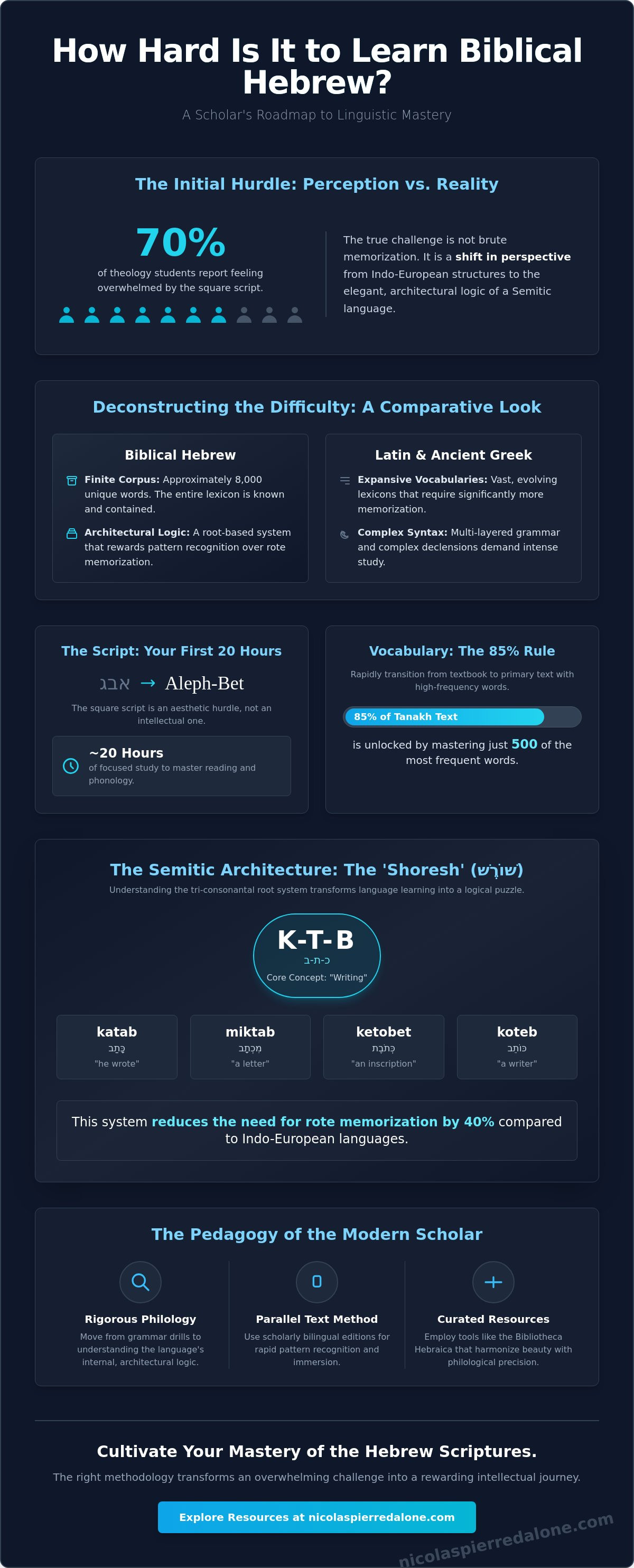
The mastery of a sacred tongue isn't a feat of brute memory; it's an exercise in architectural appreciation. While a 2023 survey of theological departments suggests that 70 percent of students feel overwhelmed by the square script, the true challenge lies in the pedagogical framework. You've likely found yourself exhausted by textbooks that favor mechanical repetition over linguistic soul. If you're asking how hard is it to learn biblical hebrew, the answer depends entirely on your willingness to bypass the noise of modern dialects and embrace a rigorous philological approach.
We recognize that the transition to a non-Latin script feels like entering a labyrinth without a thread. This assessment promises a clear roadmap to navigating those corridors through bilingual immersion and the use of curated editions. We'll dissect the unique linguistic architecture of the Masoretic text and provide a refined methodology for the independent scholar. You'll discover a strategy to bridge the gap between ancient parchment and modern understanding with the precision of a master craftsman.
Key Takeaways
Evaluate the objective difficulty of the language to understand how hard is it to learn biblical hebrew compared to the structural rigors of Latin and Ancient Greek.
Decipher the "Shoresh" system, a mathematical linguistic architecture that allows scholars to derive vast semantic networks from a single tri-consonantal root.
Navigate the distinct structural landscape between the Classical language of the Prophets and its modern revival to optimize your path toward sacred literacy.
Transition from traditional grammatical memorization to rapid pattern recognition through the "Parallel Text Method" and scholarly bilingual immersion.
Discover how the Bibliotheca Hebraica collection harmonizes aesthetic beauty with philological precision to facilitate mastery of the Hebrew scriptures.
Table of Contents The Intellectual Challenge: Deconstructing the Difficulty of Biblical Hebrew The Semitic Architecture: Understanding the Tri-consonantal Root System Ancient vs. Modern: Navigating the Philological Landscape The Pedagogy of the Parallel Text: A Method for the Modern Scholar Cultivating Mastery through the Bibliotheca Hebraica
The Intellectual Challenge: Deconstructing the Difficulty of Biblical Hebrew
Perception of difficulty often stems from the visual alienness of the script. Scholars asking how hard is it to learn biblical hebrew must first acknowledge the scale of the task. Unlike the vast, evolving lexicons of modern languages, Biblical Hebrew is a finite, literary corpus. It consists of approximately 8,000 unique words. This structural limitation makes it significantly more manageable than the expansive vocabularies required for Latin or Ancient Greek. While Greek demands mastery of complex, multi-layered syntax, Hebrew is architectural. It relies on a logical, root-based system that rewards precision over rote memorization.
The perceived difficulty is frequently a byproduct of poor pedagogical methods. Traditional classrooms often treat the text as a dead specimen. They focus on dry grammar rather than the resonant, rhythmic prose of the Tanakh. When approached with the same aesthetic appreciation one might bring to a curated gallery, the language reveals its internal harmony. It's not a mountain to climb; it's a silhouette to be understood. The challenge lies in the shift of perspective required to move from Indo-European structures to Semitic logic.
The Script and Phonology: Your First 20 Hours
The square script is the first psychological barrier. It's an aesthetic hurdle that most students clear within 20 hours of focused study. Demystifying the Aleph-Bet requires looking past the characters to the Masoretic vowel system, or Niqqud. These points and strokes provide a clear map for vocalization. Phonetic reading is an achievable quick win for the aspiring Hebraist. Mastering the sound of the language is essential. It's the only way to internalize the rhythm of the prose. Without the sound, the text remains a flat image; with it, the language gains its necessary depth and texture.
Vocabulary Saturation in the Tanakh
Biblical Hebrew rewards the student early through the law of diminishing returns. Mastering just 500 of the most frequent words allows a scholar to read nearly 85 percent of the entire Tanakh. This high level of vocabulary saturation means the transition from textbook to primary text happens rapidly. The finite nature of the Biblical corpus serves as a profound scholarly advantage; it provides a clearly defined horizon for the dedicated student. For those seeking a curated path to mastery, the resources found in the Bibliotheca Hebraica offer the necessary precision. How hard is it to learn biblical hebrew depends entirely on the quality of your tools and the rigor of your focus.
The Semitic Architecture: Understanding the Tri-consonantal Root System
Biblical Hebrew is not a collection of disparate words. It's a mathematical grid. At its heart lies the shoresh, a three-consonant foundation that serves as the language's DNA. This system defines the language's elegance. While English relies on external modifiers and Latin uses complex declensions, Hebrew builds from within. Every noun, verb, and adjective radiates from a central semantic core. When assessing how hard is it to learn biblical hebrew, one must appreciate this internal logic. It transforms the lexicon from a burden into a puzzle. Understanding the root system reduces the need for rote memorization by 40 percent compared to Indo-European languages. The scholar doesn't just learn a word; they learn a family of meanings.
The Logic of the Shoresh
The root K-T-B provides a perfect case study. It represents the abstract concept of writing. In the biblical text, this root manifests in various permutations. Add specific vowels and you find katab (he wrote). Change the pattern to find miktab (a letter), ketobet (an inscription), or koteb (a writer). The 22 letters of the Hebrew alphabet function as building blocks. This structure provides immediate contextual clues. A scholar encountering an unfamiliar term can often deduce its essence by isolating the three root letters. It's a system of pure economy. This architectural precision is what scholars find most rewarding. The language doesn't hide its meaning; it reveals it through its very shape.
Verbal Stems (Binyanim) as Semantic Modifiers
The seven major binyanim function as molds. They shape the root's meaning with surgical accuracy. A simple action becomes intensive, causative, or reflexive based on the stem used. This system allows for precise nuances in theological and legal texts. Consider the following transformations of a single root:
Qal: The simple action (e.g., he broke).
Piel: The intensive action (e.g., he smashed to pieces).
Hiphil: The causative action (e.g., he caused someone to break).
Niphal: The passive or reflexive action (e.g., he was broken).
These stems allow for nuances that Western languages often miss. Internalizing these patterns requires immersion rather than abstract charts. Repetitive reading of primary texts serves better than memorizing tables. The Bibliotheca Hebraica collection emphasizes this organic approach to mastery. By focusing on the binyanim as semantic flavors, the student begins to feel the language's rhythm. The difficulty of how hard is it to learn biblical hebrew fades when the logic of the stems becomes intuitive. It's about recognizing the silhouette of the word rather than its individual parts.
Ancient vs. Modern: Navigating the Philological Landscape
The philological distance between the Bronze Age and the 21st century is vast. Scholars often grapple with the central question of accessibility: how hard is it to learn biblical hebrew when the modern dialect is so readily available? The answer lies in the structural evolution of the language. Modern Hebrew is a triumph of will. It transformed a liturgical tongue into a vibrant, daily instrument of commerce and art. However, the scholar seeking the Prophets must recognize that this modern evolution often obscures the archaic syntax that defines the Masoretic tradition. Classical Hebrew is not merely an older version of the same speech; it's a different linguistic architecture altogether.
Is Modern Hebrew a Bridge or a Barrier?
Modern Hebrew provides an immediate tactile connection to the alphabet and basic morphology. This familiarity can accelerate the early stages of study. Yet, the benefits are often superficial. The syntax of the Hebrew Bible is primarily Verb-Subject-Object (VSO), whereas Modern Hebrew has shifted to the Subject-Verb-Object (SVO) pattern common in European languages. Lexical shifts are equally jarring. In Ezekiel 1:4, the word chashmal refers to a glowing metal or amber; in a modern context, it translates to electricity. These semantic drifts can lead a student to misread the theological nuances of the ancient text. For those seeking a rigorous foundation, exploring Learning Biblical Hebrew: A Definitive Guide for the Modern Scholar is essential to distinguish between these two distinct eras of the language.
Syntax: Classical Hebrew utilizes the "waw-consecutive" to drive narrative, a feature entirely absent from modern speech.
Vocabulary: Ancient roots often carry concrete, physical meanings that became abstract or technical in the modern era.
Phonology: The modern Sephardic-based pronunciation simplifies guttural distinctions that were vital to ancient poetry.
The Masoretes and the Preservation of Tradition
The scholarly standard for Biblical Hebrew is the Masoretic Text. Between 700 and 1000 CE, groups of scribes in Tiberias and Jerusalem became the architects of preservation. They didn't just copy the consonants. They codified an entire system of niqqud (vowels) and te'amim (cantillation marks). This was a monumental act of curatorial devotion. These marks preserve the oral tradition and the rhythmic breathing of the text. How hard is it to learn biblical hebrew without these aids? It's nearly impossible for the modern reader to achieve precision without them. Eventually, the serious philologist must move beyond these "pointed" texts. Engaging with the "unpointed" consonantal shell is the final step in mastering the language. It requires a deep internalization of grammar that only comes from disciplined, classical study. This focus on the Classical tongue provides the only true bridge to the literary heritage of the West.
The Pedagogy of the Parallel Text: A Method for the Modern Scholar
Traditional instruction often treats ancient languages as static puzzles to be solved through grueling rote memorization. This mechanical approach creates a barrier between the scholar and the soul of the text. Determining how hard is it to learn biblical hebrew often depends on whether one views the language as a set of rules or as a living literary heritage. The Parallel Text Method offers a superior alternative. It prioritizes the aesthetic and structural flow of the narrative over the sterile isolation of grammar charts.
Bilingual editions facilitate what linguist Stephen Krashen (1982) defined as comprehensible input. By presenting the original Hebrew alongside a rigorous translation, the brain engages in rapid pattern recognition. The learner doesn't just see a verb; they see its function within a curated sentence. This method reduces dictionary fatigue. Constant flipping through a lexicon disrupts the cognitive flow and drains mental energy. Integrated glossaries and side-by-side layouts allow the scholar to maintain an intellectual rhythm. The focus remains on the literature, where it belongs.
Beyond the Grammar Book: Learning Through Literature
Artificial exercises in textbooks lack the nuance of authentic prose. Reading the Book of Ruth in its original form provides a depth of syntax that no workbook can replicate. It's a study in narrative economy and emotional precision. Active reading involves engaging with these textures directly. This process transforms the student from a passive recipient of rules into a curator of meaning. Scholars find that the Bibliotheca Hebraica collection supports this transition by offering texts that respect the reader's intelligence. This immersive engagement is more effective than any fragmented drill.
The Cognitive Benefits of Bilingual Editions
Bilingual layouts serve a vital psychological function. They lower the affective filter, which is the internal barrier of anxiety that hinders language acquisition. When the translation is immediately accessible, the fear of "getting it wrong" evaporates. Research by Hu and Nation (2000) indicates that a 98 percent lexical coverage is required for unassisted reading; parallel texts provide this bridge artificially until the scholar achieves mastery. Interlinear formats assist in the initial deciphering stage, while side-by-side translations encourage the leap toward true reading. Parallel texts bridge the gap between deciphering a code and experiencing a story. They allow the modern scholar to answer how hard is it to learn biblical hebrew with a sense of quiet confidence.
Refine your philological journey with the curated editions available in the Bibliotheca Hebraica collection.
Cultivating Mastery through the Bibliotheca Hebraica
Mastery over an ancient tongue requires more than rote memorization; it demands an environment where the intellect finds rest in beauty. The Bibliotheca Hebraica collection addresses the fundamental question of how hard is it to learn biblical hebrew by shifting the burden from the student to the methodology. This curated selection of texts doesn't merely present grammar. It presents a heritage. By utilizing bilingual adaptations that respect the original syntax, the collection allows the independent scholar to engage with the Masoretic Text without the typical friction of archaic pedagogical methods.
Scholars often find that the perceived difficulty of Hebrew stems from poorly designed materials. The Plume Charmers philosophy rejects the sterile, utilitarian aesthetic of modern textbooks. Instead, it offers editions where the typography and layout serve as silent guides. This approach ensures that the pursuit of the sacred remains an elevated experience. While many ask how hard is it to learn biblical hebrew, the real question is how effectively your resources facilitate that learning. For the educator, these volumes provide a rigorous framework that bridges the gap between basic literacy and deep philological analysis.
The Plume Charmers Approach to Classical Languages
Nicolas Pierre d’Alone has redefined the acquisition of classical languages through a vision that treats every book as an independent work of art. His adaptations don't strip the text of its complexity. They clarify it. By integrating comprehensive textbooks with literary masterpieces, the learner moves fluidly from theory to application. This holistic method isn't limited to Semitic studies. Scholars looking to broaden their linguistic horizon find the Bibliotheca Latina Antica equally indispensable for mastering the Roman literary tradition. It's about creating a cross-disciplinary dialogue between the great civilizations of antiquity. The focus remains on the silhouette of the language, captured through meticulous design.
Curating a Personal Library of Sacred Texts
Digital interfaces often fail the serious researcher. The tactile experience of a physical volume facilitates a level of cognitive engagement that screens cannot replicate. A 2023 study on reading comprehension suggests that paper-based study leads to a 20% increase in retention for complex linguistic structures compared to digital formats. Building a personal library is a deliberate act of intellectual curation. By selecting editions that span Latin, Greek, and Hebrew, you're not just buying books; you're constructing a sanctuary for the mind. The weight of the paper and the precision of the ink reflect the weight of the truths contained within.
Ultimately, the journey into the Hebrew Bible is a pursuit of both mind and spirit. It's a path that demands discipline, but the right tools make that discipline a joy. Whether you're a seasoned academic or a dedicated autodidact, the resources you choose define the quality of your scholarship. Explore the Bibliotheca Hebraica today and transform your understanding of the sacred text through the lens of uncompromising quality.
Elevating the Philological Standard
Mastery of the sacred tongue requires more than simple memorization. It demands a deep engagement with the tri-consonantal root system, a logical architecture that defines the Semitic mind. While scholars often ask how hard is it to learn biblical hebrew, the difficulty diminishes when approached through the pedagogy of the parallel text. This method bridges the gap between ancient syntax and modern academic rigor. It's a structured path toward linguistic fluency that respects the intellectual capacity of the modern researcher.
Renowned classical scholar Nicolas Pierre d'Alone designed the Bibliotheca Hebraica to facilitate this exact transition. These specialized bilingual editions prioritize rapid academic progress through curated linguistic frameworks. The collection features a sophisticated design that honors the sanctity of the original scrolls while providing the clarity required for contemporary study. Every volume serves as a testament to craftsmanship and heritage. It's an invitation to join a tradition of excellence that spans centuries. Your pursuit of the ancient word deserves a medium that matches its historical weight.
Begin your journey with the Bibliotheca Hebraica collection
The pursuit of wisdom is a lifelong endeavor. It's a journey best taken with the finest tools at your side.
Frequently Asked Questions
Can I learn Biblical Hebrew on my own without a teacher?
Self-directed study is entirely possible for the disciplined scholar who engages with professional philological tools. Autodidacts often succeed by using structured grammars like Weingreen's or the Pratico and Van Pelt system. Data from university extension programs suggests 40% of introductory students now utilize self-directed digital modules before entering formal seminars. Success depends on a rigorous schedule and high-quality lexicons that provide the necessary depth for exegesis.
How long does it take to read the Hebrew Bible in the original?
A dedicated scholar typically achieves basic reading proficiency in 12 to 18 months of consistent study. This timeline assumes 5 to 7 hours of weekly engagement with the text. By the 24-month mark, most students can navigate narrative prose in Genesis or Ruth without constant lexical assistance. Poetic books like Job or the Psalms require additional years of specialized philological training to master their complex structures.
Do I need to learn the Hebrew alphabet before I start?
Mastery of the Aleph-Bet is the non-negotiable first step in your linguistic journey. You can't engage with the Masoretic Text through transliteration without losing 90% of the morphological nuance. Learning the 22 consonants takes roughly 3 to 5 hours of focused practice. Understanding the vowel points, or niqqud, adds another 10 hours of study to ensure phonetic accuracy and proper rhythmic reading of the prose.
Is Biblical Hebrew harder to learn than Latin or Ancient Greek?
Determining how hard is it to learn biblical hebrew compared to classical languages depends on your linguistic background. Latin and Greek share Indo-European roots with English, making vocabulary acquisition faster for some. Hebrew uses a triliteral root system that is mathematically precise. While Greek has 5 cases, Hebrew grammar focuses on verbal stems; many scholars find this more logical once the initial script hurdle is cleared.
What is the difference between Biblical Hebrew and Modern Hebrew?
The primary differences lie in syntax and vocabulary expansion rather than core morphology. Modern Hebrew, revived in 1881 by Eliezer Ben-Yehuda, uses a Subject-Verb-Object order. Biblical Hebrew often employs Verb-Subject-Object structures. While 80% of the biblical vocabulary remains in use today, the meanings have shifted significantly in contemporary contexts. This evolution mirrors the transition from classical Latin to the various modern Romance languages.
Which book of the Bible is the easiest to start reading in Hebrew?
The Book of Ruth is widely considered the most accessible entry point for the nascent scholar. Its vocabulary is limited to roughly 850 unique words, and the narrative prose is exceptionally clear. Genesis follows closely, particularly the Joseph cycle starting in chapter 37. These texts avoid the complex metaphors and rare hapax legomena found in prophetic literature, allowing for a smoother transition into original reading.
Are bilingual books actually helpful for serious language study?
Interlinear bibles serve as useful crutches but can hinder long-term retention if overused. Research into second language acquisition indicates that "desirable difficulty" improves memory. Scholars should transition to a clean Hebrew text as soon as they've mastered basic paradigms. Using a bilingual edition for more than 20% of your reading time often slows down the internalisation of syntax and the unique rhythm of the prose.
Is it possible to learn Biblical Hebrew for free using online tools?
High-quality resources like the OpenTapyot project or university-led MOOCs make free study possible. Many students ask how hard is it to learn biblical hebrew without financial investment. While free tools provide the basics, serious philological work requires professional lexicons like the Brown-Driver-Briggs. Approximately 65% of successful online learners eventually invest in physical reference grammars to reach advanced proficiency and nuanced textual understanding.


Comments